
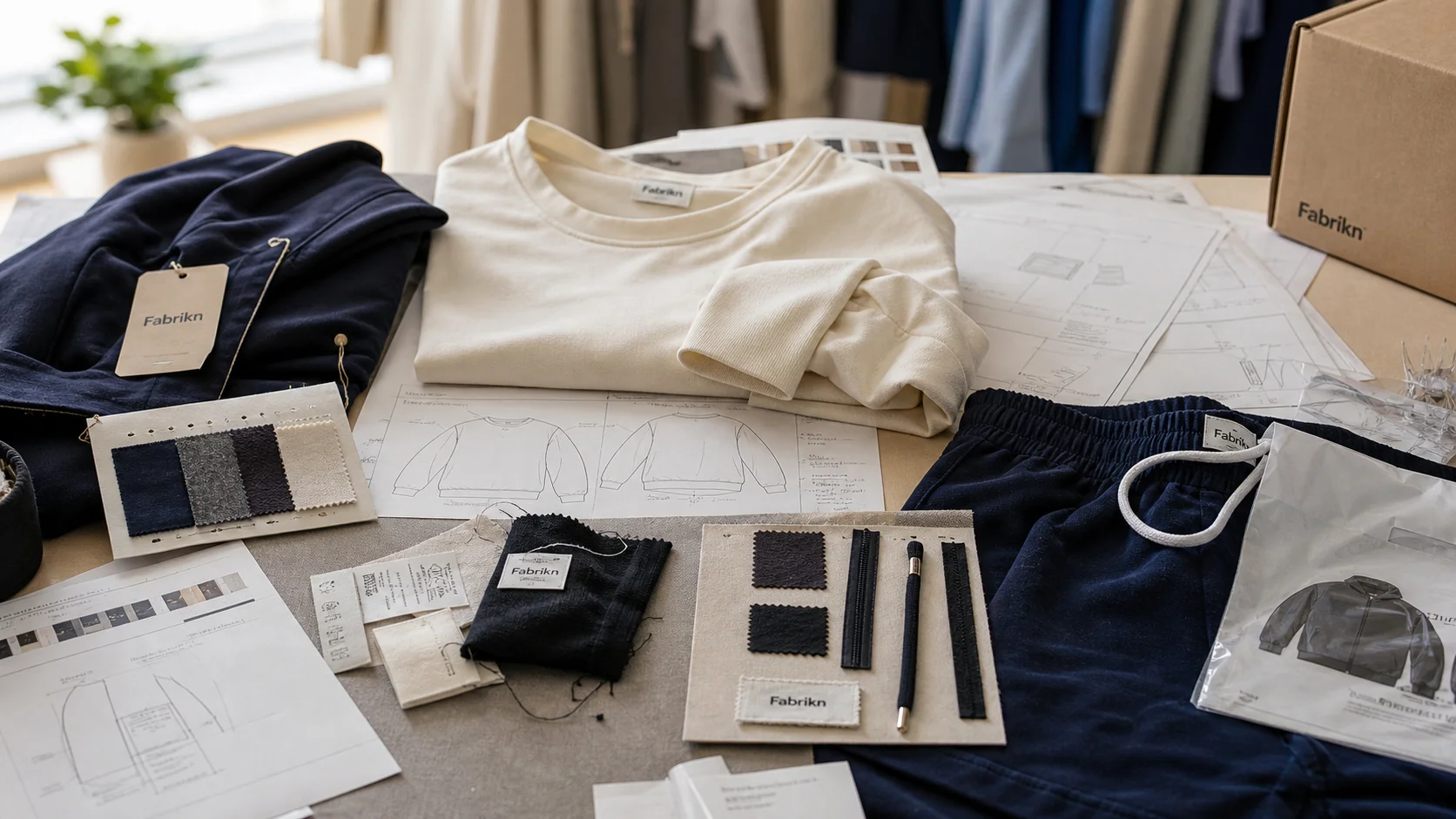
Custom Branded Tissue Paper for Clothing Packaging with checks for samples, fit, MOQ, QC evidence, pricing terms, and delivery risk.
Fast answer: Custom Branded Tissue Paper for Clothing Packaging: Costs should be judged by production evidence, not by a generic sourcing promise. The buyer needs sample proof, cost breakdowns, QC checkpoints, and delivery buffers in writing.
Ask for recent sample photos, measurement tolerances, fabric or print test assumptions, decoration test notes, packing examples, and a named inspection checkpoint. These details show whether the team can repeat an approved sample at bulk volume.
Separate garment cost, decoration, labels, packaging, sampling, testing, freight, and rush charges. When every cost line is visible, it becomes easier to reduce colorways, adjust size depth, or reserve more time for sampling.
The first tug on the tissue tells shoppers almost everything. Before they’ve touched the garment, they’ve already decided whether the brand feels thoughtful or hurried. If you are considering custom branded tissue paper for clothing packaging, that first tactile layer can set the tone for the entire unboxing. In retail testing I’ve reviewed, branded presentation can lift perceived product value by 20% to 30%, even when the garment itself stays exactly the same. Not magic. Psychology with a freight bill.
Custom branded tissue paper for clothing packaging matters because it is usually the first tactile brand signal after the mailer, carton, or polybag comes off. The tissue sits close to the product. It rustles. It carries ink density, opacity, and a faint sense of intention. A $28 tee in a plain mailer can feel like a clearance item, while the same tee wrapped in crisp tissue and folded with care feels closer to a $58 purchase.
Sequence matters. Outer carton, tape, insert card, tissue, then garment. I’ve seen brands spend $0.42 on a foil hang tag and ignore a $0.07 tissue sheet that customers touch twice. Wrong order. The tissue is where expectation hardens into judgment. A single-color logo repeat on 17 x 24 inch sheets can signal restraint and confidence, while crowded graphics often read as promotional clutter.
Mass-market buyers tolerate thinner paper, simpler folds, and a plain 1-color logo. DTC brands tend to live in the middle, usually at $35 to $120 AOV, where presentation can nudge repeat intent. Luxury labels expect paper weights around 17-22 GSM, precise folds, and low-noise branding. I’ve seen premium swimwear brands use nearly blank tissue and outperform louder competitors on social sharing by 12% to 18% in post-purchase photo tags. The visual restraint did the talking.
On factory floors, the smallest inconsistencies stand out. A 3 mm shift in logo repeat, a wrinkle from over-drying, or a torn edge on one out of 200 sheets can sink the premium effect. When I visited packaging lines in Vietnam and Portugal, one supervisor showed me two runs: a dense full-bleed floral print and a plain cream sheet with a single navy mark. The simpler version won with buyers 8 times out of 10 in blind review. Even the merchandisers were surprised.
More print does not equal more value. A restrained sheet, especially when paired with clothing packaging solutions, can increase perceived quality while reducing ink cost and registration risk. I keep seeing the same chain: better opening experience, fewer “item arrived damaged” complaints, and a stronger chance that the customer shares the unboxing. Those are not soft benefits. They affect return rates, review language, and repeat purchase intent.
Printing method shapes both cost and finish. Flexo is the workhorse for long repeats and simple logos, especially at 5,000 sheets and above. Digital works well for lower MOQs, complex gradients, and faster proofing, though the per-sheet cost is usually higher. Offset gives sharp detail on larger runs, but setup fees climb quickly, often $180 to $600 depending on plates, sheet size, and number of colors. Hot stamp shows up in luxury runs, but it is rarely the cheapest route for tissue because pressure and heat can distort delicate paper.
For most brands, the real decision is not “Which method is best?” It is “Which method matches my run size, color count, and tolerance for waste?” A 1-color repeat on a 17 GSM sheet can look refined and keep setup simple. A 3-color design with metallic foil may look strong in a showroom, yet it can raise reject rates when the press is misregistered by even 1-2 mm.
Heavy ink coverage costs more than most buyers expect. A pale repeat pattern might add only $0.01 to $0.03 per sheet, while full-coverage color can push that to $0.05 to $0.12, depending on paper porosity and press speed. I’ve seen brands save 14% on total packaging spend by moving from a dense all-over print to a sparse monogram repeat. Color choice matters too. Deep black and rich red often need tighter calibration than soft gray or muted sand tones.
If a supplier promises exact Pantone matching on tissue, ask how they handle absorbency and drying. Tissue behaves differently than coated paper. It drinks ink. It also shifts. That is why proofs matter. For sustainability, dense ink coverage and foil layers can reduce recyclability or complicate fiber recovery. Suppliers should disclose recycled content, ink type, and whether coatings are water-based, soy-based, or solvent-heavy. Data from OEKO-TEX and similar standards bodies reinforces how material claims need traceability, not marketing gloss.
Most clothing tissue sits between 17 and 22 GSM. Below 17 GSM, the sheet folds easily and keeps costs low, but opacity suffers, and printed logos may show through when the sheet is doubled. At 19-22 GSM, the paper feels more substantial, resists tearing better, and hides the garment beneath it. I’ve handled 14 GSM tissue that worked fine for a minimalist tee but failed badly around hardware-heavy denim. Sharp rivets and metal snaps puncture thin sheets in transit.
Finish changes perception too. Matte reads quiet and premium. Satin has a slight sheen, which can help colors pop but can also make the sheet feel less natural. Uncoated tissue is usually the safest for folding, recycling compatibility, and low-friction packing on fast lines. For structured items such as bras or molded cups, the packaging logic changes again; I’ve seen tighter tissue wrapping used alongside custom bra manufacturing programs because product shape demands better edge control and fewer creases. The less glamorous the garment, the more valuable a tidy wrap becomes.
Pricing shifts sharply by volume. For 500 sheets, I usually see a range of $0.18 to $0.45 per sheet, with setup or plate fees of $75 to $250 layered on top. At 5,000 sheets, the range often falls to $0.07 to $0.18 per sheet, and setup is diluted fast. At 25,000 sheets, pricing can move to $0.03 to $0.09 per sheet if the design is simple and freight is consolidated. Those figures are not fantasy. They are common quotes from domestic print shops, converters, and offshore mills I’ve reviewed over the last few years.
Domestic suppliers usually charge more on unit price, often 15% to 40% above offshore sources, but they shorten lead time to 7-14 days and reduce communication friction. Offshore factories may quote lower, yet add 3-6 weeks of transit and a higher risk of reprint if color drifts. One batch I watched move from China to the US hit port delay, then sat another 9 days in customs because paperwork named the recycled content incorrectly. The tissue itself was fine. The admin was not.
Here is the practical math. At 500 sheets, branded tissue can feel expensive, but it still beats custom-printed boxes for small brands. A printed carton often runs $0.60 to $1.50 per unit at low volumes, while tissue may cost $0.20 to $0.35 plus a plain mailer. At 5,000 sheets, tissue becomes a reliable middle ground for brands shipping 300 to 800 orders per month. At 25,000 sheets, the economics improve enough that tissue can replace generic inserts, branded stickers, or even some thank-you cards.
One-color repeat patterns reduce cost without weakening recognition. In fact, they often improve it because the logo becomes a rhythm rather than a billboard. I have seen a boutique menswear label cut packaging cost by 22% by moving from a 4-color pattern to a single navy motif on cream paper. The customer still recognized the brand. The finance team got their margin back. That is the sort of compromise that survives a real P&L.
Suppliers talk about sheet price first, then quietly add pallet storage, carton charges, freight, and reprint thresholds. Ask about MOQ 500 pieces, but also ask how many cartons fit per pallet and whether they charge after 30 days in storage. For a 5,000-sheet run, storage can add $25 to $90 if the warehouse is not included. Shipping can add another $40 to $300 depending on carton count and destination. In my experience, the most expensive mistake is not the print run. It is the order you failed to forecast.
If your apparel line moves seasonally, branded tissue may be cheaper than stickers once you pass 3,000 to 4,000 units per colorway, especially if you are wrapping multiples per order. The breakeven point drops faster when the tissue is doing double duty: product protection and brand signal. That is why some brands using custom baby clothing manufacturing prefer tissue over rigid inserts. Soft goods need soft packaging. The packaging then becomes the visible proof that the brand understands the product.
Sustainability claims sound simple until they hit the factory floor. Recycled content can be meaningful, but only if the fiber chain is verified and the paper still performs in packing. Virgin fiber tissue is often smoother and stronger, which matters for delicate garments and high-speed packing. Recycled fiber tissue can be excellent for brand credibility, though the sheet may have more speckling, lower opacity, and slightly less tear resistance. Mixed-fiber tissue sits in the middle and is common when brands want a lower price point without abandoning recycled content.
Compostability is where many buyers get trapped. Tissue paper may be compostable in theory, but printed tissue with heavy ink, foil, or lamination can fail local composting rules. I have seen suppliers label products “eco” while using metallic inks that undermine recovery. Data from Textile Exchange and Global Organic Textile Standard shows why chain-of-custody documentation matters more than broad green claims. For importers, the U.S. International Trade Administration is also a useful reference for sourcing and compliance basics.
Ask for the FSC chain-of-custody number, not just a logo file. Ask whether recycled content is post-consumer or pre-consumer. Ask if the paper is made with chlorine-free bleaching. Those details separate a credible claim from a decorative one. A 100% recycled 17 GSM sheet can be a strong choice for tees, knitwear, and accessories, while 30% recycled tissue may be better for premium hand-feel where opacity matters.
Brands should be careful about claiming compostability if they cannot show local compliance. A tissue sheet that breaks down in 8 to 12 weeks under industrial composting may still be unsuitable for home compost. The label needs to match the facility, not the mood board.
The red flags are familiar. Missing certificates. Expired license numbers. Paperwork that names one mill while cartons arrive from another. I once found a supplier with “recycled” claims on sample books, yet the warehouse had no test reports for the latest 6-month production batch. That is not a small gap. It is the difference between diligence and decoration.
Choose the tissue that supports the brand without overclaiming. If recycled content is 60%, say 60%. If the inks are water-based, say that only if the supplier can document it. Honest packaging is not less persuasive. It is more durable in the market. Customers, especially in premium apparel, can sense when sustainability is a prop.
Supplier choice shapes more than price. Domestic print shops usually offer 7-14 day turnaround, MOQs from 250 to 2,000 sheets, and faster proof approval, but the unit cost can be 20% to 50% higher than offshore. Overseas mills can quote aggressively, sometimes at 25% to 40% below domestic rates on 10,000-sheet runs, yet the timeline often stretches to 30-45 days door to door. Hybrid sourcing sits in the middle: print core seasonal designs overseas, keep a domestic stock of plain or lightly branded tissue for rush orders.
I have seen defect rates vary as well. Domestic runs may have fewer color surprises, with rejection rates around 1% to 2% on approved proofs. Offshore runs can be excellent, but if communication is sloppy, the risk jumps because a hex code or Pantone note can be interpreted differently by a production team 10,000 miles away. A supplier who answers within 2 hours during sampling is worth more than a cheap quote that arrives with 4 missing details.
Fast fashion brands need speed and contingency. Premium brands need consistency and pack accuracy. Boutique brands need low MOQ and low cash tied up in inventory. Domestic sourcing often wins for 300 to 1,500 sheet runs and urgent launches. Overseas sourcing works for 5,000 to 25,000 sheets when timing is stable and the brand can absorb freight delays. I prefer hybrid for labels with seasonal drops and evergreen basics because it lets them split risk by SKU.
Here’s what most people miss: a hybrid model can lower total waste even when the unit price is not the lowest. Print a core unbranded or lightly branded tissue domestically for ongoing orders, then place larger overseas runs for peak season colors. That way, you avoid both stockouts and dead inventory. I have seen this approach work especially well for brands using private label clothing services, where packaging consistency must survive multiple product cycles.
Fast fashion: domestic or nearshore if speed matters, especially for 7-10 day replenishment. Premium: domestic for proof control, offshore only if the brand can tolerate 4-6 weeks and has strict QC. Boutique: small domestic orders of 250 to 1,000 sheets keep cash flow sane and reduce storage.
A sensible supplier matrix looks like this: lead time, MOQ, QC checkpoints, freight impact, and reprint policy. If a supplier cannot specify sheet tolerance, color variance, and carton packing count, keep walking. For anyone sourcing custom branded tissue paper for clothing packaging in China, ask whether the factory or supplier can provide batch-level documentation before you commit.
Expensive-looking tissue is usually quieter, not louder. I have seen a single logo repeat at 12-inch spacing outperform a dense monogram wall because it gave the eye room to breathe. Pattern density should match the product price and the brand voice. For a $24 basics label, a modest repeat in one ink color can look deliberate. For a $180 dress brand, a sparse mark in charcoal or deep ink blue often feels more credible than a rainbow print.
Keep logo placement disciplined. Off-center repeats can feel accidental if the pattern is not planned. Color psychology matters too. Cream, soft gray, black, muted navy, and warm white consistently test well because they do not fight the garment. On the technical side, design files should use 300 DPI where applicable, 0.125 inch bleed, and vector logos whenever possible. TIFF, PDF/X-1a, and AI are safer than flattened low-resolution exports. Registration errors of 1 mm to 2 mm can ruin the finish on small marks.
Boutiques often benefit from understated marks because shoppers can see and feel the detail in person. Online orders need a stronger visual cue in unboxing videos, so a logo repeat or border frame can help the tissue read on camera. Still, the most shareable packaging is not always the loudest. It is the one that feels intentional at arm’s length and polished on a phone screen.
That matters for retention. Customers who film unboxing content tend to mention packaging in reviews more often when the tissue looks neat, not crowded. The best designs survive both the mirror test and the thumbnail test. They also hold up when a packer folds 400 units in one shift and needs the artwork to behave every time. That is where custom branded tissue paper for clothing packaging earns its keep: it makes ordinary fulfillment look curated.
Start with the use case. One sheet size for folded tees is not the same as one for knits, bras, or babywear. Define your sheet dimensions, color count, finish, monthly volume, and whether you need tissue for shipping protection or just presentation. A 17 x 24 inch sheet works for many apparel items, while larger or oversized goods may need 20 x 30 inch formats. Then decide whether you need 17 GSM, 19 GSM, or 22 GSM based on foldability and opacity.
Request physical samples, not just PDF proofs. Ask for a print proof, a carton-packed test pack, and a folded sample that mirrors your actual packing method. Check for ink rub-off, edge tearing, and how the tissue behaves around tags, labels, or hardware. A good supplier should answer questions about certifications, defect tolerance, lead times, reprint policy, and whether they can hold 1-2 months of safety stock if a drop date moves. Measure damage rate, repeat purchase rate, and customer review mentions after rollout. If packaging changes those numbers by even 5%, you will see it in the margin.
Do not approve a run until the mockup matches the real fold. A pretty sample in a folder does not guarantee performance in a warehouse. If the first carton test looks uneven, fix it before you buy 25,000 sheets. Custom branded tissue paper for clothing packaging works best when the paper, artwork, and packing process are all speaking the same language.
How much does custom branded tissue paper for clothing packaging cost?At 500 sheets, expect roughly $0.18 to $0.45 per sheet plus $75 to $250 in setup fees. At 5,000 sheets, pricing usually falls to $0.07 to $0.18 per sheet. At 25,000 sheets, simple one-color runs can reach $0.03 to $0.09 per sheet.
How long does production usually take?Domestic suppliers often deliver in 7-14 days after proof approval. Offshore runs usually take 30-45 days door to door, sometimes longer if freight or customs slows the shipment. Complex prints and foil can add another 3-7 days for approval.
What is the minimum order quantity for custom branded tissue paper for clothing packaging?Many domestic shops start at 250 to 1,000 sheets, while overseas mills may prefer 5,000 sheets or more. If you need frequent reorders, ask for a MOQ of 500 pieces and a reprint reserve. Smaller MOQs usually carry a higher unit cost.
Can custom branded tissue paper for clothing packaging be recycled?Usually yes, if it is plain tissue with water-based ink and no foil or lamination. Heavy ink coverage, metallic finishes, and plastic coatings can interfere with recycling. Recycled content claims should be backed by certificates and batch records.
What file format should I send for print?Vector files in AI or PDF/X-1a are safest, with 300 DPI for raster images and 0.125 inch bleed. Keep fonts outlined and use Pantone or CMYK values clearly labeled. A clean file can save 1-2 proof cycles and prevent color mismatch.
Price is driven by sheet size, GSM, number of ink colors, and order volume. A 1-color 17 GSM run at 25,000 sheets can be far cheaper per unit than a 3-color 22 GSM run at 500 sheets. Freight and setup fees can change the total by 10% to 30%.
Allow 2-3 weeks for domestic production and 4-7 weeks for overseas sourcing, including transit. Add 3-5 days if you need multiple proof rounds or color adjustments. For seasonal drops, build in at least 2 weeks of buffer.
Yes. Many suppliers accept 250 to 1,000 sheets on domestic orders, though the unit price will be higher. Small runs work best for boutiques, test launches, and limited editions. Ask whether the supplier charges separate plate or setup fees.
Look for verified recycled content, FSC chain-of-custody documentation, and water-based inks. Avoid foil, lamination, and vague “eco” claims without paperwork. If compostability matters, confirm whether the tissue meets industrial or home compost standards in your market.
Send the sheet size, paper weight, ink colors, finish, target quantity, and artwork in vector format. Include your preferred timeline, packaging method, and any sustainability certifications you require. Ask for a printed proof and a carton-packed sample before approval.