
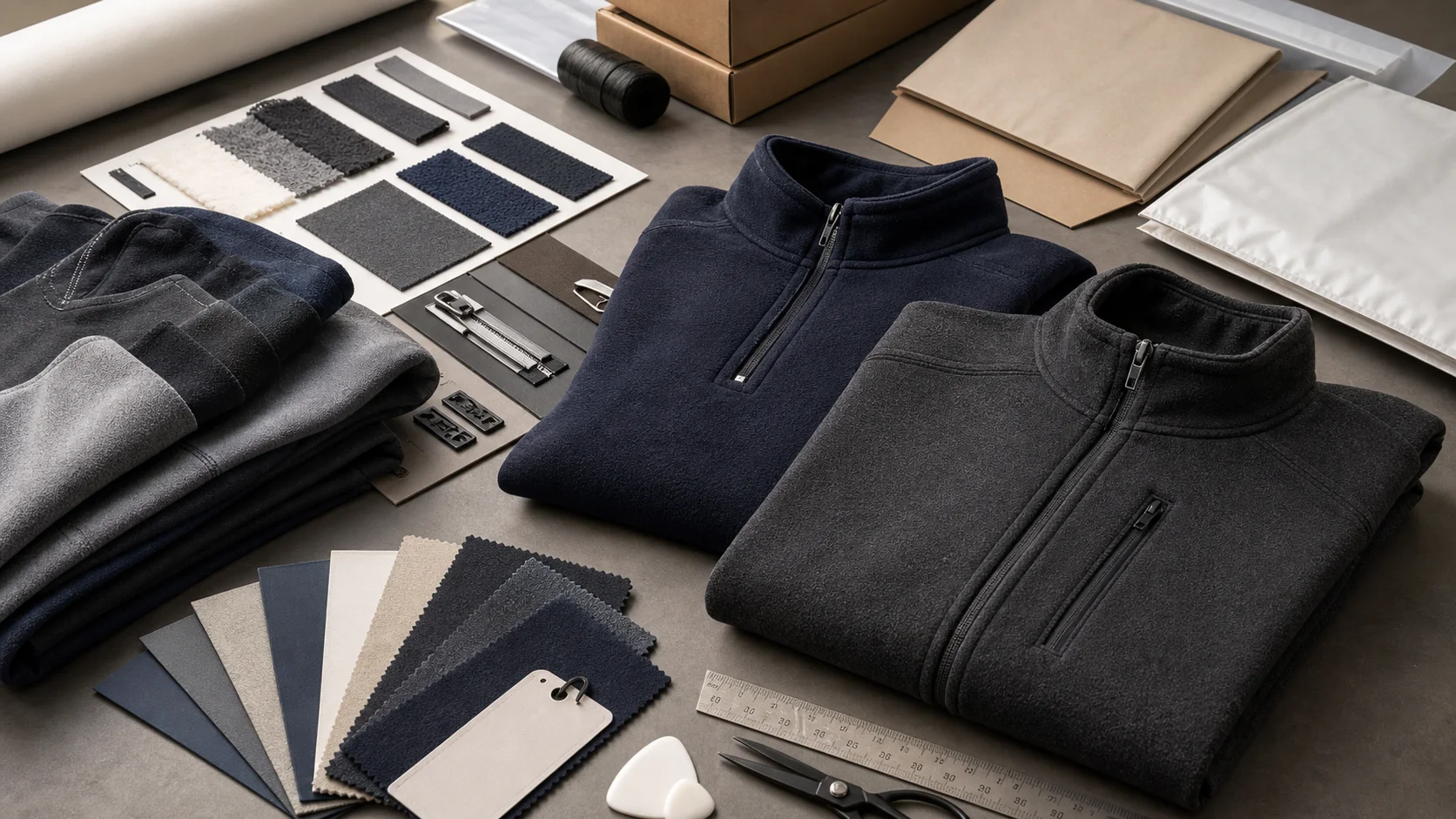
The Packaging for Clothing Brands with checks for samples, fit, MOQ, QC evidence, pricing terms, and delivery risk.
Fast answer: The Packaging for Clothing Brands: Material, Print, Packing Flow, and Cost should be judged by production evidence, not by a generic sourcing promise. The buyer needs sample proof, cost breakdowns, QC checkpoints, and delivery buffers in writing.
Ask for recent sample photos, measurement tolerances, fabric or print test assumptions, decoration test notes, packing examples, and a named inspection checkpoint. These details show whether the team can repeat an approved sample at bulk volume.
Separate garment cost, decoration, labels, packaging, sampling, testing, freight, and rush charges. When every cost line is visible, it becomes easier to reduce colorways, adjust size depth, or reserve more time for sampling.
Most founders ask what is the best packaging for clothing brands and start with the unboxing moment. I start with the shipping invoice.
When I first approved a “premium” mailer that turned a $3.80 pack into a $6.40 one before a single hoodie left the warehouse, I learned how quickly packaging can eat margin. So yes — the answer to what is the best packaging for clothing brands starts on the factory floor, not in a mood board.
After more than 200 factory visits across China and Southeast Asia, I’ve seen the same mistake over and over. Founders stare at presentation and miss the ugly part: cartons still have to survive 3-4 weeks on a vessel, two handling points in a warehouse, and one delivery driver who clearly skipped lunch.
Mass-market labels usually want a simple poly mailer or plain carton because they live and die on unit economics. Premium brands want a stronger first touch, but they still need speed and fewer claims. Luxury labels care about structure, inserts, and presentation, sometimes paying $1.20-$3.50 per pack for details that would be madness for a $28 tee.
Factories keep pushing standard cartons, poly mailers, and tissue packs for a reason: lower MOQ, faster approval, fewer damages. A plain folding carton might start at MOQ 1,000 pieces, while a custom rigid box can demand 3,000-5,000 pieces and 4-6 weeks just for tooling and print. Nobody is trying to kill your brand. They’re trying to keep the line moving and the rejection rate low.
The thing nobody tells you: the most sustainable-looking option is not always the lowest-impact once you count transport weight, carton size, and the return rate from crushed product.
I’ve watched a brand switch from a recycled paper box to a heavier rigid setup because it looked “more eco.” Their outbound freight went up $0.42 per order, and damage claims rose 11% because the box took more space but didn’t actually protect the garment any better. Fit, cost, protection, brand story. That’s the real checklist.
According to the World Trade Organization, apparel trade moves through long, complex logistics chains, which is exactly why packaging choices should be judged on transport efficiency as much as appearance. That applies whether you sell a $18 basic tee or a $180 knit set.
The best packaging for a garment changes with the garment. If you want to know what is the best packaging for clothing brands, you have to match the format to the product, price point, and channel. A 160 GSM cotton tee, a 14 oz denim jean, and a 900 GSM puffer jacket should not live in the same box just because someone on Pinterest said “minimal feels premium.”
For tees, tanks, underwear, and light knits, I usually recommend a poly mailer or a slim paper mailer for direct-to-consumer shipments, plus a neat fold and a single tissue sheet if the brand wants a cleaner reveal. Wholesale? A corrugated shipper with 10-20 units per master carton is still the safer move. I’ve seen basic brands pay $0.08 for a plain poly mailer and $0.42 for a custom printed paper version, which is fine if your AOV supports it and foolish if it does not.
Denim and outerwear need structure. A pair of 14 oz jeans folded badly inside a flimsy mailer becomes a wrinkled apology. For those, I prefer a corrugated carton with a 32 ECT or better rating, maybe a simple insert for shape, and enough headroom to avoid seam crush. Outerwear often needs 2-3 cm of clearance on each side and packaging that can survive compressed stacking at the factory. If you sell puffers, fleece, or wool coats, presentation matters, but protection matters more.
Premium DTC labels can use folding cartons, printed sleeves, or reinforced mailers with tissue, stickers, and a small thank-you card. Luxury brands may use rigid boxes, magnetic closures, and structured inserts, but I’ve also seen them waste $2.80 per order on packaging that made returns slower and storage worse. For a $120 knit dress, a $0.65 folding carton plus a tissue wrap can work beautifully. For a $600 jacket, a sturdier structure may be justified.
Regional habits matter too. In Asia, I see more standard cartons, stronger poly bags, and tighter insert tolerances. Europe tends to lean harder on recycled board, cleaner print, and smaller ink coverage. North America often tolerates larger mailers and more branded outer packaging, though that depends on channel. In one Shenzhen factory, they treated a 3 mm board insert like overkill. In a Los Angeles warehouse, the same insert was considered bare minimum.
If you are building a multi-category line, compare packaging by SKU, not by brand fantasy. The right setup for bras is different from hats, and different again from knitwear. I’ve sent brands to custom clothing packaging solutions for apparel brands only after they understood that product mix drives the decision. A bra set in a soft mailer is one thing. A structured cap shipped in a crushed pouch is another. Same with custom bra manufacturing and custom hat manufacturing. The package has to respect the product.
Here is where the paper-versus-plastic debate gets messy. If you want to know what is the best packaging for clothing brands, compare formats by cost per unit, moisture resistance, and how customers actually open them at home.
Poly mailers usually run about $0.07-$0.22 each at MOQ 5,000, depending on thickness and print. Paper mailers often sit closer to $0.18-$0.45. Corrugated mailers range from $0.30-$0.85, folding cartons from $0.25-$1.10, and rigid boxes from $1.20-$4.50 before special finishes. Reusable bags can be anywhere from $0.70 to $3.00, and they still need clear reuse demand or they become drawer clutter.
Poly travels best in humid and wet routes. It is light, cheap, and hard to beat for protecting a single folded tee. Paper mailers look nicer for sustainability messaging, but they can soften in rain and get ugly fast if the route includes coastal humidity or rough warehouse handling. Folding cartons offer better presentation and stack well in retail or DTC kits. Rigid boxes feel expensive, but they increase freight weight and can drive up dimensional charges by 10% to 18%.
For inserts, tissue, stickers, and cards, the bill is smaller but the labor is not. Tissue might cost $0.03-$0.08 per sheet. A printed sticker adds $0.01-$0.05. A branded insert card is often $0.04-$0.16. Those numbers sound tiny until your packing team is handling 8,000 orders in a week and every extra motion slows the line.
Marketing claims are where brands lie to themselves. Recycled content is not the same as recyclability. Compostable is not the same as actually composted. A compostable mailer that ends up in landfill behaves like trash, because that is what it is there. Data from Textile Exchange keeps reminding brands that material claims need context, not slogans.
Heavy premium packaging can also raise damage claims. Why? Because it often forces smaller internal clearances and more hand packing, which means more crushed corners, scuffed print, and slow pack-out. I once saw a brand spend $1.90 on a rigid set and lose another $0.33 per order in extra labor. That is not prestige. That is expensive theater.
My practical ranking is simple. For basics, poly or paper mailers. For mid-tier DTC, folding cartons or reinforced mailers. For premium gifting, folding cartons with one insert. For luxury, rigid boxes only if the product price and margins can absorb them. For private label bundles, a master carton inside a clean outer mailer often gives the best balance. That is why many founders who use private label clothing services end up with a hybrid setup instead of one beautiful but silly box for everything.
Sustainability in packaging is measurable. I care about four things: material input, recyclability, reuse potential, and shipping efficiency. If a package uses 30% less material, ships in a smaller cube, and can enter normal local recycling streams, that is real progress. If it just says “eco” in green ink, that is marketing with a conscience problem.
Recycled paper, FSC-certified board, PCR plastic, and compostable films are not interchangeable. Recycled paper means some or all of the fiber came from recovered material. FSC-certified board means the paper source was tracked against forest management standards. PCR plastic uses post-consumer recycled resin. Compostable films are only useful if the end-of-life system can process them, which varies wildly by city and country.
I’ve seen brands over-package to look sustainable. Thick cardboard sleeve, tissue wrap, printed insert, ribbon, two stickers, and a compostable mailer. That stack looks responsible on camera. It also creates mixed-material waste that most consumers will not separate properly. A simpler setup often performs better: one FSC mailer, one water-based ink print, and one small insert.
Print coverage matters too. Full-bleed dark ink on recycled kraft can increase waste in setup and make recycling harder if coatings are added. Water-based inks are cleaner than heavy solvent systems, and reduced adhesive use helps keep the format simpler. If you are using labels, choose peelable options where possible. If you are using tape, do not wrap the whole package in five layers because someone likes a “premium seal.”
Certifications buyers actually recognize are the ones that are legible and relevant. FSC is widely understood for paper. OEKO-TEX is more about textiles, but brands often mention it because their product and packaging story sit together. For packaging claims, the main thing is traceability and local compliance. According to OEKO-TEX, material safety claims need proper documentation, and packaging teams should think the same way.
Factory reality is less glamorous. The greenest-looking option can fail if the local waste system cannot process it. I visited a plant in Vietnam that offered compostable poly bags, but the nearest municipal collection system did not accept them. So the bags became landfill waste with better branding. That is not sustainability. That is guilt with a barcode.
Packaging decisions get real when the invoice lands. At 1,000 pieces, a custom folding carton might cost $0.62-$1.20 each. At 5,000, that can drop to $0.28-$0.55. At 10,000, you may see $0.18-$0.38 if the print is simple and the board spec is standard. Rigid boxes barely cooperate with volume, which is why they stay expensive at $1.20-$4.50 even when you buy more. Fancy packaging is only magical until you try to scale it.
MOQ is the real gatekeeper for emerging brands. A startup selling 300 units a month does not need 10,000 custom boxes sitting in a garage next to the founder’s old winter coat. I’ve seen brands spend $4,000 on packaging inventory before they had product-market fit. That money could have bought better fabric, better grading, or two more sample rounds.
Lead times vary by format. Plain mailers can ship in 2-3 weeks. Printed poly bags often need 3-4 weeks. Folding cartons usually take 4-6 weeks. Rigid boxes can run 6-8 weeks, especially if there is foil, embossing, or special lamination. Add 1-2 weeks if the supplier keeps “finding” a new typo in your artwork. That happens more than it should.
Warehouse speed changes with packaging choice. A standard mailer is fast to pack, usually under 20 seconds once the line is trained. A carton with tissue, insert, and sticker can push that to 45-70 seconds. A rigid box with multiple components can stretch past 90 seconds. Multiply that by 5,000 orders and suddenly your cute box has become a labor bill.
Hidden costs show up everywhere. Oversized boxes raise dimensional weight. Multi-part inserts slow packing. Special finishes like soft-touch lamination, foil, and spot UV add cost and can complicate recycling. Custom printing on the inside and outside of the same box can double the setup work for almost no customer benefit. I’ve watched founders spend $0.40 extra on branding details while ignoring a $1.80 return shipping problem caused by poor folding specs.
Damage risk is not just about the outer package. It is about the garment inside. A 320 GSM French terry hoodie needs more structural support than a 120 GSM tee. A denim jacket with metal hardware scratches easily if it is packed too tight. A box that is too large can allow movement and scuffing, while a box that is too small crushes seams. You want just enough room, not a floating wardrobe.
To keep the math sane, I usually tell brands to choose the package that lowers total operating cost, not the package that looks nicest in a reel. Lower damages, fewer returns, faster pack-out times, and fewer carton complaints beat a prettier box every time. This is especially true if your AOV is under $80 and your margin is already thin.
Factories cannot read your mind. I wish they could. They cannot. If you want the right packaging, send the technical details early: garment dimensions, fold method, carton strength, finish, artwork, barcode placement, and insert needs. Include whether the item is a tee, knit, denim, bra, or cap, because each one folds differently and behaves differently in transit.
Give exact measurements. Not “small box” or “nice mailer.” I want internal dimensions in millimeters, such as 280 x 220 x 40 mm for a folded tee or 380 x 300 x 70 mm for a hoodie. If the garment has hardware, be clear about protection zones. If you use hangtags, note their size and placement. If the package must fit a retail shelf, say so. Nobody should have to guess.
Ask for samples and test them under real conditions. Drop them from 1 meter. Leave them in heat for 24 hours. Put them in a humid room if you are shipping through Southeast Asia or coastal North America. Check whether print rubs, corners crush, or tape fails. I have rejected packaging after one failed corner test and saved a brand a 6,000-piece mistake.
Factory communication should include approved swatches, printing tolerances, carton bursting strength, and expected damage thresholds. If you do not know the difference between a good sample and a production-ready sample, ask for both. Proofing should include one physical sample, not just a PDF. PDFs are how people miss bad colors, bad dielines, and bad spelling. Yes, I have seen all three.
Common mistakes on factory visits are painfully consistent. Vague specs. No sign-off on artwork. No plan for seasonal volume swings. A winter jacket line that needs 2,000 boxes in October will not be helped by a supplier who thought you meant 200 boxes sometime “later.” The cleaner your brief, the fewer emergency air shipments you pay for.
My checklist is simple:
Start with a 30-day test, not a full rollout. Pick 2-3 options, sample them, and compare them on the same SKUs. Track packing time, damage rate, return rate, customer feedback, and shipping cost. If one option saves $0.18 per order and cuts packing time by 15 seconds, that is real money, not a vibe.
Your scorecard should be plain. Rate each option from 1 to 5 on protection, cost, sustainability, and brand fit. Then add up the scores and sanity-check the winner against your price point. A $32 basic tee does not need a $3 box. A $220 coat may justify one. I know. Wild.
Run a small pilot before you commit. Ship 100 orders with each format, or test 50 wholesale units if retail is your channel. Ask customer support to tag complaints related to damaged packaging, wrinkled garments, or confusing opening experience. If your team keeps repacking returns, the package is failing, even if the Instagram shots are cute.
My framework is blunt. Budget brands should choose the cheapest format that protects the garment. Premium brands should choose the format that lifts presentation without bloating freight. Luxury brands should pay for structure only when the product and margin can carry it. Sustainability matters, but it has to be real, measured, and operationally useful.
That is the practical answer to what is the best packaging for clothing brands. Choose by product, price point, and shipping route. Then test it. Then fix what breaks. Fancy packaging does not save a weak product, but the right package can stop a good one from arriving like it lost a fight with a conveyor belt.
For brands building sourcing and compliance workflows, it can also help to review broader trade guidance from Trade.gov market and export resources. Packaging decisions sit inside a larger production and logistics system, especially when a manufacturer or supplier is coordinating production in China or other overseas hubs.
For basic tees, I usually recommend a poly mailer or slim paper mailer for DTC orders and a corrugated shipper for wholesale. At MOQ 5,000, poly mailers often run $0.07-$0.22 each, which keeps margins sane for lower-AOV products.
A folding carton with tissue, a small insert, and a clean printed sleeve is usually the sweet spot. It looks premium without the $1.20-$4.50 cost and freight penalty of a rigid box, which only makes sense for higher-ticket items.
Simple mailers can cost $0.07-$0.45 each, folding cartons $0.25-$1.10, and rigid boxes $1.20-$4.50 depending on volume and print. At 10,000 units, costs usually fall, but special finishes and custom inserts can wipe out those savings fast.
Plain mailers can take 2-3 weeks, printed poly bags 3-4 weeks, folding cartons 4-6 weeks, and rigid boxes 6-8 weeks. Add extra time if you need foil, embossing, or a revised dieline after proofing.
Yes, but only if your market can actually process it. Compostable films are useful in some regions and pointless in others, so check local waste systems first. I have seen “eco” packaging end up in landfill because the city had no compost stream for it.