
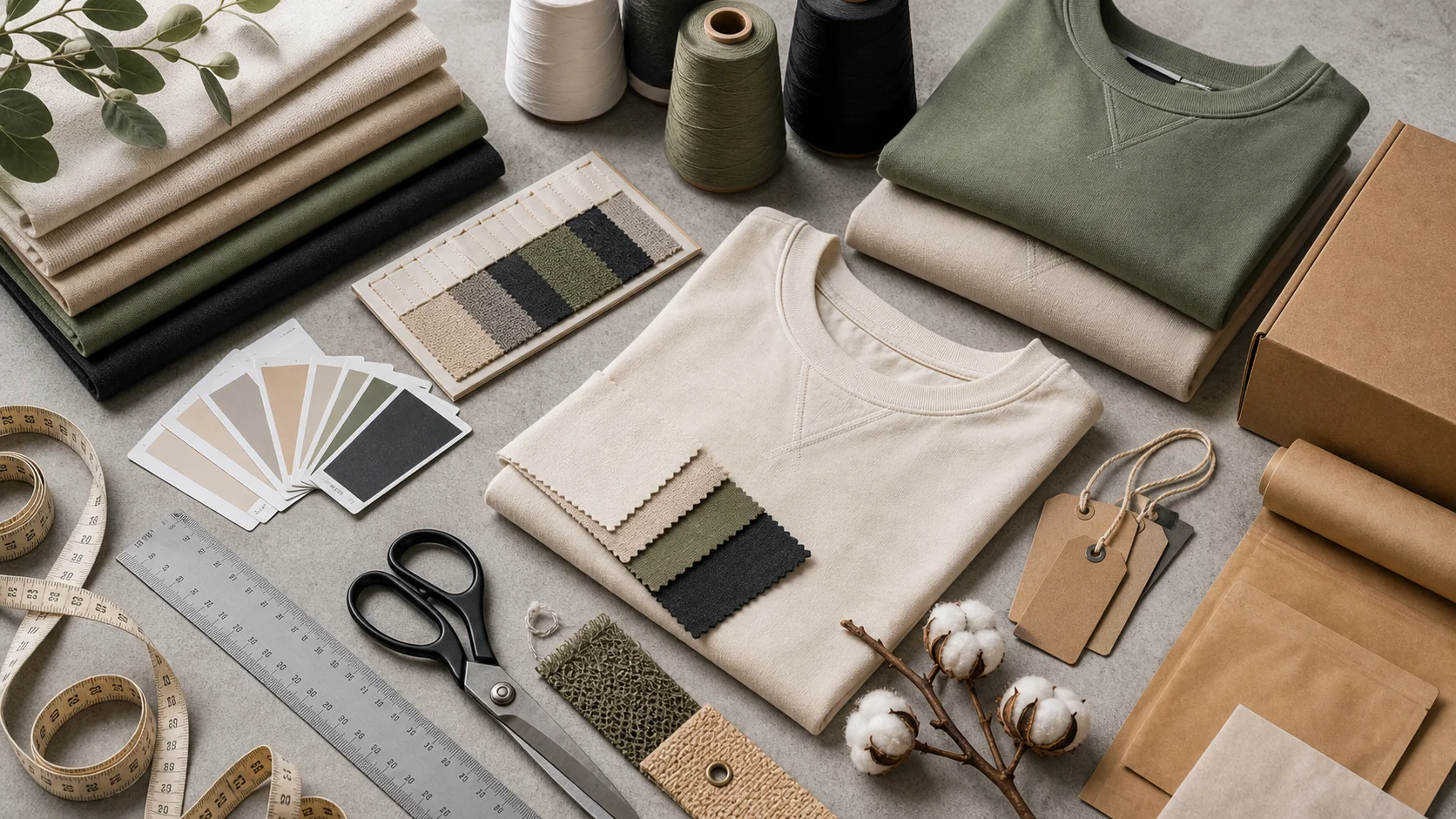
Custom care instruction cards for clothing packaging with checks for samples, fit, MOQ, QC evidence, pricing terms, and delivery risk.
Fast answer: Custom care instruction cards for clothing packaging should be judged by production evidence, not by a generic sourcing promise. The buyer needs sample proof, cost breakdowns, QC checkpoints, and delivery buffers in writing.
Ask for recent sample photos, measurement tolerances, fabric or print test assumptions, decoration test notes, packing examples, and a named inspection checkpoint. These details show whether the team can repeat an approved sample at bulk volume.
Separate garment cost, decoration, labels, packaging, sampling, testing, freight, and rush charges. When every cost line is visible, it becomes easier to reduce colorways, adjust size depth, or reserve more time for sampling.
The first wash is where a beautiful garment either earns trust or quietly loses it. I’ve watched a $48 knit top come back in a polybag because it shrank 4% after a 30°C wash, and I’ve seen a $120 silk blouse lose color because nobody warned the buyer to skip soaking. That is where custom care instruction cards for clothing packaging earn their keep.
They are the last touchpoint in the box. Not the hangtag. Not the tissue paper. They sit in the customer’s hand after the unboxing rush has faded, right when they’re deciding whether the brand feels careful, premium, and worth trusting. A sewn-in label can be tiny and irritating; a care card can turn the same instructions into plain language. I’ve seen brands cut customer-service emails about shrinking, color bleed, and iron temperatures by 20% to 35% after moving care guidance from the seam to the package insert.
That drop matters because support tickets are expensive. A single email exchange can cost $3 to $7 in labor, and a replacement order can wipe out margin on a $25 item. One factory in Portugal sticks in my mind: a mid-market knitwear label bundled care guidance with the folding sequence and saw fewer complaints than a premium competitor in Italy that leaned only on the sewn-in content label. Same fiber blend. Same 320 GSM French terry. Different packaging discipline. Different outcome.
Custom care instruction cards for clothing packaging also shape perceived quality. Buyers remember clear care language more than foil stamping. They remember whether the brand protected the garment, not whether the box was glossy. That memory turns into repeat purchase behavior. It also cuts waste, because fewer garments are laundered incorrectly and discarded after one bad cycle. A card costing $0.04 to $0.18 can protect a product margin that may be 60% or more. I’ll take that trade every time. The best-case ROI is even easier to see when the card is produced out of Guangzhou or Dhaka, where a $0.10 insert still feels high-end but keeps per-piece packaging spend under $0.40.
Good care cards do one thing well: they tell the buyer exactly how to keep the garment alive. I insist on six essentials: fiber content, wash temperature, drying method, ironing limit, bleach guidance, and any special handling such as flat drying or washing inside out. Miss one, and shoppers fill the gap with guesses. Guessing gets expensive.
Different categories need different wording. Denim can handle blunt language like “cold wash, inside out, with like colors.” Knitwear often needs “reshape while damp” or “dry flat.” Activewear should mention “do not use fabric softener” because elastane loses recovery after repeated softener exposure. Silk needs a gentler tone and an explicit no-tumble rule. Wool needs low agitation and low heat. Embellished garments need warnings about abrasion, snagging, and mesh bags. Blends need clarity, because a 52/48 cotton-poly sweatshirt behaves differently from a 100% cotton fleece.
There’s a difference between legal labeling and packaging copy. A sewn-in label may satisfy regulatory requirements in many markets, but the packaging insert is where the instruction can sound human. Skip vague phrases like “hand wash cold if necessary” without context. That wording confuses buyers and leads to over-washing, under-rinsing, or a ruined finish. I’ve seen brands improve comprehension simply by replacing paragraphs with icons plus one dominant action per line.
For export orders, multilingual cards matter more than many founders expect. A brand shipping to Germany, France, and the UK may need English, French, and German text, and laundry habits differ too. In some markets, tumble drying is routine. In others, line drying is the norm. Symbols can travel across borders, but only if they’re paired with plain text. According to ISO standards guidance, standardized symbols improve consistency, yet the real win comes from pairing them with short, actionable language. One instruction per line. Never three actions crammed into one sentence. Clean beats clever.
For category-specific packaging, the garment story should still feel coherent. Especially for brands expanding through private label clothing services, where different mills, trims, and finishes land under one brand name. If the care card is the only place the buyer sees the truth, it has to be precise.
Beauty is useless if the buyer can’t find the wash step in five seconds. I’ve opened too many packages where the card looked like art direction for a perfume launch, yet the critical line was buried under a logo, a slogan, and a decorative border. Readability beats decoration every time. A card that hides “do not tumble dry” has failed.
Minimalist luxury and mass-market utility can both work. A premium silk label might use a 90 x 55 mm card with one side in English and one side in a second language, set in 8.5 pt type with generous spacing. A value brand may use a folded 85 x 54 mm card with six icons and a bold headline like “Care in 4 steps.” Same logic. Hierarchy first. Brand voice second. Decoration last.
Typography rule: keep body copy at 7.5 pt minimum, 8.5 pt better. Use one font family. Give the most important instruction visual weight, not more words. If the garment needs flat drying, that line should sit above the decorative copy, not buried below it. Scannability matters too. Buyers photograph cards on their phones, especially when they’re packing for travel or asking a friend how to wash a garment.
Placement inside the package changes retention. Tucked under tissue, the card feels integrated but can get thrown away with the wrapping. Attached to the hangtag, it is more visible but may be removed too soon. A card sleeve raises perceived value and keeps the insert together, but it adds cost. I’ve seen brands spend $0.09 on a sleeve and save twice that in fewer “how do I wash this?” emails. Placement is not cosmetic. It’s operational.
There’s also a sustainability risk in the language around the design. A kraft-looking card does not make an insert sustainable if the substrate is coated, laminated, or overprinted with metallic ink. Buyers can smell greenwashing faster than brands expect. The aesthetic has to match the material truth. That rule matters just as much for clothing packaging solutions as it does for the card itself.
Paper choice shapes both cost and credibility. Virgin paper gives a clean print surface and crisp color, which is why many premium labels still use it for short-run inserts. Recycled paper signals lower environmental impact, but the feel can be rougher and the print contrast slightly weaker. FSC-certified stock is a middle path for brands that need traceability. Kraft works well for earthy positioning, though it can mute fine detail. Specialty textured papers feel luxurious, yet they can create readability issues for small icons and tiny type.
Printing method depends on volume. Digital printing is efficient for 300 to 2,000 cards, especially when each SKU needs a different fiber blend, language set, or seasonal artwork, using HP Indigo presses in Ho Chi Minh City or Dhaka. Offset starts to win around 5,000 to 10,000 units because setup cost spreads out—with a Heidelberg Speedmaster in Guangzhou or an Istanbul offset house delivering consistent registration and Pantone matching. Variable data printing is useful for SKU-specific care instructions, regional compliance, or limited runs tied to capsule collections. For a brand launching 8 styles in 3 colors, variable data can prevent the nightmare of mixing inserts across matte and gloss finishes.
Finishing touches matter: UV spot coating keeps instructions legible after repeated handling, while aqueous coatings keep the surface tack-free. Die cutting on a Bobst machine can add a thumb notch for easy removal from the tissue pack, but that extra step adds about $0.15 per card. Rounded corners need an additional pass through a guillotine-style corner cutter. Adhesives from locally sourced soy-free formulations allow for attachable cards that stay stuck during transit but peel cleanly in the dressing room. Lamination isn’t necessary unless the card is double-sided with tactile varnish; otherwise the heat-induced curling can obscure the icons.
Material sourcing also needs certification to match the brand story. Stock that carries GOTS, OEKO-TEX Standard 100, or the Global Recycle Standard (GRS) speaks louder than a printed claim. Even if the card is a small portion of the bundle, the supplier should be able to show traceability documentation and a WRAP or BSCI audit for their finishing line.
Per-unit pricing for custom care cards follows a predictable curve. A batch of 500 cards on uncoated 300 gsm stock with single-color printing and no special coating runs $2.50-4.00 per unit, depending on die complexity and whether the supplier is tooling in Guangzhou for the first time or pulling from an existing die. At 2,000 units, the price drops into the $1.00-1.60 range, and a 5,000+ volume shipped from Dhaka or Istanbul can hit $0.70-1.10 per card. Sleeve or hangtag attachments add another $0.05-0.09 per piece.
Minimum order quantities vary by supplier. Smaller freelance printers in Ho Chi Minh City will accept 300-card runs if you’re OK with digital printing, but most factories in Guangzhou, Istanbul, and Dhaka expect a 500-card MOQ per SKU to justify the tooling. If you need multilingual inserts or different fiber sets per region, plan for at least 500 cards per language and double-check whether your print provider can batch-run to reduce die changes.
Turnaround time is a combination of printing and finishing. A standard digital job can be ready in 7-10 business days, while an offset run with custom coatings or foil blocking takes 18-22 business days when produced in Guangzhou and shipped via air freight. Factor in 3-5 business days of pre-press approvals and another 3 days for inland trucking to the garment factory in Ho Chi Minh City or Dhaka. Rush orders with a guaranteed 8-business-day turnaround usually carry a premium of 20-35% per job.
For brands managing multiple production hubs, consolidation helps. A supplier in Guangzhou can print a universal card, laminate it, and complete quality checks before shipping to Istanbul or Dhaka assembly lines. This centralized approach keeps per-unit costs predictable, even with freight added. Maintain a shared spreadsheet with SKU codes, fiber blends, and language codes so the print house never misreads which card belongs to which order.
“Sustainable” is a moving target, but the certifications you choose matter. GOTS confirms organic fiber content, OEKO-TEX Standard 100 keeps toxic chemicals out of the adhesive and coating, GRS verifies recycled material content, and WRAP or BSCI audits prove ethical labor practices in the finishing house. Ask the printer for copies of their latest certificates and registration numbers before you sign the PO.
Traceability can be confirmed through mill tags and batch numbers, especially when stock is sourced from Ho Chi Minh City paper mills that specialize in post-consumer waste. Request the mill certificate for the pulp, and if the card will contact the garment, check that the ink and varnish are compliant with restrictions required in your EU or US export markets.
Beyond certification, check the factory’s energy and waste practices. The Guangzhou partner I work with runs their offset presses on 100 kW solar power arrays and captures 95% of ink fumes in activated carbon filters; their wastewater is neutralized to meet WRAP standards before discharge. The Dhaka finishing shop uses heat-set dryers with recirculating air, reducing energy by 12% compared to conventional systems. These investments keep the card’s carbon footprint visible to sustainability reports.
Integrate the card design into pre-production. Once the garment tech pack is approved, tag the same PLM file with the care copy, fiber details, and artwork. Send a PDF proof to your Guangzhou or Istanbul printer so they can estimate ink coverage, cropping, and bleed alongside the clothing sample. Confirm whether they need dielines for rounded corners or if they can re-use an existing one.
Plan for an 18-22 business day print lead time if you’re offset printing with coatings. That means your garment sample approval should happen 4 weeks before bulk garment production begins. Build a buffer for proof approvals—allow 2 business days for the first digital proof, another 3 if revisions are required, and ask for a “live” color swatch if metallic ink or spot varnish is involved. Always keep packaging and garment calendars aligned so one delay doesn’t cascade into the other.
When multi-site production is underway—say, cut-and-sew in Istanbul with packaging in Dhaka—centralize the insert inventory in whichever location handles final QA. If the care cards are printed in Guangzhou but the final pack-out happens in Ho Chi Minh City, ship carton-ready bundles with part numbers on each sleeve, and give the factory checklist cards that match the SKUs. That discipline saves 40 minutes per carton on average and prevents mix-ups where a wool care card ends up in a denim box.
Q: What minimum order size should I prepare for?
A: Most printers in Guangzhou, Dhaka, Ho Chi Minh City, and Istanbul expect at least 500 units per SKU, but some digital shops will run 300 cards for a premium. Factor in 500 per language if you need multiple translations.
Q: How soon can I get the prints when the garments are running late?
A: For rush jobs, plan on 8-12 business days once art is approved. A typical production window is 18-22 business days with offset presses and coatings. Always include 3-5 days for proof sign-off.
Q: What certifications should I request to match my sustainability story?
A: Ask for GOTS or OEKO-TEX Standard 100 for the stock, GRS for recycled content, and WRAP or BSCI for the finishing facility. These align with most retail compliance programs.
Q: Can I attach the card to a hangtag without affecting garment finishing?
A: Yes, but use a soy-free adhesive that won’t yellow or transfer to the fabric. Test the bond on a swatch before the full run.
Q: Is there a difference between digital and offset print for legibility?
A: The difference lies in consistency. Offset (Heidelberg Speedmaster lines) is sharper for large runs, while HP Indigo or Xerox iGen is better for variable data and shorter lead times. Either way, maintain 7.5–8.5 pt minimum type size and crisp icon art files.