
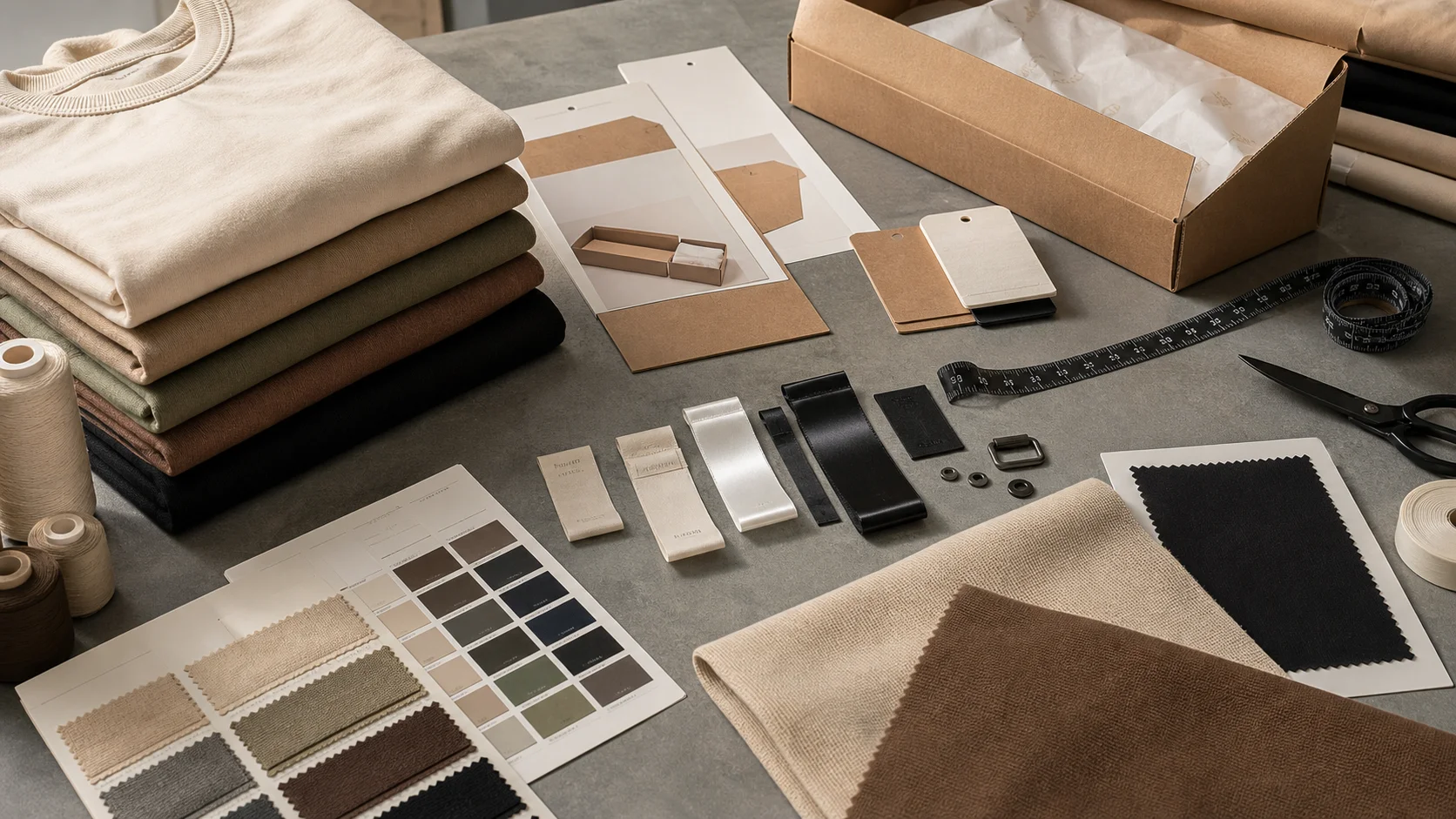
Custom Care Labels for Clothing Brands China compared by sample evidence, fabric or trim specs, MOQ, AQL terms, cost lines, delivery timing, and rework...
Fast answer: Custom Care Labels for Clothing Brands China: Material, Print, MOQ, and QC Terms should be judged by production evidence, not by a generic sourcing promise. The buyer needs sample proof, cost breakdowns, QC checkpoints, and delivery buffers in writing.
Ask for recent sample photos, measurement tolerances, fabric or print test assumptions, decoration test notes, packing examples, and a named inspection checkpoint. These details show whether the team can repeat an approved sample at bulk volume.
Separate garment cost, decoration, labels, packaging, sampling, testing, freight, and rush charges. Clear cost lines make it easier to reduce colorways, adjust size depth, or reserve more time for sampling.
A mislabeled care tag can wreck a great dress faster than a bad hem. And when brands source custom care labels for clothing brands china, they are not buying a tiny accessory; they are buying compliance, brand trust, and margin control in one small component. I’ve watched a smudged wash icon in Guangzhou turn into returns, chargebacks, and very pointed emails from retail buyers within weeks of delivery, while a neighboring Ho Chi Minh City cut-and-sew plant had the same info sealed correctly and shipped in 18-22 business days without issue.
The profit leak is usually invisible until it gets expensive. But when a fiber mix is printed as 100% cotton instead of 95% cotton and 5% elastane, retailers start cutting checks for $250-$1,500 per shipment, depending on order size and market. Customs delays are worse when the content language is wrong or wash symbols conflict with the country code. In the EU, UK, US, and Australia, that mistake can slow receiving by 7-14 days, long enough to miss a launch window. So I insist every supplier certify their inks and adhesives to GOTS or OEKO-TEX Standard 100, even for non-organic blends.
China still wins on speed, scale, and repeatability. A mature label mill in Zhejiang can turn a 1,000-piece sample batch in 5-7 days using jacquard looms connected to automated laser edge folders, while many smaller regional suppliers need 10-15. And for repeat orders above 50,000 pieces, automation, heat-setting ovens, and inline ultrasonic cutting usually keep defect rates lower, often under 2% when the factory runs a disciplined QC line.
Not a free pass, though. I’ve walked through label rooms where the print was perfect on the roll and wrong on the garment because stitching tension distorted the text by 1.5 mm. Small defect, big headache. Premium brands still source from China because they can get damask looms, satin finishing, laser cutting, and multi-language compliance sets in one place. For a brand selling through three or four regions, that consolidation matters more than marketing talk, especially when a mid-tier factory near Guangzhou can print, die-cut, and ultrasonic-weld a label set with a QR code and RFID antenna in the same shift.
According to U.S. trade sourcing guidance for textile and apparel buyers, sourcing decisions are increasingly measured by lead-time reliability, not just unit cost. That matches what I have seen on the floor. Labels are not accessories. They are legal documents stitched into clothing.
Factories in China produce far more than the classic white polyester care slip. The menu is long, including woven damask labels, satin labels, cotton labels, printed polyester, heat-transfer labels, and care label sets that combine size, origin, fiber content, and washing instructions. For basics and private label tees, printed polyester often lands at $0.02-$0.06 per piece in runs above 10,000, especially when sourced from a mill near Guangzhou’s textile park that runs eight digital printers and three heat transfer presses per shift. For luxury outerwear, damask woven labels with fine thread counts can reach $0.10-$0.28 each, depending on fold and finish, and those are usually woven on jacquard looms that also manufacture satin ribbons for Istanbul-based couture houses.
Woven damask works well for premium knitwear and denim because it keeps legibility after 40-60 wash cycles. Satin feels softer against the skin, which matters for lingerie and children’s garments, though it can fray if the cut edge is poor. Heat-transfer labels suit activewear and seamless pieces where a stitched label would irritate the wearer. RFID-ready formats show up in higher-value programs too, especially where inventory tracking has to span two or three warehouses. I’ve also seen Dhaka-based suppliers ship stitch-on labels for low-cost basics while the same global brand used GRS-certified recycled polyester labels and OEKO-TEX Standard 100 inks from a Guangzhou partner for their organic cotton collection.
For activewear, I usually specify heat-transfer care info on the inside neck and a separate woven size tab. For luxury shirting, a fine damask with folded edges gives a cleaner drape. For children’s wear, the print must stay readable after repeated washing at 40°C and tumble drying, which is why soft-touch satin or printed cotton blends work better than harsh coated materials. If you source custom baby clothing manufacturing, the label hand feel matters almost as much as the compliance text. Brands often ask for GOTS, WRAP, or BSCI documentation before approving fabric and label combinations for babies and toddlers.
Higher price does not always mean better legibility or softer hand feel. I’ve handled $0.18 woven labels that felt scratchier than $0.07 satin prints because the edge finish was rushed. In Guangdong, many mills specialize in speed and export consistency. Zhejiang factories often handle finer woven detail and private label orders in the 3,000-20,000 piece range. Jiangsu tends to be strong on integrated textile finishing, especially where labels are part of broader private label clothing programs.
According to OEKO-TEX material safety standards, material and chemical testing are central to textile safety. And that matters because label ink, coating, and adhesive can fail long before the garment fabric does. That is why I always request OEKO-TEX Standard 100, GOTS, and GRS certificates even from suppliers who primarily work with thermo-transfer or silicone-coated labels.
Good labeling starts with a spec sheet that leaves no room for guesswork. I ask brands to include label size in millimeters, fold type, stitch method, artwork file format, Pantone references, language set, fiber content order, and placement on the garment. If the factory is quoting custom care labels for clothing brands china without this information, the sample room will improvise. Without that clarity the process usually adds 1-2 extra rounds and another 7-10 days. I also require details on adhesives (silicone-based for heat transfers, hot-melt for sewn labels) because the wrong glue can lead to delamination or stamping issues on satin edges.
Compliance details matter more than logo placement. The US, EU, UK, and Australian markets each have their own expectations for fiber content disclosure, country of origin statements, and care symbols. A 100% polyester shell with a 90% cotton lining must be written carefully, or a buyer may reject the label entirely. I’ve seen translation errors where “do not tumble dry” became a vague icon sequence that no retailer wanted to approve. When you work with Guangzhou or Ho Chi Minh City partners, double-check the language sheet for each region because the same icon pack is often reused unless specifically updated.
Size and placement sound simple, but they cause a surprising number of defects. A 55 mm by 20 mm label can look fine on paper and then disappear in a thick seam allowance. On French terry 320 GSM, I usually allow 8-10 mm stitching margins and test the label against a side seam, not just the neck. For cut-and-sew programs, a misread placement note can force rework across an entire 500-piece pilot run. That is where a detailed tech pack with photographs beats vague descriptions, and I insist on physical prototypes being sewn onto swatches before full production.
I run a few basic checks before signing off on bulk orders:
A strong brief makes the supplier's job narrower and the quote more reliable. For custom care labels for clothing brands china, include the target customer, sales channel, expected order quantity, size range, decoration needs, packaging requirements, and delivery market. Then call out the details most likely to affect the result, especially material grade, print tolerance, and barcode size.
The brief should also explain what cannot change. Some brands care most about hand feel, some about price, some about launch timing, and some about retail compliance. When those priorities are not written down, suppliers tend to optimize for whatever is easiest to quote. Clear priorities help the factory make better tradeoffs before the first sample is cut or printed.
Ask the supplier to respond with assumptions, not just a price. A useful reply states MOQ, sample route, production capacity, inspection plan, packing method, and freight handoff. If the answer is vague, the project may still work, but it needs a tighter pre-production stage before money and calendar pressure build up.
The best time to catch problems is before the pre-production sample is approved. Check measurements, color, placement, material behavior, shrinkage, construction, labels, and packaging in the same review instead of approving each item in isolation. Many bulk issues are not caused by one dramatic mistake; they come from several small unchecked assumptions.
For custom care labels for clothing brands china, pay special attention to folding method, pack-out sequence, and retail compliance. These details often look minor in an email but become expensive once cutting, printing, sewing, packing, or shipping begins. A simple checklist with owner, due date, and approval status keeps the brand team and factory aligned.
Bulk production should not start until the supplier can explain how the approved sample becomes a repeatable production standard. That means reference sample storage, line instructions, inline checks, final inspection, and defect handling. A factory that can describe this process clearly is usually safer than one that only promises speed.
Price differences are useful only when the quotes cover the same work. Compare sample cost, material source, trims, decoration, packaging, testing, inspection, and freight assumptions. A low unit price can become expensive if it excludes items the brand needs before launch.
Timeline promises deserve the same scrutiny. Ask what happens if the first sample needs revision, whether materials are in stock, when the production slot is reserved, and how export packing is handled. The most reliable supplier is often the one that gives a realistic calendar instead of the fastest optimistic answer.
Before making the final decision, write down the specification, approval owner, delivery expectation, and the one or two risks that would cause the most trouble if missed. For custom care labels for clothing brands china, this usually means checking material grade, print tolerance, barcode size, and the support process after the order is placed.
This last review does not need to be complicated. It simply makes the decision easier to repeat, easier to explain, and easier to verify when the finished product or jewelry arrives.
One useful way to pressure-test the decision is to ask what would happen if the order had to be repeated in six months. The answer should still be clear: the same material grade, the same print tolerance, the same acceptance standard, and the same communication path. If a second order would depend on memory or guesswork, the first order is not documented well enough yet.
Another useful check is to separate preference from requirement. Preference is the look, wording, or finish the brand likes. Requirement is the measurement, tolerance, certificate, material, or delivery condition that cannot fail. Good buying decisions keep both visible, so the final choice is not pushed around by the last email, the cheapest quote, or the prettiest sample photo.
Finally, ask who owns each approval. A project with one accountable owner for sample review, one owner for final content or artwork, and one owner for delivery sign-off usually moves faster than a project where every decision is shared loosely across a team. Clear ownership reduces delays and makes the finished result easier to judge.