
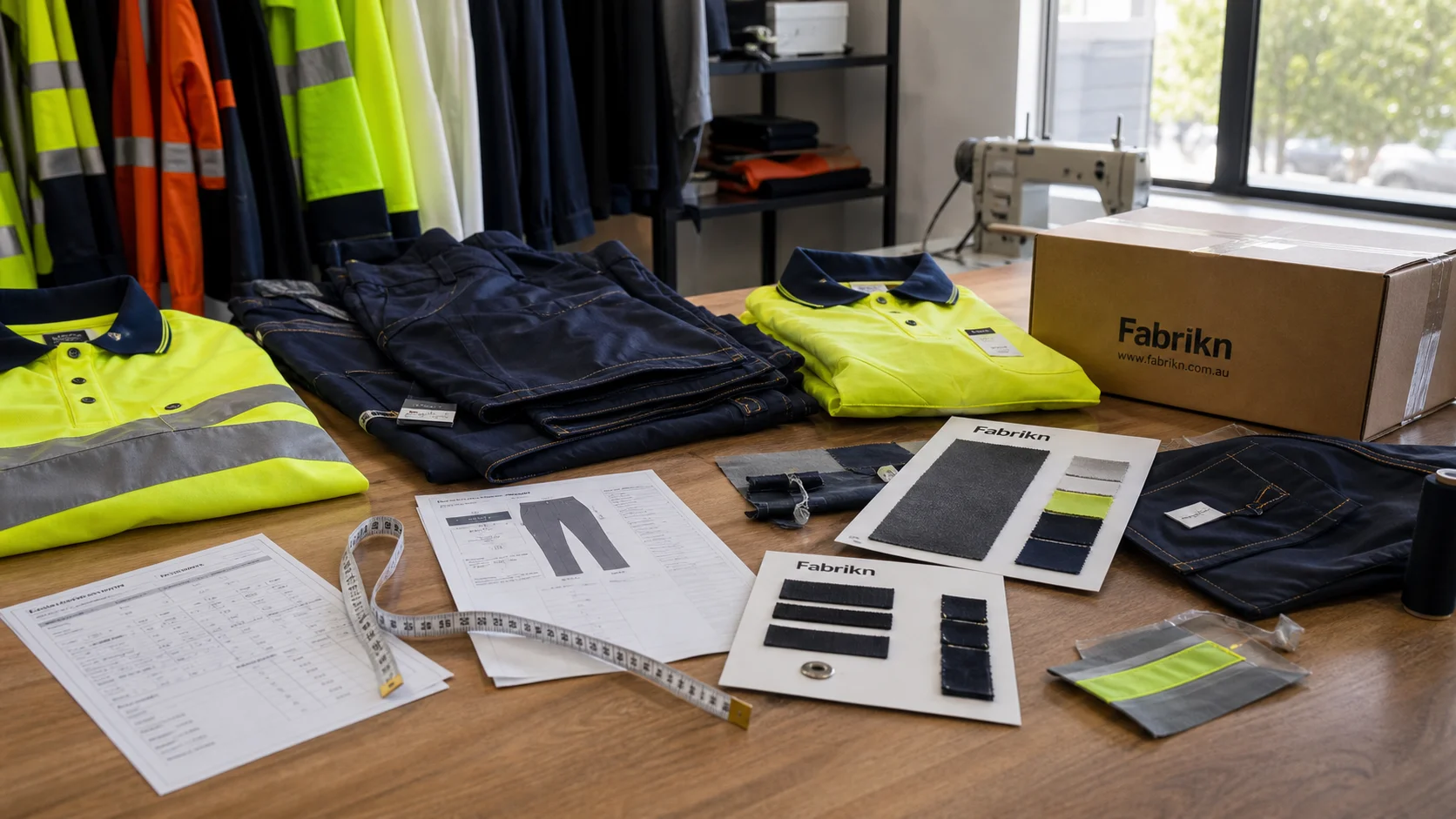
Country-of-Origin Tags for Apparel with checks for samples, fit, MOQ, QC evidence, pricing terms, and delivery risk.
Fast answer: Country-of-Origin Tags for Apparel: Text, Placement, Language, and Compliance should be judged by production evidence, not by a generic sourcing promise. The buyer needs sample proof, cost breakdowns, QC checkpoints, and delivery buffers in writing.
Ask for recent sample photos, measurement tolerances, fabric or print test assumptions, decoration test notes, packing examples, and a named inspection checkpoint. These details show whether the team can repeat an approved sample at bulk volume.
Separate garment cost, decoration, labels, packaging, sampling, testing, freight, and rush charges. When every cost line is visible, it becomes easier to reduce colorways, adjust size depth, or reserve more time for sampling.
One wrong tag can freeze an entire shipment, and it usually happens at the worst possible moment. A 12,000-unit order sat dead on a packing floor in Dhaka because country of origin tags for apparel packaging had been printed for the wrong market. Three days gone. Two relabeling rounds. One furious buyer who had already booked freight. I have watched the same mess in Vietnam, Turkey, and Portugal: the tag is tiny, the damage is not.
Mistakes usually start upstream, not at the printer. A late pack-plan change. Artwork approved from the wrong email thread. A buyer assuming one tag can cover Germany, Canada, and the US. That assumption gets expensive fast. On a $48 blouse, a mislabeled pack can trigger a 5% chargeback, and an urgent airfreight correction can add $1.20 to $3.80 per unit before the goods even hit retail.
Origin tags do more than satisfy compliance. Retail receiving teams compare them with carton markings. Customs officers compare them with invoices. Buyers use them in audits. Consumers use them as a trust test. When one document says one thing and another says something else, every checkpoint slows down.
In low-cost plants, packing labor is often tight but document control is loose. One operator can fold and insert 1,500 polybags in a shift; the same factory may still rely on a paper sign-off sheet with no revision history. Higher-cost plants usually trace better, but they still miss retail-specific wording because the packing room works by habit, not by market rule.
The cheapest tag can become the most expensive packaging on the job. I learned that when a brand tried to save $180 on reprinted inserts and ended up paying $2,400 in rework plus 48 hours of lost sailing time. clothing packaging solutions only work when the data behind them stays controlled.
At minimum, the tag has to show the origin country, the product identity, and a way to match the pack item to the order. In many programs, that also means fiber content references, brand name, style or SKU, importer or distributor details, and language that fits the destination market. A good tag lets a warehouse picker identify it in 5 seconds and a customs reviewer reconcile it in 30.
Packaging labels are not sewn-in garment labels. Different objects. Different jobs. A neck label or side-seam label speaks to the garment; a hangtag, polybag sticker, or carton marking speaks to the pack. I have seen brands assume the sewn-in label solved the packaging issue, then find out the retail buyer wanted origin printed on the outer polybag too.
Rules change by market. The US usually focuses on clear origin disclosure, while the EU and UK can demand extra consumer information depending on category and language. Canada often expects bilingual handling, especially in retail channels tied to Quebec. Australia and GCC countries can be stricter on language and importer references than new buyers expect. According to trade guidance from the U.S. Commercial Service, the ugly surprises usually come from document mismatches, not product defects.
Overprinting “just in case” can backfire. I have seen suppliers add six lines of text, two logos, and a recycled-content claim, then discover the extra copy changed the pack spec and buried the required origin line. More text, more exposure.
Keep the control stack clean. Legal requirements first. Buyer packaging spec second. Factory work instructions third. Once those three disagree, the packing line starts improvising, and improvisation is where errors multiply. For private label programs, that hierarchy matters as much as the fabric itself, especially if you manage private label clothing services across multiple destinations.
The same origin tag can pass in one market and fail in another. In the US, clear origin disclosure is the main requirement. In the EU and UK, language, consumer presentation, and category-specific rules can change what “clear” means. A tag that works for Madrid may get rejected by a US wholesale customer who wants a bolder statement, or by a UK importer who wants the wording aligned to an internal template.
Retailer rules often sit above the law. Department stores, marketplaces, and premium chains write their own packaging specs, and those specs can be tighter than customs requirements. I have seen a Japanese brand ship 8,000 tees legally, only to have a European department store reject half the order because the carton and polybag origin statements used different abbreviations. “Made in PRC” looked tidy. It also looked wrong to the retailer.
On factory visits in Bangladesh and Vietnam, export-oriented plants handled multi-market labeling better than domestic-only suppliers. Not because they were fancy. Because repetition teaches discipline. A factory shipping 25 destinations a month has already built the habit of switching labels, while a domestic-focused plant may only see 2 or 3 export formats in a quarter. In Turkey and Portugal, I saw stronger documentation discipline on smaller runs, especially for 500- to 2,000-piece premium orders, because the team knew every detail would get inspected.
Common failures are painfully ordinary: missing local language, country names shortened too aggressively, carton labels saying one origin and invoices saying another, or a polybag sticker naming the packaging country instead of the garment origin. Not exotic. Workflow failures. When a US wholesale customer receives a carton marked “Made in Italy” but the invoice lists “Final packing in Spain,” the questions start, and questions cost time.
One-size-fits-all origin tags create rework because retail teams read them as control points, not design details. If the market matrix says Germany, the tag has to support Germany. If the order splits across 3 destinations, the files need 3 controlled versions, not one universal compromise. That is where cut and sew manufacturing teams earn their margin: by keeping destination logic visible from the start.
Sticker labels, thermal prints, digitally printed hangtags, and pre-printed packaging all price differently, and the gap widens fast as volumes change. At 1,000 units, a simple paper sticker might run $0.04 to $0.09 each, while a digital hangtag with variable data can land at $0.12 to $0.28 depending on size, stock, and finishing. At 10,000 units, those same items may fall to $0.02 to $0.05 and $0.05 to $0.14. At 100,000 units, setup amortization can push a pre-printed pack down near fractions of a cent, but only if the design never changes.
Setup fees bite as hard as unit cost. I have paid $60 for a simple digital plate change and seen a $380 tool charge for a more complex carton mark. Artwork revisions can run 2 to 4 rounds when the buyer, sourcing team, and compliance team are not on the same page. Add 1 extra QC line, and a “cheap” tag starts losing its shine by the hour.
Hidden costs are where budgets bleed out. A relabeling team of 6 workers at $28 to $42 per shift can burn a full day correcting 4,000 pieces. If a label mismatch holds a shipment at port, airfreight for 2 pallets may add $1,100 to $2,600. I have watched a 2-cent tag turn into a 20-cent problem simply because the packing room never got told which market version to use.
Region changes the equation too. Labor can be cheaper in parts of Asia, yet documentation correction can move faster in Eastern Europe or North Africa for certain programs, especially when a 500-piece rush order needs same-week rework. A factory in Morocco fixed a misprinted polybag run for me in 36 hours. Another plant elsewhere needed 6 days because the approval chain sat under three managers and one absent merchandiser.
Buyers love optimizing the wrong number. They chase the per-tag quote and ignore the packing failure rate. That is why I ask for pricing and process data together: minimum order quantity, expected changeover time, and the cost of a reprint. Print method matters. The correction path matters more.
The workflow should move in one direction only: tech pack, artwork approval, pre-production sample, bulk packing sign-off. If any step loops backward without a logged revision, the label control breaks. I have seen a 3-week production window lose 4 days because someone approved a carton mark from an old email thread instead of the latest PDF.
Three control points catch most mistakes. Single source of truth for origin data. Version control with dated proofs. Line clearance before packing starts. Without those, origin text gets copied from memory, and memory is a terrible compliance system. A factory can pack 20,000 units a week, but if 1 label version escapes into the wrong line, the rework is still real.
Factories should separate similar styles, sizes, and destinations physically. Mixed-SKU cartons create enough confusion to fill a truck bay. A size M polo for France should not sit next to a size M polo for the US if the packaging text differs by language or importer details. The packing room is not the place for judgment calls.
My QC routine is simple. Verify the first 20 packs on the line. Inspect every carton at line opening. Then do random end-of-shift checks, especially after breaks and shift changes. That catches most drift. It is less dramatic than a last-minute rescue, but it saves more money. Buyers rarely reward heroics. They punish repeat mistakes.
Discipline pays because it cuts reprint rates, packing delays, and deductions more reliably than emergency inspection ever will. In a factory handling 2,500 pieces a day, a 1% label error rate means 25 faulty packs. On a 20,000-piece order, that is a headache with a freight bill attached.
A good audit is not paperwork theater. It is reconciliation. I check the purchase order, commercial invoice, packing list, barcode sheet, carton markings, and retail label to see whether they tell the same origin story. If one document says Vietnam, another says final packed in Cambodia, and a third says “Asia,” I stop there. The story is broken.
Red flags show up fast once you know the pattern. Country names abbreviated one way on the carton and another on the invoice. Mixed origin claims in one multi-country order. Pack-outs that do not match the approved sample. A polybag that says recycled material, origin, and size in three fonts because three people touched the file. None of that helps a warehouse move faster.
Physical sampling matters. Pull packs from the top, middle, and bottom of cartons, because variation often appears when the line gets tired or rushed. In one audit, the first 12 packs were perfect, but the bottom layer had 6 mismatched labels because the operator switched rolls after lunch. That single check saved 9,000 pieces from a potential chargeback.
Traceability gets messy when fabric comes from one country, cut-and-sew from another, and final packing from a third. Guessing is not the answer. Document the origin logic in advance, especially if the program includes OEKO-TEX certified materials or retailer sustainability claims. A clean origin narrative supports both compliance and brand credibility.
One 30-minute review can prevent days of port delays or wholesale deductions. Not hype. Arithmetic. When the freight booking is live and the retailer dock appointment is fixed, every label error becomes a calendar problem, not just a packaging problem.
Start with a one-page origin label spec. State the approved text, approved languages, placement, font minimums, and carton-versus-hangtag rules. If the buyer wants “Made in Bangladesh” on the hangtag and “Country of Origin: Bangladesh” on the carton, write both down. Don’t leave it to a margin note.
Then issue four files: annotated artwork, country matrix by SKU, destination-market list, and a change-control log. That combination strips out guesswork. If a style ships in 3 colors and 2 markets, the file set should show all 6 combinations clearly. I have seen a single mislabeled spreadsheet column create a week of corrections, even on a 1,200-piece order.
Order pre-production label proofs and physical strike-offs before bulk materials are released. If the color, stock, or wording is wrong, you want the error on a sample table, not in a packed carton. If origin data changes after PPS approval, pause packing until every packaging file is updated. Annoying once. Cheaper than rework twice.
Use one contact, one version, one approval path. No verbal edits in packing rooms. No “just change this line” messages on phones. If the supplier, merchandiser, and QA team all see the same file, the label stays controlled. That is how brands protect margin and keep shipments moving. If you need support, get a free quote only after the spec is locked.
Before I issue a PO, I ask three blunt questions: How do you manage multi-market labels? Who owns artwork control? How many origin-related claims have you handled in the last 12 months? A supplier who answers with numbers usually understands the risk. A supplier who answers with adjectives usually does not.
Low-cost factories often quote faster and cheaper. I have seen a tag package priced at $240 in one plant and $510 in another for the same 5,000-unit run. The first quote looked better until I learned they had no digital version control and no trained pack supervisor on night shift. The savings vanished in one revision cycle.
Warning signs show up in the audit room. No written label SOP. Handwriting on carton specs. Repeated sample revisions because nobody signed the same proof twice. Reluctance to show batch records. If a supplier cannot produce a clean revision trail for 1 label, they will not manage 10 destination markets well. Trade data from the World Trade Organization shows how quickly documentation quality turns into a trade issue once volumes scale.
The strongest suppliers treat origin tags as controlled compliance items, not decorative afterthoughts. That mindset matters more than a low quote. I have watched one sloppy label create a 2% deduction on a wholesale order and another factory lose a repeat customer over a 3-line carton mismatch. The garment was fine. The packaging was not.
If you want margin, start with discipline. Factories that protect origin data protect everything else too: lead times, audit scores, repeat business. The price of a tag may be measured in cents. The cost of a mistake is measured in freight, time, and trust.
Most buyers expect the origin country, product identity, style or SKU reference, and any required importer or distributor details. Some markets also expect language-specific wording and carton markings that match the commercial invoice. Keep the text short enough to read in 5 seconds.
At 1,000 units, sticker labels can run about $0.04 to $0.09 each, while digitally printed hangtags may land at $0.12 to $0.28. At 10,000 units, those costs usually fall as setup gets spread out. Reprints, relabeling, and airfreight can cost far more than the tag itself.
A clean approval cycle can take 2 to 7 days if the artwork is complete and the market list is fixed. It can take 2 to 4 weeks if there are multiple buyers, language changes, or missing data. Pre-production strike-offs usually add 3 to 5 extra days.
Sometimes, but only if the text, language, and retailer spec work in both markets. The US is usually simpler on origin disclosure, while the EU may require different consumer information or language handling. A single version often fails once retailer standards are added.
Match the purchase order, invoice, packing list, barcode sheet, carton marking, and retail label. Then inspect samples from the top, middle, and bottom of cartons to catch packing variation. A 30-minute audit can stop customs holds, chargebacks, and relabeling costs before they start.