
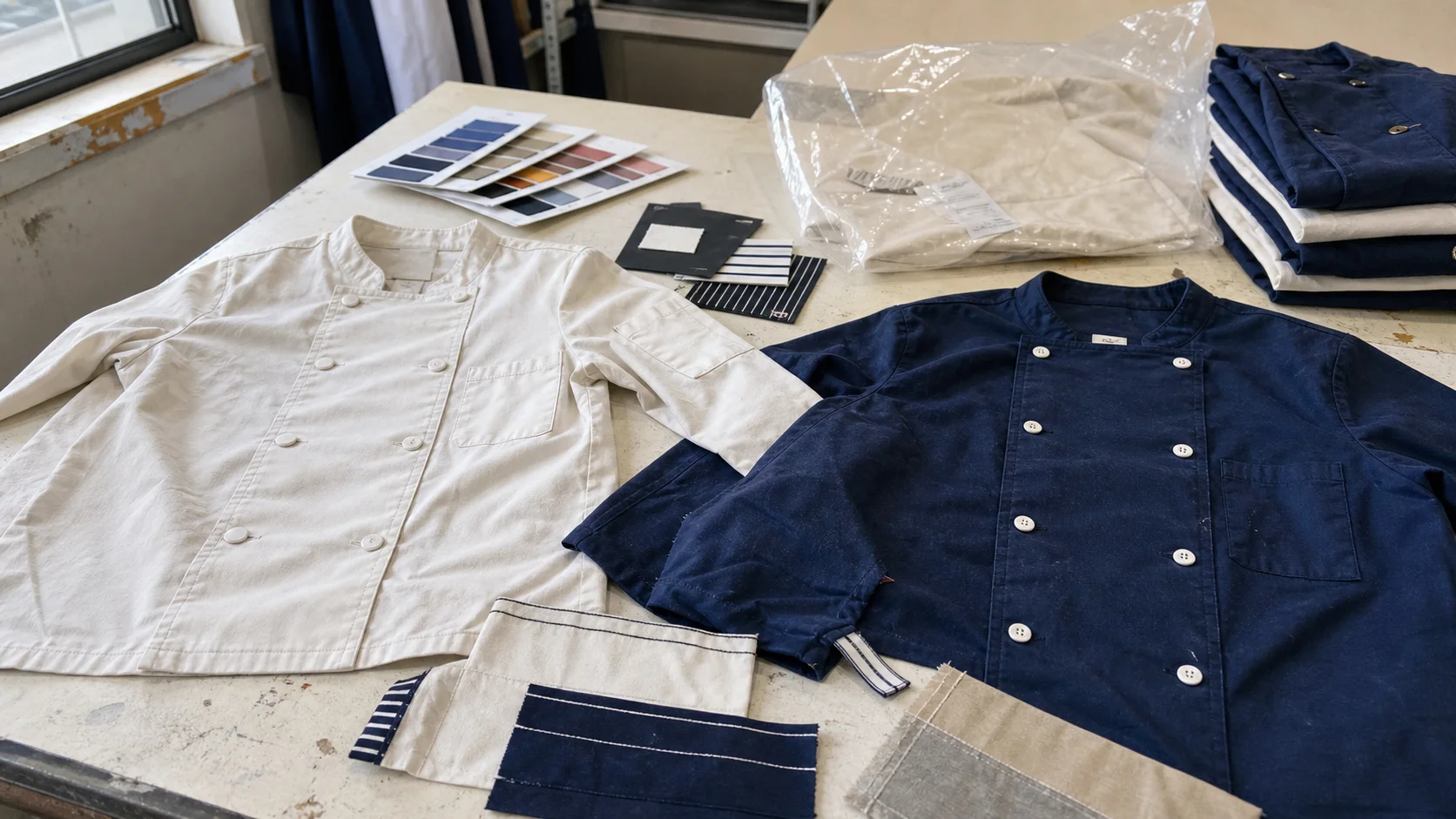
A quality inspection outline for outdoor school buyers reviewing custom chef coat wash tests, fabric durability, embroidery performance, shrinkage, stains,...
Chef Coat Wash Test Review for School Buyers - Quality & Inspection manufacturing guide
Buying custom chef coats for outdoor school programs is not the same as buying uniforms for a climate-controlled culinary classroom. A coat may look clean in a product photo, pass a basic size check, and still fail after repeated laundering, field use, sun exposure, food stains, and rough student handling. For school buyers, the wash test is not a formality. It is one of the most practical ways to judge whether a chef coat is fit for a full academic term.
This review guide is written for purchasing teams, school uniform coordinators, culinary program directors, camp operators, and outdoor education buyers sourcing custom chef coats in bulk. The focus is quality and inspection: what to test, how to read the results, what risks to flag before production, and how to balance price, durability, comfort, and branding.
A chef coat that survives one showroom wash is not automatically school-ready. Outdoor school buyers should test shrinkage, colorfastness, seam strength, stain release, trim durability, and appearance after repeated laundering before approving bulk production.
Outdoor school environments are hard on chef coats. Students may cook over portable ranges, prep food at field stations, carry supplies, sit on benches, walk between kitchens and outdoor classrooms, and store garments in backpacks. The coat is exposed to sweat, soil, smoke, rain, UV light, sauces, oils, and repeated laundering. A basic white cotton coat may be acceptable for a short indoor workshop, but it can become a maintenance issue when used every week by students in changing weather.
School buyers also face a different risk profile from restaurants. A restaurant may replace a few staff coats as needed. A school usually buys by intake, semester, grade level, camp session, or department budget. If a custom coat fails after distribution, the buyer may have limited time and funding to reorder. Complaints are also spread across students, parents, instructors, and administrators. That makes pre-production testing more important than post-delivery problem solving.
A wash test helps answer basic but critical questions. Will the garment shrink beyond tolerance? Will sleeve length become too short? Will the coat twist after drying? Will embroidery pucker? Will printed logos crack? Will snap buttons rust or loosen? Will stains release well enough for student reuse? These are practical buying questions, not lab-only concerns.
The most useful wash test is not necessarily the most complex one. For school procurement, a controlled domestic or commercial laundering simulation can reveal many risks before bulk production begins. The goal is to test the exact fabric, trims, stitching, branding method, label, and care instruction intended for the real order.
Outdoor school buyers often need chef coats that can handle mixed-use learning environments. The garment must look professional enough for culinary instruction, yet be durable enough for outdoor education. Comfort also matters because students may wear the coat for several hours, sometimes over base layers or T-shirts.
Typical requirements include easy laundering, moderate stain resistance, stable sizing, breathable fabric, secure closures, safe pocket placement, clear school branding, and a size range that fits teenagers or young adults. Some programs need gender-neutral grading, while others require youth sizing or extended adult sizes. A good supplier should confirm size ratios early, because poor size planning creates more returns than many fabric issues.
Outdoor school programs may also prefer slightly darker colors than traditional white. White looks classic and makes hygiene visible, but it shows soil quickly and can appear worn after repeated outdoor use. Black, charcoal, navy, stone, or forest green may be easier to manage, though darker shades require stronger colorfastness control. For schools that still need a traditional look, an off-white or light grey poly-cotton coat may be a practical compromise.
Customization usually includes embroidered school logos, woven labels, name areas, department colors, or sleeve branding. Buyers should be cautious with large back prints or heavy chest embroidery on lightweight fabric. Branding that looks premium on a sample can become uncomfortable, puckered, or distorted after washing if backing, stitch density, or fabric weight are not matched correctly.
For support on uniform planning, buyers can review manufacturing and customization options through Fabrikn services. The useful starting point is always the same: define the use case before choosing the garment construction.
Fabric is the main driver of wash performance. The best choice depends on climate, program intensity, budget, and the expected life of the garment. For outdoor school buyers, the common choices are cotton twill, poly-cotton twill, recycled polyester blends, stretch blends, and lightweight canvas-style weaves.
Cotton twill has a familiar chef coat hand feel and good breathability. It absorbs moisture and can be comfortable in warm conditions. The downside is shrinkage risk, longer drying time, and heavier wrinkling. If the school wants a traditional appearance and can manage ironing or steam finishing, cotton is workable. For high-volume student laundering, it may create more maintenance burden.
Wash testing cotton is essential. Pre-shrunk cotton can still move after repeated laundering, especially in sleeve length and body length. A reasonable shrinkage target for school uniforms is often within 3% after washing, though the exact tolerance should be written into the purchase specification. If a supplier cannot provide fabric shrinkage data or a pre-production wash sample, the buyer should treat that as a risk.
Poly-cotton twill is often the most balanced option for school chef coats. Common blends include 65/35 polyester/cotton or 80/20 polyester/cotton. Polyester improves shape retention, faster drying, and wrinkle resistance. Cotton improves comfort and reduces the plastic feel of pure polyester.
For outdoor school buyers, 65/35 poly-cotton twill in a medium weight is usually a practical starting point. A fabric around 180-220 gsm can offer enough structure without becoming too hot. Heavier 240-260 gsm options may look more premium and last longer, but they can be uncomfortable in warm outdoor sessions. Lighter fabrics may breathe better, but they can show transparency, seam stress, and embroidery puckering.
Some schools want recycled polyester content to support sustainability policies. This can be a valid choice, but the wash test becomes even more important. Recycled polyester yarn quality can vary. Buyers should confirm colorfastness, pilling, dimensional stability, and hand feel after laundering. Certification claims should be documented, not simply listed in a sales deck.
Recycled content can also affect pricing and MOQ. Mills may require higher fabric minimums for custom colors or certified lots. If the school needs only a few hundred units, stock fabric with verified composition may be more practical than a custom-dyed certified fabric.
Stretch chef coats can improve comfort, especially for active programs. A small elastane content may help movement around the shoulders and elbows. The tradeoff is higher care sensitivity. Elastane can degrade with high heat, chlorine bleach, and aggressive tumble drying. If students or school laundry services use hot cycles, stretch fabric may lose recovery faster than expected.
For outdoor school buyers, stretch is worth considering only when the care process is controlled. A coat that feels better on day one but bags out after ten washes is not a good bulk purchase.
A useful wash test should be simple enough for procurement teams to understand and strict enough to expose real production risks. The test should use the approved sample or pre-production sample made with bulk fabric, bulk trims, and final decoration. Testing an early sample made from substitute fabric gives limited value.
For a school-focused review, test at least five wash and dry cycles before approval. Ten cycles are better for programs expecting heavy use or annual reuse. The wash method should match the likely real-world process. If families will wash garments at home, use a domestic machine simulation. If the school uses a laundry provider, request a commercial wash simulation.
A typical domestic test may use warm water at 40°C, standard detergent, medium spin, and tumble dry on low or medium heat. A stricter test may include 60°C washing if hygiene protocols require it. Bleach should be tested only if it is part of actual care instructions. Many colored chef coats and embroidered logos are not suitable for chlorine bleach.
For outdoor programs, include at least one stain challenge. Common test soils may include tomato sauce, cooking oil, mud, grass, and smoke exposure. The goal is not to guarantee perfect stain removal. The goal is to see whether normal laundering leaves the coat looking acceptable for school reuse.
The buyer should keep all results in a simple report. A table with measurements before washing, after five washes, and after ten washes is usually enough for decision-making. If the garment fails visibly after three washes, do not wait for a full test cycle to raise the issue. Early failure is useful information.
Wash testing is only valuable if the buyer knows what to look for. The following inspection points are especially relevant for custom chef coats used in outdoor school settings.
Shrinkage is the first concern. Body length and sleeve length are usually the most noticeable. A coat that shrinks 4-5 cm in length may still fit the measurement chart technically, but it may look poor on students. Sleeve shrinkage is a frequent complaint because students notice it while working.
Set tolerance before production. For many school chef coats, a shrinkage tolerance within 3% is reasonable for poly-cotton fabric. Cotton-heavy fabrics may need a different agreement, but the buyer should not accept vague wording such as “normal shrinkage.” Normal to the supplier may not be acceptable to the school.
Outdoor use puts stress on shoulder seams, armholes, side seams, and pocket openings. After washing, inspect for seam slippage, broken stitches, loose threads, and puckering. Puckering can come from thread tension, fabric shrinkage, or mismatched sewing thread.
For school buyers, reinforced stress points are worth paying for. Bar tacks at pocket corners and secure stitching at side vents can reduce repair issues. French seams may look clean but can add bulk. Overlocked seams are common and cost-effective, but they must be neat and secure.
Colorfastness matters even for white coats. White fabric can yellow, grey out, or absorb dye transfer from other garments. Colored chef coats should be checked for fading, crocking, and dye bleeding. Dark navy, black, burgundy, and green often require closer review.
If the school orders multiple colors by year group or department, test each color separately. Do not assume the navy coat performs like the white coat. Different dyes can behave differently on the same fabric base.
Buttons, snaps, zippers, labels, and hook-and-loop closures often fail before the main fabric. Plastic buttons can crack. Metal snaps can loosen, discolor, or rust if plating quality is poor. Hook-and-loop tape can collect lint and lose grip. Woven labels can curl or fray.
For student garments, snaps are convenient but must be securely attached. Buttons are easier to replace but may fall off if stitching is weak. Hidden plackets look cleaner but can trap food debris if poorly constructed. There is no perfect trim choice. The right answer depends on care process, student age, and program supervision.
Custom branding should be wash-tested exactly as ordered. Embroidery is durable but can pucker on lightweight fabric. Screen print can crack if ink and curing are poor. Heat transfer can peel under repeated laundering or high tumble heat. Woven patches can look premium but may curl at the edges.
For school chef coats, left-chest embroidery is usually the safest option for logos. Keep stitch density moderate and avoid oversized filled designs on light fabric. If the school needs student names, consider whether names are embroidered, printed, or applied by removable name badge. Embroidered individual names improve ownership but increase sorting complexity and replacement cost.
A structured approval process prevents misunderstandings. It also gives the buyer leverage when discussing defects later. The approved sample should represent the final product, not a rough idea of it.
Start with a written requirement sheet. Include fabric composition, fabric weight, color, size range, logo method, pocket layout, closure type, care instruction, packaging, and inspection standard. Outdoor use should be clearly stated. If coats will be used near grills, burners, or open flame, the buyer should discuss safety requirements and fabric suitability with the supplier before sampling.
The fit sample checks size, silhouette, comfort, and pattern balance. It may use available fabric if final bulk fabric is not ready, but this limitation should be recorded. For school programs, test fit across several body types when possible. A gender-neutral coat should not simply be a men’s pattern renamed as unisex.
Approve swatches, lab dips, buttons, snaps, labels, thread, and decoration samples. This step is often rushed, but it is where many future wash problems begin. Thread quality, button material, and backing choices can change garment performance.
The pre-production sample should use bulk fabric and final trims. It should include actual logo placement and final care label. This is the sample to wash test. If it passes, sign and seal it as the production reference.
Review a size set before bulk cutting when the order size and budget justify it. A size set confirms grading across XS-XXL or youth-to-adult sizes. For school orders, the middle sizes often look fine while the smallest and largest sizes reveal grading problems.
Bulk inspection should check workmanship, measurements, shade consistency, trims, branding placement, packing, and random wash verification if agreed. For higher-risk orders, an inline inspection during production is better than waiting for final inspection. Final inspection can reject goods, but it cannot recover lost delivery time.
Buyers who need help structuring specifications or inspection checkpoints can start a sourcing discussion through Fabrikn contact.
MOQ and lead time depend on fabric, customization, factory capacity, and sampling requirements. For custom chef coats, typical MOQs can range from 100-300 pieces for stock fabric with simple embroidery, 300-500 pieces for adjusted patterns or custom trims, and 500-1,000 pieces or more for custom-dyed fabric or special certified materials. These are typical planning ranges, not fixed rules. A supplier may accept lower quantities at a higher unit price.
School buyers should be careful with very low MOQ offers. Low MOQ can be useful for pilot programs, but it may come with limited fabric choice, higher unit cost, substitute trims, or less control over dye lots. If the school needs repeat orders, confirm whether the same fabric and color will be available later.
Sampling lead time often takes 7-14 days for a simple fit sample using available fabric. A pre-production sample with custom fabric, logo development, or special trims may take 2-4 weeks. Bulk production commonly takes 30-60 days after sample approval, depending on order quantity and material readiness. Shipping, customs, school receiving schedules, and holiday closures can add meaningful time.
Lead time is strongly affected by approval speed. Many delays are not caused by sewing. They come from late logo files, unclear size ratios, color changes, slow sample feedback, or missing purchase approvals. For school calendars, build in buffer time. A coat needed for the first week of term should not be ordered as if everything will go perfectly.
The most common wash test failure is shrinkage beyond expectation. This is often caused by fabric not being properly finished, cotton-heavy construction, aggressive drying, or failure to test the actual bulk fabric. A sample made from leftover fabric may pass, while the real bulk lot behaves differently.
Another frequent issue is puckering around embroidery. This happens when the fabric is too light, the embroidery is too dense, the backing is wrong, or the garment panel was not stabilized properly. The fix may be a lighter logo stitch, different backing, heavier fabric, or a switch to a patch.
Trim failure is also common. Snaps that feel secure on a new sample can loosen after washing if attachment pressure is inconsistent. Buttons may detach if thread quality or stitch count is low. Labels can curl when cheap materials are used. These are not cosmetic details when hundreds of student garments need to be distributed on time.
Color change is another concern. Dark coats may fade unevenly. White coats may grey after washing with mixed loads. Contrast piping can bleed into the main fabric if not tested. If the school wants contrast trim, the wash test should include color migration review.
Pilling is less dramatic but still important. Students and parents may read pilling as poor quality, even if the coat remains wearable. Polyester-rich fabrics can pill if yarn quality is low or abrasion resistance is weak. Outdoor use increases abrasion from backpacks, benches, and equipment.
Odor retention should not be ignored. Some synthetic blends hold cooking and smoke smells more than cotton. If coats are used around outdoor cooking stations, test odor release after washing. A fabric that looks clean but smells smoky after laundering may become a complaint item.
The best chef coat for outdoor school buyers is rarely the cheapest option. It is also not always the heaviest or most premium-looking coat. The right purchase balances durability, care reality, student comfort, replacement cost, and delivery reliability.
If the program runs short sessions or one-off camps, a stock poly-cotton coat with simple embroidery may be the best value. The buyer can keep MOQ low, reduce sampling time, and reorder more easily. Spending heavily on custom fabric may not pay off.
If the program runs year-round culinary training, a stronger custom specification makes sense. Better fabric, reinforced seams, tested snaps, and controlled branding can reduce complaints and replacement orders. The unit price may be higher, but the cost per wear can be lower.
If the school prioritizes sustainability, recycled content or organic cotton may support procurement goals. The buyer still needs to verify durability. A sustainable coat that fails early creates waste, budget strain, and credibility issues. Sustainability claims should be paired with performance testing.
If the climate is hot, avoid overbuilding the garment. Heavy chef coats can discourage proper wear. Students may roll sleeves, leave coats open, or stop wearing them. Lightweight breathable fabric with strong seams may be better than a thick coat that looks durable but performs poorly in use.
If the school uses a central laundry service, align the garment with that process. Commercial laundering can be harsher than home washing. Higher temperatures, stronger detergents, and tumble drying can expose weak trims and unstable fabric. If care cannot be controlled, choose conservative materials and avoid heat-sensitive decoration.
Clear documentation is the buyer’s best protection. The purchase order should refer to the approved sample, specification sheet, wash test result, size chart, tolerance, packaging requirement, and inspection standard. General descriptions such as “good quality chef coat with logo” leave too much room for interpretation.
Not every defect carries the same risk. School buyers should classify issues before inspection so the supplier and inspector know what is acceptable.
Critical defects may include sharp metal parts, unsafe trims, severe contamination, mold, or construction that creates a safety issue. Major defects may include incorrect size, wrong logo, open seams, excessive shrinkage, broken snaps, obvious stains, shade mismatch, or serious measurement deviation. Minor defects may include small loose threads, slight wrinkles, or minor appearance issues that do not affect wear.
For school orders, logo mistakes should usually be treated as major defects. A coat with the wrong school logo, wrong department name, or poor placement is difficult to distribute even if the garment itself is wearable. Size label errors are also serious because they slow distribution and create fitting complaints.
Buyers should not rely only on carton-level inspection. Open cartons, check size breakdown, review random pieces from different sizes, and inspect decorated areas carefully. If the order includes multiple colors or logos, sampling must cover each variation.
Care labels are often treated as a compliance detail, but they affect garment life. Outdoor school chef coats should have care instructions that students, parents, or laundry teams can realistically follow. If the coat requires delicate washing, no tumble drying, and low heat ironing, it may not be suitable for a busy school program.
A practical care label for poly-cotton chef coats may allow machine wash warm, wash with similar colors, non-chlorine bleach when needed if compatible, tumble dry low, and warm iron if required. Exact instructions must match the tested fabric, trim, and decoration. Heat transfer logos may require lower drying temperatures. Dark colors may need stronger warnings against bleach.
Care instructions should also be communicated outside the garment label when students take coats home. A simple distribution sheet can reduce damage caused by hot drying, bleach, or washing dark coats with light garments.
A sample should be rejected if it fails the core use case. Excessive shrinkage, unstable color, weak seams, unsafe trims, and failing decoration are not minor concerns. Reworking a sample is reasonable when the supplier can identify the cause and propose a specific correction.
Buyers should be cautious when the explanation is vague. Phrases such as “bulk will be better” or “washing issue is normal” should not replace evidence. Ask for a revised sample made with corrected fabric, trim, or process. Then wash test again.
Some issues are acceptable tradeoffs if documented. Cotton coats may wrinkle more. Dark coats may show some fading over time. Lightweight fabric may need simpler embroidery. The key is to understand the tradeoff before ordering, not after distribution.
Strong supplier communication reduces quality risk. Share the intended outdoor use, washing method, student age range, term length, branding needs, size breakdown, and delivery deadline. Ask the supplier to confirm whether the selected fabric and trims are suitable for the care process.
Request fabric test data when available, but do not treat paperwork as a substitute for garment washing. Lab results can support the decision, while a physical wash test shows how the full garment behaves. Both are useful.
Buyers comparing suppliers should look beyond unit price. A supplier that asks detailed questions about fabric, trims, care, and inspection is often more reliable than one that only quotes quickly. Company background and sourcing approach can be reviewed through Fabrikn about us.
A custom chef coat is school-ready when it remains wearable, presentable, and safe after realistic laundering and student use. It should keep its size, hold its color, retain its branding, and withstand normal stress at seams and trims. It should also be comfortable enough that students will actually wear it correctly.
For outdoor school buyers, the strongest buying decision is usually a tested medium-weight poly-cotton chef coat with reinforced stress points, practical closures, moderate branding, clear care instructions, and documented inspection standards. Custom features can add value, but every added detail should survive the wash test.
The wash test review should happen before bulk production, not after goods arrive. Once hundreds of coats are cut, sewn, decorated, packed, and shipped, quality problems become expensive to solve. Early testing is cheaper than replacement, faster than dispute resolution, and more reliable than assumptions.
The practical rule is simple: approve what has been tested, produce what has been approved, and inspect against what was agreed. That approach protects the school budget, the program schedule, and the students who need uniforms that work in real conditions.
Get a free quote from Fabrikn — your trusted B2B clothing manufacturer with 10+ years of experience. MOQ as low as 200 pieces.
Get a Free Quote →Five wash cycles are a practical minimum for most school orders. Ten cycles are better for outdoor programs, annual reuse, or central laundry conditions. The test should use the final pre-production sample with actual fabric, trims, and branding.
A 65/35 poly-cotton twill around 180-220 gsm is often a balanced option. It offers better shape retention and faster drying than cotton while keeping more comfort than pure polyester. Hot climates may need lighter fabric, while heavy-use programs may need stronger construction.
Typical MOQs range from 100-300 pieces for stock fabric with simple customization, 300-500 pieces for adjusted patterns or custom trims, and 500-1,000 pieces or more for custom-dyed or certified fabrics. Lower MOQs may be possible at higher unit cost or with fewer custom options.
Left-chest embroidery is usually durable and professional for chef coats. It must be tested for puckering, especially on lightweight fabric. Screen print or heat transfer can work, but buyers should test cracking, peeling, and heat sensitivity after repeated washing.
For stable poly-cotton chef coats, many buyers target shrinkage within 3%. Cotton-heavy fabrics may need separate agreement. Sleeve length and body length should receive close attention because shrinkage in those areas affects appearance and fit quickly.
The main risks are shrinkage, seam puckering, weak pocket corners, loose buttons or snaps, color fading, dye bleeding, logo distortion, wrong size labels, and inconsistent packing. Outdoor use adds abrasion, stains, sun exposure, and odor retention to the risk list.
Reject the sample if it shows excessive shrinkage, unstable color, unsafe trims, poor logo durability, seam failure, or a care requirement that does not match the school’s real laundering process. A revised sample should be tested again before bulk approval.
Bulk production often takes 30-60 days after sample approval, depending on order size, fabric readiness, trims, factory capacity, and decoration workload. Sampling, wash testing, shipping, customs, and school receiving schedules should be planned separately.