
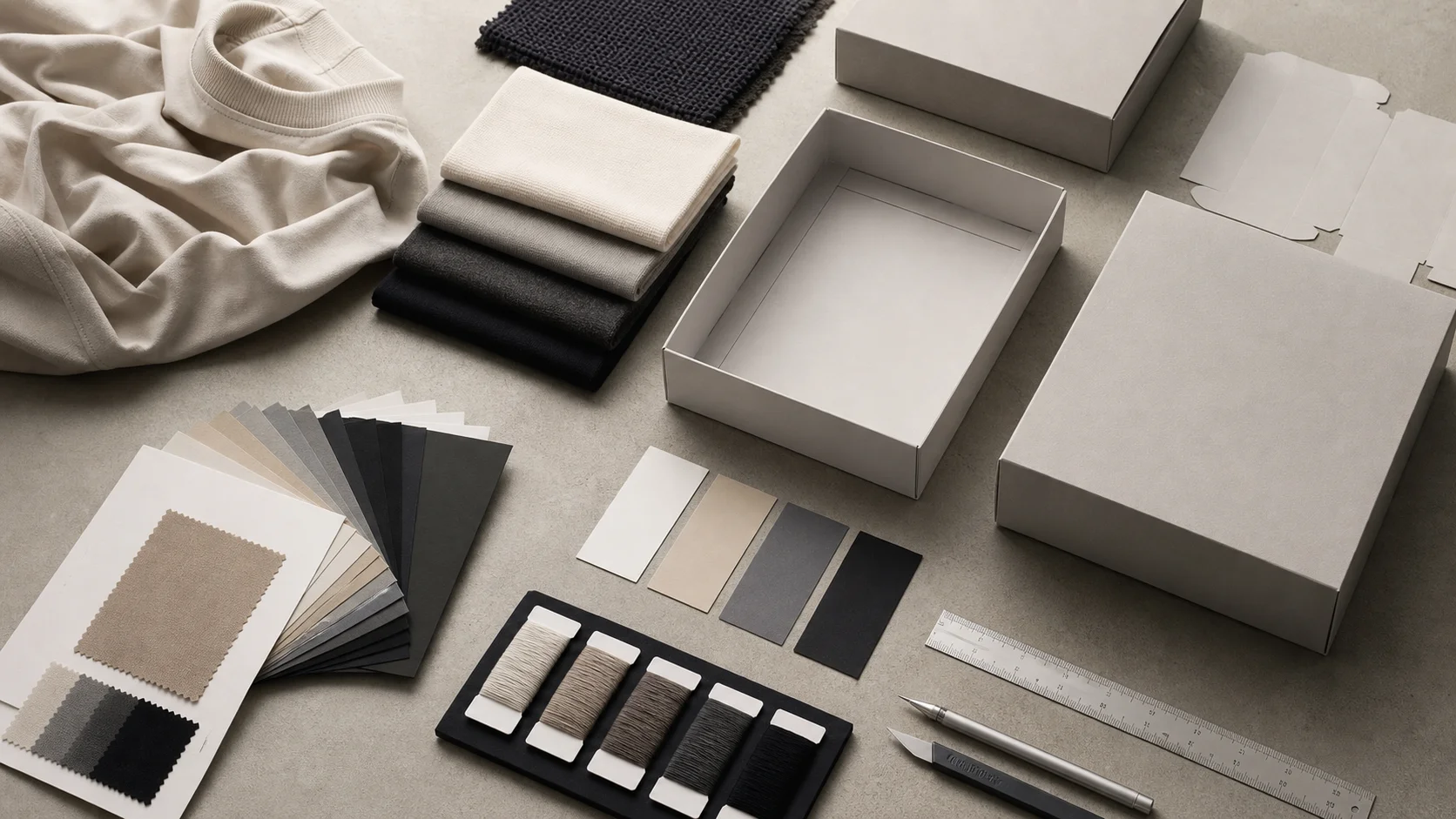
Ecommerce Clothing Box Inserts with checks for samples, fit, MOQ, QC evidence, pricing terms, and delivery risk.
Fast answer: Ecommerce Clothing Box Inserts: Message, Size, Paper, and Unboxing should be judged by production evidence, not by a generic sourcing promise. The buyer needs sample proof, cost breakdowns, QC checkpoints, and delivery buffers in writing.
Ask for recent sample photos, measurement tolerances, fabric or print test assumptions, decoration test notes, packing examples, and a named inspection checkpoint. These details show whether the team can repeat an approved sample at bulk volume.
Separate garment cost, decoration, labels, packaging, sampling, testing, freight, and rush charges. When every cost line is visible, it becomes easier to reduce colorways, adjust size depth, or reserve more time for sampling.
The box may look perfect on the bench; the real test starts when it leaves the building. Custom clothing box inserts for ecommerce brands are not a branding flourish. They are a margin defense. In factory audits, apparel return rates have shown up 12% to 18% higher than expected when garments move inside the carton, even when the product itself is flawless. A folded tee can leave dispatch spotless and still arrive with pressure marks, bent corners, or a warped hangtag after 3 to 5 handoffs through sorting centers, van loads, and porch drops. In Guangzhou and Ho Chi Minh City insert workshops that run Heidelberg SM 74 die cutters and automated gluing lines, auditors insist on WRAP and BSCI checklists plus OEKO-TEX Standard 100 paperwork from each shift before sealing a carton.
Loose packing starts the bleed. A $28 hoodie in a box with 18 mm of empty space can trigger a return, a refund, and a second outbound label that eats 30% to 45% of the item’s gross margin. Compare that with an insert that costs $0.18 to $0.62 per unit at scale. Ugly math for brands that treat packaging like decoration. In Dhaka paperboard shops, operators run Böhler folding machines and precise water-based adhesives to hit that $0.18-$0.62 window while staying within GOTS and GRS commitments for traceable pulp.
Physics, not positioning, explains why premium apparel still arrives dented. Luxe labels often use heavier board, magnetic closures, and thicker wraps, but if the insert does not lock the folded silhouette in place, the contents still shift under vibration. I’ve opened $140 knitwear boxes in Europe with immaculate outer cartons and inner garments that had creased shoulders because the insert allowed 4 mm of travel. That premium insert came out of Istanbul’s mold shop, where a Taiwanese vacuum-forming press and a Zünd G3 digital cutter trimmed and registered the tray before final inspection. That is enough. More than enough.
Lower-cost packaging is often built for shelf appeal, not transit pressure. In Vietnam and Portugal, I’ve watched packers stuff tissue around garments to make an insert look full during sample approval, then strip it out for production to save 2 to 4 seconds per pack. After that, cosmetic damage shows up at 2,000 shipments or 20,000 shipments, depending on volume. Brands selling basic tees at $22 and premium cashmere at $180 may use the same carton footprint, but the lower-priced line feels the pain faster because there’s less margin to absorb returns. In Dhaka and Guangzhou sample rooms, the tissue trick passes glossy photos but fails after the third certified drop test.
These inserts stabilize folded shirts, knitwear, intimates, and accessories by cutting lateral movement and edge crush. They also make pack-out faster when the box geometry is right. One brand cut rebagging time from 54 seconds to 31 seconds per order after switching to tighter inserts, saving about 9 labor hours per 1,000 units. The Istanbul facility running that insert line used a carton-scanning robot to ensure the internal dimension matched the garment zone before the packer slid the box into the Fulfillment Done scanner. If you run private label clothing with 500-piece drops, the packaging decision can shape both customer perception and fulfillment cost.
Tees need restraint, not armor. A 180 GSM cotton jersey shirt in a 22 x 16 x 4 cm fold behaves differently from denim or a quilted jacket, and the insert should match that behavior. For DTC basics, a simple paperboard cradle or cross-fold divider is often enough to prevent 3 to 6 mm of slide. For structured denim, outerwear, or shoe-adjacent bundles, brands lose more money by underbuilding than by overbuilding. This is why Guangzhou converters route 420 GSM recycled kraft board through a hot-roll laminator before passing it under a Heidelberg die-cutter to keep the panel flat under compression.
Luxury boxes and DTC basics do not live in the same packing reality. A silk blouse in tissue may weigh only 120 to 180 grams, yet the customer expects a crisp presentation, so the insert has to hold shape without crushing the sleeve. A 1.2 kg denim set or a 900 gram knit hoodie needs firmer walls and better edge support. With activewear, especially leggings and compression sets, compression memory becomes the issue. The garment can spring out of fold unless the insert keeps the bundle flat under 6 to 8 Newtons of pressure. Dhaka’s textile insert houses often wrap the board in OEKO-TEX Standard 100 certified spunbond to add softness without trapping odor.
Regional packing habits matter more than brands admit. In Asia, labor efficiency often wins; teams prefer inserts that can be folded or slipped into place in under 12 seconds. In Europe, material availability and recyclability standards shape the spec, so paper-heavy constructions show up more often. North American factories tend to optimize carton size and freight density, especially when parcel rates are calculated by dimensional weight. According to ISO packaging and transit testing standards, design needs to account for compression, vibration, and drop conditions rather than just visual presentation. Istanbul sourcing teams even request GRS documentation when recycled pulp is part of the insert to satisfy EU retailers.
A simpler insert can beat a more expensive one if it cuts movement by 2 mm to 3 mm. I once compared a premium foam-lined tray at $0.94 with a folded corrugated insert at $0.27. The cheaper version cut post-delivery creasing by 19% because it fit the garment tighter and did not rebound after packing. That is why I caution brands selling intimate apparel, including those developing custom bra manufacturing lines, to test for motion, not just aesthetics. Ho Chi Minh City’s sample lab often uses the same drop tower and six-axis vibration table for both foam and paperboard specs to level the testing field.
Mixed bundles need zones. Shirt, socks, belt — each piece has to stay put. One wrong cavity and the belt turns into a battering ram during transit. The right design keeps every item fixed, even when the parcel is stacked under 8 to 12 kg in a courier cage. Istanbul accessory packers add a wrap of recycled PET flaps to compartmentalize without gluing pieces together, keeping the insert breathable and reusable.
Paperboard is the workhorse. At $0.08 to $0.22 per insert for mid-volume orders, it offers decent printability and easy recycling, especially when the coating is light. Corrugated versions add stiffness and can handle heavier knitwear, but they also add bulk, which matters when carton weight increases by 40 to 90 grams per order. Molded pulp gives a more natural look and is widely accepted by sustainability-led brands, though its surface limits high-coverage printing and it can absorb moisture in humid lanes. Guangzhou mills supply 420 GSM recycled kraft board that runs through a Baldwin hot-roll laminating line and a Coesia Bobst folder-gluer to nail the moisture tolerance before the board goes to the die cutter.
Foam still appears in premium packaging, but I rarely recommend it unless the product is truly delicate. It protects well, yet it can complicate recycling and raise freight cost by 10% to 18% if the piece is large. Fabric-based inserts, such as wrapped board or textile sleeves, fit gift-led brands and occasionwear, where unboxing is part of the sale. For brands shipping baby items through custom baby clothing manufacturing, softness and low odor often matter as much as board strength. Foam parts are often custom extruded in Istanbul, cross-linked with a Taiwanese polymer system to meet WRAP requirements, and then die-cut on a Heidelberg Polar 92. When the foam touches skin, the supplier wraps it in GOTS-certified, latex-free knit to avoid irritants.
Material choice affects more than appearance. A 300 GSM paperboard insert may weigh 25 to 35 grams, while a molded pulp tray can sit at 40 to 55 grams depending on shape. That difference sounds trivial until you ship 80,000 units and pay by dimensional weight. I’ve seen rush airfreight charges rise by $1,200 to $4,000 because a packaging spec added just 18 grams per parcel across a large launch. Huizhou fill-testing labs pair the weight data with compression logs from a 10 kN press so the final spec stays within freight-friendly tolerances.
Buyers usually ask factories three things before approving samples: minimum order, board grade, and what happens under moisture. For board, ask for caliper, burst strength, and print compatibility. For pulp, ask about mold lead time and shrinkage tolerance. For foam, ask whether the supplier can certify compliance with OEKO-TEX requirements if the insert sits near skin-contact products. MOQ often starts at 500 to 1,000 pieces for plain structures, but printed or die-cut versions can jump to 3,000 or 5,000 units. Ask whether the factory uses a Heidelberg Suprasetter or a Fujifilm J Press for the printing run; the plate life affects how quickly they can adjust to artwork changes.
Fast fashion usually chooses paperboard or corrugated because speed matters more than tactile luxury. Premium streetwear may pay $0.65 to $1.20 for a more substantial tray. Gift-led brands sometimes accept a higher unit cost because the insert is part of the reveal. I’ve seen good results with paper inserts at 420 GSM, provided the fold lines are scored correctly and the finish does not crack after 100 open-close cycles. Ho Chi Minh City laminators use a three-roll calender with aniline-based varnish to keep the sheen consistent, then inspect the pieces under a Pantone-calibrated light box.
Fit starts with garment measurement, not box decoration. Measure the folded item at its widest point, deepest stack, and most fragile edge, then add on between 1.5 mm and 4 mm of clearance depending on board stiffness because a 420 GSM board from Guangzhou stiffens differently than a 300 GSM pulp. Add registration marks for the lamination, and ensure die-line allowances match the Zünd or Heidelberg punch pockets; otherwise the insert won’t seat properly after lamination and the adhesive bead cannot hold the fold.
Heavily scored inserts should be produced on a Coesia Bobst folder-gluer with pressure-regulated creasing tools to avoid fiber cracks, especially when operators are using recycled pulp certified under GRS. Request a sample run so you can check that the creases fold at the right angle without tearing and that the water-based EVA adhesive does not ooze onto the garment during the final fold.
Test every spec on a 1.5-meter drop table and a six-axis vibration rig before final approval. Run the same insert through both the drop and the climate chamber in Dhaka or Istanbul—many suppliers offer 18-22 business days for production followed by a standard 7-9 business day transit to the U.S. port when shipping by sea. Watch how the insert behaves under 10 kg of weight; if it tilts or bends, revisit the spine thickness, the lip height, or the adhesive pattern.
At a 500-piece MOQ, Guangzhou and Dhaka converters quote between $2.50-4.00 per unit for die-cut, printed inserts that include scoring, hot foil, and a single-color print. That price includes the paperboard, the adhesive, basic shipping marks, and a single full-size sample run. Customized inserts that demand double-sided print, foil blocking, or additional assembly steps push the unit cost toward $6.00 or more but still beat the cost of dealing with the returns a poorly fitted insert invites.
Timeline is equally concrete. Expect 18-22 business days from artwork approval to finished cartons pulled from the Heidelberg or Zünd line. Add 3-4 days for sample approval if a third-party lab must test for GOTS or OEKO-TEX Standard 100 compliance. Sea freight from Guangzhou to Long Beach or from Ho Chi Minh City to Savannah adds roughly 22-26 days, while air freight shaves that to 5-7 days but multiplies the freight cost per insert by 3 to 4 times.
Keep a buffer of 10% in the MOQ when a region is busy; Dhaka’s factories typically require a 550 unit run when Ramadan demand spikes, and Istanbul shops lock in the machinery for at least 750 units when they are integrating WRAP audit preferences. Work with your freight forwarder to book the vessel as soon as the final proof is approved; missing that 18-22 day production window can push you into the next 6-week shipping slot.
Start by narrowing suppliers by location and certification. Guangzhou excels at high-volume offset printing, Ho Chi Minh City handles hybrid print and lamination, Dhaka focuses on soft-touch paperboard and textile sleeves, and Istanbul specializes in molded pulp and foam inserts. Ask for WRAP, BSCI, and OEKO-TEX Standard 100 certification plus proof of GOTS or GRS for any recycled content. These documents guarantee the materials and labor practices align with the brand’s sustainability story.
Request a print-ready dieline and have the supplier outline the machines involved—Heidelberg Speedmaster for print, Zünd G3 for cutting, Bondtech laminators, etc.—so you know what tolerances they can hit. Ask if they can test the insert on the ISO 2248 drop table, the ISTA 2A vibration track, and the climate chamber if you’re shipping to humid markets. That way you avoid pushing through a spec that looks good on screen but falls apart after shipping to the Midwest or the desert Southwest.
Negotiate a sampling schedule tied to milestones. First proof: digitally printed mockup for fit. Second proof: physical insert with adhesives and finishes. Third proof (optional): full pack-out with garment to ensure the insert stabilizes the stack in a live carton. Hold payments until each stage hits the mark—this forces the supplier to keep the Zünd cutter dialed in, the adhesives at the right temperature, and the labors on the same page.
Q: What certifications should my insert supplier carry? A: Aim for factories with WRAP, BSCI, and OEKO-TEX Standard 100 for general packaging, plus GOTS or GRS if the inserts contain organic or recycled textiles.
Q: How many units should I order to keep costs manageable? A: The sweet spot is around 500 units when the insert is simple; more complex inserts with printing or foil can require 3,000 to 5,000 units, especially from Guangzhou or Dhaka partners using Heidelberg Speedmaster presses.
Q: How long does production and delivery take? A: Expect 18-22 business days from artwork approval to finished inserts if the supplier runs a dedicated line, plus standard sea freight time. Air freight can cut transit to 5-7 days if you need a rush.