
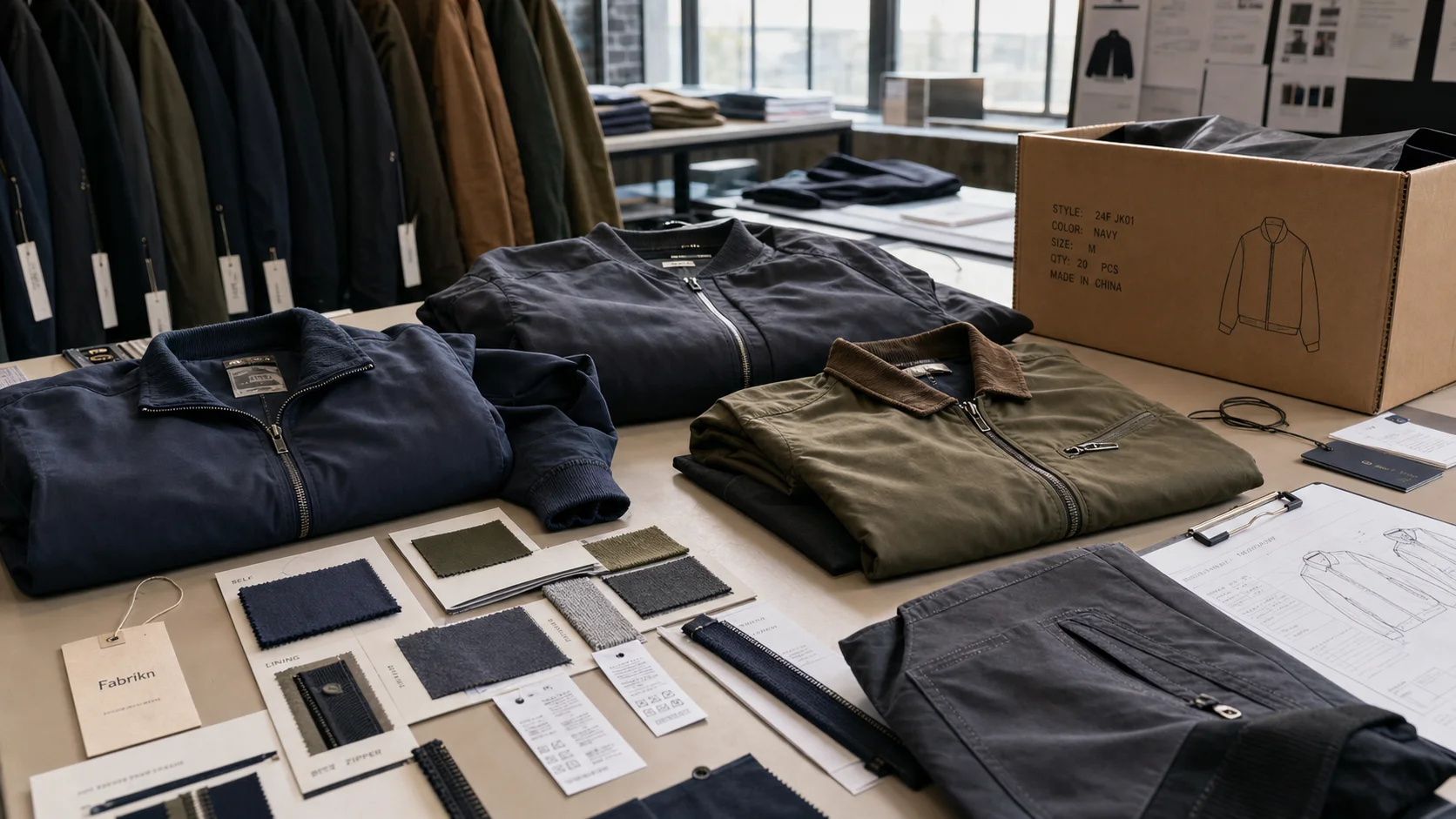
Branded Apparel Packaging Supplier in China with checks for samples, fit, MOQ, QC evidence, pricing terms, and delivery risk.
Fast answer: Branded Apparel Packaging Supplier in China: Samples, MOQ, and Lead Time should be judged by production evidence, not by a generic sourcing promise. The buyer needs sample proof, cost breakdowns, QC checkpoints, and delivery buffers in writing.
Ask for recent sample photos, measurement tolerances, fabric or print test assumptions, decoration test notes, packing examples, and a named inspection checkpoint. These details show whether the team can repeat an approved sample at bulk volume.
Separate garment cost, decoration, labels, packaging, sampling, testing, freight, and rush charges. When every cost line is visible, it becomes easier to reduce colorways, adjust size depth, or reserve more time for sampling.
Packaging has ended more launches than bad fit ever did. I have watched a brand team approve the garment on Tuesday, then learn on Friday that the boxes needed 18 days of print, 7 days of finishing, and another 10 to 14 days for sea freight. Six weeks gone. One box did that. A custom clothing packaging supplier china is often the quiet variable that decides whether a collection lands on time or misses retail windows by a full month.
Structure explains the appeal. China’s packaging ecosystem can combine printing, die-cutting, lamination, embossing, assembly, and carton packing in one supply chain, so handoffs shrink compared with splitting those steps across three countries. In factories I have visited, one team moved from artwork proof to a finished rigid box in 12 to 16 days when board and paper were already in stock. Europe or North America often needed two separate vendors and three or four approvals. Slow, then slower.
Starter brands like the low thresholds. Paper mailers at MOQ 500 pieces. Tissue at 1,000 sheets. Hang tags at 2,000 units. Large labels like the material spread. They can start with kraft mailers at $0.18-$0.35 each, then move to rigid gift boxes at $1.20-$3.50 each without changing the sourcing country. That flexibility matters when a brand is testing a $28 T-shirt line next to a $240 wool coat.
Counterintuitive, but true: a higher unit price can lower total cost. I saw a supplier quote a box at $0.62 instead of $0.48, yet the pricier version cut corner crushes by 70% and reduced rework by 4% on a 20,000-piece run. Freight damage is not abstract. A 3% reject rate on a 15,000-unit launch can wipe out the savings from choosing the cheapest board.
Packaging is not decoration. It shapes margin, first impression, return risk, and brand trust. I have seen brands spend $18 on a hoodie and ship it in a thin poly bag, then spend another $9 per order handling dents, wrinkled inserts, and customer complaints. Bad arithmetic. Smart buyers treat packaging as part of product development, which is why many teams map clothing packaging solutions alongside the garment, not after it. If you are evaluating sustainability claims, independent references from Textile Exchange, OEKO-TEX, and trade.gov can help you compare materials and compliance claims with more confidence.
The range is wider than most buyers expect. A strong custom clothing packaging supplier china can produce garment boxes, tissue paper, hang tags, swing tags, dust bags, paper bags, mailer boxes, garment sleeves, poly alternatives, inserts, and branded sealing tape. I have also seen garment folders for formalwear, sleeve bands for knitwear, and neck labels packed separately for private-label programs. The choice depends on the product, the margin, and how much protection the item needs during a 7-15 day transit.
Luxury shirts usually need crisp presentation and a flat pack structure. Denim can tolerate heavier corrugated mailers or reinforced sleeves because the fabric itself is less delicate, though indigo transfer still matters. Athleisure often ships in compact paper mailers or lightweight boxes, while intimates and swimwear need privacy, clear size communication, and moisture resistance. Outerwear has a different problem. A puffer jacket in a compressed bag may save freight, but it can create recovery issues if the fill is stressed too hard.
Material choice drives the final feel. Kraft is honest and economical. Coated paper gives sharper print and richer color. Rigid board supports premium gifting. Recycled fiber and FSC-certified paper suit brands with tighter sustainability goals, while molded pulp can replace plastic inserts in some categories. Cotton dust bags still have a role for premium pieces, though they are rarely the lowest-impact option once water use and sewing labor are counted. Compostable films exist, but buyers should verify actual end-of-life behavior, not just the promise on the brochure.
Finishes carry real buyer consequences. Embossing and debossing add tactile depth. Foil stamping signals luxury but can raise scrap risk if the die pressure is uneven. UV coatings brighten logos, while lamination can improve scuff resistance at the cost of recyclability. Spot varnish helps direct attention to a logo panel. Pantone control matters more than many teams realize, because a deep black that reads as charcoal on one run can dilute a premium identity across a whole collection.
I have been in sample rooms where recycled content looked excellent on a mockup, then showed scuffing after 30 minutes in a courier test. That is the tradeoff buyers face. A lower-footprint board may reduce gloss and sharpen contrast, while a coated white board may look cleaner but use more virgin fiber. For categories like premium knitwear, the right answer is often not the greenest option on paper. It is the one that survives handling, keeps the brand image intact, and still supports category-specific packaging needs where hygiene and softness matter.
Sales decks are easy. Production proof is harder. When I visit a factory, I ask for the business license, export records, certifications, QC documents, material specifications, and photos or videos of the actual production lines. If a supplier cannot produce a clear board spec within 10 minutes, or if the ink system is described only as “good quality,” I slow the process down. That usually means the supplier is hiding either weak documentation or limited control over subcontracted steps.
The distinction between a trading company and a factory is not always a deal-breaker. Trading companies can work well for buyers ordering 500 to 3,000 pieces across several SKUs, especially when communication speed matters more than deep engineering support. Factories matter more when customization is complex, tooling is expensive, or repeat orders will exceed 10,000 units. A trader can consolidate options; a factory can often tighten tolerances. I have used both, depending on the brief. For full brand programs, they can even coordinate with private label clothing services so labels, cartons, and inserts align from the start.
Red flags show up on the floor. Empty workshop sections with no active lines. Carton labels that do not match the samples. Shared mockups from unrelated clients sitting in the sample room. Moisture control that looks improvised. Answers that dodge where the paper board comes from, where the glue is made, or whether the UV coating is water-based or solvent-based. I have seen spotless sample rooms in facilities that later failed mass production by 8% because the packing area had no discipline at all.
The thing nobody tells you: a beautiful sample room can hide a weak packing line. I trust the staging area, the in-process inspection tables, and the pallet wrap more than the polished display shelf.
Sustainability checks need hard evidence. Ask for recycled content proof, FSC chain-of-custody documents, chemical compliance records, and waste handling practices. For finishes and adhesives, look for relevant standards and third-party testing. Data from OEKO-TEX and ISO matter because they give you a reference point for materials and process control, not just green claims. If a supplier talks only about “eco-friendly” paper and cannot show documentation, that is marketing, not verification.
Pricing is never just the unit quote. I build comparisons around design fees, plate or tooling costs, sample cost, unit price, freight, duties, and a defect allowance. A simple mailer may carry a $60-$150 artwork setup, a $30-$80 sample charge, and a unit cost of $0.20-$0.55. A rigid box can bring tooling to $180-$600, with unit pricing moving from $0.95 to $3.80 depending on board thickness, insert style, and finish. The shipping bill changes everything if cartons are oversized or poorly nested.
At low volume, local sourcing can win on speed and convenience. If a brand needs 300 boxes next week, a nearby printer may beat China simply because transit is measured in days, not 18 to 28 days by sea. At mid-volume, China often pulls ahead. Once a run reaches 5,000 to 20,000 units, the tooling amortizes, material access widens, and factory overhead becomes more efficient. At high volume, the gap can be dramatic, especially for paper goods that do not need expensive domestic labor.
The hidden costs are where buyers get burned. Long shipping routes can add 7 to 21 days and require buffer stock. Carton damage can erase savings from a cheaper quote. Language-driven revision errors create reprint costs, especially when design teams send artwork changes in separate emails instead of one controlled file. Over-specifying finishes also inflates minimum spend. I once saw a brand insist on five processes for a $38 sweatshirt box, then wonder why the quote jumped 42%.
Here is what I have learned from factory visits: a supplier quoting $0.07 more per mailer may still save money if it ships cleaner packs and cuts waste from 5% to 2%. On a 50,000-piece order, that 3-point difference can offset the higher ex-factory price by several thousand dollars once replacements, labor, and customer service are included. Cheap only looks cheap until the first damaged shipment arrives.
Price-point strategy matters too. Premium rigid boxes absorb higher tooling because the margin can carry it. Budget mailers cannot. For a $12 basic tee, a $1.10 box is usually absurd. For a $220 coat, the same packaging spend may be entirely justified. I tell brands to match packaging ambition to product margin and not to copy luxury cues from categories that sell at 10 times the ticket.
Timeline control starts before the first sample. A realistic project moves through brief, dieline, sample, revisions, pre-production approval, mass run, inspection, packing, export, and transit. If the supplier already has the right board in stock, a simple printed mailer can move in 15 to 25 days before freight. Rigid gift boxes with foil, inserts, or magnets often need 30 to 45 days before the shipment even leaves the port.
Seasonality changes everything. Before spring launches, back-to-school drops, and fourth-quarter retail windows, factory slots tighten fast. I have seen material availability stretch by 2 to 4 weeks when paper mills were busy and corrugate supply was booked out. Brands that wait until garment production is nearly done often pay for air freight. That turns a packaging decision into a logistics penalty.
My advice is blunt. Build buffer time for revision rounds, color matching, and customs delays. If your artwork depends on a specific Pantone and the first proof comes back too warm, you may need another 3 to 5 days. If the packaging supplier waits for final garment measurements, the dieline can shift late in the process. That is how brands end up shipping boxes first and solving the garment fit later, which is backwards.
For tighter coordination, I have seen teams align packaging with cut and sew manufacturing so board size, fold method, and garment dimension are locked together. That one decision can save 1 to 2 revision cycles and make the export booking cleaner. Order sequencing matters more than most brands admit.
The most common failures are boring, expensive, and preventable. Poor fold lines. Misregistered print. Weak adhesive. Warped rigid board. Scratch-prone lamination. Bad nesting for shipping. I have seen a premium shirt box arrive with a 2 mm bow in the lid, which sounds tiny until you place it on a retail shelf and it looks crooked next to ten other boxes. The fix was not artistic. It was better board storage and tighter humidity control.
Test before you commit to mass production. Drop tests from 80 cm. Humidity exposure at 65% to 75% relative humidity for 24 hours. Rub tests on coated surfaces. Compression checks on stacked cartons. Fit tests with actual garments, not a paper dummy. A folded hoodie behaves differently from a silk blouse, and a padded coat can distort an insert in ways flat samples never reveal. This is where spec discipline saves money.
Third-party inspection is worth paying for. A pre-shipment check can confirm sample retention, carton count, print consistency, and board thickness before goods leave the factory. I ask for one sealed master sample, one production sample from the first 500 units, and one random carton pulled from the final pallets. That gives you a trail if color shifts or glue failures appear later.
Reusable or recyclable claims mean little if the package fails in transit and must be replaced. A board made from 80% recycled fiber is not a win if it collapses under stacking pressure and creates double shipping. Sustainability is not a slogan. It is a performance test. If the package survives, it supports waste reduction. If it fails, it creates more waste than the virgin alternative it was meant to replace.
Clear specs stop disputes. I want exact board thickness in mm, glue type, approved reference samples, finish tolerance, and color targets stated in writing. For example: 1.8 mm rigid board, water-based adhesive, Pantone 432 C within Delta E 2.0, matte lamination, and no exposed glue marks on the edge fold. When that level of detail is set early, disputes fall fast.
Start with the numbers. Define product type, annual volume, target unit cost, sustainability requirements, and required certification before you request a quote. Then standardize the bid. Same Incoterms. Same sample timeline. Same payment terms. Same inspection scope. Ask for three tiers of pricing: economy, mid-range, and premium. That spread shows where the real cost drivers sit, and it keeps suppliers from hiding expensive upgrades inside vague language.
In the first 10 minutes of supplier calls, I ask three things: what can be simplified without hurting brand impact, which materials are in stock, and how they handle reorders at 500 pieces versus 10,000. That usually exposes the factory’s real strengths. If they cannot explain the difference between a $0.28 mailer and a $1.60 rigid box without reading from a sheet, they are not ready for a serious program.
Shortlist two manufacturers. Run one pilot order. Measure defects, communication speed, and on-time delivery. Then expand only if QC metrics stay stable across two consecutive runs. I have seen too many brands split a launch across three suppliers and spend more time managing exceptions than selling product. Keep the process tight. Keep the paperwork tighter.
When packaging needs to sit beside styling, labeling, and replenishment planning, I treat it as part of the full product stack, not a decorative afterthought. That is why brands that already use a strong private label clothing services framework usually move faster on packaging decisions than brands starting from scratch. The supplier relationship gets easier when everyone is working from one spec sheet.
Printed paper mailers often run about $0.18-$0.55 each at 1,000 to 5,000 pieces, depending on size and print coverage. Rigid boxes commonly start around $0.95 and can move above $3.50 each with foil, magnets, or inserts. Tooling and samples can add $100-$600 before production.
Simple printed mailers can take 15 to 25 days before freight if artwork is approved quickly. Rigid boxes with specialty finishes usually need 30 to 45 days, and peak seasons can add 2 to 4 weeks. Ocean freight often adds another 18 to 28 days.
Ask for a business license, export records, QC documents, material specs, and production line photos or videos. Then request proof of recycled content, FSC chain-of-custody documents, and chemical compliance records. A real factory should also show packing and in-process inspection areas, not only a sample room.
Yes. Many paper items start at MOQ 500 to 1,000 pieces, while hang tags may start around 2,000 units. Complex rigid packaging usually needs higher quantities, often 3,000 to 5,000 pieces or more. Trading companies can help smaller brands consolidate these orders.
Ask for board thickness, glue type, Pantone tolerance, defect allowance, sample timeline, Incoterms, and whether they can simplify finishes without weakening brand impact. Also ask how they handle reorders, since a stable reorder at 10,000 units often reveals more than the first sample run.