
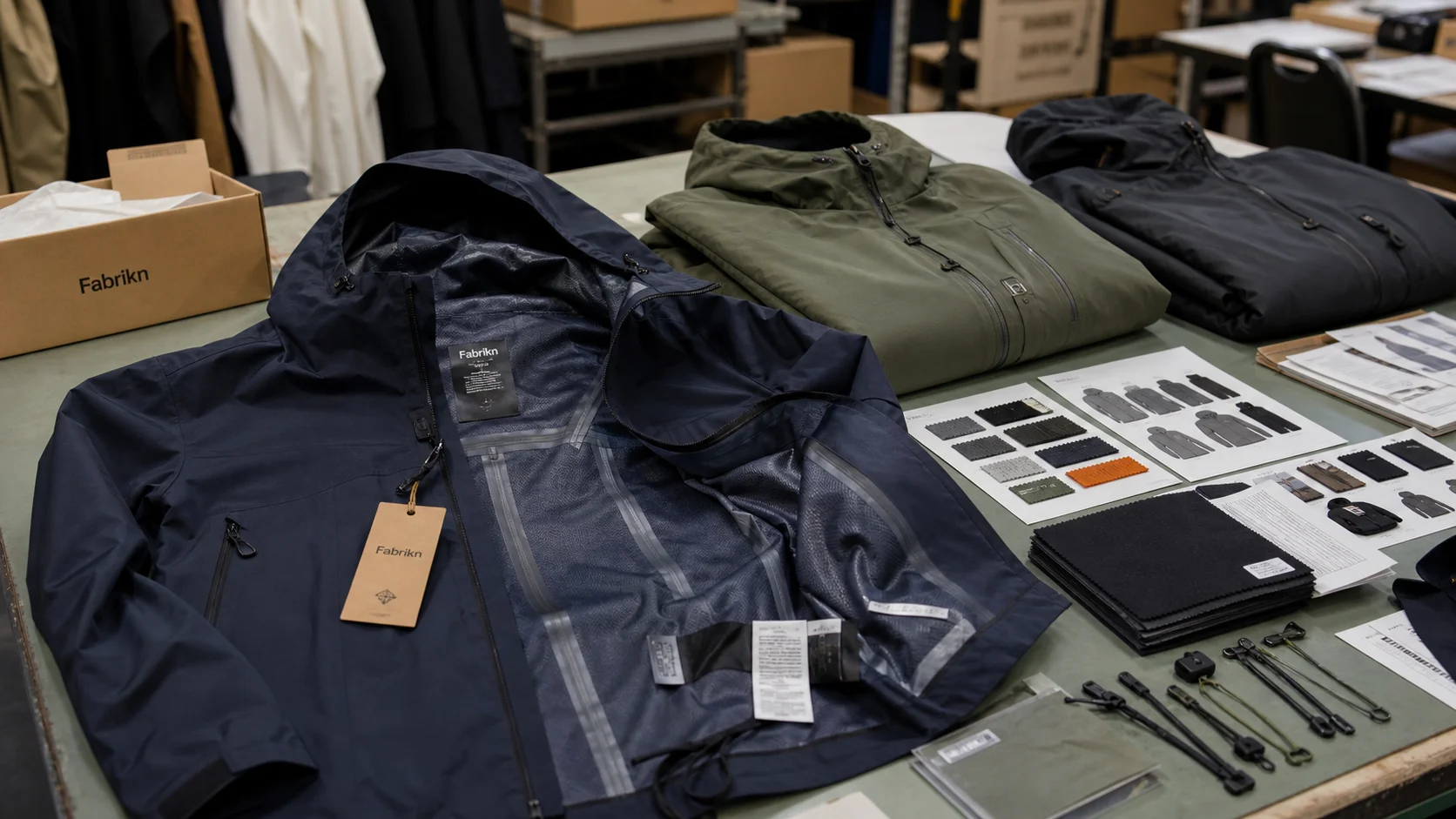
OEM and ODM Clothing Production Choice with checks for samples, fit, MOQ, QC evidence, pricing terms, and delivery risk.
Fast answer: OEM and ODM Clothing Production Choice: Design Control, MOQ, IP, and Timeline should be judged by production evidence, not by a generic sourcing promise. The buyer needs sample proof, cost breakdowns, QC checkpoints, and delivery buffers in writing.
Ask for recent sample photos, measurement tolerances, fabric or print test assumptions, decoration test notes, packing examples, and a named inspection checkpoint. These details show whether the team can repeat an approved sample at bulk volume.
Separate garment cost, decoration, labels, packaging, sampling, testing, freight, and rush charges. When every cost line is visible, it becomes easier to reduce colorways, adjust size depth, or reserve more time for sampling.
Ask what is the difference between oem and odm clothing at a sourcing table, and you will usually get three answers, two half-truths, and one very expensive misunderstanding. In Dongguan, I once watched a buyer request “something custom” on a 10,000-unit hoodie order, then sit through a quote that blended pattern work, stock fleece, and private label trims. Twenty-five minutes later, everyone nodded as if they had agreed on the same thing. They hadn’t. In Guangzhou’s Baiyun district, the same buyer would hear “ODM” from a trading company even when the specification demanded a new block and custom zipper.
OEM means the brand owns the brief. Sketch, fit requirements, fabric specs, packaging rules — the factory builds to that file. A 12-page tech pack might call out a French terry 320 GSM body, rib 2x2 at 430 GSM, an embroidered metal eyelet, and a bonded inside neck seam with a precise overlock width. The factory in Ho Chi Minh City or Dhaka simply follows each stitch count and Pantone match. ODM starts somewhere else: the supplier already has a polo block, a trouser block, a sweatshirt base, and the brand adjusts color, branding, trims, maybe fabric. Same category. Very different control. That is what is the difference between oem and odm clothing comes down to before anyone starts talking price.
The terminology blurs because the labels shift by market. In China, trading companies may use OEM for almost any made-to-order item, even when the style leans heavily on a stock template. In Dhaka, mill-linked factories may call anything with buyer logos “OEM,” while in Vietnam the same quote might be described as “development” instead. Turkey and Portugal often talk in pattern ownership and sampling rounds, not labels. Istanbul factories typically insist on showing pattern ownership documents, whereas a Ho Chi Minh City ODM partner advertises ready-made silhouettes with a vertical dye house. The words change. The economics do not.
The stakes are real. On a 10,000-unit order, a 6- to 16-week lead-time gap can decide whether a brand hits peak season or misses it. Development costs can move margins by 8-20%, especially when the label is paying for repeated samples, extra lab dips, or a whole new block. A basic sweatshirt with a 320 GSM French terry body may look cheap on paper, then turn expensive once you add custom zipper tape, enzyme wash approval, and three rounds of fit comments.
Control is only half the story. Cash flow, speed, and design risk decide whether a project stays healthy or starts bleeding money. Some labels should buy OEM. Others should buy ODM and keep both eyes open about what they are giving up.
OEM is buyer-led development. I’ve seen brands send 12-page tech packs with graded size charts, stitch counts, seam allowances, Pantone references, and packaging rules down to polybag thickness. A serious OEM brief can specify a French terry 320 GSM hoodie knit from GOTS-certified combed organic cotton, rib 2x2 at 430 GSM, laser-cut pockets, and a bound inside neck seam with a precise overlock width using a Juki AMS-210EN automatic serger. The manufacturer is building to the brand’s spec, not improvising around its own template. They might spread the knit on an Eastman Model 3000 automatic cutter, then use a PFAFF operator-assisted double-needle topstitch before handing it to a Brother PR-655 embroidery machine calibrated for OEKO-TEX Standard 100-approved threads.
ODM is factory-led development. A supplier brings a ready-made or semi-finished style to the table, then changes what can be changed without breaking the base. Color can move. Branding can move. Fabric may shift from brushed jersey to a compact cotton-poly blend with 20% GRS-certified recycled polyester. Trims can change from metal snaps to matte resin. The shape usually stays close to the factory’s core pattern because that is what it knows, stocks, and cuts efficiently. Their in-house pattern maker in Ho Chi Minh City, armed with a Lectra digital cutter and an AutoCAD marker planner, will allow small hacks so the grade rule stays intact.
Ownership is where the split shows up. OEM generally gives the brand more control over fit, identity, and product story. If I want a cropped women’s jacket with a 47 cm body length and sleeves shaped for layering, OEM makes sense. ODM narrows that freedom because the factory protects the integrity of its base style. Push too far, and it stops being their style. Stop too soon, and it still isn’t really yours. That tension is the heart of what is the difference between oem and odm clothing in practice.
Pricing follows the same logic. OEM often carries pattern-making charges, grading, sampling, and fit approval work. I have seen development fees run from $150 to $600 per style before bulk production even starts, depending on complexity and the number of size sets. ODM lowers those upfront costs because the factory spreads its design expense across several clients. That matters for a brand testing three colors at MOQ 500 pieces each, or a startup that cannot absorb a $2,500 development bill on day one.
The thing nobody tells you: some ODM programs are more flexible than small OEM orders. Factories often prioritize styles they already know will sew efficiently, so a “factory design” with minor changes can move faster and with fewer mistakes than a tiny custom run that forces them to change lines, markers, and attachment settings.
So the model name matters less than the working reality. I’ve seen an ODM sweatshirt beat a supposedly custom OEM tee on delivery discipline, because the sewing team had already made 40,000 similar units for another client. One was familiar. One was friction.
Cost is where buyers stop debating theory and start counting cash. OEM usually has higher development cost, but it can support stronger brand differentiation and a better retail story. ODM usually has lower start-up cost, but less uniqueness. Compare a basic tee: OEM might cost $3.20 to develop and $4.10 landed in bulk, while an ODM version could start closer to $3.55 landed because the factory already amortized its pattern and sample work. Small gap. Big effect at 8,000 units.
Sample rounds change the picture again. OEM often needs 2 to 5 samples before sign-off, especially if fit, fabric handfeel, or shrinkage targets are strict. ODM often needs 1 to 2 rounds, unless the brand pushes for heavy changes in silhouette or fabric. Every extra round carries courier fees, pattern revisions, and lost weeks. I have watched a $180 sample budget become $900 after three fit revisions and one fabric substitution from 180 GSM combed cotton to a denser 200 GSM jersey.
Hidden costs are where buyers get surprised. Fabric sourcing premiums show up if the requested yarn count is unusual. Custom hardware raises minimums. Special washes such as enzyme wash, silicone softener, or vintage stone wash add time, water, and rejection risk. Inspection time rises too, because a more detailed spec means more checkpoints. Data from OEKO-TEX and factory audit reports often show that material compliance can cost as much as the embellishment if the brand asks for recycled fibers, restricted chemicals, and traceable trims in the same order.
MOQ behavior differs by region. I’ve seen factories in China and Vietnam accept smaller ODM runs, sometimes 300 to 800 pieces per color, because the base style is already in motion. A version of that is the $2.50-4.00 per unit price at 500 MOQ in Ho Chi Minh City, where the supplier sources GRS-certified recycled polyester for trims and has a vertically integrated dye house. OEM programs often need 1,000 to 3,000 pieces per style to justify development. Turkey can be more flexible on small-batch OEM because many factories are vertically integrated and close to trim suppliers; Istanbul-based partners frequently run 600-unit small-batch OEM programs that absorb the cost of chromed snap buttons dropped at a local plating house. Portugal does well on refined premium programs, but the order may need a stronger margin to absorb labor rates that sit well above some Asian alternatives.
Margin is not automatically higher just because the unit cost is lower. A basic tee may cost 12-18% less in ODM at entry, yet sell at a weaker premium if the product looks like five other labels online. I’ve seen brands win on price and lose on identity. Bad trade. If customers cannot tell your tee from a marketplace duplicate, the savings evaporate.
Timeline can decide the whole season. ODM can move from concept to bulk in 4 to 10 weeks if the factory already has fabric, patterns, and trims in stock. OEM often runs 8 to 20 weeks, sometimes longer when fabric development, print strike-offs, and fit revisions stack up. A brand chasing a 60-day launch window usually cannot afford the slower path unless internal approvals are tight.
Where does the time go in OEM? Tech pack corrections, pattern re-makes, lab dips, color approvals, and shipping samples across continents. One semi-automatic flatbed cutter in Dhaka may take 10 days to cut the first marker, another 5 days to level and stack via an Amada 1.6-meter spreader, and a further week while the brand approves fit, wash, and embroidery files. The brand might also ask for screen print strike-offs done via a M&R rotary press, which adds another 7 days on top of the machine setup.
ODM shorthand speed is not magic; it is inventory. When a supplier already keeps stock fabric in the warehouse, uses a Juki DDL-8700 double-needle for hems, and runs a Brother PR-1000e for brand labels, they can sign a contract and ship bulk in as fast as 18-22 business days to a West Coast port. That includes 72-hour pre-production sampling, a week of inline audits, and ocean freight from Ho Chi Minh City to Long Beach. OEM requires more parallel coordination — dyehouse approvals, custom hardware tooling, and buyer-produced packaging multicolored polybags — so the timeline tends to stretch.
Development requires monitoring, especially when the brand or the factory operates across Guangzhou, Dhaka, and Istanbul. Keeping a running board with the latest marker, shrinkage ration, and trim lead times allows you to spot delays before they blow the whole season.
OEM gives you control over certified input materials. When you specify GOTS-certified organic cotton yarn spun in Dhaka, an OEKO-TEX Standard 100 dye lot, and GRS-certified recycled polyester for microsuede patches, the factory must prove compliance with test reports and raw material origins. OEM tech packs typically contain a compliance matrix referencing specific WRAP and BSCI audit reports. The factory’s quality assurance team will check each roll on an Auto ID reader before it moves to cutting, and record inspection coverage using a digital checklist tied to your sample roof.
ODM relies on the factory’s own certifications and standard operating procedures. A supplier with WRAP and BSCI certificates on the wall may carry an internal GRS record for recycled trims, and they might only need to add your logo. They are comfortable working with their repeat trim suppliers, their CAD blocks, and their existing finishing lines. They still run CMM inspections, but the focus rests on running the same standard across multiple clients rather than accommodating a one-off spec.
Quality control on OEM often means more checkpoints. Incoming inspection may require measuring 50 key points per garment, recording the finish, and logging the wash shrinkage. ODM, by contrast, tends to be more about statistical sampling: 10% of pieces go through the final inline check, rejection rate below 4% triggers a table-top root cause review, and each production line logs its performance on a QR-coded dashboard. OEM may capture stitch counts, thread tensions, and ultrasonic seal quality, while ODM automates that through machinery like a digital sewing simulation board.
Sustainability is also shaped by the model. OEM lets you choose compostable hangtags, waterless DyeCoo color booths, and partners with third-party auditors for chemicals. ODM may offer a baseline sustainability story — they buy GOTS cotton at scale and run the same wash across clients — but you may be limited to the fibers and finishes they already carry. Both paths can deliver compliance, but OEM usually means more documentation work, while ODM means leveraging existing systems.
Sourcing is a matrix of capability, cost, and comfort. Start with the product you want to build. If you need a unique hoodie with a bonded gusset, custom zipper, and a proprietary paint job using water-based pigments, look for an OEM factory. They should have lead times mapped on a whiteboard, a sample-room with a PFAFF model, and the willingness to invest in pattern ownership. If your priority is quick turn and you are comfortable with a known silhouette, ODM can reduce the burn rate.
Consider geography. Guangzhou and Ho Chi Minh City bring scale, quick samples, and logistics windows. Dhaka offers unbeatable cost per unit on fully cut-and-sew operations but might need longer lead times for trims. Istanbul provides quick European test runs, especially for small OEM orders under 1,000 pieces that need faster shipping into EU warehouses. Ask about their machine park (e.g., computerized embroidery heads, ultrasonic sealing, automatic pocket setters) and their Certifications: GOTS, OEKO-TEX Standard 100, WRAP, BSCI, or GRS. Those tell you where the factory’s quality focus lies before you sign anything.
Audit the details: how many days for first sample? Who owns the gradings? What happens if the first bulk run hits a 5% defect rate? Do they have a digital quality report visible to you? When your specification asks for "OEKO-TEX Standard 100" thread, ensure they log it in the BOM. If they can’t provide a GOTS certificate for the cotton band, keep asking until you either get it or the quote justifies the risk.
Map your brand onto a chart: axis for speed vs. uniqueness, so you can see where OEM or ODM fits. Write down your absolute minimum lead time (for some, a 60-day window), maximum MOQ, and whether you need certifications like GRS or WRAP. Use that to filter the factory short list.
Engage early. Request reference orders that match your complexity: “Show me a GOTS-certified hoodie produced in the last six months,” or “Give me a sample of the ODM triangular knit top you run for another brand.” Ask for BOM breakdowns with real numbers, e.g., “What is the per-unit cost of this 320 GSM cotton hoodie when we order 1,500 units with enzyme wash?” Use those figures to benchmark.
Finally, formalize the relationship. Insert acceptance criteria in the contract (fit, color, certifications), define sample review cadence, and specify remedies for defects. A good OEM partner will accept pattern ownership documentation; a good ODM partner will show you how they keep their base styles production-ready.