
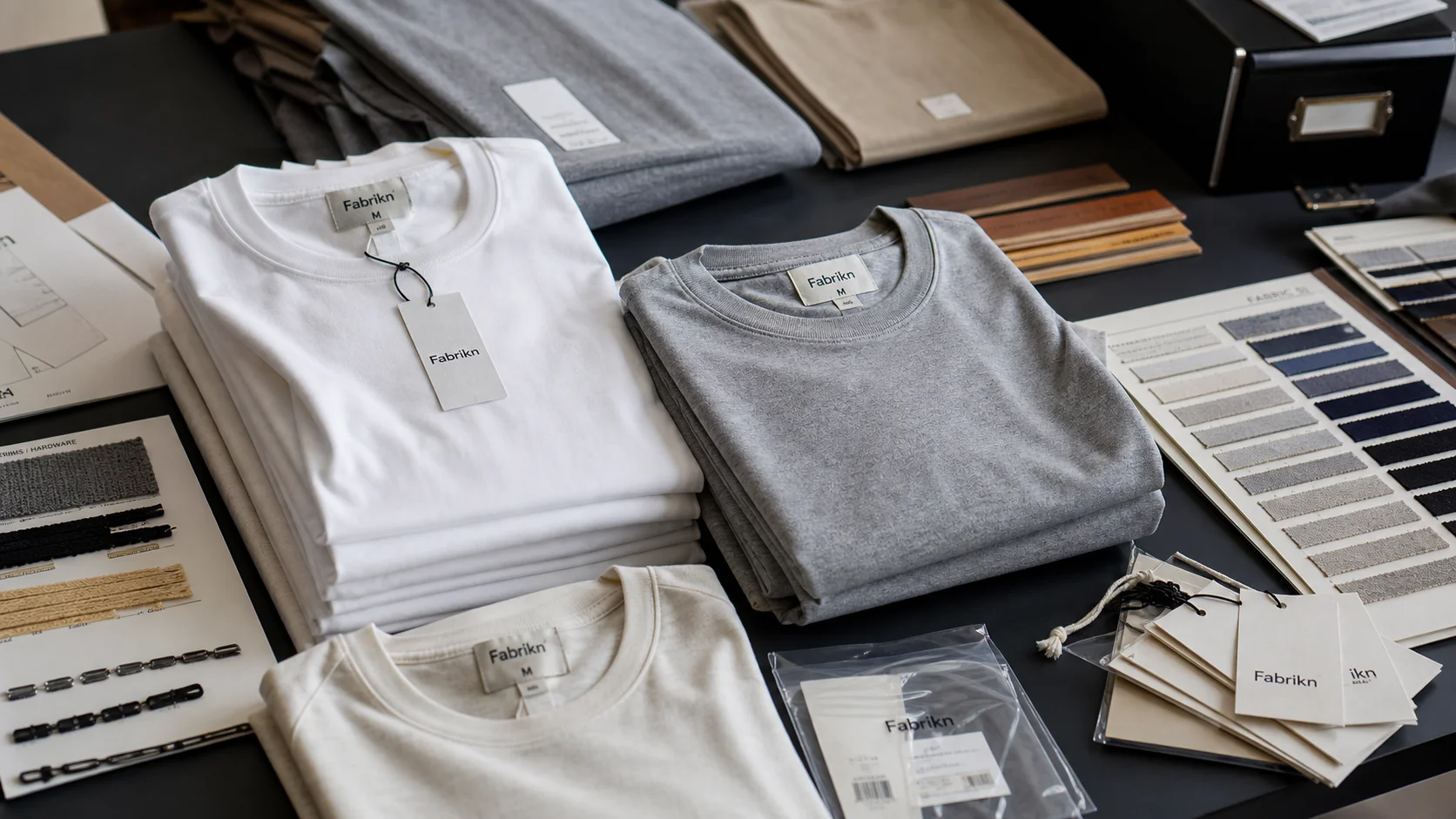
Apparel Composition Labels with checks for samples, fit, MOQ, QC evidence, pricing terms, and delivery risk.
Fast answer: Apparel Composition Labels: Fiber Content, Language, Print, and MOQ should be judged by production evidence, not by a generic sourcing promise. The buyer needs sample proof, cost breakdowns, QC checkpoints, and delivery buffers in writing.
Ask for recent sample photos, measurement tolerances, fabric or print test assumptions, decoration test notes, packing examples, and a named inspection checkpoint. These details show whether the team can repeat an approved sample at bulk volume.
Separate garment cost, decoration, labels, packaging, sampling, testing, freight, and rush charges. When every cost line is visible, it becomes easier to reduce colorways, adjust size depth, or reserve more time for sampling.
A $68 knit dress can arrive wrapped like a gift and still fail at receiving if the label forgets one small line: country of origin. Premium on the outside, paperwork in pieces. That gap is exactly why custom composition labels for apparel packaging matter before a shopper even touches the fabric.
In return-heavy categories like activewear, denim, and children’s apparel, shoppers scan labels fast. Fiber content. Care instructions. Brand trust. When any of that looks fuzzy, the product feels risky, and the basket starts to wobble. I’ve seen return rates sit at 12% to 18% on programs with weak labeling, then drop to 6% to 9% after the packaging and compliance system was cleaned up.
The damage doesn’t stop with disappointed customers. Retail chargebacks can run from $2 to $15 per unit, customs holds can freeze a 5,000-piece shipment for 1 to 3 weeks, and relabeling after arrival can add another $0.20 to $0.60 per garment before labor and rework. On one factory floor in Vietnam, a 20,000-piece basics order moved smoothly because the label spec had been locked at approval. A premium loungewear run told the other story: one missing bilingual fiber line created 4 extra days of inspection and 2 rounds of reprint.
High-volume basics are built around speed and repeatability. Premium apparel expects precision at the packaging stage. Sounds cosmetic until a label error triggers a markdown, a return, or a rejected receipt. According to ISO quality management standards, traceability and documented control are the backbone of consistent production.
Factory visits changed my view of label budgets. The cheapest label rarely stays cheapest. A low-cost pack of composition tickets can fail a retailer audit, force a rerun, and cost more than a higher-grade label that passed on the first submission. Buyers planning clothing packaging solutions should treat the label as part of the product, not an afterthought tucked into the polybag.
Specification starts with the basics: fiber percentages, country of origin, care symbols, brand identity, and often a size line. In the US, the Federal Trade Commission expects accurate fiber disclosure and origin labeling, while the EU and UK add language and formatting requirements that shift by market. Children’s wear, intimate apparel, and sleepwear tighten the rules and shrink the room for error.
Regional differences are not abstract. In France and Belgium, bilingual or multilingual content may be necessary depending on distribution. In Canada, English and French often appear together. In Japan and South Korea, local language content can be expected for retail programs, even when export cartons already pass elsewhere. Data from trade.gov shows that apparel compliance problems often cluster around documentation mismatches rather than fabric defects, which is why the label text must match the commercial invoice, packing list, and mill test records.
Retailer demands often exceed the legal minimum. Department stores may require an RN or registered brand number, seasonal SKU codes, and exact placement rules. Marketplaces are even less forgiving. I’ve seen a two-word difference, “Made in” versus “Product of,” trigger a relabel order because the buyer’s template treated one as ambiguous. Another common failure: cotton-polyester split rounded wrong. 60/40 printed as 65/35. Small change, big mess.
When I visited factories in Turkey and China, the pattern was obvious. The supplier offering labels at $0.03 less per piece often charged back that savings through revisions, courier samples, and reprinting. The supplier at $0.08 to $0.14 per label delivered cleaner proofs, fewer errors, and faster approvals. Cheap on paper. Expensive in motion.
For brands expanding into private label clothing, the label spec should be written before the first PP sample, not after the sales meeting. It needs to sit beside the pack list, carton marking, and hangtag artwork. I also tell buyers working on broader clothing packaging solutions to align the label text with the factory’s approval chain, because packaging, garment construction, and labeling fail together when teams work in silos. Especially in cut and sew manufacturing programs — one late-stage pattern change can wipe out the fiber composition already printed.
Material choice changes everything. Woven labels feel premium and last well, but they cost more and take longer to produce. Printed satin labels are smoother and cheaper, often around $0.04 to $0.12 per unit depending on size and color count. Heat-transfer labels reduce bulk, which buyers love for babywear and performance tops, but they can fail if the fabric surface is oily, textured, or heavily brushed.
Recycled stock and recycled polyester options are now common in sustainable programs, yet the claim must be documented. If a supplier says a label is recycled, I ask for the certificate, the recycled content percentage, and the chain of custody. Textile Exchange and similar industry bodies have pushed the market toward proof-based claims, not vague green language. A green hangtag with no evidence is just expensive ink.
Adhesives matter in transit and storage. Pressure-sensitive labels can lift in humid warehouses if the adhesive tack is wrong for the substrate. Heat-activated systems need controlled temperature, usually around 150°C to 170°C, and a stable dwell time, or they peel after a few wash cycles. I’ve watched a supposedly premium label package survive the sales sample phase and fail after 48 hours in a carton stacked 12 high in a 32°C warehouse. The carton compression exposed weak bonding.
Print method should match volume and artwork. Digital printing works well for 500 to 5,000 pieces and quick color changes. Flexographic printing becomes more efficient at 10,000 pieces and above. Woven jacquard is slower, but it can deliver a richer hand feel for sweaters, outerwear, and luxury basics. A label that passes hand feel can still fail a wash test if the ink cracks after enzyme wash versus stone wash testing. That one difference has killed more “premium” launches than buyers admit.
On the factory floor, I check the label beside the garment, not separately. French terry 320 GSM, brushed fleece, and nylon-elastane blends each stress adhesives and inks differently. A label system that survives a cotton tee may fail on a coated shell. This is where quality meets packaging, and where supplier promises need evidence, not adjectives. In China, a reliable factory will usually show wash-test records and production batch notes before you ask, because they understand how quickly one weak run can affect wholesale reorder plans.
Buyers often ask for a unit price and stop there. That misses setup fees, artwork changes, proof rounds, and spoilage. At 5,000 units, a simple printed composition label might land at $0.06 to $0.14 each, while a woven label can sit at $0.10 to $0.25. At 20,000 units, the same products often fall to $0.03 to $0.09 and $0.06 to $0.18 respectively. At 100,000 units, the unit cost can compress further, but only if the artwork and compliance text stay frozen.
Setup charges matter more at small runs. Digital prep might be $25 to $80, flexo plates can run $60 to $250 per design, and specialty finishes such as matte varnish, metallic thread, or anti-counterfeit stitching add another $0.01 to $0.05 per piece. QA checks, barcode verification, and document control can add $50 to $200 per order, especially if the buyer requests retail-ready carton labeling and matched inner packs.
Low minimum order quantities sound friendly. They often are not. A supplier quoting 300 pieces at $0.22 each may look attractive until the same label drops to $0.07 at 10,000 pieces. I’ve seen brands overpay by 35% to 60% simply because they split orders across too many colorways and seasonal capsules. Standardizing artwork across 3 seasons saved one European brand $8,400 on a 60,000-unit program.
Domestic sourcing can reduce lead time to 7 to 10 days for samples and 2 to 4 weeks for production, but landed cost is often higher. Offshore sourcing may cut unit pricing by 20% to 40%, yet freight, customs, and longer transit can erase part of the gain. A sea shipment from Asia may add 18 to 32 days, while air freight can inflate the total by $0.10 to $0.40 per piece. The cheapest ex-works quote is not the cheapest landed result.
For brands comparing apparel packaging suppliers, I recommend building a true cost sheet that includes MOQ, freight, duties, rework risk, and approval time. If your label art changes after the sample stage, expect another $40 to $150 in revisions and at least 3 to 7 days lost. Buyers who lock the composition label early usually protect both margin and launch date. Brands building custom clothing packaging solutions around multiple SKUs see the biggest savings when every SKU uses one shared label template with only the size and batch code changing.
QC starts before production. I want a pre-production proof with the exact fiber percentages, origin line, care symbols, and barcode or SKU data visible at actual size. The proof should match the garment size the label will sit on, because a 6-point font may look fine on screen and become unreadable in the factory. I also ask for a strike-off or sewn sample on fabric, not a flat paper proof alone.
Common failures are predictable: color shifts from Pantone drift, truncated text, wrong fiber percentages, and weak adhesion after folding or heat exposure. On one inspection in Bangladesh, a label line that should have read “92% cotton, 8% elastane” arrived as “92% coton, 8% elastane.” That single missing letter delayed packing by 2 days because the retailer wanted a corrected set before receipt. AQR-style sampling catches a lot of this early if the buyer insists on it.
Testing should include abrasion, wash durability, and adhesion after shipping simulation. I ask for a rub test, a wash cycle at 30°C or 40°C depending on the product, and carton compression checks when the packaging stack is heavy. Labels need to be reviewed alongside hangtags, inner polybags, and outer cartons, because one mismatch can wreck the whole pack-out.
For high-volume or multi-SKU programs, third-party inspection is worth the fee. A 1% defect rate on 100,000 units means 1,000 problem labels, which is enough to trigger retailer complaints and labor-heavy rework. If your vendor cannot provide documentation turnaround in 24 to 72 hours, the risk is not just quality. It is calendar damage. Brands that source custom composition labels for apparel packaging from a disciplined manufacturer or factory usually see better repeatability, especially when the supplier shares inspection photos before shipment.
I source labels the same way I source garments: brief, sample, approval, production. Start with a written spec that includes dimensions, material, finish, language, and the exact compliance wording. Then send a single approved dieline and one artwork file. If three people edit the copy separately, the project slows by days, sometimes weeks.
Digital labels usually move fastest. I’ve seen samples ready in 3 to 5 days and production in 7 to 14 days for small runs. Flexo and woven runs move slower, often 2 to 4 weeks for sampling and 3 to 6 weeks for production, depending on loom capacity and color count. A rush order can shave time, but it rarely removes it completely.
Region matters too. Suppliers close to your final assembly site cut transit and make corrections faster. A factory in Vietnam or India may answer within the same workday for buyers in Europe, while a supplier 12 time zones away can lose a full day on every clarification. Customs clearance adds another variable: 2 to 7 days is common, and that can break a launch if the packout date is fixed.
Here is the practical checklist I use: lock artwork, confirm fiber content with the mill, approve color on a sewn sample, fix the barcode, and freeze pack quantities before mass production. If you are also coordinating custom cut and sew manufacturing services, align label approval with the garment PP sample so one change does not force two reworks. That coordination saves more time than any “rush” fee ever will. For large-volume production, it also helps the supplier plan bulk material allocation and avoid last-minute shortages.
Before you place the order, ask for MOQ, material options, proofing method, testing evidence, and compliance support in writing. I also want the supplier’s defect rate, replacement policy, and document turnaround time. If they cannot answer those in numbers, they probably do not control the process tightly enough for a retail program.
Ask whether the supplier can support sustainability claims with certificates and traceability records. Ask how many days they need for first proof, how many revisions are included, and whether late-stage text edits cost extra. Ask who signs off on the final art, because a yes from sales is not the same as a yes from production. A strong supplier will also explain what happens if the order changes after approval, especially for wholesale programs with multiple drops.
Compare vendors on more than price. Responsiveness matters. Consistency matters more. Audit readiness matters most when a retailer asks for records 18 months later. If a supplier can send a sample in 4 days, replace a defect within 7 days, and show batch documentation immediately, that supplier is worth more than one offering a quote that is $0.01 lower.
If you want a quick next move, shortlist 3 suppliers, request the same spec pack, and compare them on cost, lead time, and correction speed. Then choose the one that protects launch timing, not just the one that trims pennies. If you need help moving from sample to production, request a custom quote for apparel packaging support and ask for a label review against your garment spec before approving the run. For brands working across private label clothing, that pre-check often prevents the most expensive mistake: printing 50,000 labels that fit the product but fail the paperwork.
At 5,000 units, many printed labels land around $0.06 to $0.14 each, while woven labels often run $0.10 to $0.25. At 20,000 units, unit pricing usually drops by 20% to 40%. Setup, proofing, and freight can add $50 to $250 to the order.
Digital samples can take 3 to 5 days, with production in 7 to 14 days for small orders. Woven or flexo programs usually need 2 to 6 weeks depending on artwork complexity and color count. Transit time can add 2 to 32 days.
Most buyers need fiber percentages, country of origin, care instructions, and brand identity. Many retailers also want SKU codes, batch numbers, or bilingual text. The exact wording should match the commercial invoice and packing list.
Yes, but claims should be backed by documentation, such as recycled content certificates or chain-of-custody records. Recycled polyester or recycled paper stock may cost 5% to 20% more, depending on volume. Ask for proof before you print the claim on the label.
The most expensive mistake is approving the wrong text or fiber percentage and discovering it after production. That can trigger relabeling, customs delays, and retailer chargebacks. A 1% defect rate on 100,000 units can mean 1,000 units to fix.