
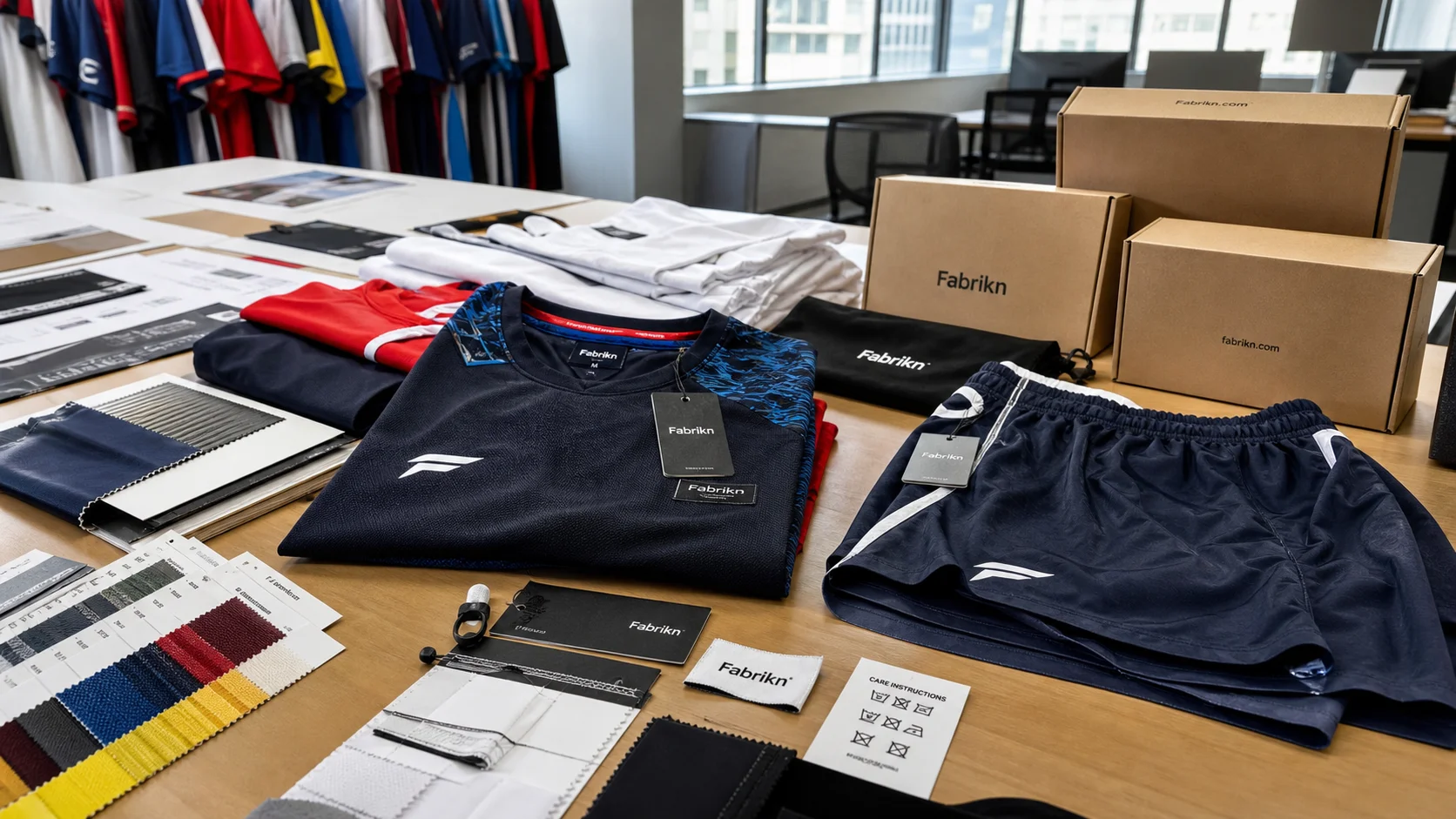
Country-of-Origin Clothing Labels with checks for samples, fit, MOQ, QC evidence, pricing terms, and delivery risk.
Fast answer: Country-of-Origin Clothing Labels: Text, Placement, Language, and Compliance should be judged by production evidence, not by a generic sourcing promise. The buyer needs sample proof, cost breakdowns, QC checkpoints, and delivery buffers in writing.
Ask for recent sample photos, measurement tolerances, fabric or print test assumptions, decoration test notes, packing examples, and a named inspection checkpoint. These details show whether the team can repeat an approved sample at bulk volume.
Separate garment cost, decoration, labels, packaging, sampling, testing, freight, and rush charges. When every cost line is visible, it becomes easier to reduce colorways, adjust size depth, or reserve more time for sampling.
A shipment worth $148,000 sat on the dock in Long Beach because the origin marks on the cartons, hang tags, and polybags did not match. I’ve seen the same mismatch trigger a 10-day delay, a $3,200 relabeling bill, and a retailer chargeback that wiped out the margin on a 5,000-piece order. The country of origin label for clothing packaging looks small. The consequences do not.
Across factory visits in Vietnam, Bangladesh, Portugal, and Mexico, the pattern keeps repeating. A buyer approves one version in email, production prints another, and the packing team follows a third file because packaging was split across two vendors and one sourcing office. A clean pre-production approval may take 2 hours of compliance review and one signed sample. A mislabeled run can force 3-4 weeks of rework, air freight, and manual inspection. The math is ugly.
Retailers care because their compliance teams care, and customs cares because origin marks are one of the easiest things to check. Consumers care too, even if they never say it out loud. A label that reads neatly and consistently signals order. A carton that says one country, a hang tag another, and a barcode sticker a third tells a different story. It says the brand was rushed.
Here’s what most people miss: some of the highest-priced labels I’ve audited belonged to premium brands with the worst documentation. A $220 cashmere sweater line with three packaging vendors had more mistakes than a $14 basic tee program run by one factory and one label house. Luxury does not protect you from sloppiness. Sometimes it multiplies it.
When I visited factories that got it right, they treated origin marking like a quality gate, not a design flourish. One source file. One origin declaration. One signoff sheet for every SKU. That discipline saved them from relabeling 20,000 cartons at $0.06 each and from losing a customer who demanded clean dock audits on every delivery. Small marks. Big consequences.
The country of origin label for clothing packaging has one job: tell regulators, buyers, and warehouse teams where the product was manufactured or substantially transformed. In practice, that means the country stated on packaging must match the legal origin rule used for the garment, not just the place where a shirt was packed into a polybag. A packaging origin and a garment origin are not the same thing.
I’ve seen brands treat garment labels, packaging marks, and retail stickers as if they were interchangeable. They are not. A sewn-in neck label may say “Made in Turkey,” the carton may need “Product of Turkey,” and the retail sticker may need a barcode plus size and color data. Hang tags, carton labels, polybag prints, master case marks, and barcode labels all can carry origin data, but each one serves a different audience.
That is where brands over-design and under-document. A team will spend $0.40 per unit on embossed cards, matte lamination, and custom twine, then forget to write the exact origin language in the spec sheet. I’ve watched that mistake create avoidable non-compliance in two different factories, both shipping under 10,000-piece programs. Packaging looked beautiful. The paperwork was thin.
For clothing packaging solutions, the safest rule is to map every surface that carries text. If the hang tag says “Made in India,” the carton label should not abbreviate it as “India” if the retailer requires the full phrase. If the polybag is direct printed, the print proof should show the exact font size, placement, and language version. One missing line can put the whole order on hold.
Market rules vary. The United States is strict on origin statements. The European Union and United Kingdom focus on traceability and truthful marking, while Canada often ties the check to bilingual presentation and customs clarity. The label is not decoration. It is a compliance document with ink on it.
For brands planning custom programs with a factory, supplier, or manufacturer, origin language should be locked before production starts. That matters especially for wholesale and bulk orders, where one file may be used across multiple cartons, sizes, and channels. If the packaging team is building a run for China sourcing or a mixed-country production flow, the wording needs to be checked against the final production route, not the sales deck.
The US, EU, UK, and Canada all ask a version of the same question, but they police it differently. In the United States, customs and retail buyers focus hard on visible origin marks and consistency across packaging. In the EU and UK, enforcement is often tied to consumer protection and import documentation. Canada adds another layer because packaging language and bilingual presentation can expose text mismatches fast.
For private label clothing, the risk is higher. Buyers often source basics from two countries, then consolidate in a third. A T-shirt made in Peru, packed in Honduras, and shipped to a US retailer can have origin wording that must reflect the manufacturing rule, not the last packing stop. That distinction is easy to miss when the style is a $6.80 basic and the packaging budget is only $0.12 per unit. For private label clothing, the country of origin label for clothing packaging is part of the brand promise.
What buyers need to verify before production starts is simple, though rarely done well: fiber content, country naming conventions, placement, and whether the retail channel has its own format. One marketplace may accept “Made in China,” while another demands a more specific treatment on carton marks. In my audits, the cleanest programs had a one-page origin matrix attached to every SKU.
Data from trade.gov shows that customs-related delays add cost fast when documents and marks disagree, especially in high-volume consumer goods lanes. I see that same pressure in apparel, where a 2,000-piece delay can snowball into missed floor sets and air freight. The regional lesson is blunt: one format does not fit every market.
Multilingual packaging creates another trap. Teams copy English text into French or Spanish layouts, then carry over the wrong origin phrase because it looked fine in the template. That is how a carton ends up saying the right thing in the wrong way. Translation is not the problem. Blind copying is.
For factories handling production at scale, a clear country of origin label for clothing packaging should be built into the QC checklist alongside material, print, and carton verification. The best teams review the origin line at the same time they review quality and packing consistency. That habit reduces rework and keeps the shipment moving.
Paper tags are cheap, clean, and widely accepted. A plain coated paper hang tag might cost $0.03-0.08 per piece at 5,000 units, while an adhesive label can run $0.02-0.05 depending on stock and finish. Direct print on polybags costs less on paper, often just $0.01-0.03 per unit, but setup errors are harder to fix once the film is printed. Appearance is one thing. Staying legible through transit is another.
When the product is folded tightly, shipped in humid lanes, or stored for 30-45 days, I prefer heat-sealed or adhesive solutions for the origin line. Paper tags can curl, tear, or rub off if they sit against rough carton board or metal rack edges. French terry 320 GSM arrives differently from a lightweight jersey tee. One absorbs less abuse. The other gets scuffed by every touchpoint.
Factories that avoid headaches test for failure before freight leaves. I’ve watched teams run rub tests, peel tests, and carton compression checks on origin marks because the cheapest label often becomes the most expensive one once reprints, waste, and missed sailing dates are counted. A label that costs $0.02 can create $2,000 in air freight and rework. That is not an exaggeration.
Sustainability people sometimes treat label choice as cosmetic. I don’t. A lower-grade adhesive that fails on 15% of units creates more waste than a better stock that holds for 60 days in transit. The greener option is usually the one that survives first print. That is where custom baby clothing manufacturing programs get especially careful, because safety, legibility, and skin-contact packaging all matter at once.
According to ASTM International, standardized testing matters because materials behave differently under abrasion, compression, and handling stress. I agree. A label that looks fine in a showroom can fail after 12 forklift moves and one rainy customs inspection. Durability is not a nice extra. It is the proof that the packaging survives real life.
When a manufacturer is quoting a country of origin label for clothing packaging, the packaging material should match the order type. A MOQ of 300 units may justify a simple stock label, while a wholesale run in bulk may need a more durable adhesive and tighter print control. The right choice depends on the factory setup, the supplier’s print line, and how the garments will be packed for shipping.
Budget basics are the easiest place to win, because the cost structure is simple. A low-cost setup for 10,000 units might use a one-color paper hang tag, a standard carton sticker, and a single packaging proof, landing around $0.05-0.14 per unit before freight. A mid-tier program with coated cards, barcode labels, and two proof rounds often lands at $0.16-0.32. Premium packaging can climb to $0.45-1.20 if you add foil, specialty stock, and custom die-cuts.
The biggest cost drivers are rarely the paper itself. Artwork changes, plate setup, label stock, adhesive quality, compliance review, and rush fees add up faster than buyers expect. A new plate may cost $60-180. A late text revision can trigger another $40-120 proof cycle. Rush air shipment of corrected packaging can add $250-900 before the goods even reach the factory floor. For a 1,500-piece capsule, that hurts.
Volume matters. At 500 units, a carton label can cost $0.18-0.35 because setup is spread over too few pieces. At 20,000 units, the same label may fall to $0.02-0.06. Brands sourcing from one factory usually get cleaner pricing and fewer origin errors because one team controls the file chain. Brands using three factories across two countries often pay more in revisions than in printing. The extra coordination is expensive.
When I visited a knitwear factory in Portugal, the packaging room showed me a premium program that looked immaculate, but it had been reprinted twice because the brand changed the matte finish and forgot to recheck the country line after the final design update. The defect rate on premium packaging can hide in the aesthetics. Everything looks finished. Nothing is actually frozen.
That is why cost comparisons should include rework, not just print quotes. A $0.08 label that passes first time is cheaper than a $0.04 label that fails, even before you count 3-4 weeks of delay. For brands using cut and sew manufacturing, the packaging budget should be tied to production complexity, not only to garment cost.
Brands should also compare a custom carton label against a standard label house option. For a manufacturer working with a supplier in China, the lowest quote is not always the lowest landed cost. Quality issues, extra proofs, and missed MOQ thresholds can turn a cheap label into an expensive problem.
The most frequent failures are boring, which is exactly why they keep happening. Wrong country name. Mixed origin claims. Unreadable print. Incorrect placement. Mismatch between carton and garment labeling. I’ve seen all five in one 8,000-piece shipment, and the fix required a full packaging revision plus two extra QC checkpoints.
A sample pass does not guarantee a production pass. Sample room teams often work from one file, one operator, and one hand-checked carton. Production runs involve 20 people, 3 shifts, and packaging coming from different pallets. A factory that catches errors early uses approval checklists, barcode verification, and pre-production signoff on every packaging component. That process sounds tedious. It saves money.
Buying teams matter because they own the decision. QC teams matter because they spot drift. Compliance consultants matter because they know which markets accept “Made in” language and which need a stricter origin declaration. I’ve seen a shipment held for 6 days because one line of text on the master case used the wrong country abbreviation. I’ve seen another rerun because a single carton revision was never reapproved after a font change.
Factories that treat origin labeling as a control point work faster, not slower. They lock the artwork, date the approval, and archive the signed sample in the production folder. That discipline is especially valuable in custom baby clothing manufacturing, where traceability standards, consumer scrutiny, and retailer audits are all tighter than on adult basics.
If a plant cannot show you the latest approved pack file within 5 minutes, the system is too loose. That is not a design problem. It is a process problem.
The best factories also connect the packaging review to quality control at the start of production. That way, a country of origin label for clothing packaging is checked at the same time as trim, size ratio, and carton count. It is a small step that prevents expensive corrections later.
Start with one checklist, not three. Request the label artwork, spec sheet, country of origin declaration, test records, and production approval sample before bulk production starts. Then compare the garment label, carton mark, and import paperwork line by line. If one document says “Vietnam” and another says “Made in Vietnam,” decide the final wording before any printed proof is signed.
For brands using multiple suppliers or multiple countries of manufacture, I recommend a signoff sequence that runs buyer, compliance, then factory, then freight forwarder. That order catches the most expensive mistakes first. A 15-minute review can prevent a 15-day hold. I have seen brands save a 12,000-piece order by freezing the wording two weeks earlier than they wanted to.
Keep the archive tight. One PDF. One version number. One approval date. If packaging changes after fit approval, stop and recheck the origin line before the next run. The fastest way to avoid origin-label chaos is to lock the wording before the first printed proof is approved.
If you are planning a custom launch, ask the manufacturer for a packaging mockup that shows the exact country line, font size, and placement. The same rule applies whether the order is small or wholesale. A clear country of origin label for clothing packaging should be approved as part of the production pack, not as an afterthought.
It is the printed or attached origin statement on packaging, tags, cartons, or stickers that identifies where the garment was made or substantially transformed. In many programs, that means the same origin must appear consistently on the hang tag, master carton, and import paperwork.
At 10,000 units, a basic label setup can cost $0.05-0.14 per unit, while mid-tier packaging often lands at $0.16-0.32. Premium versions with specialty stock, foil, or extra proofs can reach $0.45-1.20 per unit.
Simple approvals can take 2-5 business days if the wording is already confirmed. If you need a redesign, compliance review, and new proof, plan on 1-2 weeks before bulk production starts.
It can appear on hang tags, carton labels, polybags, barcode stickers, or master case marks, depending on the market and buyer requirement. The critical point is consistency across all visible pack components and the import document set.
Yes, but only if the legal origin rule and retailer requirements support it. The US, EU, UK, and Canada may accept different phrasing or placement, so confirm the exact wording before printing 5,000 or 50,000 units.