
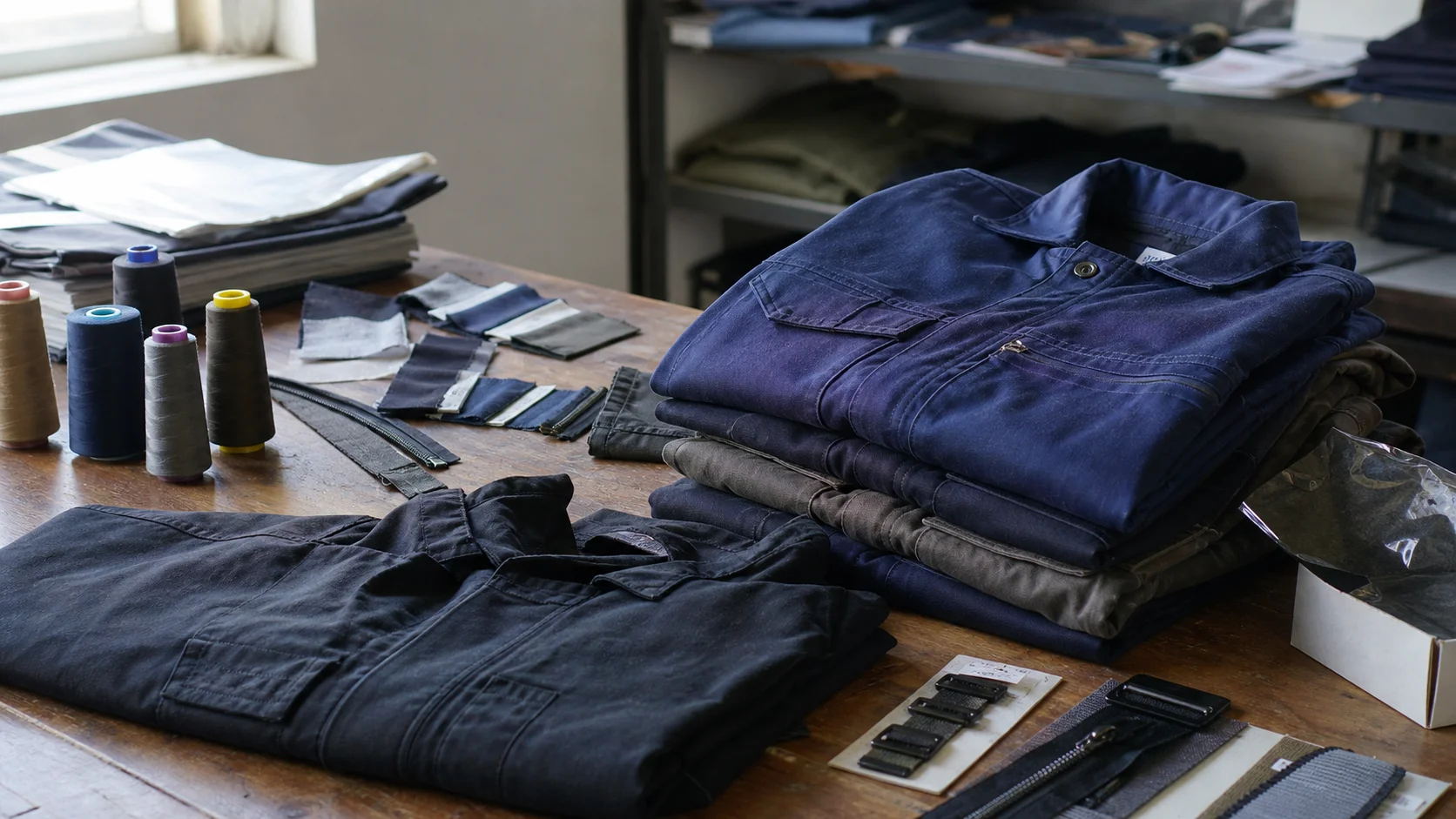
A product-specific SEO outline helping fitness club buyers calculate the true landed cost of custom coveralls, from fabric and decoration to freight,...
Custom Coverall Landed Cost Guide for Club Buyers - MOQ, Cost & Sourcing manufacturing guide
Fitness clubs do not usually buy custom coveralls as fashion items. They buy them because staff uniforms need to work across maintenance, cleaning, pool operations, equipment repair, event setup, and back-of-house service. The cost question is rarely just “what is the unit price?” A club buyer needs to understand the landed cost: the full cost of getting the finished garment approved, produced, packed, shipped, cleared, delivered, and ready for staff issue.
This guide is written for fitness club buyers, gym chains, wellness centers, sports clubs, and procurement teams comparing custom coverall options. It focuses on MOQ, sourcing, cost drivers, approval steps, fabric choices, trim details, inspection risks, and practical tradeoffs. The goal is not to make every buyer choose the cheapest supplier. The goal is to help buyers avoid incomplete quotations that look attractive at the start and become expensive later.
Landed cost is the total cost of a product after every required expense is included. For custom coveralls, this means more than cut-and-sew pricing. It includes fabric, trims, branding, sampling, size grading, testing if required, packing, freight, duties, customs clearance, local delivery, possible warehousing, and the cost of correcting quality problems.
A low FOB or EXW price can be useful for comparing manufacturing quotes, but it is not enough for budgeting. Club buyers should ask suppliers to separate the garment price from logistics and service charges. This helps the procurement team see where the money goes and where savings are realistic.
A coverall quote is only useful when it clearly states what is included, what is excluded, what specification it is based on, and which incoterm applies.
For example, a supplier may quote a custom coverall at USD 18.50 per piece FOB. That sounds simple. Once branding, size labels, cartons, international freight, duty, customs brokerage, and domestic delivery are added, the landed cost may be closer to USD 23 to USD 32 per piece, depending on destination, order size, fabric weight, shipping method, and duty treatment.
Fitness club buyers should also consider internal handling costs. If coveralls arrive loose, poorly sorted, or without size-level carton labels, the operations team may spend extra time sorting uniforms by branch, department, or employee. That labor cost is often invisible during supplier negotiation, but it affects rollout efficiency.
Coveralls are not needed for every role in a fitness club. They are most relevant when staff need protection, utility, or a cleaner operational look. Common use cases include maintenance technicians, janitorial teams, pool plant staff, spa facility workers, equipment installers, warehouse staff, and event setup crews.
Club buyers usually choose custom coveralls for four reasons: brand consistency, staff identification, garment durability, and operational convenience. A branded coverall can make technical staff easy to recognize without looking improvised. It also keeps employees from mixing personal clothing with workwear in areas where cleaning chemicals, grease, dust, or water exposure may be present.
The right garment depends on the club environment. A premium wellness club may prefer a softer, cleaner-looking coverall with subtle branding. A large gym chain may prioritize durability, fast replenishment, and size availability. A club with pools, mechanical rooms, and outdoor maintenance may need reinforced fabric and stronger closures. There is no single correct specification.
Buyers should avoid treating coveralls as generic uniforms. A garment that works for light indoor facility staff may fail quickly in equipment maintenance. A heavy industrial coverall may be too hot for staff working around members. The practical sourcing decision is to match the garment to the actual job, not to copy an industrial catalog blindly.
The landed cost of custom coveralls usually comes from several cost blocks. Some are fixed costs that matter more in smaller orders. Others are variable costs that rise with every unit.
In sourcing discussions, buyers should ask for a costed bill of materials or at least a detailed specification sheet. A factory does not need to reveal every internal margin, but a serious supplier should be able to confirm the fabric, GSM, trims, branding method, packing method, and incoterm behind the quote.
For broader support on apparel sourcing and product development, buyers can review the manufacturing and sourcing capabilities listed on Fabrikn’s services page. A clear service scope helps buyers understand whether they are dealing with a cut-and-sew vendor, a development partner, a sourcing office, or a full-package supplier.
MOQ is one of the biggest friction points for fitness club buyers. Many clubs want a polished custom garment but do not need thousands of units immediately. Suppliers, on the other hand, need enough quantity to justify fabric purchasing, pattern work, sampling, production line setup, and trim sourcing.
Typical MOQ ranges vary by customization level:
Customization Level Typical MOQ Range Best Fit Cost Implication Stock coverall with logo only 50 to 200 pieces Small clubs, trial programs, urgent needs Lower development cost, limited style control Stock fabric with custom pattern and trims 200 to 500 pieces Regional clubs, multi-location gyms Balanced cost and customization Custom dyed fabric or unique color 500 to 1,000 pieces or more Chains needing brand-specific color matching Higher fabric MOQ and longer lead time Special performance fabric or certified fabric 500 to 2,000 pieces or more Clubs with safety, flame resistance, or technical requirements Higher material cost and possible testing cost Fully custom program with replenishment planning 1,000 pieces or annual commitment Large fitness groups and franchise networks Better unit economics but requires forecastingThese ranges are typical planning references, not fixed rules. A supplier may accept a lower MOQ if the fabric is available, the pattern is simple, and production capacity is open. A supplier may require a higher MOQ if the buyer requests custom-dyed fabric, special zippers, reflective tape, imported trims, or multiple colorways.
Buyers should be careful with very low MOQ custom offers. A small order can work, but the unit cost usually rises. The supplier may also simplify construction, use available fabric, limit size grading, or charge higher setup fees. That is not automatically a problem, but it needs to be transparent.
Fabric choice controls comfort, durability, appearance, and price. For fitness club coveralls, the most common options include polyester-cotton blends, cotton twill, stretch woven fabric, ripstop, and lighter workwear fabrics. The right choice depends on whether the garment is used indoors, outdoors, around cleaning supplies, or in technical maintenance areas.
For most fitness club use, a midweight polyester-cotton twill is often the safest starting point. It is durable enough for facility work but not as heavy as industrial coverall fabric. If staff work in hot rooms, laundry areas, or pool equipment zones, breathability should be tested before committing to bulk.
Trims are easy to overlook, but they can create the difference between a professional garment and a frustrating one. A coverall has more stress points than a polo shirt or T-shirt. The zipper, pockets, seams, cuffs, and crotch area need attention.
Buyers should specify the zipper quality, not just “zipper.” A weak zipper can ruin an otherwise acceptable coverall. If the garment will be laundered frequently, trims must tolerate washing temperature, detergent, and drying method. Logo applications also need wash testing, especially heat transfers and printed patches.
Branding is a major reason to order custom coveralls, but it needs restraint. Large logos can make staff look promotional rather than operational. Small embroidered logos or woven patches are often more suitable for club maintenance and service teams.
Typical branding options include:
Logo setup charges may apply. Embroidery digitizing, screen setup, transfer mold fees, or patch development costs can be spread across the order. On low quantities, setup cost can noticeably increase landed cost per unit. On larger programs, the setup cost becomes less important than consistency, placement accuracy, and durability.
Before bulk production, buyers should approve actual logo size, thread colors, patch colors, placement measurements, and wash performance. A logo that looks correct on a PDF can look too large on size XS or too small on size 3XL. Graded placement rules may be needed if the size range is broad.
Sampling is not a formality. It is the buyer’s main opportunity to catch fit, fabric, trim, and branding problems before bulk production. Skipping sample approval to save two weeks can create far more expensive issues later.
A typical custom coverall approval process includes these steps:
Coverall fit has a specific risk: torso length. A garment can look fine when standing and become uncomfortable when bending, reaching, squatting, or climbing. Fitness club staff often lift equipment, repair machines, move storage items, and clean low areas. The sample should be tested with movement, not just viewed on a hanger.
Buyers should keep one approved pre-production sample sealed or clearly marked as the production standard. If an inspection dispute happens later, the approved sample becomes the comparison reference. A clear tech pack and signed sample approval reduce arguments over what was promised.
Lead time for custom coveralls depends on fabric availability, sampling speed, production capacity, branding method, inspection schedule, and shipping mode. For planning, many custom coverall programs fall into a range of 6 to 14 weeks after final approval. More complex or custom-dyed projects can take longer.
Stage Typical Time Range Key Dependencies Specification and quotation 3 to 10 days Clear tech pack, logo files, quantity, size range Development sample 7 to 20 days Pattern complexity, fabric availability, trim availability Fit and logo revisions 7 to 21 days Buyer feedback speed and number of corrections Bulk fabric and trims 10 to 35 days Stock fabric versus custom dyeing or special trims Bulk production 20 to 45 days Order quantity, production line availability, decoration workload Inspection and packing 2 to 7 days AQL plan, carton sorting, rework if needed Freight and delivery 3 to 45 days Air, courier, sea freight, customs clearance, local deliveryUrgent club launches often create expensive decisions. If the opening date is fixed and uniforms are approved late, air freight may become necessary. Air shipping bulky coveralls can be costly because the cartons may be charged by volumetric weight. Sea freight is better for cost control, but it requires earlier planning and more disciplined approvals.
Buyers should also plan replenishment. Staff turnover, size exchanges, new locations, and garment wear all create repeat demand. A one-time order without spare stock can lead to mismatched uniforms later. For multi-location clubs, a sensible approach is to order the opening allocation plus buffer stock by size. The buffer does not need to be excessive, but it should reflect the real size curve and hiring plan.
Coveralls have more inspection risk than simple tops because they contain many seams, pockets, closures, and measurement points. A good supplier should inspect during production and before shipment, but buyers should still define expectations clearly.
An AQL inspection can help manage risk, but inspection is not a substitute for a clear product specification. The inspection checklist should include fabric, shade, measurements, stitching, branding placement, trims, labels, packing, carton marks, and quantity. For club programs, size sorting is especially important because staff issue dates can be tight.
Buyers should ask whether the supplier can provide in-line inspection photos, final inspection reports, and packing lists by size. For larger orders, third-party inspection may be worth the cost. For smaller orders, a structured supplier inspection report with detailed photos may be enough if the buyer has confidence in the supplier.
The table below shows how landed cost can be built. It is not a price promise. It is a practical framework buyers can use when comparing suppliers.
Cost Item What It Includes Typical Cost Behavior Buyer Watchpoint Garment base cost Fabric, trims, cut and sew, factory overhead, margin Falls as volume increases Confirm fabric GSM, construction, and size range Branding cost Embroidery, patch, transfer, printing, setup Setup cost hurts small orders Approve logo sample on actual fabric Sampling cost Development samples, fit samples, courier fees Often fixed or semi-fixed Clarify whether refundable or included in bulk Packing cost Polybags, size stickers, cartons, branch sorting Small per-unit cost Good packing can reduce internal handling work Freight Courier, air, sea, trucking, destination handling Depends on mode, volume, and destination Bulky cartons can increase volumetric charges Duties and taxes Import duty, VAT/GST, customs fees Depends on HS code and destination country Use proper classification and documents Inspection and rework Factory QC, third-party inspection, repairs Optional but often worthwhile Inspection catches problems before shipment Local distribution Warehouse handling, branch delivery, staff packs Depends on rollout model Branch-level sorting should be planned earlyFor budget planning, small custom orders may have a higher landed cost per unit because sampling, setup, and shipping are spread across fewer garments. Larger orders can reduce unit cost, but they increase inventory risk. A club that orders too many units in the wrong sizes may not save money in practice.
The strongest landed cost comparison uses the same specification, same quantity, same size breakdown, same branding, same packing, and same incoterm across all supplier quotes. If one quote includes air freight and another is FOB only, the comparison is misleading.
Good supplier questions reduce surprises. Club buyers should not wait until production starts to clarify sizing, packaging, trim quality, or logistics.
Buyers should also ask about replenishment. If a club needs repeat orders every quarter, the supplier should confirm whether the fabric and trims will remain available. A custom color or special trim may not be easy to repeat unless the buyer commits to a stock plan or annual forecast.
If the buying team needs a direct discussion about a specific coverall program, supplier requirements, or order planning, it can use Fabrikn’s contact page to start a sourcing conversation. Clear quantities, target delivery dates, and reference photos make the first discussion more productive.
The best coverall sourcing decision is not always the lowest unit price. A cheap garment that fails in laundering, restricts movement, or arrives late can cost more than a better-built option. At the same time, not every club needs an overbuilt industrial coverall. Over-specification creates unnecessary cost and may reduce staff comfort.
A lower MOQ option makes sense when the club is testing a new uniform concept, opening a small location, or buying for a limited department. Stock coveralls with custom branding can work well in this situation. The tradeoff is limited color, fit, pocket layout, and fabric control.
Buyers should accept that low MOQ programs usually have higher per-unit costs. That is reasonable if the purpose is testing or short-term deployment. It becomes less attractive if the club already knows it will roll out to many branches, because the same setup costs may be paid again later.
Full custom development makes sense when the coverall is part of a long-term staff uniform system. A custom pattern, consistent fabric, proper size grading, and planned replenishment can improve staff satisfaction and brand consistency. The tradeoff is higher upfront development time and higher MOQ.
Large club groups should consider total program cost rather than single-order cost. A well-planned custom program can reduce size exchange problems, improve garment life, and simplify reorders. The savings may not appear in the first quote, but they can show up over multiple seasons or store openings.
Fabric upgrades are worthwhile when staff wear the coverall daily, launder it often, or work in demanding areas. Better fabric can improve colorfastness, abrasion resistance, shape retention, and comfort. A small increase in fabric cost may be sensible if it extends garment life.
Buyers should not pay for technical claims that are not needed. Flame-resistant, water-repellent, anti-static, or high-visibility specifications may be necessary in some environments, but they can add cost and compliance requirements. If the club does not need those features, a durable standard workwear fabric may be the better value.
Better packing is often worth the small extra charge. Size stickers, carton labels, branch-level packing, and clear packing lists reduce receiving errors. This matters when uniforms must be distributed to many locations or issued to staff before an opening date.
Cheap packing may save a few cents per garment and cost hours of sorting later. For multi-location clubs, packing should be part of the purchase specification, not an afterthought.
A complete coverall specification does not need to be overly complicated, but it should answer the questions that affect price and quality. Club buyers can use the following checklist before requesting quotations.
If a buyer cannot provide all details at the beginning, a reference garment or reference photo can help. Still, the final purchase order should not rely on vague wording such as “same as sample” without a written spec. Samples can be lost, misread, or interpreted differently during production.
Coverall sizing deserves more attention than standard tops. The garment must fit the chest, waist, hip, torso, sleeve, and inseam at the same time. A unisex pattern can simplify inventory, but it may not fit all employees equally well. Separate men’s and women’s fits can improve comfort, but they increase pattern work, sampling, and size management.
For smaller clubs, a unisex fit with a sensible size range may be the most practical option. For larger club groups, a broader size range and size set approval are more defensible. The buyer should collect staff sizing data before ordering bulk, especially if the garment is new to the organization.
Size curves can create hidden cost. If the order includes very small and very large sizes, fabric consumption and grading work may increase. Some suppliers charge extra for extended sizes because they use more fabric. This is normal, but it should be stated clearly before the purchase order is issued.
Incoterms change responsibility and risk. EXW may look cheap because the buyer handles almost everything after factory pickup. FOB is common for international orders because the supplier delivers goods to the port and clears export formalities. CIF includes cost, insurance, and freight to the destination port, but not necessarily customs clearance or final delivery. DDP can be convenient because it includes delivery with duties paid, but the buyer should still check what is included and whether the supplier has reliable destination handling.
For many fitness club buyers, DDP or delivered pricing is easier for budgeting. The tradeoff is that the buyer may have less visibility into freight and duty components. FOB can be better for experienced importers with a freight forwarder. Small orders may move by courier, while larger orders may justify air or sea freight.
Air freight is useful for urgent openings, but it should not become the default. Coveralls are bulkier than lightweight apparel, so volumetric weight can push freight cost up quickly. Sea freight is usually better for planned rollouts and replenishment orders, especially when the buyer has enough lead time.
Fitness club coveralls are usually workwear uniforms rather than regulated protective equipment, unless they are marketed for specific safety protection. Buyers should be careful with claims. If the garment is described as flame resistant, high visibility, chemical resistant, or protective, the relevant standards, test reports, and labeling requirements become more important.
Basic documentation may include commercial invoice, packing list, country of origin, fiber content, care label information, and HS code classification. Destination countries may have specific textile labeling rules. The buyer should confirm requirements with the importer of record, customs broker, or compliance advisor.
Care labeling is especially important for club uniforms. Staff may wash garments at home or the club may use a laundry service. The care label should match the fabric and branding method. A heat transfer logo that cannot tolerate high-temperature drying should not be placed on a garment expected to go through industrial laundering.
A fair comparison starts with a common specification. Asking three suppliers for “custom coveralls with logo” will produce three different assumptions. One may quote lighter fabric, one may include cheap zippers, and one may exclude logo setup or freight. The lowest number may not be the best number.
Use a comparison sheet with these columns: supplier, MOQ, unit cost, fabric, GSM, trims, branding, sample cost, production lead time, packing, incoterm, freight, duty responsibility, payment terms, inspection plan, and replenishment terms. This makes gaps visible.
Supplier reliability also matters. A sourcing partner that asks detailed questions before quoting may seem slower at first, but that caution often prevents problems. A very fast quote with vague specifications may be useful for rough budgeting, not for final purchasing.
Buyers who want to understand a sourcing partner’s background and operating focus can review Fabrikn’s about page. For uniform programs, the buyer should look for clear communication, practical production knowledge, and a willingness to define specifications before pushing an order forward.
Some quotation issues deserve attention before a deposit is paid. Not every red flag means the supplier is unsuitable, but it does mean the buyer should ask follow-up questions.
Buyers should be especially cautious when a supplier promises everything at once: low MOQ, low price, full customization, fast lead time, premium trims, free sampling, and delivered pricing. Some suppliers can be competitive, but production economics still apply. If the offer looks unusually easy, the specification may be loose.
A sensible buying process starts with use case definition. Identify which staff will wear the coveralls, how often they will wear them, where they will work, and how the garments will be washed. From there, define the fabric, fit, pocket layout, branding, and delivery deadline.
For a first order, many clubs should avoid excessive complexity. One body color, one logo placement, a practical size range, and a proven fabric can produce a cleaner result than a complicated design with multiple trims and special panels. Once the program is proven, the buyer can refine the garment in later orders.
For multi-location clubs, the best approach is usually a planned program: sample approval, size set testing, opening allocation, buffer stock, and replenishment schedule. This reduces last-minute air freight and avoids mismatched uniforms across locations.
Buyers should document every decision. The purchase order should attach or reference the final tech pack, approved sample, size chart, logo artwork, packing instruction, delivery term, and inspection standard. A detailed order file protects both buyer and supplier.
Get a free quote from Fabrikn — your trusted B2B clothing manufacturer with 10+ years of experience. MOQ as low as 200 pieces.
Get a Free Quote →Typical MOQ ranges from about 50 to 200 pieces for stock coveralls with logo decoration, 200 to 500 pieces for custom patterns using available fabric, and 500 to 1,000 pieces or more for custom-dyed fabric or special trims. Exact MOQ depends on fabric availability, color, branding method, size range, and supplier capacity.
Landed cost should include the garment cost, branding, sampling, packing, freight, duties, taxes, customs clearance, local delivery, inspection, and any branch-level distribution costs. Buyers should ask suppliers to state the incoterm clearly so they know which costs are included and which remain the buyer’s responsibility.
A midweight polyester-cotton twill is often a practical starting point because it balances durability, wrinkle resistance, and cost. Cotton twill can feel more breathable, while stretch woven fabric improves movement. The best fabric depends on staff tasks, temperature, laundering method, and desired brand appearance.
Many custom coverall programs take about 6 to 14 weeks after final approval, depending on sampling, fabric sourcing, production capacity, branding, inspection, and shipping mode. Custom-dyed fabric, special trims, broad size sets, and sea freight can extend the timeline.
Stock coveralls with logo decoration are better for small quantities, urgent needs, or trial programs. Fully custom coveralls are better for larger club groups, long-term uniform programs, and buyers needing specific fit, color, pocket layout, or branding control. The decision should balance MOQ, lead time, staff comfort, and brand consistency.
The main risks are poor torso fit, zipper failure, weak seams, missing reinforcement, shade variation, logo placement errors, shrinkage, and packing mistakes. Buyers should approve a pre-production sample and define measurement tolerances before bulk production starts.
Embroidery is durable and professional for chest logos, but it can be costly for large designs. Heat transfer can handle detailed logos and provide a clean finish, but it must be wash tested to avoid cracking or peeling. The best method depends on logo size, garment fabric, laundry method, and brand look.
Buyers can reduce landed cost by using available fabric, limiting colorways, simplifying trims, consolidating orders, planning early enough for sea freight, and approving samples quickly. Cutting zipper quality, fabric weight, inspection, or packing too aggressively can create higher downstream costs.
Prepare target quantity, size range, delivery destination, required date, reference images, fabric preference, logo files, branding placement, pocket requirements, packing needs, and preferred incoterm. Better input produces more accurate quotes and fewer revisions.
Standard fitness club coveralls usually do not need safety certification unless they are sold or used as protective equipment. If the garment claims flame resistance, high visibility, chemical resistance, or other protection, buyers should confirm applicable standards, testing, and labeling requirements before ordering.