
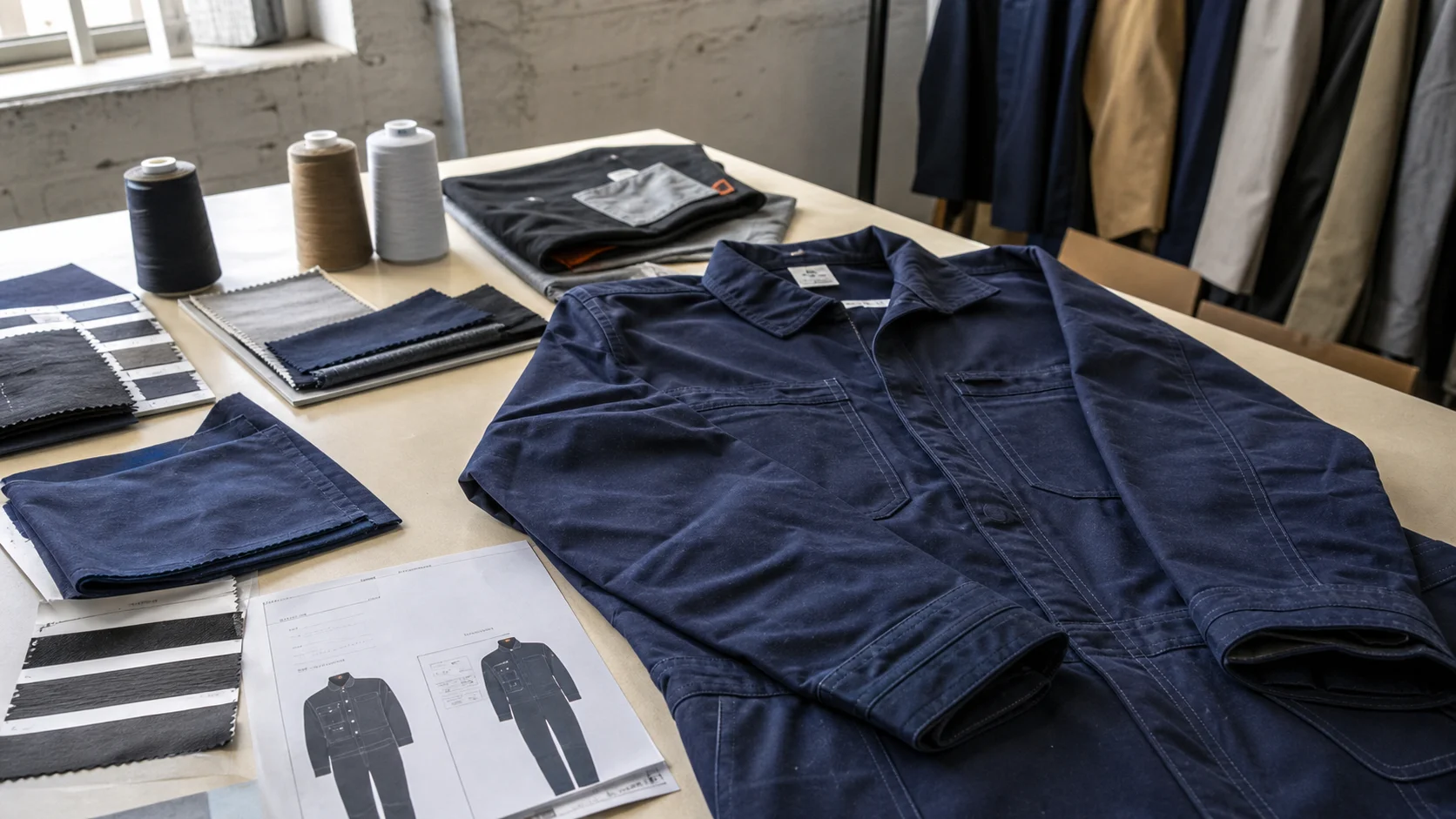
A focused inspection and pricing outline for event staffing teams comparing custom coverall MOQs, decoration choices, sample approvals, fabric specs, and...
Event staffing teams rarely buy coveralls for fashion. The purchase usually serves a practical purpose: protect clothing, keep crews visually consistent, and meet safety or branding needs without overcommitting budget. That makes MOQ pricing a sourcing issue, not just a garment issue. A low unit price can look attractive, but the real cost often sits in setup fees, fabric minimums, trim matching, sample rounds, and inspection risk when the order is too small for the factory’s normal production structure.
This review is written for teams buying custom coveralls for events, promotions, live productions, stadium operations, experiential activations, and temporary field crews. The goal is simple: understand what drives MOQ, where pricing moves up or down, and which tradeoffs matter before a purchase order is issued. For broader manufacturing support, see services, company background at about-us, or initial sourcing questions through contact-us.
Custom Coverall MOQ Pricing Review for Event Teams - Quality & Inspection manufacturing guide
MOQ is the minimum order quantity a factory is willing to produce at a workable cost. For coveralls, MOQ is rarely a single number that applies to every request. It usually changes based on fabric availability, color matching, decoration method, pattern complexity, and whether the factory must cut a dedicated production run or can join your order with another style.
Event teams often assume MOQ only affects how many pieces must be ordered. In practice, MOQ also affects how a factory prices development work. A small order can still carry costs for pattern adjustments, graded sizing, logo application, labeling, and compliance documents. If the total order size does not spread those costs well, the per-unit price climbs fast.
For coveralls, a usable MOQ review should answer four questions:
Those answers matter more than the headline unit price. A low price with a high hidden setup burden is usually a worse buy than a slightly higher quote with cleaner terms.
Fabric choice is the biggest pricing lever. Basic cotton drill, polyester-cotton blends, and standard twill are usually easier to source than specialty flame-resistant, anti-static, water-resistant, or high-visibility materials. As the fabric becomes more technical, the MOQ often rises because mills work in larger dye lots and the mill’s own minimums flow into the garment factory’s offer.
For event teams, common fabrics usually sit in the 180 to 260 GSM range for general use. Lightweight garments can price well for indoor activations, while heavier weights are better for hard-wearing field work or cooler climates. If the coverall is meant for a single event cycle and not repeated use, over-specifying fabric is a common budget mistake.
A simple one-piece coverall with standard pockets and a front zipper is easier to produce than a style with reinforced knees, articulated sleeves, extra tool pockets, elastic inserts, and multiple logo placements. Each extra panel adds cutting time, sewing time, and inspection points. Complexity also increases the chance that the first bulk run deviates from the approved sample.
Screen printing, embroidery, heat transfer, woven labels, and reflective transfer all carry different setup patterns. Embroidery can look strong on heavy garments, but large stitched logos add cost and can distort lightweight fabric. Heat transfer can support low quantities and fast turnarounds, but it can fail earlier under rough use or repeated laundering. For temporary event staffing, decoration should be durable enough for the use case, not overbuilt for a garment that may be retired quickly.
Stock colors are easier to buy than custom-dyed fabric. If the event requires a very specific brand color, the factory may need custom lab dips and dye lot approval. That adds time and can increase MOQ. Teams working on short deadlines are usually better served by selecting a near-stock color and using branding through labels or transfers rather than forcing a custom textile match.
Zippers, snaps, buttons, elastic, reflective tape, thread, and packaging all affect MOQ. The cheapest quote may assume standard trims already used by the factory. Once a team asks for branded zipper pulls, custom snaps, or specific reflective tape widths, the supplier may need to source dedicated materials. That is where smaller orders lose price efficiency.
There is no universal MOQ for custom coveralls, but useful planning ranges exist. These are not guarantees. They are practical sourcing bands that reflect how garment factories often structure low to mid-volume orders.
Order Type Typical MOQ Range Pricing Shape What Usually Changes The Cost Simple stock-fabric coverall with logo 50 to 200 pieces Lower setup cost, better unit pricing at 100+ Decoration method, size spread, packaging Custom-color coverall with standard trims 100 to 300 pieces Higher fabric and dye cost Lab dip approval, dye lot minimums High-visibility or reflective coverall 100 to 500 pieces Higher compliance and trim cost Reflective tape specs, certification needs Technical coverall for workwear use 200 to 500+ pieces Material and QA costs rise quickly Fabric performance, seam construction, testing Very small promotional run 20 to 50 pieces Highest unit price Pattern creation, sample labor, limited fabric optionsFor event staffing teams, the most common pricing trap is requesting a small run with custom details and expecting factory economics to stay friendly. At low quantities, every one-off choice matters. A low MOQ can still be viable if the garment is simplified early and the team accepts stock-based materials.
When the event requires multiple sizes, a reasonable size curve also matters. Small lots with a wide size range often cost more than expected because the factory cannot optimize cutting yield. A narrow size distribution is easier to price and easier to keep consistent.
A practical sourcing rule: if the order is below the supplier’s normal production batch, simplify the garment before trying to negotiate the unit price. Reducing complexity often saves more than arguing over a small price delta.
Coveralls used for event staffing are usually judged on comfort first, then visual consistency, then durability. A garment that is too heavy becomes difficult to wear through a long shift. A garment that is too light may wrinkle badly, tear at stress points, or look cheap under lighting. The right answer depends on the venue and climate.
Common fabric choices include cotton twill, poly-cotton blends, and canvas-like structures for sturdier use. For short-term event wear, a poly-cotton blend can make sense because it balances cost, wash performance, and dimensional stability. Pure cotton can feel better, but it may shrink or wrinkle more unless the spec is controlled tightly.
Zipper quality is not cosmetic. A failed front zipper can ruin the garment in service. If the coverall will be worn repeatedly or by a mixed team with different sizes, the zipper should be specified clearly: coil or metal, gauge size, pull style, and placement. Pocket construction also matters. Loose pocket bags, weak bar tacks, or poor stitching at pocket corners are common early failure points.
Knee reinforcement, crotch seams, underarm stitching, and cuff finishing should be reviewed if the event team expects movement, kneeling, lifting, or repeated laundering. Even a low-cost event garment should not fail at the first strain. That said, not every order needs workwear-grade reinforcements. Overbuilding a temporary garment wastes budget.
Branding should be planned around the garment’s seams and movement. Chest logos are usually straightforward. Sleeve and back placements may need extra review so the decoration does not distort when the wearer bends or stretches. Large prints across a seam are a common source of approval problems.
If the team is comparing garment suppliers and decoration vendors separately, the risk of mismatch rises. A single source can simplify accountability, while a split setup can lower some line items. The right structure depends on internal procurement capacity and turnaround pressure.
Sample approval is where many low-MOQ orders either become manageable or turn expensive. A clear sample process reduces the chance of bulk rejection and slows down the kind of errors that are expensive to fix after production starts.
Event teams often rush the sample stage because the event date feels fixed and non-negotiable. That pressure is understandable, but skipping approvals usually costs more than it saves. A quick sample review should still check garment length, sleeve fit, seam behavior, zipper function, logo position, and the feel of the main fabric against the intended use.
For smaller orders, one additional sample round can be worthwhile if the garment is highly visible on camera or on stage. For lower-visibility support staff, a lighter approval process may be enough. The point is to match QA effort to exposure risk.
These details sound basic, but small mistakes here are common. The wrong size chart or a stale artwork file can affect the entire lot. Once bulk cutting starts, changes become expensive fast.
Lead time depends on more than sewing capacity. Fabric availability, trim sourcing, sample approval, and shipping mode all influence the schedule. A team planning for a live event should treat lead time as a chain, not a single promise date.
For standard coveralls using stock fabrics and straightforward decoration, lead times can be far more manageable than for custom technical garments. The more the order depends on special inputs, the more brittle the timeline becomes. Event teams should build buffer time into planning rather than assuming a quoted factory schedule already includes every delay.
Rush orders often look possible until the supplier checks fabric stock, cutting capacity, and print or embroidery queue status. A rushed order may still be possible, but it should be priced as a premium service rather than treated as a normal baseline.
Inspection matters because coveralls are functional garments with multiple stress points. Even when the visual standard is acceptable, construction defects can show up in use. A reasonable inspection plan should focus on the failures most likely to affect wearability, consistency, and return rates.
For event teams, aesthetic defects are visible immediately, while fit or seam issues may surface only after a full shift. That is why pre-shipment inspection should check both appearance and function. A garment that looks acceptable on the hanger can still fail once worn, especially around shoulders, crotch seams, cuffs, or closure points.
Inspection standards should be proportionate to order value and event risk. A short-run promo order may only need a basic checkpoint on measurements and decoration. A higher-stakes order for public-facing staff, safety crews, or broadcast environments deserves tighter control.
If the team has to choose between lower MOQ and stronger QA, stronger QA usually wins. A small savings on unit price does not help if the garments arrive with mixed sizes, poor zipper quality, or inconsistent branding. A tighter inspection plan is a better investment than absorbing avoidable replacement costs.
Budgeting for custom coveralls should separate the garment cost from the full landed cost. The factory quote may only reflect production, but real spend also includes sampling, freight, duties if applicable, inspection, and occasional rework. A clean budget view prevents a false comparison between suppliers.
When comparing quotes, ask whether the sample fee is credited against bulk production, whether artwork setup is one-time or recurring, and whether size breakdowns affect pricing. A supplier with a higher base unit but lower hidden fees may be better for a team buying only once or twice a year.
A good benchmark is to test the quote under three scenarios: low quantity, realistic quantity, and slightly higher quantity. That shows whether the price curve behaves sensibly. If the quote becomes dramatically better only at an order size the team cannot use, it is not a useful offer.
The best buying decision is usually not the cheapest per-piece quote. It is the quote that minimizes total risk for the event calendar. For a one-off activation, the priority may be speed and acceptable appearance. For a repeated staffing program, consistency and re-orderability matter more. The right answer changes with usage, not with the sales pitch.
Negotiating coverall pricing works best when the team trades flexibility for value in the right places. Factories respond better to clear simplification than to vague pressure on price. A buyer who knows where compromise is acceptable gets a better outcome than one asking for every feature at a lower cost.
These changes often deliver more value than chasing a small unit price reduction. It is also worth asking whether the supplier can reuse a previous pattern block if the style is close to an existing program. Pattern reuse can reduce development cost, though fit still needs to be checked against the current spec.
Teams should be careful not to over-negotiate at the expense of quality documentation. A lower price with weak specs is a bad trade. The purchase order should clearly lock in fabric composition, garment measurements, logo placement, finishing, and acceptance criteria.
Before placing the order, a sourcing team should confirm the following:
If the supplier is still being evaluated, it is reasonable to ask for a straightforward capability discussion through contact-us and compare the response against the more general manufacturing overview on services. For teams that need to assess fit for future programs, the background information on about-us helps frame the relationship, but the commercial terms should still be tested in writing.
Get a free quote from Fabrikn — your trusted B2B clothing manufacturer with 10+ years of experience. MOQ as low as 200 pieces.
Get a Free Quote →For simple coveralls using stock fabric and basic logo application, a realistic MOQ is often in the 50 to 200 piece range. Custom color, technical fabric, or high-visibility requirements can push that higher. Small promo runs below 50 pieces are possible, but the unit price usually rises fast.
Small orders still carry pattern work, sampling, setup, labeling, and inspection overhead. When those fixed costs are spread across too few pieces, the unit price climbs. Fabric minimums and trim sourcing can also raise the cost of low-volume runs.
Fabric usually matters more. Decoration affects setup and finishing cost, but the base textile choice drives the core garment price and often sets the MOQ. A custom-dyed or technical fabric can have a larger cost impact than adding a standard logo.
At minimum, confirm the tech pack, review a fabric swatch or lab dip if color is important, approve a prototype or size sample, and sign off on logo placement before bulk sewing starts. Complex or regulated garments may need a pre-production sample as well.
The most common risks are fabric shade mismatch, uneven sizing, weak zipper performance, poor seam strength, misplaced branding, and label or packaging errors. These problems are often avoidable if the sample stage and pre-shipment inspection are handled carefully.
Ordering slightly above headcount is usually safer if the coveralls are hard to replace quickly or if size exchanges are likely. The right buffer depends on event risk, size spread, and whether the garment is intended for a one-time activation or repeated use.
Yes, if the garment is simplified early and the team accepts stock materials, limited decoration, and standard trims. A lower MOQ becomes poor value when the order tries to keep every custom feature while cutting quantity too aggressively.
For event staffing teams, custom coverall sourcing works best when the buying decision is based on total risk, not just unit price. MOQ, sample control, and inspection discipline matter as much as the sewing quote. A practical spec, a clean approval path, and realistic lead-time planning usually produce a better result than a rushed attempt to force factory pricing into a shape it cannot support.