
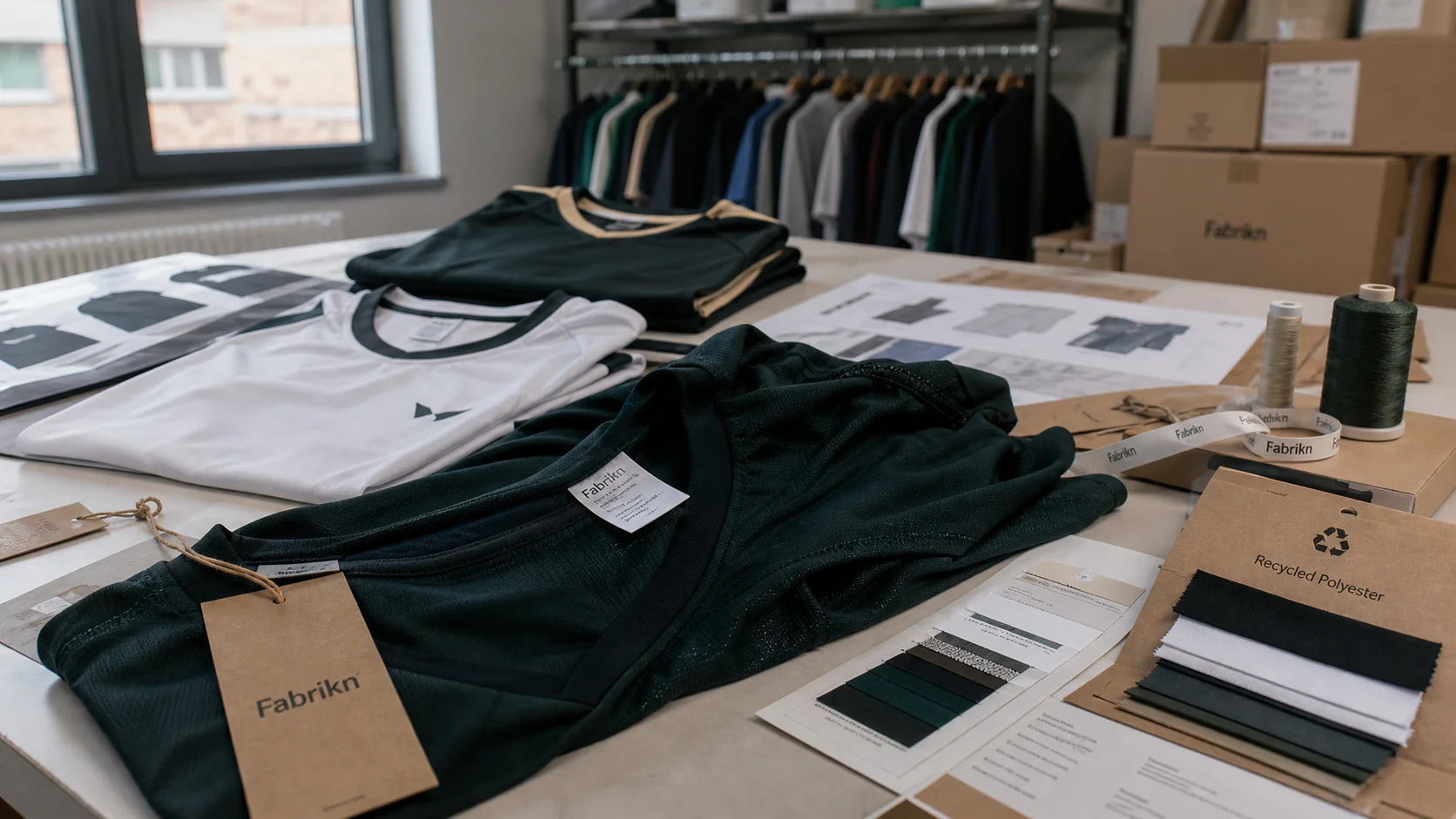
Custom Eco Packaging for Apparel Shipping with checks for samples, fit, MOQ, QC evidence, pricing terms, and delivery risk.
Fast answer: Custom Eco Packaging for Apparel Shipping: Costs, Specs, Buyers should be judged by production evidence, not by a generic sourcing promise. The buyer needs sample proof, cost breakdowns, QC checkpoints, and delivery buffers in writing.
Ask for recent sample photos, measurement tolerances, fabric or print test assumptions, decoration test notes, packing examples, and a named inspection checkpoint. These details show whether the team can repeat an approved sample at bulk volume.
Separate garment cost, decoration, labels, packaging, sampling, testing, freight, and rush charges. When every cost line is visible, it becomes easier to reduce colorways, adjust size depth, or reserve more time for sampling.
A $3 mailer can trigger a $38 return. I have watched that math fail in real time. When custom eco packaging for apparel shipping is underspecified, a tee arrives crushed, a zipper catches through thin plastic, or the customer opens a damp-looking parcel with bent corners and dust on the hem. That is not a branding problem. It is a margin leak.
Across factories in China, Vietnam, India, Turkey, and Eastern Europe, the same pattern keeps surfacing: apparel brands that slash packaging too far often pay twice. Online apparel return rates commonly run 15% to 30%, and damage-related claims can add another 1% to 3% of orders when packs are poorly matched to product weight and transit distance. On a 50,000-order month, even a 2% damage rate means 1,000 compromised shipments. At $12 to re-ship, restock, and service each case, that is $12,000 gone before product margins are even counted.
Small DTC labels usually spend $0.22 to $0.65 per shipment on packaging. Larger wholesalers can push that lower in volume, sometimes to $0.12 to $0.28. Cheaper does not automatically mean cheaper once dimensional weight, mis-sizes, and replacements enter the picture. I have watched brands save $0.05 on the mailer and lose $1.80 per parcel in inflated freight because the pack was 20 mm too deep. That trade does not hold.
Factory floors make the waste visible. Offcuts pile up fast. In one knitwear plant, 18 percent of carton stock was being scrapped because buyers had approved six size variants for products that could have fit into three. In another, polybags were being doubled inside boxes because the outer carton lacked moisture resistance. The waste was not hidden in a spreadsheet; it was stacked in bins by the loading dock.
First impressions matter because apparel is tactile. A customer who buys a $24 tee and a customer who buys a $240 coat both judge the parcel in under 10 seconds. I have seen repeat purchase rates move by 6 to 9 points after brands upgraded from generic stock mailers to custom eco packaging for apparel shipping that fit the product properly, used cleaner print, and cut the return friction. Logistics first. Branding follows.
Recycled paper mailers, compostable mailers, and FSC-certified cartons lead the field, and each behaves differently once it hits a warehouse, a courier van, or a wet front step. Recycled paper mailers usually run about $0.18 to $0.42 at 5,000 to 20,000 units, depending on print coverage and seal type. Compostable mailers often cost $0.24 to $0.58, because the resin blend and certification controls raise procurement costs. FSC cartons can land at $0.30 to $0.95 each, with the spread driven by board grade, fold style, and whether you are ordering 2,000 or 50,000 units.
For lightweight tees and underwear, a 100 to 120 GSM recycled paper mailer is usually enough. For knits and sweats, a sturdier outer works better, often a carton or a reinforced paper mailer with a 140 GSM face and a stronger seam. Denim is less forgiving. A pair of jeans can abrade thin mailers during transit, so I usually see better outcomes with FSC cartons or a two-layer paper system. Outerwear needs compression resistance; otherwise a puffer arrives flattened and customers assume it was returned and re-bagged.
Recycled content does not equal instant recyclability in practice. According to the World Trade Organization, packaging moves through varied national systems, and local collection rules decide whether a pack is actually recovered. A paper mailer contaminated with tape, wet ink, or laminated windows can drop out of the recycling stream. Compostable mailers are even trickier. They may meet industrial compostability standards, but most household curbside systems do not accept them. Disposal claims matter as much as material origin.
Inks, adhesives, labels, and insert cards carry environmental weight too. Water-based inks are usually cleaner than heavy solvent systems, but full-coverage dark print can still raise cost by $0.03 to $0.09 per unit. Pressure-sensitive adhesives affect both seal strength and recyclability. A glossy insert card with a big sustainability claim can undermine the whole package if it uses mixed coatings or high-bleed laminate.
According to Textile Exchange, claims around recycled and preferred materials are scrutinized more heavily each year, and packaging is no exception. The best custom eco packaging for apparel shipping programs match the substrate to the garment, not the mood board. I have seen simple uncoated kraft mailers outperform elaborate multi-part builds for both damage control and cost discipline.
At the budget end, a brand shipping 3,000 to 10,000 units a month can expect stock paper mailers with a one-color logo to cost roughly $0.16 to $0.32 each. Add custom sizing, and the price usually rises by $0.04 to $0.10. Order 25,000 units and the same format may fall to $0.11 to $0.24, depending on board stock and print plates. The trap is buying the wrong size range. I have seen brands carry nine SKUs of mailers when four would have covered 90 percent of orders.
Mid-market apparel brands, especially those doing 10,000 to 50,000 monthly shipments, often land in the $0.28 to $0.65 range for custom eco packaging for apparel shipping. That usually buys better print registration, more consistent glue lines, and stronger tear resistance. It also supports better presentation. A clean mailer or box can hold a folded French terry 320 GSM hoodie without the lumpiness that makes a parcel look stuffed. This is where clothing packaging solutions start to matter as a system, not a one-off purchase.
Premium brands spend more, but they do it differently. I have quoted cartons and mailers at $0.70 to $1.40 for limited runs under 5,000 units, and the price is not only about the material. Tooling, specialty print, magnetic closures, and custom inserts all pile on. Yet premium brands can justify the spend if packaging reduces damage, lowers return handling, and supports retention. I have seen a coat label recover a $0.38 packaging upgrade through a 1.4-point lift in repeat purchase rate over two quarters.
Here is what most people miss: the fanciest pack is rarely the best performing one. On factory visits, I have watched embossed boxes with foil accents lose to plain kraft mailers because the fancy build added 80 grams of dead weight and slowed packing by 12 seconds per order. That extra time matters at 20,000 orders a month. Simpler formats win more often than buyers expect.
Where brands overspend is usually in overprinting and unnecessary structure. Where they cut too far is in seal integrity and sizing. A high-volume parcel can tolerate a $0.02 upgrade for better adhesive more easily than it can tolerate a 3 percent rise in damage claims. For many labels, private label clothing services and packaging should be planned together, so the pack supports the garment story rather than fighting it.
Factories quote faster when they get exact numbers, not adjectives. Send the internal and external dimensions in millimeters, the target material GSM, closure type, print colors, ink coverage, and the expected order volume by SKU. If your tee ships in a 280 x 220 x 35 mm mailer and your hoodie needs 340 x 280 x 60 mm, say so. If you guess small, freight rises later because cartons arrive too tight and must be repacked. If you guess large, you pay for air and wasted board.
I ask brands to include these specs in the first email:
For apparel, I usually request drop tests from 80 cm to 100 cm, burst tests for cartons, and humidity exposure for 24 to 72 hours if the route includes tropical ports or rainy domestic lanes. A mock shipment should include one packed tee, one packed knit, and one heavier style like denim or outerwear. That mix exposes failure points fast. For premium brands, I also ask for pre-production proofs with the exact Pantone code and an unopened sample so the adhesive line can be checked before full run approval.
Artwork files should be vector-based, with fonts outlined and image resolution at 300 dpi if raster graphics are unavoidable. Certification claims need proof, not slogans. If a supplier says recycled content or compostability, ask for test methods and certificate numbers. For custom cut and sew manufacturing programs, packaging should align with the same product calendar, which is why a coordinated brief often saves two weeks of back-and-forth.
When I worked with a brand that shipped 18,000 units a month, we cut quote time from 11 days to 4 by sending a proper spec sheet on day one. That is the kind of operational savings people ignore until they see it on the calendar. If you want speed and clean pricing, the closest route is to get a free quote with exact dimensions, finishes, and volumes attached.
China still has the widest range of recycled paper converters, printing houses, and carton specialists. Lead times for custom eco packaging for apparel shipping often run 15 to 25 days after proof approval, and MOQ can start around 3,000 to 5,000 units for standard paper mailers. Vietnam is strong on export-oriented conversion, especially for simple mailers and cartons, but material sourcing can be narrower, so a 20-day lead time may stretch if the board grade is unusual. India is competitive on paper-based packaging and print, with MOQs often around 5,000 to 10,000, but consistency varies widely by plant. Turkey is efficient for nearshore European buyers, with lead times of 10 to 18 days and better freight proximity to the EU, though specialty substrates can be limited.
The footprint is not only about where the box is made. Energy mix, inland trucking, and port distance all matter. A cheaper quote from a factory 1,200 kilometers inland can erase savings once you add extra truck miles and delayed shipping. I have seen a 7 percent price advantage disappear under 14 days of delay and one emergency airfreight booking. Read the invoice with that in mind.
During audits, brands usually miss the practical issues. Does the plant have humidity control for paper stock? Are print plates stored properly? Can the line keep seal tolerance steady at 500 units per hour, or does quality drift after lunch? I have watched a factory in South China produce immaculate samples and then lose consistency on the production floor because the operator changes were not documented. Documentation beats promises.
High volume helps when the pack is simple and repeatable. Flexibility matters when the brand sells many sizes or runs frequent capsule drops. A label shipping 2,000 pieces of one box style can often negotiate far better pricing than a brand requesting 12 different sizes across eight colors. In that setting, private label clothing services and packaging consolidation can trim both labor and freight.
The cheapest quote can become the most expensive order when a factory cannot hold tolerances or cannot document compliance. I have seen brands save $0.06 per unit and then spend $1,900 on reprints, $800 on repacking labor, and three weeks of sales momentum. Cheap is only cheap when it arrives on time and fits the garment.
Certifications matter, but only if they are real. FSC shows responsible forestry sourcing for paper and board. Compostability claims should reference a valid standard, not a vague promise. Recycled content should name the percentage and the test basis. If a supplier says “eco-friendly” without a chain-of-custody document, a recycled content declaration, or a third-party test report, I treat the claim as marketing copy, not evidence.
The strongest suppliers show their paperwork before they are asked. I want sample packs, factory photos, test reports, customer references, and a list of the exact machines they run. If they claim recycled fiber, ask where it is pulped and whether de-inking occurs on-site or upstream. If they claim compostability, ask what standard applies, whether the certification is industrial or home compost, and where the disposal pathway actually exists. A beautiful pack that cannot be processed locally is not a clean solution.
Audit questions should be direct. What is the recycled percentage by weight, not by marketing name. What adhesive is used on the seal. Is there a coating, and if so, what is it made from. How many grams of material are added by print coverage. Can they show a production sample from the same line, not a studio mockup. Those questions expose weak suppliers fast.
Warning signs are usually visible. Specs that change from one email to the next. Certifications that are shown as logos, not documents. Hidden glossy coatings on “matte kraft” packs. A quote that is 20 percent below the market without a technical explanation. I have audited factories where the sample looked recycled but the bulk run used a different board. The legal and reputational risk sits with the brand, not the vendor.
For brands sourcing apparel shipping pack systems alongside the garments themselves, packaging should be folded into the same due diligence used for cut and sew manufacturing. That is how you reduce surprises. If the supplier cannot answer questions in writing, they are not ready for scale.
Start with a 7-day audit. Map your top 20 SKUs by folded size, weight, and return rate. Identify where you can remove one pack size or combine two. Then ask for quotes on three formats: a stock option, a custom paper mailer, and a carton. By day 10, you should have sample sets in hand and a short list of two suppliers.
Days 11 to 20 should be testing. Run fit checks on 30 to 50 units per SKU, then do drop tests, seal checks, and moisture exposure. Measure shipping weight, pack time per order, and damage after a simulated transit cycle. If the pack fails on the first test, do not rationalize it. Fix the dimensions or change the substrate.
By day 21, approve artwork and request a pre-production proof. Use day 25 to compare landed cost, including freight and duties, not just unit price. On day 30, place the pilot order. Track damage rate, shipping weight, customer complaints, and repurchase rate over the next 60 to 90 days. If your damage rate falls by even 1 point and your average parcel weight drops by 30 to 50 grams, the switch is probably paying for itself.
The brands that win here are the ones that treat custom eco packaging for apparel shipping as operational infrastructure. They reduce wasted size counts, tighten specs, and use data instead of guesswork. That is the route to packaging that earns its keep—and keeps earning it after the first shipment.
Most recycled paper mailers cost $0.16 to $0.42 each, while compostable mailers often land at $0.24 to $0.58. FSC cartons usually range from $0.30 to $0.95 depending on size, print coverage, and order volume. Higher MOQs of 25,000 or more can lower unit cost by 15% to 30%.
For tees and light knits, recycled paper mailers work well. For denim, heavy sweats, and outerwear, FSC cartons or reinforced paper systems usually perform better because they resist puncture and compression. The best choice depends on garment weight, transit distance, and local recycling rules.
Typical production lead times run 10 to 25 days after proof approval, with China and Vietnam often landing in the 15 to 25 day range and Turkey sometimes faster at 10 to 18 days. Add 5 to 10 days for sampling and artwork approval if the project is custom.
Ask for dimensions, GSM or board thickness, seal strength, print method, recycled content documentation, and test reports. Also request sample packs, factory photos, and references from brands shipping similar volumes. If the supplier cannot provide written evidence, treat the quote cautiously.
Yes. Better sizing, stronger seals, and more durable materials can reduce damage-related complaints by 1% to 3% in many apparel programs. Cleaner unboxing also supports repeat purchase, especially for brands shipping 10,000 units a month or more. The savings show up in lower reships, fewer refunds, and less repacking labor.
Check the brand owner and supplier documents first, then verify standards through authority sources such as the OEKO-TEX certification system and the U.S. International Trade Administration. For recycled and preferred material programs, Textile Exchange is also a useful reference point.