
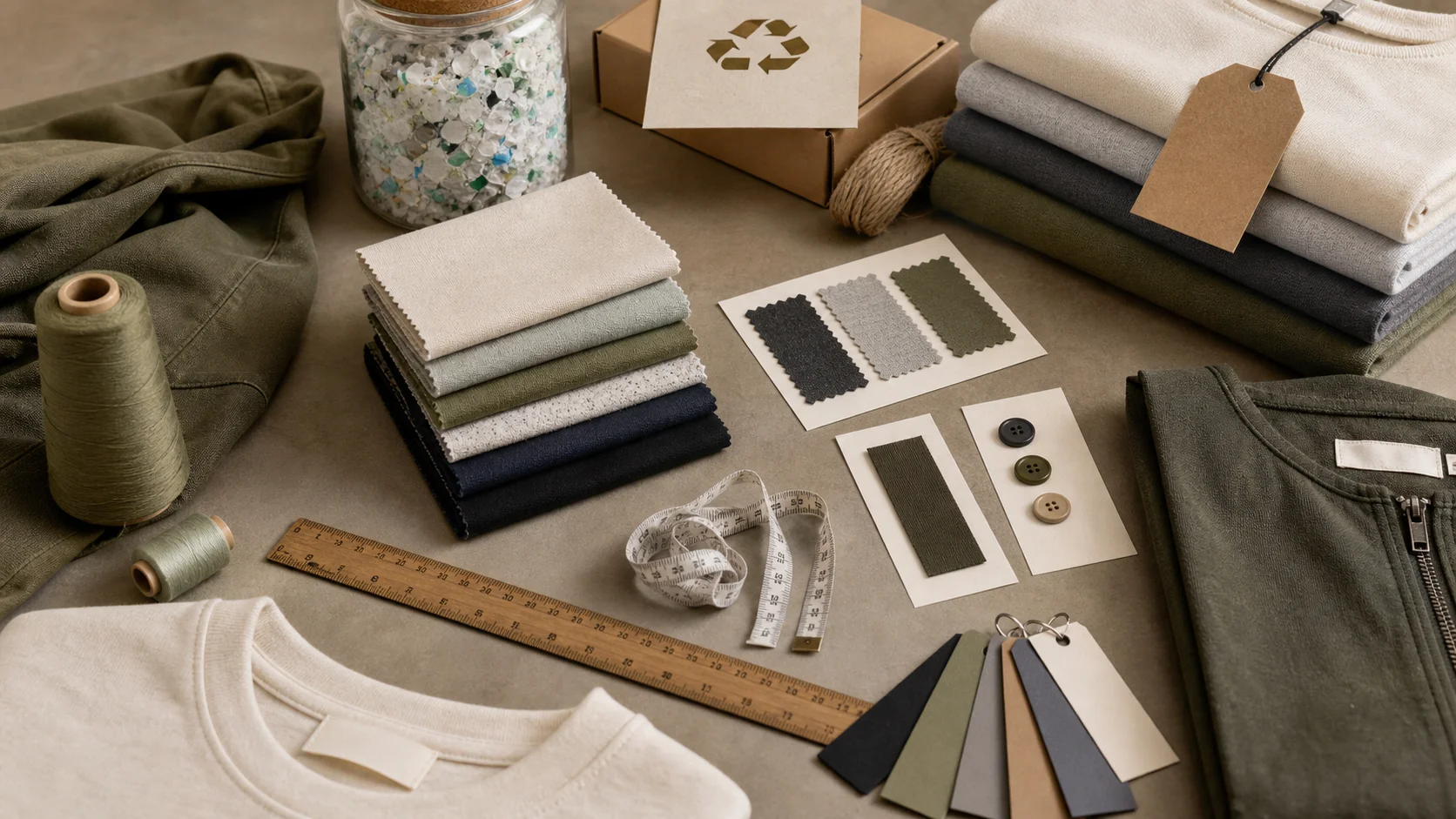
Wholesale Apparel Packaging with checks for samples, fit, MOQ, QC evidence, pricing terms, and delivery risk.
Fast answer: Wholesale Apparel Packaging: Cost Lines, Options, ROI, and MOQ should be judged by production evidence, not by a generic sourcing promise. The buyer needs sample proof, cost breakdowns, QC checkpoints, and delivery buffers in writing.
Ask for recent sample photos, measurement tolerances, fabric or print test assumptions, decoration test notes, packing examples, and a named inspection checkpoint. These details show whether the team can repeat an approved sample at bulk volume.
Separate garment cost, decoration, labels, packaging, sampling, testing, freight, and rush charges. When every cost line is visible, it becomes easier to reduce colorways, adjust size depth, or reserve more time for sampling.
I have stood in factories and watched a $0.42 folding box sit beside a $1.10 tee. The packaging line item was doing more damage to margin than the sewing cost. Multiply it by 10,000 units and the math gets loud fast. A $0.18 mailer adds $1,800 to a program. A branded box at $0.42 adds $4,200. On a wholesale order with a 32% gross margin, that gap can turn a healthy season flat.
Buyers still talk about packaging as if it sits outside the product. It does not. It sits inside the margin, inside the first impression, and often inside the return decision. I have watched boutique buyers reject a perfectly good garment because the carton arrived dented and the tissue looked sloppy. The product inside was fine. The perception was not. That is why custom packaging for apparel wholesale buyers has become a merchandising choice, not a decorative extra.
Across Asia, Turkey, and Central America, factory habits diverge in obvious ways. In China and Vietnam, standardization tends to be tighter, MOQ 3,000 to 5,000 units is handled with more discipline, and color consistency on offset printing is usually better. Turkey often brings sharper board quality and faster sampling—sometimes in 7-10 days—but costs can run 12% to 25% higher once freight and finishing are counted. Central America usually wins on proximity and lower transit risk for U.S. brands, though the print ecosystem can be less consistent on fine detail and spot colors. A supplier that can hold Delta E under 2.0 across a full run is rare. At MOQ 500, rarer still.
What changed over the last five years is not vanity; it is damage math. I have seen a 4% transit damage rate drop to 1.5% after a brand switched from weak polybags to reinforced mailers with corner support. I have also seen retail-ready presentation cut unpacking time at stores by 20 to 30 seconds per unit, which matters when a team is processing 800 units before opening. A carton is not just a shell. It is a buffer, a billboard, and sometimes a replacement for in-store labor.
According to World Trade Organization trade data, trade flows remain sensitive to freight volatility and border delays. That is exactly why packaging that reduces rework and damage pays back faster than most buyers expect. I have seen brands treat packaging as a fixed expense, then discover it works like insurance with a visible shelf effect.
Custom packaging for apparel wholesale buyers is a stack, not a single item. It usually begins with primary packaging, the part that touches the garment first: tissue, polybags, garment sleeves, hangtags, size stickers, care labels. Then comes secondary packaging, which helps the product sell: folding cartons, printed boxes, branded mailers, insert cards, tissue wraps. The last layer is transit packaging: master cartons, corner protectors, pallet wrap, void fill. Miss one layer and the whole system weakens.
For tees and French terry sweatshirts, the smartest programs often use a simple combo: a printed belly band, recycled tissue, and a master carton with 12 to 24 units. Denim needs stronger inner protection because weight and rivets can tear light poly. Intimates are more about hygiene signaling, so a clean sleeve plus size sticker often works better than a heavy box. Outerwear is different again. A puffer jacket in a thin mailer looks cheap; the same jacket in a structured carton with a matte finish can support a higher retail story. Luxury basics do well with restraint: one-color print, FSC paper, and a clean fold.
Custom branding adds value where it helps the buyer sell or handle the item. It adds cost where it merely repeats the logo. I have watched brands spend $0.28 on a custom insert that nobody reads while neglecting a barcode label that saves 15 seconds at receiving. Backwards. The best clothing packaging solutions serve the garment, the warehouse, and the shelf in that order.
Channel changes the brief. DTC can tolerate a branded unboxing moment, especially at $40 to $120 ASP. Boutique wholesale wants something easy to open, price, and display. Big-box retail usually wants standard dimensions, reliable barcodes, and pallet efficiency. If packaging slows receiving by 5 minutes per carton, the store buyer notices. If packaging uses recycled board, FSC paper, or plastic-free closures without sacrificing stackability, that notice can turn into a reorder.
Custom packaging for apparel wholesale buyers is where people get surprised. A plain white mailer with one-color flexo print can land around $0.12 to $0.22 at MOQ 5,000. A mid-tier folding carton with offset print, matte lamination, and a custom insert usually sits around $0.35 to $0.75. Premium packaging with foil, embossing, soft-touch coating, and complex die-cutting can hit $0.90 to $2.40 before freight. Order 1,000 units instead of 10,000, and per-unit cost climbs by 20% to 60%—sometimes more when finishing is involved.
Digital print is the move for lower volumes and faster changes, but the per-unit cost is usually higher. Offset print lowers cost at scale, though plates and setup charges can add $150 to $600 per design. Foil stamping, embossing, and debossing add tactile appeal, but they also create separate tooling and slower throughput. Lamination improves scuff resistance, yet it can complicate recyclability and add another $0.03 to $0.10 per unit.
Regional pricing is not random. China and Vietnam often win on tooling efficiency and board sourcing. India can be competitive on paperboard and print labor, especially for mid-volume runs, but lead times may stretch by 1 to 2 weeks when finishing queues pile up. Europe usually carries the highest base price, often 15% to 35% above Asia, because labor, overhead, and compliance costs are higher. Turkey sits between Europe and Asia on cost and often performs well on speed. Freight can erase the advantage if you are shipping a light packaging component by air.
Hidden costs are where budgets leak. Dielines may be free at one factory and $80 to $200 at another. Sampling can take 2 to 4 rounds. Plate charges, color matching, and storage fees for overrun stock add up quickly. I have seen brands ignore warehousing charges of $25 to $45 per pallet per month and then wonder why packaging looks expensive on paper. For apparel programs tied to cut and sew manufacturing, packaging should be quoted in the same model as fabric, trims, and freight. Otherwise the margin math lies.
According to ISO quality management standards, process control and consistency are not luxuries; they are part of quality management. That matters here because packaging defects show up late, after the garment is finished and the calendar is tight. I have watched a brand lose 11 days to a color mismatch that should have been caught on the first proof.
Buyers notice three things in the first 3 seconds: structure, color, and whether the package feels organized. Logo placement matters, but hierarchy matters more. If the size label is buried under a flap, or the barcode is on the wrong face, the package becomes a problem at receiving. A clean front panel, a clear top opening, and a single brand cue often outperform overdesigned graphics that look expensive in a mockup and awkward in a warehouse.
I have seen a beautiful rigid box collapse after 14 days in humid shipping lanes because the board spec was too light for the climate. I have also seen a surprisingly thin mailer survive a 1.2-meter drop test because it used the right gusset and a better seal. There’s the contradiction buyers miss: visual weight and physical strength are not the same. A package can look premium and fail in transit. It can look plain and outperform everything else.
Custom packaging for apparel wholesale buyers should support assortment strategy. Entry-level basics need efficiency and low cost. Mid-market lines need a stronger brand signal without adding unnecessary grams. Premium assortments can justify textured paper, soft-touch coatings, or foil accents if the retail price supports them. A $16 tee should not carry the same packaging burden as a $180 cashmere sweater. I have seen brands waste $0.60 on the low end and underinvest on the high end. That is a merchandising error, not a design triumph.
Warehouse efficiency still rules. Packages must stack, scan, and survive bulk handling. Keep barcodes on a flat face, avoid awkward overhangs, and test carton dimensions against pallet patterns before production. If the master carton accepts 24 units instead of 20 without crushing the inner pack, freight density improves and labor drops. That is the sort of practical gain that shows up in retail audits and resale value. Packaging that looks polished but slows handling loses its shine fast.
The thing nobody tells you: a packaging change that costs $0.06 more per unit can save $0.18 in damages, rework, and complaint credits if it reduces transit failures by even 2%.
Sustainability claims collapse fast under factory scrutiny. Recycled content, recyclability, and compostability are not the same thing. A mailer can be made with 30% PCR and still be hard to recycle if the ink coverage is heavy or the adhesive is wrong. A paper box can be recyclable in theory and rejected in practice if it is laminated with plastic film. A compostable bag may be technically certified and still be useless in a market with no commercial composting.
For most wholesale apparel, I prefer paper-based packaging, especially where the garment is folded cleanly and shipped in master cartons. Molded fiber works well for inserts and separators, though the finish is often rougher. Recycled poly mailers can be practical for DTC and certain outerwear programs, especially when they lower damage rates. Compostable plastics are the least convincing option unless the buyer has verified collection routes. According to Textile Exchange material guidance, material claims are only as credible as the chain of custody behind them, and packaging should be treated with the same discipline.
One market can make a material look greener than another. A paper mailer may be sensible in the U.K. or Germany, where recovery systems are stronger, but less effective in regions where recycling is inconsistent and contamination rates are high. Buyers should ask for FSC certificates, recycled content percentages, PCR claims, and test reports for tear strength and burst resistance. I also ask for the exact basis of the claim: post-consumer, post-industrial, or both?
You can reduce packaging weight by 10% to 25% without making the product feel cheaper. The trick is not stripping everything away. It is removing redundancy. A lighter board grade, a narrower insert, a cleaner print layout, and fewer layers can preserve the premium feel while cutting grams and freight. That is where sustainability meets margin, and where empty marketing gets exposed.
A standard packaging run usually needs 3 to 5 weeks for artwork, 7 to 10 days for sampling, 10 to 20 days for production, and 2 to 6 weeks for freight, depending on origin and destination. A rushed program compresses that to 10 to 21 days only if the artwork is final, the dieline is approved, and the factory has stock board on hand. One delayed approval can push a seasonal apparel launch back by 2 to 4 weeks, because packaging often sits on the critical path after garment approval.
Time disappears in proofing, color correction, board sourcing, and finishing queues. I have seen a buyer spend 4 days debating a shade of black that looked identical under office light and different under factory light. I have also seen a missing barcode spec add a second sampling round and 6 extra days. Sea freight is usually far cheaper than air freight for packaging components shipped from Asia, and the difference can be dramatic: a pallet by sea might add $180 to $450, while air can push the same volume past $900 to $1,800 depending on weight and season.
A buyer-friendly way to compare options is a simple matrix: unit cost, lead time, damage risk, and storage need. Small orders under 2,000 units often justify faster print methods. Orders over 10,000 units usually benefit from offset and sea freight. The right choice depends on launch date, margin, and whether the packaging will be reused across multiple deliveries. For brands seeking private label clothing services, packaging lead time should be locked before booking production, not after.
Send suppliers a brief with order volume, garment type, folded dimensions, branding assets, target unit cost, destination market, freight method, and any sustainability requirement. Leave out carton size or destination and the quote will be soft, probably wrong. I ask for three comparable quotes every time, because packaging pricing varies enough that one factory may look 18% cheaper while quietly excluding sampling or freight to port.
Here is the testing sequence I trust: real cartons, 48-hour humidity exposure, 1-meter and 1.5-meter drop tests, barcode scans, and shelf checks under warehouse lighting. If a package swells, scuffs, or bows under humidity, it will not improve in transit. Test the actual master carton with the exact unit count, not a prototype with half the fill. I have seen “approved” packaging fail only after a full pallet was built. That mistake costs more than the packaging itself.
Negotiate MOQ, freight terms, and replacement policy, but do not bargain away the standard. A lower MOQ of 500 units may be fine for a pilot, while a launch line might need 3,000 to 5,000 to achieve the right cost. Ask who pays for reprints, who owns overrun stock, and how color tolerances are defined. If the supplier cannot explain a Delta E target or a board spec, move on.
My practical plan is simple: pilot run, scorecard, benchmark, then scale. Order 1 sample, then 100 to 300 pilot units, then compare supplier performance on cost, consistency, damage rate, and speed. If the supplier clears those four gates, keep going. If not, revise the brief and re-quote through request a custom packaging quote from Fabrikn. The brands that win here are not the ones with the fanciest box. They are the ones that document what worked, what failed, and what it cost.
Simple mailers often run $0.12 to $0.22 each at higher volumes, while mid-tier folding cartons usually fall between $0.35 and $0.75. Premium finishes like foil, embossing, or soft-touch coatings can push pricing to $0.90 to $2.40 per unit before freight.
Standard lead time is usually 3 to 5 weeks for artwork and sampling, plus 10 to 20 days for production. Add 2 to 6 weeks for shipping, depending on origin and whether you choose sea or air freight.
Include order volume, garment type, folded dimensions, branding files, target cost, destination market, and your preferred freight method. Add sustainability requirements, barcode placement, and whether you need retail-ready packaging or only transit protection.
Yes. Recycled board, FSC paper, and clean one-color print can look premium if the structure is crisp and the finishing is consistent. I have seen brands use 30% to 100% recycled content and still achieve a polished retail presentation.
Ask at least 3 suppliers for quotes using the same dieline, board spec, print method, MOQ, and destination. Then compare unit price, sampling fees, plate charges, storage fees, freight terms, and replacement policy side by side.