
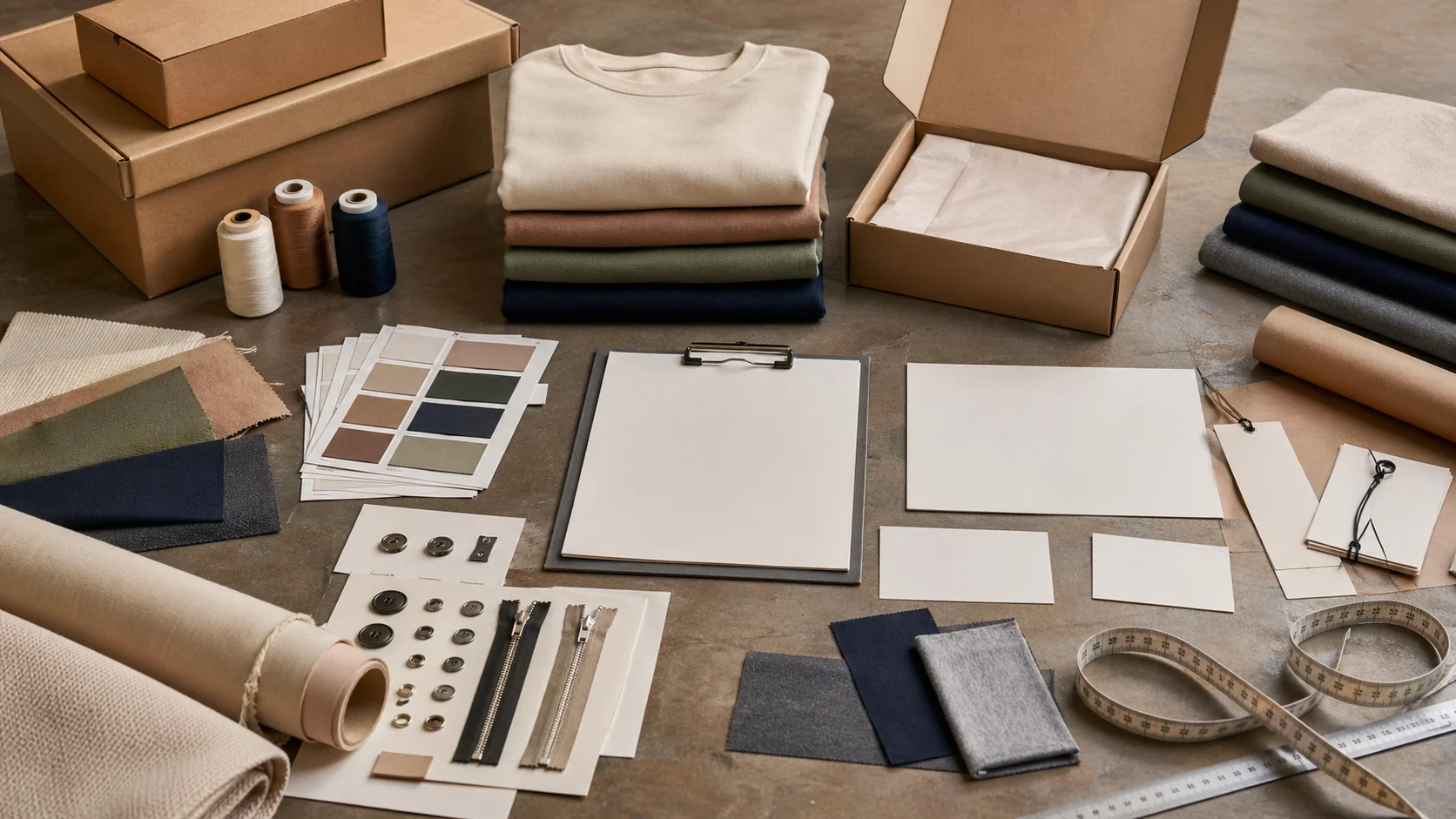
China Logo Garment Bags with checks for samples, fit, MOQ, QC evidence, pricing terms, and delivery risk.
Fast answer: China Logo Garment Bags: Material, Zipper, Print, and Supplier Checks should be judged by production evidence, not by a generic sourcing promise. The buyer needs sample proof, cost breakdowns, QC checkpoints, and delivery buffers in writing.
Ask for recent sample photos, measurement tolerances, fabric or print test assumptions, decoration test notes, packing examples, and a named inspection checkpoint. These details show whether the team can repeat an approved sample at bulk volume.
Separate garment cost, decoration, labels, packaging, sampling, testing, freight, and rush charges. When every cost line is visible, it becomes easier to reduce colorways, adjust size depth, or reserve more time for sampling.
The easiest packaging line to cut is the one that looks harmless. Then the damage report arrives. Last year, I watched a mid-market womenswear brand trim packaging spend from $1.18 a unit to $0.46 by switching to a custom garment bags with logo china supplier, then cut transit damage from 4.2% to 1.6% after changing the zipper spec and seam allowance. That was not a packaging story. It was a margin story.
In factories across Guangdong and Zhejiang, I kept hearing the same complaint from buyers: samples looked fine, then bulk orders arrived with broken zippers, crooked prints, or bags that tore at the hanger opening after two uses. Cheap samples can hide expensive failures. A $0.32 sample can mask a $3.00 return problem.
The economics shift by buyer type. Premium retail brands often specify PEVA or cotton, 80-120 micron film, and a molded zipper pull because presentation matters as much as protection. Mid-market labels usually want nonwoven at 70-90 GSM, one-color screen print, and a hanger slit sized to fit 38-44 cm shoulders. Promotional buyers chase unit cost, but they still need solid stitching if they want the bag reused 5-10 times instead of tossed after one event.
Thicker film does not automatically mean better protection. I’ve seen 0.18 mm PVC bags fail sooner than 0.12 mm PEVA bags because the zipper track was weak and the side seam was poorly welded. In factory audits, the 2 mm difference in seam width mattered more than the extra plastic. Protection comes from construction, not just grams or microns.
Freight efficiency matters too. A flat-packed carton of 500 nonwoven bags can ship in roughly 0.18 cubic meters, while rigid packaging can eat 0.35 cubic meters for the same quantity. On a 5,000-unit order, that gap changes landed cost by $120-250 depending on route and season. Add a 2-3% damage reduction in transit and the math gets sharper. Packaging is not a side expense. It is a margin tool.
For brands comparing factory options in China, the strongest advantage of a custom garment bags with logo china supplier is the combination of scale, competitive bulk pricing, and flexible MOQ structures. That mix is hard to match outside a mature manufacturing hub.
China suppliers rarely sell one thing well by accident. The better factory teams organize by material and finishing line, and that specialization shapes what you can buy. Nonwoven garment bags usually suit mid-market apparel and trade show programs because they are light, low cost, and printable. PEVA works for brands that want clearer visual appeal and better moisture resistance. PVC is more durable but heavier and less favored by sustainability-led labels. Cotton and recycled blends serve premium and eco-positioned buyers, though they usually carry higher minimums, often 1,000-3,000 pieces.
Logo method changes both appearance and cost. Screen print is the workhorse: clean, cheap, and viable from 500 pieces up. Heat transfer gives finer detail, especially for multi-color logos, but it can crack if the film is poor. Embroidery signals premium positioning, though it adds labor and makes sense only on thicker cotton or woven bags. Woven labels are understated and durable, and they work well when the bag itself should stay quiet while the clothing brand speaks loud.
Factory capability matters more than sales language. I look for cutting tables, sewing lines, lamination, printing stations, QC benches, and export packing areas. A real manufacturer can show machine lists, daily output, and carton drop-test records. A trader can only show photos. If you also source apparel, their garment packaging arm may sit alongside custom clothing packaging solutions and related private label clothing services, which can help consolidate production.
Regional specialization inside China still matters. Coastal factory clusters in Guangdong and Fujian are usually more export-focused, faster on paperwork, and comfortable with 3-5 day sample turns. Inland workshops can be excellent on labor cost, sometimes 8-12% lower, but lead times can stretch by 1-2 weeks if material sourcing is not pre-planned. I have seen both. The difference is not geography alone. It is process control.
Paperwork tells you some things, not everything. Request the business license, BSCI, ISO certificates, REACH documentation, OEKO-TEX claims where relevant, and material test reports for the exact film or fabric, not a generic catalog sheet. According to OEKO-TEX, certification is tied to specific standards and product scopes, so a logo on a website is not enough. I ask for report numbers, testing dates, and the laboratory name.
Then I verify production depth. Ask for real-time video of the cutting line, sewing line, printing area, and final packing. Ask how many machines are on site: 12 sewing machines is not the same as 42. Ask for monthly output and the share of export orders. A trader will deflect. A manufacturer will answer with numbers, usually within 24 hours.
My audit checklist is simple and unforgiving. Check labor conditions, lighting, ventilation, waste storage, and whether QC happens at inline, midline, and final stages. Ask where defects are logged, who approves rework, and how mixed sizes are prevented. In one factory in Zhejiang, I found size stickers stored beside cartons in four colors, which cut mispacks to under 0.5%. Small discipline. Big effect.
Sample evaluation should include seam strength, print alignment, odor, zipper performance, and shrinkage after repeated use. For garment bags, I also check hanger opening width, closure smoothness, and whether the bag resumes shape after folding. A supplier that can produce 10,000 pieces with 1% QC rejects often beats a cheaper one that ships 3% rejects and argues about replacements. That difference is worth more than a quoted saving of $0.06 per unit.
To separate a real maker from a hybrid operation, ask three questions: who owns the sewing machines, who buys the main raw material, and where is final QC done. If the answer keeps changing, you are not dealing with a clean factory chain. Data from trade.gov shows export compliance and documentation quality remain major factors in cross-border sourcing, and I have seen that play out line by line in factory offices.
When a custom garment bags with logo china supplier is truly set up for export production, you should be able to see consistent quality control, stable output, and clear answers about factory vs. supplier responsibilities. That distinction helps you avoid traders posing as a factory.
Factory quotes are built from six cost blocks: fabric weight, zipper quality, hanger opening, printing colors, labeling, and cartons. A 70 GSM nonwoven bag with one-color screen print and a standard nylon zipper might land at $0.42-0.58 at 5,000 pieces. Push that to a 120 GSM PEVA bag with a branded zipper pull, woven label, and two-color print, and the number can climb to $0.88-1.30. Add cotton or recycled fabric and you move higher again.
Buyer tier changes the economics. A promotional order of 1,000 units may price 18-35% above a 10,000-unit run because setup is spread across fewer pieces. Mid-market labels usually land in the $0.50-0.95 range, while premium retail specifications often sit at $1.10-2.40 depending on fabric and finishing. Those numbers are not random. They reflect labor, waste, and the cost of handling custom details.
MOQ matters because cutting and printing setup costs are stubborn. A screen plate fee may run $20-60 per color. A sample mold or custom zipper pull can add $80-300. Rush sampling can add another $30-100. If a supplier says “free sample,” I look for where they hide the cost. Usually it shows up in the bulk quote.
Freight and duty change landed cost more than many buyers expect. A low FOB price can become a poor deal once cartons hit a warehouse, especially if the pack-out is bulky. I have seen a $0.56 FOB bag land at $0.91 after sea freight, import fees, and domestic drayage. That is why I treat transport as part of the product spec, not an afterthought. For brands with apparel lines, packaging must align with production realities in cut and sew manufacturing too.
Price pressure also depends on lead time. A 3-week order with confirmed artwork and standard materials might stay close to base pricing. A 10-day rush with color matching, custom sizing, and carton printing will not. I have watched factories add 8-15% for urgency alone. Buyers who know this ask for true apples-to-apples comparisons: same material, same zipper, same print count, same carton spec, same Incoterm.
For a custom garment bags with logo china supplier, the quote should always reflect production method, quality targets, and whether the order is wholesale or bulk. That keeps comparisons accurate across different suppliers and factories.
Sample development usually takes 3-7 days for simple print jobs and 7-14 days for multi-material builds. Bulk production then runs 10-25 days for standard runs of 3,000-10,000 pieces, assuming materials are in stock. Sea shipping can add 18-35 days depending on destination, while air freight compresses transit to 3-7 days but changes the cost equation quickly.
Simple nonwoven or PEVA bags move faster because they use standard dies and familiar stitches. Fully customized pieces with contrast piping, embroidery, reinforced zipper ends, and woven labels can trigger a second approval loop. I’ve seen a 6-day print job stretch to 19 days because one PMS shade had to be rematched twice. Not incompetence. Just how custom work behaves.
Peak season slows everything. June to September can be busy for fashion packaging tied to autumn launches, and factories often lose 5-10 production days around Chinese New Year. Zipper sourcing can also slip by 4-7 days if the factory insists on a specific puller style. Inspection rework is another classic delay. One rejected carton can hold up a full pallet if the supplier lacks disciplined segregation.
Buyers can shorten lead times without gambling on quality. Approve the artwork in vector format, lock the size spec before sampling, choose stock materials where possible, and confirm carton design early. Send one complete tech pack instead of scattered emails. I have seen that cut total turnaround from 28 days to 19 days on a 4,000-unit order. Speed comes from clarity, not pressure.
A reliable custom garment bags with logo china supplier will also explain where production bottlenecks may appear, which helps buyers plan around China holiday schedules, material sourcing, and freight windows.
Risk control starts with the first sample and does not stop at final inspection. I inspect seam consistency, zipper track alignment, print placement, odor, accessory count, and carton labeling. For garment bags, I also specify tolerances: length within ±0.5 cm, logo placement within ±3 mm, stitch count per seam, and pack count per carton. If the supplier cannot commit to tolerances, they are not ready for bulk.
Payment terms tell you how much leverage you actually have. A 30/70 structure is common, but 50/50 can work on smaller orders if the supplier is new and the buyer wants tighter control. Trade assurance or escrow-style arrangements reduce exposure when the relationship is untested. If you are paying 100% upfront, you are buying trouble unless the supplier is exceptionally well vetted.
Artwork ownership needs written clarity. Confirm who owns the logo files, who stores the print plates, and whether the supplier can reuse your artwork for other clients. Color standards should reference Pantone or a signed physical swatch, not a screenshot. I always ask for a replacement clause if color drifts beyond tolerance or if mixed sizes exceed 1%. Those clauses are boring. They save money.
Common failures are predictable. Mixed sizes happen when cartons are packed from multiple workstations. Weak seams appear when operators rush or skip reinforcement at stress points. Print smearing often comes from under-cured ink or bad humidity control. Accessory shortages are usually a counting problem, not a supply problem. I once saw a 12,000-piece order held back because 800 zipper pulls were short. One box. One missing count. One ugly delay.
If the order sits inside a larger brand program, align packaging review with the same calendar you use for apparel approvals, especially if the factory also handles seasonal development through contact our team for a custom quote workflows and lead-time planning. Coordination beats crisis management every time.
For sustainability-minded buyers, it is worth confirming whether the factory can support recycled materials or documented chemical compliance. External standards from Textile Exchange can also help set internal sourcing expectations for responsible production.
When you are comparing a custom garment bags with logo china supplier against other sourcing options, ask for the same quality checks, same MOQ, and same bulk pricing basis so risk and cost are measured fairly.
Start with an RFI that includes your target price, artwork files, size chart, material preference, packaging requirements, and target delivery window. Then ask each supplier for the same quote basis: same dimensions, same fabric weight, same zipper spec, same print count, same carton size. If one factory quotes on 1,000 pieces and another on 5,000, you are not comparing reality.
Build a scoring grid with 8 to 10 fields: price, MOQ, lead time, QC process, communication speed, certifications, sample quality, export experience, and willingness to sign tolerances. I prefer a simple 1-5 score with notes beside each line. It keeps emotion out of the deal.
Order samples before scaling. One sample is not enough if your bag has multiple materials or a premium closure. I usually recommend 2-3 samples from the top two suppliers, then a small pilot run of 300-500 pieces before a full 5,000-unit production. That pilot is cheap insurance. It can expose print drift, zipper issues, or packaging mistakes before they become expensive.
Buyers who treat packaging as a sourced product, not a favor, make better decisions. Slow down the first quote. Compare true landed cost. Demand the test report. Then place the order. That discipline is how you keep margin intact when the factory floor gets messy.
The strongest custom garment bags with logo china supplier partnerships are built on repeatable production, transparent quality checks, and a sourcing process that scales from sampling to wholesale and bulk orders without surprise costs.
Start with factory proof, not sales language. Ask for a business license, recent production photos, machine lists, and 2-3 client references from the last 12 months. Then compare sample quality, QC discipline, and response time within 24 hours.
Most suppliers start at 500-1,000 pieces for simple nonwoven or PEVA bags. Cotton, embroidery, and fully custom builds often start at 1,000-3,000 pieces. Lower MOQ usually means a higher unit price, sometimes 15-35% more.
Basic nonwoven bags often fall around $0.42-0.58 at 5,000 pieces. Mid-range PEVA or upgraded nonwoven bags usually land at $0.70-1.30, while premium cotton or detailed custom versions can reach $1.10-2.40. Freight and duty can add 20-40% to landed cost.
Samples usually take 3-14 days depending on complexity. Bulk production often takes 10-25 days, and shipping adds 3-35 days depending on air or sea. Peak season and material shortages can push that longer by 1-2 weeks.
Yes. Use a pre-production sample, inline inspection, and a final AQL-style check before the balance payment. Specify tolerances for size, print placement, seam strength, and carton count in writing. That reduces disputes and makes replacement claims easier to enforce.