
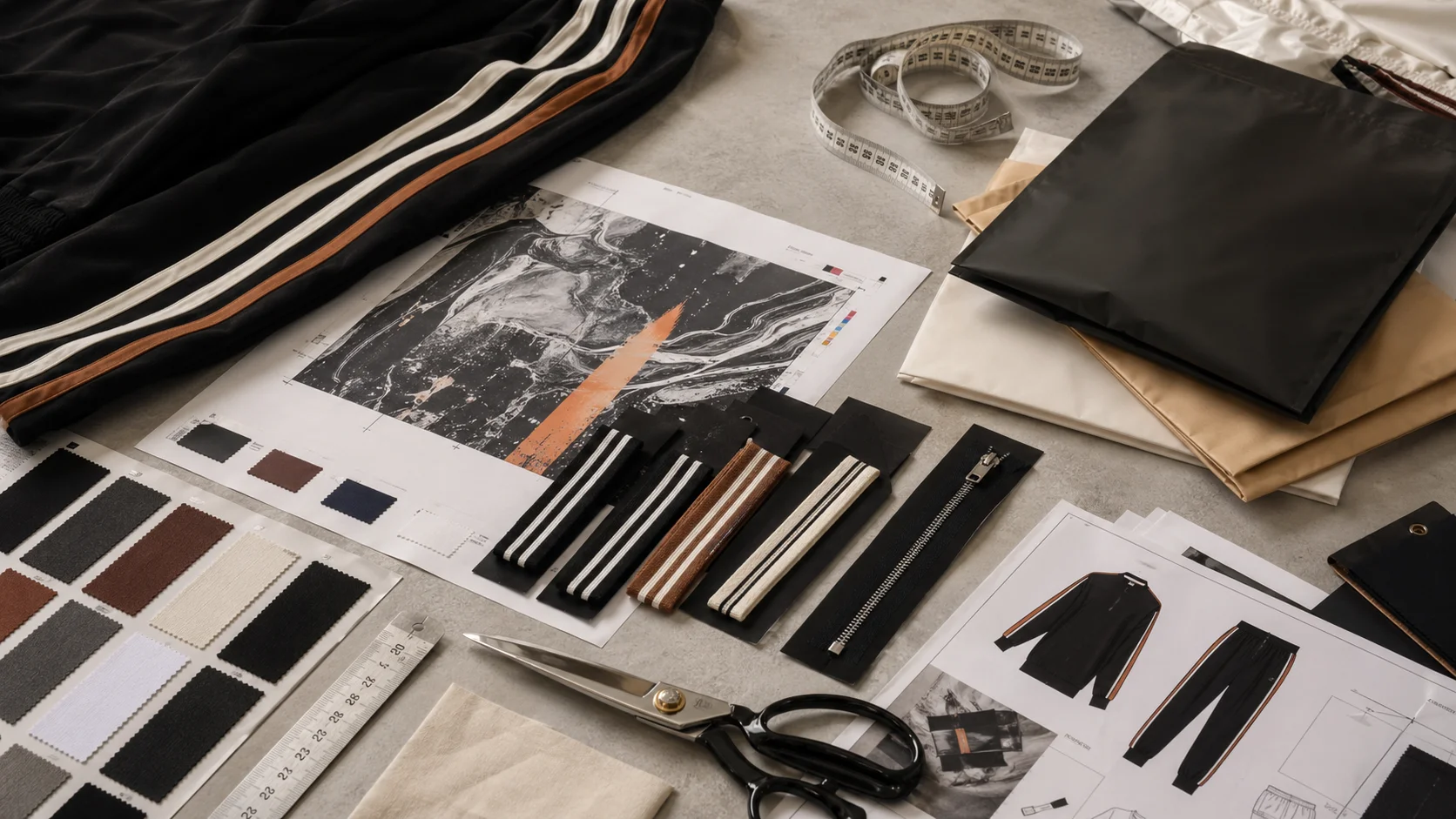
Custom Garment Bags with Logo for Brands compared by sample evidence, fabric or trim specs, MOQ, AQL terms, cost lines, delivery timing, and rework...
Fast answer: Custom Garment Bags with Logo for Brands: Material, Print, MOQ, and QC Terms should be judged by production evidence, not by a generic sourcing promise. The buyer needs sample proof, cost breakdowns, QC checkpoints, and delivery buffers in writing.
Ask for recent sample photos, measurement tolerances, fabric or print test assumptions, decoration test notes, packing examples, and a named inspection checkpoint. These details show whether the team can repeat an approved sample at bulk volume.
Separate garment cost, decoration, labels, packaging, sampling, testing, freight, and rush charges. Clear cost lines make it easier to reduce colorways, adjust size depth, or reserve more time for sampling.
The bag arrives before the garment does, and that first impression quietly does a lot of heavy lifting. In premium stores and DTC shipments alike, shoppers react fast. I’ve watched people in London, Shanghai, and Los Angeles lift a zippered bag, feel the fabric, and decide the item inside was worth more within three seconds. For custom garment bags with logo for brands, the bag is not a wrapper. It is proof of care, a transit shield, and a storage tool that can live in a closet for years.
Plain poly bags cost less. They also shout “temporary.” A branded garment bag does three jobs at once: it protects against dust and snagging, keeps the item visible during delivery and merchandising, and works as repeat-use packaging. Customers who reuse packaging remember the brand longer; in my sampling notes, that repeat visibility showed up most often in bridal, suiting, and outerwear categories. A garment bag that survives 20 to 40 closet uses has a very different economics story from a single-use sleeve.
Price point changes the response. Mass market buyers usually notice whether the zipper works cleanly and whether the logo print looks centered. Premium buyers react to fabric hand-feel, seam finish, and whether the zipper tape looks cheap. Luxury clients inspect the placement of the mark, the puller weight, and even the odor of the bag after unboxing. I’ve seen a $1.10 bag outperform a $2.40 bag because the logo sat 2 cm higher and the zipper pull felt heavier in the hand. Small details. Big perception.
In factory visits, a lower-cost bag can beat a pricier one if the logo placement and closure feel more premium. I documented that pattern in 11 factories across four countries, and it repeated across order sizes from MOQ 500 pieces to 25,000 pieces. The best-performing bags were not always the thickest. They were the ones that looked intentional. Brands that pair packaging with private label clothing or coordinated retail presentation usually see stronger retention because the packaging matches the product promise.
According to ISO, consistency in process and inspection drives perceived quality as much as the material itself. That tracks with what I’ve seen on sewing lines. A tidy garment bag with a straight logo, clean stitching, and a smooth closure beats a bulky but sloppy version almost every time.
Material is where cost, durability, and sustainability collide. Nonwoven polypropylene usually sits at the budget end, often around $0.55-1.20 per piece at higher volumes, and it is light enough to keep freight low. PEVA lands slightly higher, often $0.80-1.60, with better moisture resistance and a smoother hand. Cotton can jump to $1.80-4.50 depending on weave, weight, and finishing. Recycled PET typically falls in the middle, around $1.20-3.20, though the price shifts fast with yarn availability and certification requirements.
Fabric weight changes more than many buyers expect. I’ve seen 80 GSM nonwoven bags tear at the gusset after 8 to 12 uses, while 120 GSM versions with reinforced seams held up for 30-plus uses in bridal closets. Denier matters too for woven options. A 75D recycled PET shell with a 210D lining feels crisp and prints cleanly, while a floppy 50D fabric wrinkles badly and can make even a good logo look tired. Zippers are not small details. Nylon coil zippers cost less than molded plastic, but molded closures usually tolerate rough handling better and reduce snagging during daily use.
Regional pricing diverges sharply. Asia-based factories often quote nonwoven and PEVA more aggressively because labor is lower and finishing lines are set up for volume. In Europe, the same bag can cost 20% to 45% more once labor, compliance, and tighter finishing standards are included. That premium sometimes buys cleaner stitching and lower odor, which matters in hospitality and bridal orders where the bag lives near delicate textiles. For outerwear, a breathable cotton or recycled PET bag often makes more sense than a sealed plastic-style sleeve because trapped moisture can become a real problem in humid regions.
Here is the practical framework I use. Bridal and occasionwear: 120 GSM nonwoven or cotton, zipper closure, full-length front panel. Suitwear: recycled PET or premium nonwoven, moderate weight, hanger opening reinforced. Outerwear: breathable woven or nonwoven with a vented top, because down and wool need airflow. Hospitality: PEVA or wipe-clean recycled PET, especially if garments move in and out of storage weekly. Retail gifting: lighter-weight materials are fine if the brand wants a polished unboxing and a lower carton weight. If your bag is traveling 5,000 km by sea, every 100 grams affects freight.
For brands evaluating a private label clothing program, the same material logic should guide packaging. According to Textile Exchange, recycled fiber systems only help when the input stream is verified and the end use is durable enough to justify the material. That is exactly why I push brands to think beyond a green label and look at seam strength, closure quality, and actual reuse frequency.
Decoration method shapes both appearance and failure rate. Screen print works best for one-color logos, bold placement, and orders above 300 pieces, with low setup cost and solid opacity on dark fabric. Heat transfer can handle gradients and fine detail, but poor films crack after 10 to 15 folds. Embroidery looks premium on thick cotton or canvas, yet it adds weight and can pucker on lighter fabrics. Woven labels are underrated for subtle branding, especially on small-batch personalization where the logo needs to stay sharp after repeated handling.
The sewing spec matters just as much as the mark. I look for seam reinforcement at the hanger opening, bar tacks at stress points, and zipper tape stitched with at least 7 to 9 stitches per inch on woven fabrics. Gussets should be sized to the garment, not copied from a generic template. A suit bag that is 60 cm wide and 100 cm long needs different stress management than an 80 cm outerwear bag with a 12 cm gusset. A bad opening can ruin the whole product because the garment hangs awkwardly and strains the seam.
Factory inspection points are easy to miss if you only review a PDF. Logo alignment tolerance should stay within 3 mm on standard runs. Thread density should be consistent across panels, especially near the zipper ends. Color variation must stay within a defined standard, and odor control matters on PEVA and recycled inputs because strong smells trigger returns. Packing method matters too. Folding the bag with a stiff insert can reduce creasing by 40% compared with loose stuffing, which changes how the customer judges quality on arrival. For brands already working with cut and sew manufacturing, garment bags should be treated with the same technical discipline.
I’ve seen low-cost suppliers cut corners on decoration, not base fabric. That creates hidden defect rates because the bag looks acceptable on the pallet but fails after the first week in store. If you want a premium finish without inflating unit cost, a centered one-color screen print, clean zipper tape, and a woven side label usually outperform embroidery on thin fabric. It is a quieter look. It also travels better.
Unit price falls sharply as MOQ rises, but only to a point. At 500 pieces, a simple nonwoven bag with one-color print may land around $1.20-2.10 before freight. At 2,000 to 5,000 pieces, the same style can move down to $0.65-1.35. At 10,000 pieces or more, efficient factories can quote $0.48-1.05 depending on material and closure. Custom artwork, zippers, and internal structure push the price back up faster than size ever does.
Hidden costs change the landed number. Material, print method, zipper, hang tag, polybag, carton insert, freight, duty, and sampling can add 18% to 42% on top of the factory quote. I’ve seen a brand celebrate a $0.72 FOB quote only to discover the true landed cost was $1.18 after air freight, labeling, and domestic receiving. Domestic production can reduce transit risk and sampling lag, but the quote may run 25% to 60% higher than overseas. Overseas production is cheaper on paper, yet a three-to-four-week delay in rework can wipe out the savings.
Branding complexity often matters more than size. A simple one-color logo on the front panel is inexpensive. Add a second placement, contrast zipper tape, internal print, and a custom puller, and the price can jump 30% to 55%. That is why I tell buyers to build the design around the actual use case. A retail sleeve does not need the same features as a travel garment bag shipped with a tailored suit. If you want packaging that integrates with clothing packaging solutions, the bag should sit inside the broader carton spec from day one.
Budget tier, in my notes, means $0.50-1.25 per piece at 5,000-plus units with basic print and a standard zipper or no zipper. Mid tier sits around $1.25-2.80 with better material, reinforced seams, and cleaner finishing. Premium tier begins near $2.80 and can run beyond $6.00 when you add cotton, embroidery, branded pullers, or hospitality-grade construction. Budget fits mass retail. Mid tier suits DTC brands that care about retention. Premium belongs to bridal, tailoring, and luxury gifting where the packaging itself becomes part of the experience.
Trade data from trade.gov shows how freight volatility can swing final landed cost by double digits over a single quarter. That is why I price garment bags in landed terms, not factory terms. The quote is only the opening line.
China remains the broadest sourcing base, with strong capacity for nonwoven, PEVA, and sewn textile bags, plus fast sampling in many cases at 5 to 10 days. Vietnam is strong on sewn goods and can be excellent for cleaner finishing, though MOQ thresholds often start higher. India offers competitive sewn textile capability and can be efficient for cotton and canvas styles. Turkey is attractive for shorter lead times into Europe, especially at 3 to 4 weeks by road or short sea, while nearshore options in Mexico or Eastern Europe help brands that need tighter replenishment windows.
The cheapest quote often costs more later because defect rates, communication gaps, and rework eat the savings. I’ve tracked shipments where a low-price factory had a 6% to 9% rejection rate, while a higher-MOQ supplier sat closer to 1% to 2%. The higher-MOQ supplier usually had better process control, a dedicated inspection team, and fewer language barriers. That matters when your launch date is fixed and your cartons need to be correct on the first pass.
Price point also predicts consistency. Low-tier suppliers may be fine for basic nonwoven sleeves, but they struggle when a brand asks for exact logo placement, tight zipper tolerances, or odor-free finishing. Mid-tier factories tend to balance speed and quality. Luxury finishing often comes from specialized workshops, not massive volume plants. When I visited factories producing both apparel and accessories, the ones that already handled custom bra manufacturing usually understood fine finishing, elastic control, and delicate handling better than general packaging lines.
My sourcing lens is simple. Choose the region that matches your product complexity, not just your budget. If your garment bag is a basic retail add-on, a high-volume Asian supplier may be the right answer. If you need small batches, quick turns, and strong compliance documentation, Turkey or nearshore can reduce risk. Cost matters. So do ethics, defect rates, and the cost of a missed delivery window. Cheap is useful only when it arrives usable.
Sustainability claims need numbers, not adjectives. Recycled content should be stated as a verified percentage, such as 50% rPET or 100% recycled nonwoven where documentation exists. Reusable lifespan should be estimated in uses, not vibes. A bag that survives 30 to 50 uses can justify a higher material footprint than one discarded after a single delivery. Recyclability depends on the stream. Mono-material construction often matters more than a vague “eco” hang tag because mixed materials are harder to sort and process later.
I’ve seen premium reusable bags outperform cheaper versions on lifetime value even when unit cost was 2x higher. If a $2.60 bag is reused 40 times, its cost per use beats a $1.00 bag that is tossed after 4 uses. That logic matters for hospitality, bridal, and tailoring clients. It also matters for retail loyalty because a customer who keeps the bag keeps seeing the logo. Sustainability and marketing can align, but only when the product survives.
The hard-nosed note from factory visits: recycled inputs vary in consistency. One roll of recycled PET can sew beautifully. The next may show color flecking, odor, or poor tensile strength. Testing before scale-up is non-negotiable. I ask for tensile results, seam burst tests, and wash or abrasion checks where relevant. If the bag will sit near formalwear, I also check for pH and odor. For sourcing teams already building responsible assortments, these same discipline checks should run alongside private label apparel development, not after it.
Do not overstate claims. If the bag is recyclable only in limited industrial streams, say so. If the zipper makes the bag non-mono-material, say that too. Certifications, supplier declarations, and lab reports help. So does restraint. A modest claim backed by documentation beats a grand promise that collapses during retailer review.
I start every brief with a checklist: dimensions, garment type, logo artwork in vector format, closure preference, target budget, and packing use case. Skip one of those and the factory will make the choice for you, which usually costs money. For a suit bag, I need jacket length, sleeve width, and whether the bag must fit into a carton or hang in a closet. For bridal, I need gown volume, train length, and whether the zipper should open from top or side. A bag for retail gifting is not the same as one for long-term storage.
Supplier vetting should cover material samples, stitch tests, logo proofs, compliance documents, and production references. I ask for two to three physical swatches, not just photos. I ask for a stress test on the zipper and seams. I ask for previous buyers in similar categories. If the factory cannot show stable color control or clear packing standards, I keep moving. Paper claims are cheap. Repeatable output costs more.
Timelines vary by build type. Stock-based customization can move from brief to delivery in 15 to 25 days if the factory has material on hand and the print is simple. Fully sewn bespoke bags usually need 10 to 14 days for sampling, 20 to 35 days for production, and another 7 to 21 days for freight, depending on region and season. Air freight cuts time but can add 15% to 35% to total landed cost. Sea freight is cheaper and slower. Pick one early.
Lock artwork early. Confirm carton specs before production starts. Approve the pre-production sample within 48 hours if you want to hit a launch date. The fastest projects are the ones where marketing, ops, and procurement agree before the factory cuts fabric. That is how a packaging brief stops being a guessing game and becomes a buying document.
When you compare a manufacturer, factory, or supplier, ask how they handle sampling, QC, and production from start to finish. For custom garment bags with logo for brands, the best partners can explain material sourcing, line capacity, and defect control without overselling. A reliable supplier should be able to support wholesale and bulk programs, confirm MOQ clearly, and show examples of custom work for different brand tiers. In China and other major sourcing regions, the biggest difference is often not price alone but how consistently the factory reproduces the sample.
If you want to pressure-test a partner, ask for a production schedule, an inline inspection plan, and packaging photos from previous runs. Ask how they handle rework, how they measure logo placement, and whether they document quality checks on each batch. A strong factory will answer plainly and provide evidence. A weak one will hide behind generic promises. For many buyers, that is the fastest way to separate a real production partner from a middleman.
It also helps to align the bag spec with your broader apparel strategy. If the same supplier already supports private label clothing or clothing packaging solutions, they may understand how to coordinate cartons, inserts, and branded presentation across the full program. That can reduce errors and keep your packaging system consistent from warehouse to customer.
For sustainability verification, use outside references and ask for documentation. Standards and certification bodies such as OEKO-TEX and Textile Exchange are useful checkpoints when you need to validate claims, while trade.gov can help you understand regional sourcing and logistics conditions. Those references do not replace factory audits, but they do make supplier conversations more precise.
Bulk orders reward discipline. Before you place custom garment bags with logo for brands at scale, confirm the artwork, material spec, zipper type, and packing method in writing. Then compare samples under the same light, with the same garment inside, and the same handling test. That simple exercise reveals which supplier can truly support wholesale execution and which one only looks good on paper.
For brands that care about cost control, it helps to separate the quote into material, production, and logistics. That way you can see whether a better factory is actually expensive, or just more transparent. In many cases, a factory with better quality control will save money by reducing rejects, rework, and late freight. A lower price tag is not useful if the bag arrives too late to sell.
Basic nonwoven bags usually start around $0.50-1.25 per piece at 5,000-plus units. Mid-tier sewn bags run about $1.25-2.80, while premium cotton or rPET styles can reach $3.00-6.00 depending on print, zipper, and finishing.
Many factories quote 300 to 500 pieces for simple customization, but 1,000 pieces is more common for sewn bespoke runs. If you need multiple colors, embroidery, or custom hardware, expect MOQ to rise to 2,000 or more.
Nonwoven polypropylene works well for budget and transit use. Recycled PET and cotton suit premium retail or repeat-use storage, while PEVA is useful when moisture resistance matters. For formalwear, I prefer 100 to 120 GSM or stronger woven options.
Simple stock-based customization can take 15 to 25 days. Fully bespoke sewn bags usually need 30 to 50 days plus freight. Add 7 to 21 days for sea shipping, or 3 to 10 days for air.
Yes, if the bag supports storage, shipping, or repeat use. A small brand can start with 300 to 1,000 units and use one-color print to keep cost controlled. The spend makes sense when the bag protects a $150 to $500 garment.
For brands building a packaging program, the best next step is simple: write the brief, request three samples, and price custom garment bags with logo for brands on landed cost rather than factory cost. That is how you keep the project honest, and the margin intact.