
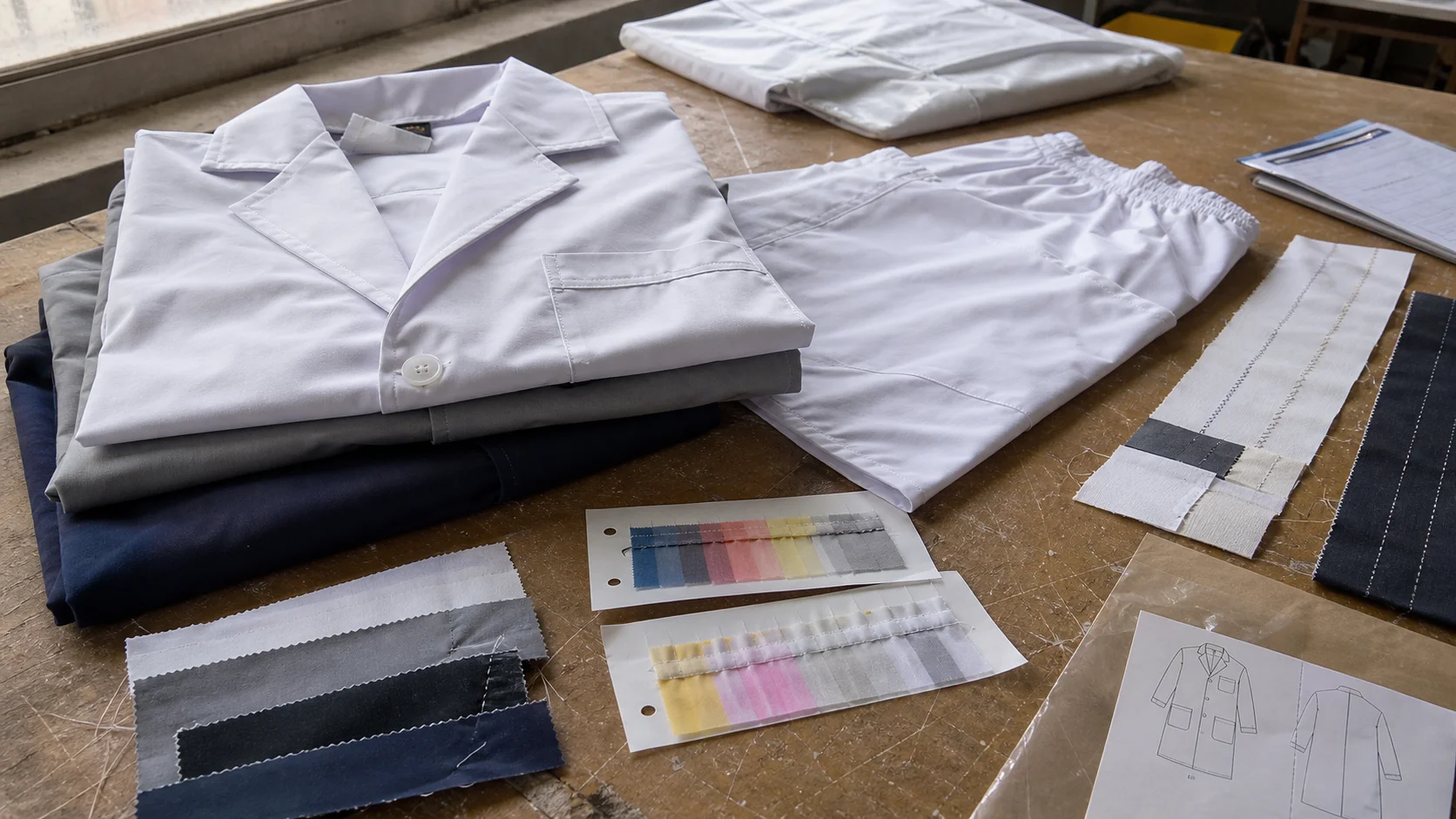
A practical SEO outline for construction safety teams auditing custom lab coat colorfastness before bulk approval, field use, and repeat production.
Lab Coat Colorfastness Audit for Safety Buyers - Quality & Inspection manufacturing guide
For construction safety teams, a custom lab coat is not just a white garment used in a laboratory. It may be worn by site safety officers, chemical handling teams, concrete testing crews, quality control inspectors, environmental monitoring staff, and supervisors moving between site cabins, testing areas, and active work zones. If the coat uses custom colors, contrast panels, company branding, reflective trims, or department-coded shades, colorfastness becomes a practical safety and procurement issue.
A lab coat that bleeds dye during laundering can stain other PPE, contaminate lighter garments, reduce brand consistency, and create questions about supplier control. A dark navy cuff that transfers color onto gloves or skin is not only unattractive; it signals weak dye fixation or poor finishing. A red or orange identification panel that fades after a few washes can reduce team visibility and undermine the reason the color was specified in the first place.
Safety buyers should treat colorfastness as part of the quality audit, not as a cosmetic afterthought. The right audit checks fabric behavior before bulk production, confirms laundering expectations, verifies trims and branding, and links test results to real working conditions. A construction team buying 300 coats for one project has different risk exposure than a national contractor ordering 10,000 coats across multiple sites, but both need a clear standard before approving production.
This article explains how to structure a custom lab coat colorfastness audit for construction safety teams, including testing priorities, buyer specifications, MOQ expectations, sample approval stages, lead-time dependencies, and inspection risks that often get missed.
A useful audit starts with a simple question: what color failure would create a problem for the buyer? The answer depends on coat design, work environment, laundering method, and the buyer’s tolerance for shade variation.
For safety buyers, the audit should cover both laboratory-style expectations and construction-site realities. Lab coats may be exposed to dust, cement residue, oils, light chemical splashes, sunlight, perspiration, and industrial wash cycles. A fabric that performs well in a retail wear test may not perform well when washed repeatedly with alkaline detergents or exposed to abrasive site conditions.
The audit should not be limited to the shell fabric. Construction safety lab coats often include snap buttons, plastic buttons, reflective tape, woven labels, hook-and-loop closures, contrast cuffs, colored collars, printed warning marks, or embroidered company logos. Each component can behave differently during wash and wear.
Good purchasing judgment: if the garment uses dark contrast fabric against a white or light body, test the full garment combination. Fabric-only testing may miss staining at seams, cuffs, collars, and pocket edges.
Colorfastness performance starts before testing. It begins with the specification sheet. If the buyer does not define fabric composition, weight, color standard, dye type, finishing requirements, and laundering method, the supplier will make practical decisions based on price, availability, and MOQ. That may be acceptable for promotional apparel, but it is risky for construction safety garments that must be reordered consistently.
For construction safety teams, poly-cotton blends are often the practical middle ground. They balance cost, durability, wash performance, and comfort. Cotton-rich garments may be preferred in hotter conditions, but buyers should expect more attention to shrinkage, shade loss, and seam puckering. Polyester-rich coats can hold color well, yet they may feel warmer and can look less “lab coat” if the fabric is too shiny.
Trim specifications need the same discipline. A coat can pass fabric testing and still fail because the pocket binding bleeds, the embroidery thread fades, or the heat transfer logo cracks after repeated wash. Safety buyers should ask the supplier to submit a trim card with physical components, not only a bill of materials in writing.
Buyers sourcing custom coats can review garment development and production support options through Fabrikn’s services when they need help turning safety requirements into a workable manufacturing specification.
A colorfastness audit should connect tests to the actual risks of the garment. Not every order needs every test, but safety buyers should avoid vague wording such as “good colorfastness.” It is better to name the test type, minimum grade, wash condition, and approval responsibility.
This test checks whether the garment loses shade or stains adjacent fabrics during washing. It is essential for custom lab coats because site teams often wash garments frequently, sometimes with heavy-duty detergents. The result usually evaluates two issues: color change on the tested fabric and staining on adjacent multifiber fabric.
For standard poly-cotton construction safety lab coats, buyers often target a grade of 4 or above for color change and staining, depending on the test method and intended use. For dark colors, a grade of 3–4 may be commercially accepted in some programs, but buyers should be cautious if the garment will be washed with white PPE or light uniforms.
Rubbing tests assess whether dye transfers from the fabric surface when rubbed dry or wet. This is especially important for dark navy, black, red, green, and high-visibility accent colors. Wet rubbing is usually more difficult to pass than dry rubbing.
Construction safety buyers should pay attention to cuffs, elbows, collars, and pocket openings. These areas experience repeated contact with gloves, clipboards, tools, harnesses, and skin. If a dark coat or panel has weak wet rub performance, it may stain gloves or lighter layers underneath.
Perspiration testing matters when coats are worn in hot site conditions, during long inspections, or over short-sleeve workwear. Sweat can trigger dye migration, especially on collars, underarms, and cuffs. This test is particularly relevant for cotton-rich fabrics and saturated shades.
Safety teams working outdoors should consider lightfastness. Lab coats used by concrete testing teams, environmental inspectors, or safety supervisors may be exposed to sunlight for long periods. A coat that looks correct at delivery but fades unevenly in a few weeks may create a poor uniform appearance and shorten replacement cycles.
Lightfastness is more important for colored lab coats and contrast panels than for traditional white coats. Buyers should also consider whether the garment is stored in vehicles, site containers, or windows where UV exposure may occur before use.
Not all lab coats are bleach-safe. If the buyer expects chlorine bleach, oxygen bleach, solvent exposure, cement slurry, oil, or cleaning chemicals, that expectation must be stated early. Many fabrics and dyes will not tolerate chlorine bleaching without shade change. White coats may yellow or weaken depending on finish and washing chemistry.
For chemical splashes, colorfastness testing is not a substitute for chemical protective performance testing. A standard cotton or poly-cotton lab coat is not the same as certified chemical protective clothing. Safety buyers should separate visual durability from hazard protection.
Some construction companies use commercial laundries. Industrial laundering can involve higher temperatures, stronger detergents, tunnel finishing, tumble drying, and more mechanical action than home washing. If that is the real care route, the audit should include industrial wash simulation or confirmed laundering trials.
Direct buying call: do not approve a dark custom coat based only on one home-wash sample if the final garments will go through industrial laundry. The test condition must match the operating reality.
Colorfastness control is easiest before production. Once bulk fabric is dyed, cut, sewn, and branded, the buyer’s options narrow quickly. A disciplined sample workflow protects both the buyer and the supplier by setting approval gates.
For repeat programs, the pre-production sample becomes the reference standard for the next order. Buyers should keep an approved sealed sample and require the supplier to keep one as well. The sample should be dated, signed, and linked to the order number, color reference, fabric lot, and trim card.
MOQ depends on fabric availability, color customization, trim development, and branding method. Buyers should treat MOQ figures as planning ranges, not fixed promises.
Order Type Typical MOQ Range Notes for Buyers Stock white lab coat with logo 100–300 pieces Lower MOQ may be possible if existing fabric and standard sizing are used. Custom color using available fabric 300–800 pieces Depends on fabric stock, shade tolerance, and size breakdown. Custom dyed fabric 800–1,500 pieces MOQ often tied to dye lot and fabric mill minimums. Special performance fabric, FR, ESD, or anti-static 1,000–3,000 pieces or more Testing, certification, and fabric sourcing can increase MOQ and lead time. Multi-color panel design with custom trims 500–2,000 pieces Contrast fabric and trim control increase inspection complexity.A small construction team may prefer stock fabric with embroidery to keep MOQ low. A larger contractor with multiple projects may justify custom-dyed fabric because brand consistency and reorder control are more important. The tradeoff is clear: lower MOQ usually means fewer customization options, while deeper customization requires longer development and stronger testing discipline.
Lead time for custom lab coats is rarely driven by sewing alone. Color approval and testing can be the longest early-stage steps. Buyers who compress sampling often accept more risk in bulk.
For a simple stock-fabric lab coat with logo, buyers may plan around a shorter production window after sample approval. For custom-dyed coats with testing, a more cautious timeline is needed. A practical sourcing calendar should include buffer time for failed lab dips, retesting, and pre-shipment inspection corrections.
Buyers can contact the sourcing team through Fabrikn’s contact page to discuss whether a project is better suited to stock fabric customization or full custom development.
A colorfastness audit should include document review, sample review, and factory-level inspection. Test reports are useful, but they do not replace production control. Many shade problems occur because bulk fabric lots are mixed, trims are substituted, or cutting rooms ignore roll variation.
A lab dip is a small sample. Bulk dyeing can vary due to fabric lot, dye bath control, finishing temperature, and moisture content. Buyers should require a bulk fabric cutting for approval when shade is critical. For large orders, the supplier should provide roll-to-roll shade records or at least segregate fabric rolls by dye lot.
Shade bands happen when panels cut from different fabric rolls are sewn into the same garment or when garments from different dye lots are packed together. A coat with one sleeve slightly darker than the body may not fail functionally, but it creates visible quality concerns. Inspection should check garment-to-garment and panel-to-panel shade consistency under controlled lighting.
Dark collars, cuffs, pocket flaps, and side panels can bleed into white or light fabric during washing. The risk rises when the contrast material is cotton-rich, heavily dyed, or not properly fixed. The audit should include a garment wash test, not only loose fabric testing, when contrast placement touches lighter areas.
Embroidery, screen print, heat transfer, and woven patches each have different wash performance. Embroidery may pucker if the base fabric shrinks. Screen print may crack if ink and curing are poor. Heat transfer can peel if pressure, temperature, adhesive, or fabric finish are mismatched. A pre-production sample should be washed before final approval.
Some suppliers protect themselves by using conservative care labels, such as cold wash only or do not tumble dry. That may be acceptable for retail apparel, but it may not match a construction safety program. If the garment will be washed warm, tumble dried, or handled by a commercial laundry, the label and test program should reflect that expectation.
White garments can fail in ways that are not classic dye bleeding. Optical brighteners, finishing chemicals, packaging, storage humidity, and unsuitable washing chemistry can cause yellowing. A white coat with dark trims can also pick up stains during packing or laundering. Buyers should inspect whiteness, packaging cleanliness, and trim contact points.
If the lab coat includes reflective tape for site visibility, buyers should not evaluate only the fabric color. Reflective material can lose brightness, crack, wrinkle, or detach after washing. The garment may need separate testing or documentation for reflective performance, depending on the intended safety claim.
Inspection works best when it is staged. Waiting until pre-shipment inspection to discover dye bleeding is expensive and disruptive. At that point, the supplier may have limited ability to correct the issue without remaking the order.
Stage What to Check Buyer Decision Development Fabric selection, lab dips, trim cards, logo method Approve direction or revise specification. Pre-production Final sample, wash test, rub test, shade standard Approve bulk production only when key risks are cleared. During production Fabric roll shade, cutting segregation, trim consistency Stop mixing lots or correct process before full output. Final inspection Garment appearance, shade bands, stains, logo durability, packing Ship, rework, sort, or reject based on agreed AQL and defects.For larger orders, an in-line or during-production inspection is worth considering. It can detect shade mixing before all garments are sewn. For smaller orders, buyers may choose a stronger pre-production approval and final inspection instead. The right approach depends on order value, delivery pressure, and replacement risk.
A construction safety buyer does not need to become a textile chemist, but the purchasing file should be clear enough that a supplier, inspector, and internal safety manager understand the same expectations. The checklist below is practical for RFQs, supplier onboarding, and pre-production approval.
For a broader view of sourcing support and inspection planning, buyers can review Fabrikn’s company background and assess whether the supplier’s process fits the risk level of the order.
One of the most common purchasing mistakes is requesting “colorfastness test report” without defining what result is acceptable. A report is only useful if it can guide a decision. Buyers should state the minimum grade, test method, sample type, and retesting rule.
A practical standard might say that the approved fabric must meet agreed minimum ratings for washing, dry rubbing, wet rubbing, and perspiration. If the coat includes contrast panels, the full garment should show no unacceptable staining after the nominated wash cycle. If the garment is used outdoors, lightfastness should be added for colored components.
Safety buyers should also define commercial tolerance. A minor shade shift after repeated washing may be acceptable if safety visibility and brand appearance remain intact. Dye transfer onto other PPE is more serious. A dark cuff staining a white coat body can be treated as a major defect, especially if it appears before delivery or after the first wash.
Better colorfastness usually has a cost. The cost may appear in higher fabric price, better dyeing, longer sampling, third-party testing, stricter trimming, or slower production. Buyers should compare that cost against the cost of replacement garments, project delays, internal complaints, and safety team dissatisfaction.
For a short-term project, a stock white coat with embroidered logo may be the lowest-risk and lowest-cost route. White fabric removes many shade-matching issues, although it introduces staining and yellowing risks. For a multi-site contractor using color-coded departments, custom shade control may be worth the extra work because visual consistency supports identification and professionalism.
High-saturation colors such as black, navy, red, royal blue, and deep green deserve more caution. They can look strong on a sample but reveal wet rubbing or wash staining problems later. Pale colors may show less bleeding but can vary noticeably from dye lot to dye lot. Contrast designs look useful for role identification, yet they increase the number of components that must pass together.
Best value is not the cheapest coat. Best value is the coat that meets the safety team’s use case, survives the expected laundering route, and can be reordered without avoidable shade disputes.
For most custom lab coat programs used by construction safety teams, a reasonable audit package includes the following:
This package is not excessive for a serious safety program. It is a controlled way to reduce avoidable disputes. If budget is tight, buyers can prioritize the tests most tied to actual risk: washing for all coats, rubbing for dark colors, perspiration for hot site conditions, and full garment wash testing for contrast designs.
A custom lab coat colorfastness audit should be built into the sourcing plan from the first RFQ. Once the buyer has approved a vague color sample and pushed the supplier into a tight delivery window, quality leverage drops. Clear specifications, staged approvals, and realistic lead times make it easier for suppliers to deliver consistent garments.
Construction safety teams should be especially careful when ordering colored coats, contrast panels, reflective trims, or branded garments intended for repeated laundering. A strong-looking sample is not enough. The garment must hold shade, avoid staining, remain identifiable, and support the safety program’s daily use.
The practical route is straightforward: define the working environment, specify the fabric and trims, test the risks that matter, approve a sealed pre-production sample, and inspect before shipment. That process costs less than replacing an entire order because a dark cuff bled into a white coat body after the first wash.
Get a free quote from Fabrikn — your trusted B2B clothing manufacturer with 10+ years of experience. MOQ as low as 200 pieces.
Get a Free Quote →Colorfastness is the ability of fabric, trims, thread, and branding to resist fading, bleeding, or staining during washing, rubbing, perspiration, sunlight exposure, or other use conditions. For construction safety teams, it helps keep coats identifiable, professional, and suitable for repeated wear.
Washing, rubbing, and perspiration tests are usually the core tests. Lightfastness should be considered for outdoor use, while full garment wash testing is important when the coat has dark contrast trims, reflective tape, embroidery, or printed logos.
Yes. White coats may yellow, stain, or pick up dye from dark trims, labels, packaging, or other garments during laundry. If a white coat includes colored collars, cuffs, piping, or logos, those components should be checked for bleeding and staining.
Stock white coats with logo customization may start around 100–300 pieces. Custom colors using available fabric often fall around 300–800 pieces. Custom-dyed fabric can require 800–1,500 pieces or more, while special performance fabrics may require higher MOQs depending on mill and testing requirements.
Fabric testing is useful, but finished garment testing is safer when the coat includes contrast panels, trims, reflective tape, embroidery, or heat transfer logos. Many failures occur where different materials touch during washing or rubbing.
The test condition should match the real care process. Home washing, warm washing, industrial laundering, tumble drying, and bleach exposure create different risks. Buyers should state the expected laundering method before sampling and testing.
Lead time depends on lab dips, sample making, trim sourcing, test lab availability, and whether retesting is needed. Buyers should allow extra time before bulk production, especially for custom-dyed fabric, dark colors, contrast designs, or performance materials.
No. Colorfastness testing checks visual and dye-transfer performance. It does not prove chemical protection, flame resistance, anti-static performance, or high-visibility compliance. If the coat is intended as certified PPE, separate standards and documentation are needed.
Buyers should ask the supplier to identify the cause before approving bulk. Common fixes include changing dye process, improving fixation, selecting a different fabric, replacing contrast trims, changing logo method, or adjusting laundering instructions. Retesting should confirm the fix.
Buyers should approve lab dips, review bulk fabric shade, require dye lot control, avoid mixing shade bands in one garment, and inspect finished coats under consistent lighting. For larger orders, during-production inspection can catch roll variation before the full order is sewn.