
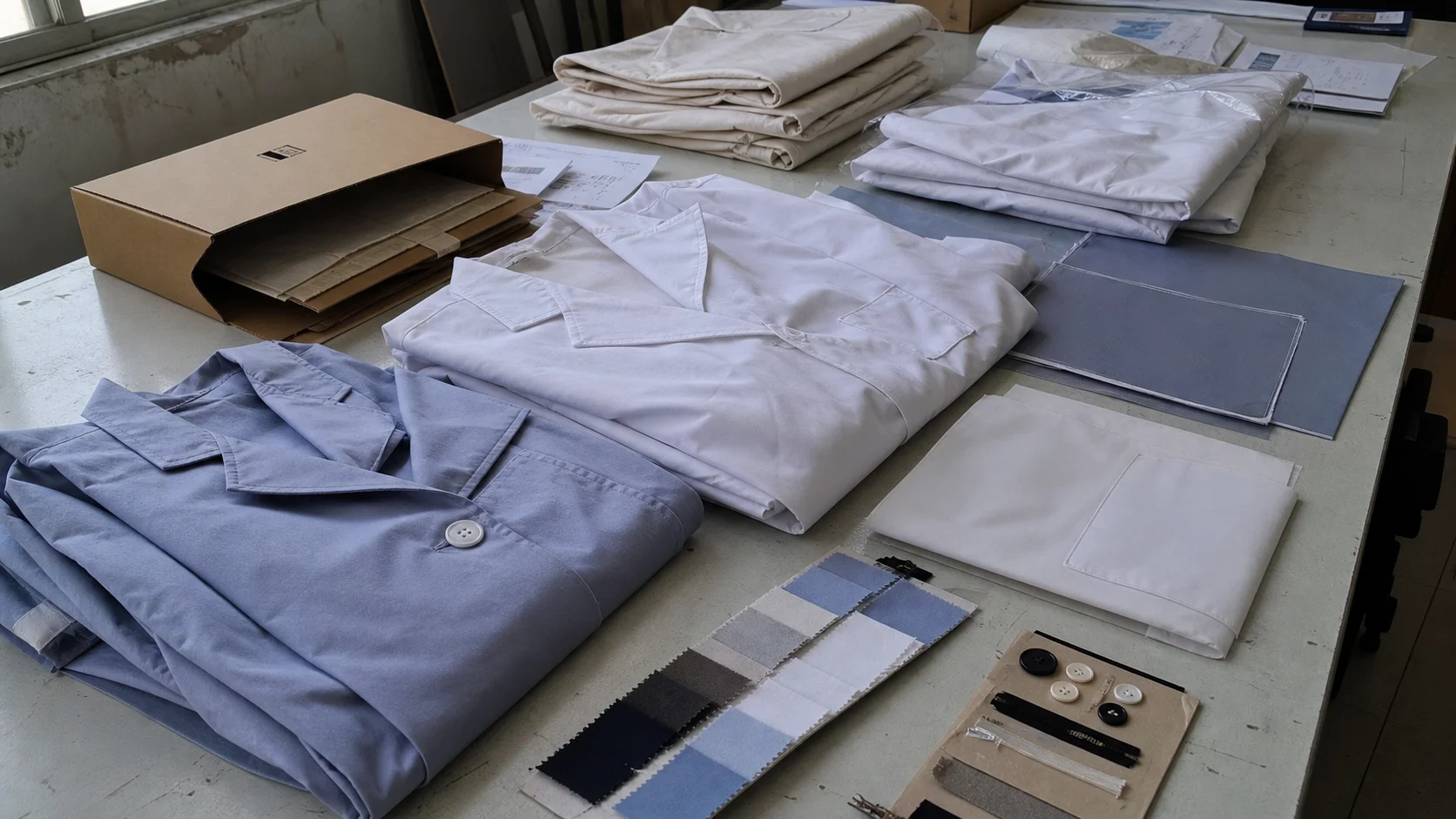
A production control outline for construction safety teams buying custom lab coats, covering specs, decoration, inspection checkpoints, defect controls,...
Custom Lab Coat QC Brief for Safety Team Buyers - Fabrikn production reference
Category: Quality & Inspection
Custom lab coats for construction safety teams sit in a narrow but important category. They are not fashion coats, and they are not full high-visibility jackets. They are usually worn by safety officers, materials testing staff, QA/QC engineers, environmental inspectors, site laboratory technicians, and compliance visitors who need clean identification, pocket utility, and a controlled professional appearance around construction zones, batching plants, material labs, and project offices.
This brief is written for buyers who need to control custom lab coat production before defects reach site. The main purchasing risk is treating a lab coat like a simple promotional garment. Once reflective tape, chemical-resistant fabric, FR requirements, size grading, embroidery, pocket loading, and repeated industrial laundering are added, the coat becomes a technical uniform. The order needs a production control plan, not only a logo file and a purchase order.
Construction safety teams use lab coats in mixed environments. A coat may be worn in a site lab during concrete cube testing, near aggregate dust, in a contractor meeting room, or during controlled walkthroughs where identification matters. The garment must look professional, but it also needs durability and basic protection aligned with the actual use case.
The most common sourcing mistake is under-specification. Buyers request “white lab coat with logo” and expect a supplier to infer fabric weight, shrinkage control, pocket reinforcement, cuff style, reflective tape quality, colorfastness, wash method, and labeling rules. That approach usually creates avoidable disputes after bulk delivery.
A custom lab coat production control brief should answer five questions before sampling starts:
For construction safety team buyers, the right garment is rarely the cheapest coat. It is the coat that matches site exposure, survives the expected wash cycle, and arrives consistently across sizes and batches.
A production control brief should begin with a clear product definition. “Lab coat” can mean several different garments in apparel manufacturing. A standard medical-style lab coat may not suit construction environments if the fabric is too light, the pockets are weak, or the white color becomes unusable after a few site visits.
Typical construction safety lab coat types include:
The buyer should not combine these into one vague specification. If one team needs reflective tape and another team needs chemical resistance, separate the styles or create clear variants under one program. This prevents the supplier from averaging the requirements into a coat that does not fully satisfy either user group.
For buyers building a repeat uniform program, it can be useful to discuss the full sourcing scope with a manufacturing partner that handles apparel development, bulk production, and QC. Fabrikn’s broader apparel support can be reviewed through its services page.
Fabric selection drives cost, comfort, durability, and compliance risk. In construction safety applications, a lightweight medical poplin may look sharp at first but fail under abrasion, dust exposure, and repeated laundering. A very heavy twill may last longer but become uncomfortable in hot climates.
Common fabric options include polyester-cotton blends, cotton twill, ripstop blends, anti-static fabrics, coated splash-resistant materials, and FR-certified fabrics. The buyer should specify fiber content, fabric weight, weave, color, finish, and required test performance.
Fabric Type Typical Use Purchasing Judgment Polyester-cotton twill, 180-240 gsm General site lab coats and QA/QC uniforms Good balance of cost, durability, and wash performance. Confirm shrinkage and pilling. 100% cotton twill, 200-260 gsm Comfort-focused coats for warmer conditions Breathable, but shrinkage and color fading need tighter control. Ripstop poly-cotton, 180-220 gsm Higher abrasion settings and field inspection use Stronger visual utility profile, but less formal than classic lab coat fabric. Coated splash-resistant fabric Limited liquid splash environments Useful only when the coating performance is tested and laundering limits are understood. FR fabric Specified flame-risk environments Requires verified certification and strict trim compatibility. Do not substitute without approval.For most non-FR construction safety team coats, a 200-220 gsm polyester-cotton twill is a practical starting point. It is usually stronger than lightweight poplin and still manageable for daily wear. For hot regions, buyers may move closer to 180 gsm, but this increases the risk of transparency, seam puckering, and shorter wear life.
Key fabric specifications should include:
If the garment is meant to provide protection, the buyer must avoid loose wording such as “chemical resistant” or “fireproof.” Those claims require defined standards, test methods, and validated materials. For ordinary safety team identification coats, “durable workwear lab coat” is often a more accurate description than implying protective certification that has not been verified.
Construction lab coats should be designed around movement and storage. Safety staff often carry pens, inspection forms, phones, tape measures, small tools, gloves, and ID cards. Pocket failure is a frequent complaint when the coat is built like a disposable medical garment.
Recommended construction points include:
Button selection needs more attention than buyers often give it. Cheap buttons crack or detach, especially after industrial laundering. Snaps are useful, but poor snap attachment can tear fabric. If metal snaps are used on FR or anti-static garments, compatibility must be confirmed.
Thread should match the garment’s performance need. Regular polyester thread is common for standard coats. FR garments need suitable FR sewing thread. Reflective tape must be stitched evenly, with secure ends and no twisting at side seams or armholes.
A good production brief does not only say what the garment should look like. It tells the factory where the garment is likely to fail and how those points must be reinforced.
Construction safety teams often need to be identifiable, especially during inspections and visitor coordination. Visibility can be achieved through fluorescent fabric, contrast panels, reflective tape, department color coding, or bold branding.
High-visibility requirements should be treated carefully. If the coat must comply with a specific high-visibility standard, the design, tape width, tape placement, background material, and test certification need to be confirmed. A white lab coat with two strips of reflective tape may improve visibility, but it should not be represented as certified high-visibility clothing unless it meets the required standard.
Branding methods include embroidery, screen printing, heat transfer, woven patches, and PVC or rubber badges. Each method has tradeoffs:
Logo placement should be defined with measurements from seams, not only shown in a mockup. For example, specify the left chest logo size, distance from shoulder seam, and distance from center front. If names or job titles are customized by wearer, the order needs a personalization data sheet and a proofing step before production.
Typical MOQ ranges depend on fabric availability, customization level, and whether special trims or certified materials are involved. For standard polyester-cotton lab coats with basic embroidery, buyers may see MOQs from about 100 to 300 pieces per style. For custom-dyed fabric, special reflective layout, FR fabric, or multiple branded trims, MOQs can move into the 300 to 1,000 piece range or higher.
Small team orders are possible, but unit cost rises quickly because pattern development, sampling, fabric sourcing, logo setup, cutting, and QC are spread across fewer units. If a construction company has several projects, consolidating demand across departments can reduce cost and improve consistency.
Order Type Typical MOQ Range Notes Basic stock fabric with logo 100-300 pcs Best for first rollouts and smaller safety teams. Custom color or custom trims 300-800 pcs Lab dips and trim approvals add time. Reflective or multi-panel design 300-1,000 pcs Pattern and tape placement need stronger QC. FR or certified protective coat Varies widely Material certification, testing, and compliance documentation drive feasibility.Lead time also varies. A straightforward custom lab coat using available fabric may take around 4-8 weeks after sample approval, depending on factory capacity, raw material availability, approval speed, and logistics. Special fabric, certification, custom dyeing, or complex branding can add several weeks.
Buyers should separate sample lead time from bulk production lead time. Delays often come from late logo files, unclear size breakdowns, missing care label instructions, or repeated sample changes. A clear brief reduces those delays more than aggressive follow-up after production has started.
Sampling is the buyer’s best opportunity to prevent bulk defects. It is not just a formality. For safety team lab coats, the sample should be reviewed by procurement, safety, and actual end users where possible.
A practical sample approval process includes:
The pre-production sample is especially important. A fit sample made from substitute fabric may not behave the same as bulk fabric. Reflective tape stiffness, fabric weight, and shrinkage can all affect garment appearance and comfort.
Approval comments should be written, dated, and linked to photos. Verbal approvals create disputes later. If the sleeve length is changed by 2 cm, the revised measurement table should show the change clearly.
Once the pre-production sample is approved, the bulk order still needs control. Construction safety team buyers should require checkpoints before the factory finishes the full run.
Incoming fabric should be checked for shade variation, stains, holes, weaving defects, coating consistency, and width. Reflective tape should be checked for width, color, surface damage, and certificate support where required. Labels, snaps, buttons, thread, and packaging should match the approved sample.
Cutting errors create size inconsistency that cannot be fixed later. The cutting room should control marker layout, ply height, fabric direction, shade grouping, and bundle identification. For coated or reflective garments, incorrect cutting direction can create visible panel differences.
Early-line inspection should check seam allowance, stitch density, pocket position, collar shape, sleeve setting, snap attachment, and tape placement. It is cheaper to correct the first 20 pieces than to repair 2,000 pieces after final inspection.
Branding defects are common and often commercially serious. Check logo size, color, position, spelling, department name, wearer name, and orientation. For embroidery, watch for puckering and backing irritation. For prints and transfers, check adhesion and curing.
The supplier should measure garments across sizes during production, not only at final inspection. Measurement tolerance should be agreed in advance. For lab coats, critical points usually include chest, waist, shoulder, sleeve length, center back length, armhole, cuff opening, and pocket placement.
Checkpoint What to Verify Why It Matters Fabric shade Panels match approved color and each other Mixed shade coats look unprofessional across teams. Reflective tape Width, placement, stitching, and surface condition Poor tape application affects visibility and appearance. Pockets Position, reinforcement, symmetry, and bar tacks Safety teams often load pockets heavily. Closures Button spacing, snap strength, alignment Weak closures fail quickly in daily use. Measurements Size spec and tolerance compliance Fit problems cause returns and low adoption.Final inspection should not be limited to counting cartons. AQL inspection can be used for larger orders, but the defect classification must match garment risk. For example, a small thread end may be minor, while an incorrect safety logo, missing reflective tape, or wrong fabric composition may be major or critical depending on the use case.
Common defects in custom lab coat production include:
Measurement failure deserves special attention. Lab coats with tight shoulders or short sleeves may be rejected even if fabric and stitching are acceptable. Safety teams need enough room for movement and, in some cases, for wearing over a shirt, polo, or light work layer.
Wash testing should be part of the approval plan if the coats will be laundered frequently. A sample that looks good before washing may show shrinkage, seam twisting, fading, or logo failure after three to five wash cycles. If industrial laundry is expected, domestic wash testing may not be enough.
Packing is often treated as a back-end detail, but poor packing creates distribution problems at project level. Safety teams may need coats sorted by department, site, name, or size. If cartons are mixed randomly, the receiving team loses time sorting garments and may report shortages that are actually packing errors.
A reliable packing instruction should define:
If garments are personalized with names, packing must be especially controlled. A name-list cross-check should be completed before shipment. Personalized errors are expensive because the garment often cannot be reassigned.
Buyers should request a packing list before shipment and compare it against the purchase order. For larger rollouts, staged shipment by project or region can be more practical than sending all cartons to one location.
The right supplier for custom lab coat production is not always the lowest bidder. A credible supplier should be able to interpret technical requirements, develop samples, control trims, provide measurement reports, and communicate production risks early.
Buyers should ask potential suppliers for:
A very low quote may indicate lighter fabric, cheaper trims, fewer inspection steps, or unapproved substitutions. That does not always mean the supplier is unsuitable, but the buyer should identify where the savings are coming from. In safety-related uniforms, hidden substitutions are rarely worth the short-term saving.
For teams comparing production options or building a custom uniform program, background information about Fabrikn can be found on the about us page. Buyers ready to discuss specifications, sampling, or production planning can use the contact page.
The following structure can be used as a working brief when requesting quotations or approving production:
Section Information to Provide Product description Custom lab coat for construction safety team, intended use, wearer type, and environment. Fabric Fiber content, gsm, weave, color standard, finish, shrinkage tolerance, and test requirements. Design Length, collar, closure, pockets, cuffs, vents, reflective tape, and reinforcement points. Branding Logo files, placement measurements, method, colors, name personalization, and approval proof. Size range Size chart, tolerance, grading rule, wearer fit expectations, and size ratio. Sampling Fit sample, fabric approval, logo approval, wash test, and pre-production sample requirements. Inspection AQL level if used, defect classifications, measurement method, and critical checkpoints. Packing Polybag, carton quantity, label, barcode, project allocation, and packing list format.This type of brief reduces ambiguity. It also gives the supplier a fair basis for costing. If the buyer only sends a photo, the quotation may look attractive but leave too many open points for later disagreement.
Custom lab coats for construction safety teams should be purchased as controlled workwear, not as generic promotional apparel. The strongest orders define fabric performance, trim quality, size tolerances, branding placement, sampling gates, and inspection risks before bulk production begins.
A practical buyer should focus on three priorities. First, match the coat to the real working environment. Second, approve a pre-production sample made with the actual materials. Third, inspect the bulk order against measurable requirements, not subjective appearance alone.
Where protection claims are required, documentation and standards matter. Where the coat is mainly for identification and professional presentation, durability, fit, wash performance, and branding consistency will usually drive user satisfaction. Clear specifications make both outcomes easier to control.
Get a free quote from Fabrikn — your trusted B2B clothing manufacturer with 10+ years of experience. MOQ as low as 200 pieces.
Get a Free Quote →For general construction safety team use, 180-240 gsm polyester-cotton twill is a common practical range. Around 200-220 gsm often gives a good balance of durability and comfort. Lighter fabrics may be cooler but can wear out faster or look transparent, while heavier fabrics may be less comfortable in hot conditions.
Basic custom lab coats using available fabric and standard branding may start around 100-300 pieces per style. Custom colors, special trims, reflective layouts, or certified protective materials can increase MOQ to 300-1,000 pieces or more. Exact MOQ depends on fabric sourcing, factory setup, and customization complexity.
A standard order may take about 4-8 weeks after final sample approval, excluding shipping. Special fabric, custom dyeing, FR materials, compliance testing, or complex personalization can extend the timeline. Delays often come from slow sample approvals, incomplete logo files, or late size breakdowns.
Reflective tape is useful when wearers need better visibility near vehicles, equipment movement, or low-light areas. If the garment must meet a high-visibility standard, the tape placement, background fabric, and certification need to be designed and verified accordingly. Decorative reflective strips should not be described as certified high-visibility protection unless they meet the required standard.
Buyers should check fabric feel and weight, fit, sleeve length, coat length, pocket placement, pocket reinforcement, closure quality, logo position, reflective tape placement, washing performance, and measurement tolerance. A pre-production sample made with bulk fabric and trims should be approved before mass cutting.
Common defects include wrong fabric weight, shade variation, weak pocket stitching, snap or button failure, uneven logo placement, embroidery puckering, poor reflective tape stitching, incorrect measurements, dirty garments, and mixed sizes in cartons. These risks should be included in the inspection checklist before production begins.
Sometimes, but not always. A general QA/QC lab technician and a safety officer walking near active equipment may need different visibility, pocket, and fabric requirements. If chemical splash, FR, anti-static, or high-visibility compliance is required, separate styles or clearly defined variants are usually safer than one compromise design.
Embroidery is durable and professional, but it can pucker lighter fabrics and may feel stiff on large logos. Printing is cost-effective and clean for larger graphics, but durability depends on ink quality and curing. Heat transfer gives sharp detail but can peel if poor materials or harsh laundering are used. The best method depends on fabric, logo size, wash method, and budget.