
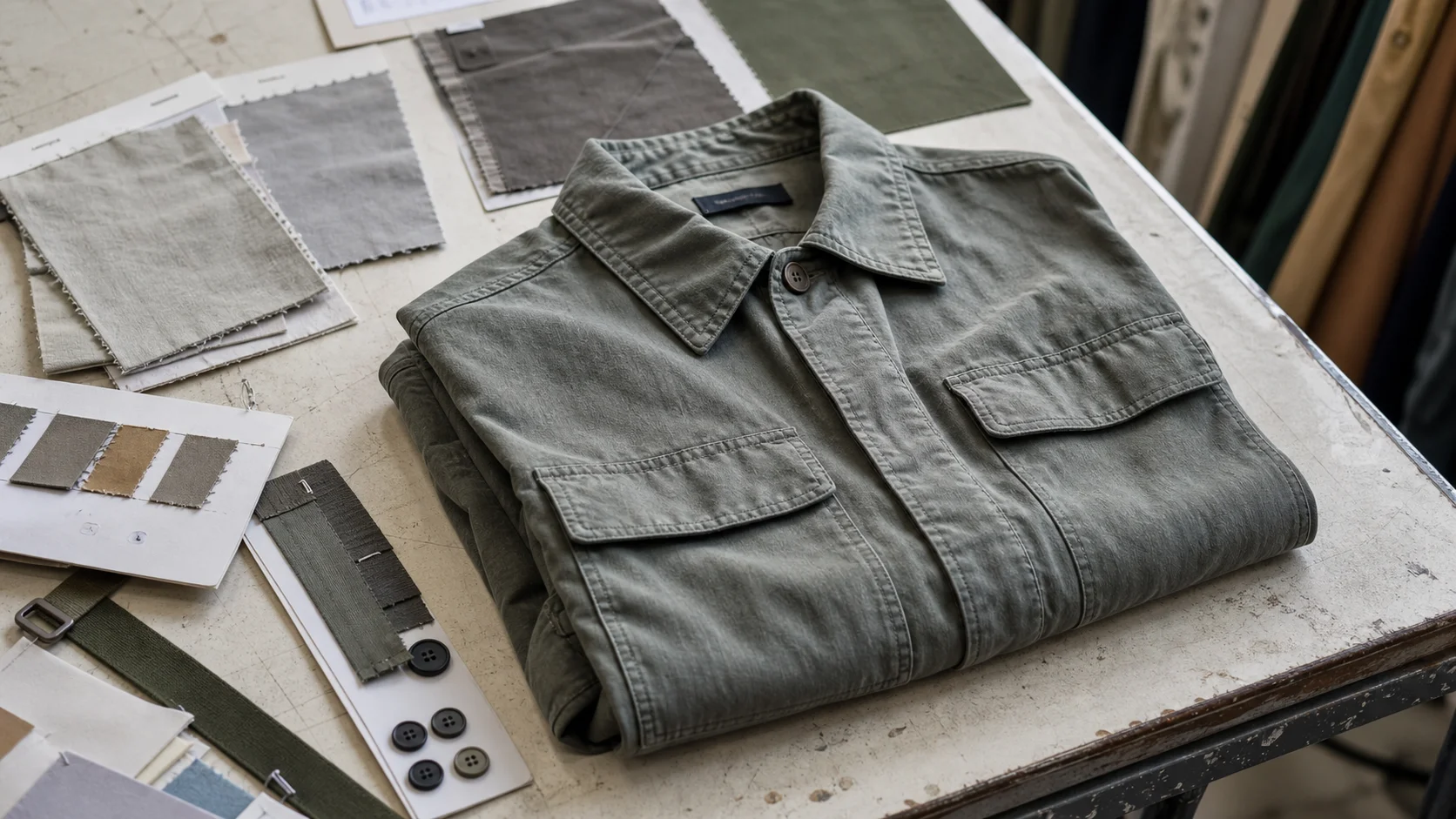
A practical SEO outline for security contractors evaluating custom lyocell utility jackets, with a focus on fit consistency, size grading, durability, and...
Custom lyocell utility jacket size grading is one of those development topics that looks simple on a spec sheet and becomes expensive the moment fit consistency slips across sizes. For security contractors, the stakes are even higher. A utility jacket must allow movement, layer cleanly over uniforms, hold equipment comfortably, and still look disciplined enough for client-facing work. In sustainable fashion, lyocell brings a strong case because it offers a cleaner material story than many conventional fibers, but the fabric choice alone does not solve pattern balance, shrinkage control, or production tolerances.
This review looks at how to approach custom lyocell utility jacket size grading for security contractors, what to watch in sampling, which construction details matter most, and where sourcing teams usually run into trouble. The focus is practical: how to get a jacket that fits across a size run, supports daily use, and keeps the sustainability message credible. If you are building a program with a private-label or uniform supplier, the grading conversation should start early, not after the first production sample.
Custom Lyocell Utility Jacket Size Grading Review - Fabrikn production reference
Lyocell has become a practical material choice for workwear and uniform programs because it combines a softer hand with decent drape and breathability. For a utility jacket, that matters. Security staff often move between indoor and outdoor environments, stand for long periods, and need a layer that does not feel stiff or plastic-heavy. Lyocell can improve comfort compared with some coarse cotton blends or heavily synthetic outer layers.
That said, lyocell is not a free pass. Pure lyocell can be prone to wrinkling and may need careful handling in wash and wear testing. In jacket programs, it is often blended with cotton, recycled polyester, nylon, or elastane depending on the required durability and stretch. The blend decision should be based on end use, not trend language. A security contractor jacket that sees daily abrasion, radio clips, and repeated laundering may need a more robust face fabric than a fashion-oriented utility piece.
For buyer teams, the right question is not “Is lyocell sustainable?” but “Is this lyocell construction durable, stable in grading, and appropriate for repeated commercial laundering?”
Security contractors generally need a jacket that supports mobility, device storage, and a controlled appearance. Fit is functional here, not decorative. The jacket should allow shoulder rotation, reaching, bending, and seated wear without pulling across the upper back or stomach. If the garment is used as part of a uniform system, it also needs to fit over base layers, polos, or lightweight sweaters.
The most common fit issues in contractor uniforms come from underestimating layering allowance and over-tight grading in larger sizes. A size medium may look fine on a sample fit model, while size XL or 2XL can become restrictive at the armhole, across the upper sleeve, or at the front belly area. For security teams, that can affect comfort and the professional look on site.
A practical fit spec for this category usually includes:
Fit requirements should be defined by size range and role. A supervisor jacket may need a cleaner silhouette, while a patrol or site-security style may require more storage and easier movement. One grading chart rarely serves every function equally well.
Size grading is the systematic increase or decrease of dimensions from a base size to create the full size range. In custom lyocell utility jackets, grading is where many programs succeed or fail. If the base size is built only for appearance, the larger and smaller sizes can distort quickly. If the base pattern is balanced around movement, the size run will usually hold up better.
The base sample should be developed from a clear size chart, not from a vague “regular fit” instruction. Buyers should define the intended wearing comfort, the target body measurement references, and the layering allowance. For example, a jacket designed for everyday security uniform use may need a chest ease different from a jacket intended as a smart casual outer layer.
Typical grading adjustments vary by market and style, but buyers should expect more careful control in these areas:
For utility jackets, grading is not just “add the same amount everywhere.” Larger sizes often need more proportional change in sleeve girth, armhole depth, and body length than smaller sizes. If the grader keeps increasing width without correcting proportions, the jacket can look heavy and sit poorly on the body.
Not every measurement deserves equal attention. In a custom lyocell utility jacket review, a few points deserve special scrutiny because they directly affect wearability and consistency across the size range.
Measurement Why It Matters Typical Risk if Poorly Graded Chest width Determines layering comfort and front closure ease Pulling at buttons or zipper, restricted movement Armhole Controls shoulder movement and sleeve hang Binding, riding up, limited reach Sleeve bicep Affects range of motion and layered wear Tight sleeves, seam stress, bad silhouette Back length Helps coverage when seated or reaching Rides up, exposed lower back, poor coverage Shoulder width Sets jacket balance and comfort Droop, pull, distorted collar position Hem sweep Preserves clean shape in larger sizes Boxy or flared lookFor security contractor use, the back shoulder and upper sleeve need close attention. Staff often reach outward, carry equipment, or sit in vehicles for extended periods. A jacket can look acceptable on a mannequin and still fail the practical motion test if the armhole is too high or the sleeve lacks room in the upper arm.
Another issue is balance between front and back length. In a utility jacket with pockets and a structured look, too much front drop can make the style look sloppy, while too little back coverage can expose the shirt underneath when bending. The grading should preserve the intended line, not just the measurement count.
Fabric specification matters because lyocell behaves differently from many standard workwear fabrics. Fabric weight, weave, blend ratio, finishing, and shrinkage control all affect the way the jacket grades and wears. A lighter lyocell twill may drape nicely but show wrinkles and structure loss more quickly. A denser weave or blended construction may perform better in a contractor setting, though it may reduce softness.
Buyers should lock down these points before finalizing the size chart:
Trims also affect fit and grading consistency. Zippers, snaps, buttons, elastic inserts, drawcords, cuff tabs, and pocket reinforcements all change how the jacket sits on the body. A heavy metal zipper can alter front drape. A structured collar interface can affect neckline feel. A poor-quality snap may distort the placket under stress.
For security contractor programs, pocket configuration deserves special mention. Breast pockets, lower patch pockets, sleeve pen pockets, and internal device pockets should be positioned so that they remain functional without pulling the garment out of shape. When pockets carry phones, notepads, gloves, or small radios, the garment may need more room in the upper chest and side body than a standard fashion jacket.
A clean sample approval process is one of the best ways to protect the grading plan. For a custom lyocell utility jacket, buyers should expect more than one sampling round if the style includes utility pockets, hardware, or mixed fabrics. One sample may confirm the aesthetic, while another confirms fit and production feasibility.
A careful approval path usually includes:
Fit checks should include actual movement, not just standing pose evaluation. Ask for reach-forward, arm raise, seated posture, and cross-body movement. If the jacket is intended for security contractors, test it with the likely layer system underneath. A size that fits over a t-shirt may fail once a polo or thermal layer is added.
When reviewing samples, check the following closely:
If the sample looks good only after heavy steaming or careful pinning, that is not production-ready confidence. A commercial jacket should be stable in ordinary wear conditions, not dependent on hand-finishing tricks.
Custom jackets in sustainable fabrics often sit at a higher MOQ than off-the-shelf programs. That is usually due to fabric sourcing, dyeing, trim minimums, and the cost of setting up graded patterns and line planning. Typical MOQ ranges can vary widely by factory, style complexity, and fabric availability, but many custom apparel programs begin around 300 to 500 pieces per color/style for simpler builds. Complex construction, premium trims, or custom-dyed lyocell blends can push MOQ higher.
Lead time depends on more than sewing capacity. Buyers should account for fabric development, lab dips or color approvals, shrinkage testing, pattern revision, sample rounds, and final production queue time. A straightforward repeat order may move faster, while a first-time custom lyocell utility jacket program can take significantly longer because the fit and fabric behavior must be proven first.
Lead time is usually influenced by:
From a purchasing standpoint, it is wise to treat lead time as a chain of dependencies, not a single date. If the fabric is delayed, the grading schedule may be delayed. If the first fit sample fails, the pre-production sample may move out. Contract programs that need uniform rollout should build in buffer time.
Custom lyocell utility jackets can fail quality checks in ways that are easy to miss during design review. Some defects are visual. Others only appear after wear, washing, or grading across sizes. For security contractor use, reliability matters more than novelty, so quality control should be conservative.
Common risks include:
Inspection should cover both measurement accuracy and construction quality. A jacket can pass measurements and still fail on appearance if the fabric puckers at a high-stress seam. It can also fail if the grading chart is correct but the sewing tolerances are too loose from size to size.
Buyers should ask about tolerances for key points such as chest, sleeve length, back length, and armhole. A sensible tolerance framework is more useful than a vague promise of “good quality.” The best factories will usually be specific about allowable variation and how they measure during in-line and final inspection.
Not every detail deserves premium spending. In utility jackets, it is usually smarter to invest in fit engineering, fabric stability, and reinforcements than in decorative styling extras. A security contractor program benefits more from reliable pocket construction and clean grading than from complicated fashion trim.
Good places to spend include:
Places where buyers can often simplify include:
The tradeoff is clear. A jacket can look more distinctive with added detailing, but every extra seam and trim point creates another place for grading variation or production defects. For contractor uniforms, the cleaner route is often the stronger one.
Sustainable fashion claims need to be grounded in material and process realities. Lyocell is a credible starting point because it is derived from wood pulp using a more controlled solvent process than some older fiber routes. Still, sustainability should be assessed across the whole garment system, not only the fiber name on the hangtag.
A responsible sourcing brief for a custom lyocell utility jacket should ask about:
There is a practical sustainability argument in getting grading right the first time. Poor fit leads to returns, rework, or replacement stock, all of which add waste. For uniform buyers, the most sustainable program is often the one that reduces production errors, size confusion, and unnecessary churn.
If your team is building a custom lyocell utility jacket program, the first step is usually to align the product brief with the intended use case, size range, and sustainability target. Fabrikn’s service structure is a practical place to begin if you want to review development options, sampling flow, and production requirements before committing to bulk.
You can review the broader development scope at fabrikn.com/services/, then move to direct project discussion through fabrikn.com/contact-us/. For buyers who want background on the company’s positioning and approach, the about page can help frame the conversation before you send a tech pack.
For a custom security contractor jacket, the most useful supplier questions are not the flashy ones. Ask how the factory handles grading between sizes, what shrinkage allowance is built into the pattern, how many sample rounds are normal, and whether the fabric choice supports your target wash cycle. The answers will tell you far more than a mood board ever will.
Custom lyocell utility jacket size grading is a technical sourcing problem dressed up as a style decision. For security contractors, the jacket must move well, layer cleanly, hold up under daily use, and stay within a professional uniform standard. Lyocell can support that brief, but only if the fabric spec, grading logic, and sample approval process are handled with discipline.
The most reliable programs start with a realistic fit brief, a conservative approach to construction, and a willingness to test before bulk. Buyers who focus on armhole balance, sleeve room, body length, and wash stability usually get better outcomes than those who chase only fabric labels or visual styling. In sustainable fashion, the best result is not just a lower-impact fiber. It is a garment that performs long enough to justify being made in the first place.
Get a free quote from Fabrikn — your trusted B2B clothing manufacturer with 10+ years of experience. MOQ as low as 200 pieces.
Get a Free Quote →Lyocell offers a softer hand, good breathability, and a cleaner sustainability profile than many conventional fibers. For utility jackets, it works best when the construction adds enough structure and durability for daily wear.
MOQ varies by factory and fabric plan, but many custom programs start around 300 to 500 pieces per style/color. Complex blends, custom dyeing, or specialized trims can increase the minimum.
Chest, armhole, sleeve bicep, shoulder width, back length, and hem sweep are usually the most important. For security contractor use, upper sleeve and armhole balance deserve especially close review.
One prototype is rarely enough for a custom jacket. Most programs need at least one fit sample and one revised sample, and some require a pre-production sample with final fabric and trims.
Fabric sourcing, color approval, pattern corrections, trim availability, wash testing, and production queue time all affect lead time. A first-time development usually takes longer than a repeat order.
Watch for shrinkage variation, seam puckering, pocket sag, collar twisting, and hardware issues. A jacket should be checked both for measurements and for how it behaves after wear and wash testing.
Pure lyocell can work, but blends are often more practical for workwear because they may improve durability, wrinkle recovery, and shape retention. The right choice depends on the expected use and wash cycle.