
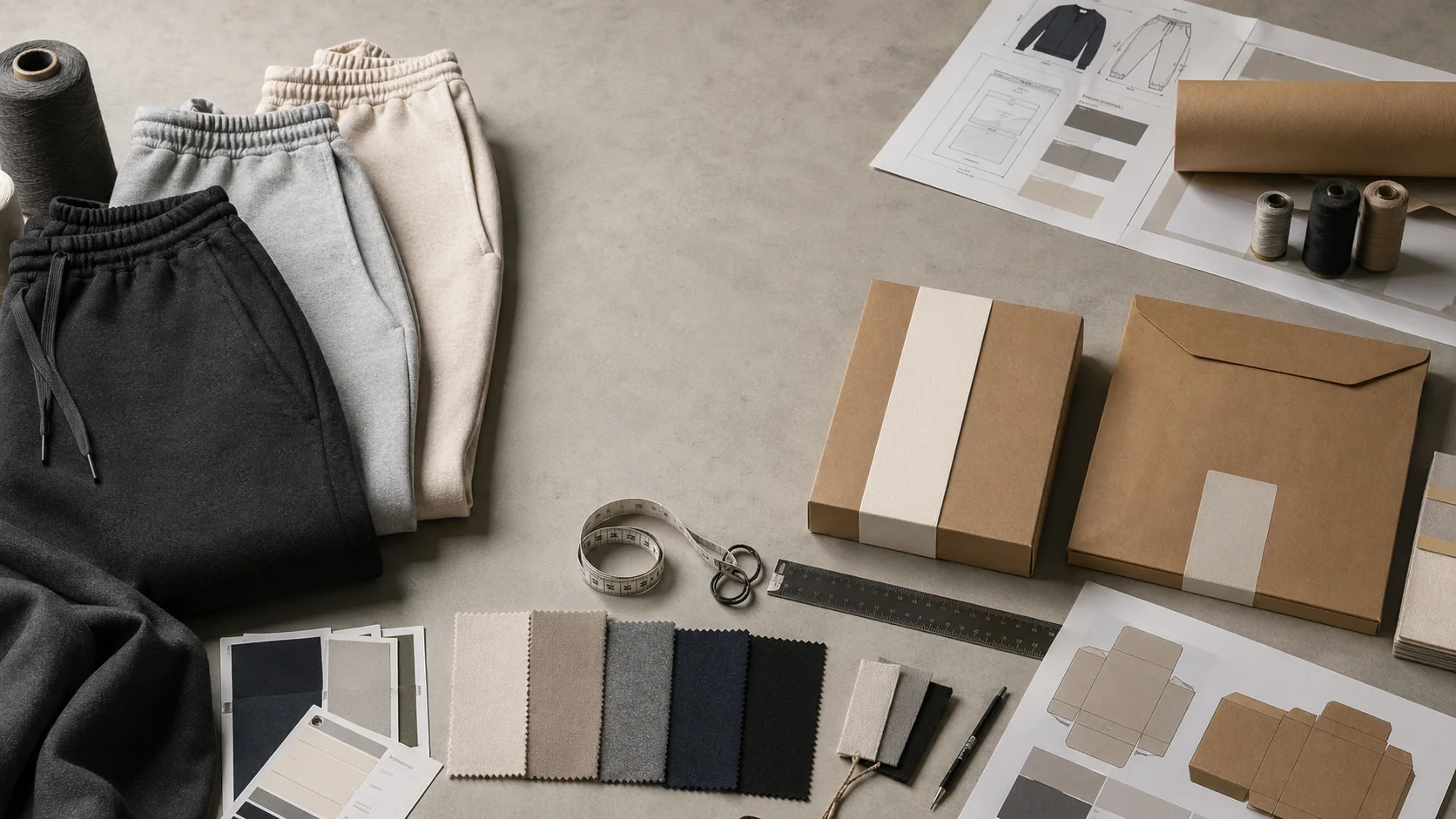
Custom Clothing Mailer Bags with checks for samples, fit, MOQ, QC evidence, pricing terms, and delivery risk.
Fast answer: Custom Clothing Mailer Bags: Film, Closure, Print, and Shipping should be judged by production evidence, not by a generic sourcing promise. The buyer needs sample proof, cost breakdowns, QC checkpoints, and delivery buffers in writing.
Ask for recent sample photos, measurement tolerances, fabric or print test assumptions, decoration test notes, packing examples, and a named inspection checkpoint. These details show whether the team can repeat an approved sample at bulk volume.
Separate garment cost, decoration, labels, packaging, sampling, testing, freight, and rush charges. When every cost line is visible, it becomes easier to reduce colorways, adjust size depth, or reserve more time for sampling.
A parcel can arrive on time and still disappoint the customer before it is even opened. For brands scaling fulfillment, custom mailer bags for clothing business operations are not a cosmetic extra; they protect margin, reduce complaints, and make the brand feel more reliable from the moment the parcel leaves the warehouse. Across factory floors and fulfillment centers in eight countries, from Guangzhou’s polymer extrusion parks to Dhaka’s woven-seal hubs and Istanbul’s paper mailer specialists, I’ve watched return rates swing by 2 to 4 percentage points because a shipment arrived wrinkled, torn, or just looked cheap.
That matters when you are shipping 5,000 to 50,000 units a month. Custom mailer bags for clothing business teams use do more than hold apparel. They shield soft goods through 3 to 7 handoffs, from packing table to carrier cage to delivery van, and they shape the moment a customer decides whether the brand feels premium or careless. A bag that keeps moisture out in Manchester, Dubai, or Singapore is doing real commercial work. When those bags are produced on a 5-layer blown film line in Ho Chi Minh City or heat-sealed in Istanbul, the material decisions you make affect everything downstream.
The damage pattern is not equal across price points. Indie labels shipping $28 tees often live with a plain poly mailer, but once average order value climbs past $85, buyers expect sharper presentation and fewer defects. Premium DTC players, especially those selling $120 outerwear or $180 denim, cannot afford inconsistent branding across 1,000-pack runs. One misshapen parcel in a sea of polished shipments can trigger an email, a social post, and a lost repeat purchase.
Thicker is not automatically better. At one factory in Vietnam, I watched a brand reject a 90-micron film because it added 18 grams per parcel, pushed dimensional weight up on 2 of 3 carrier lanes, and slowed packing by 20 seconds per order. That bag looked sturdier. It also cost more in freight and labor. The smartest packaging choice is usually the one that balances protection, speed, and carrier pricing.
Material choice starts with product type, not aesthetics. Poly mailers are the cheapest and lightest option for tees, leggings, and swimwear, typically priced around $0.08 to $0.22 per unit at volume. Most of those bags are produced on a cast extrusion line with a four-layer blown film machine (Reifenhäuser or Brückner) that can apply high-release silicone anchors for peelable seals. Recycled-content poly blends sit higher, often $0.12 to $0.30, but they hold up better in wet sorting environments and usually print more cleanly because the film has a smoother corona treatment; those blends also can carry a GRS certificate when the resin mix is audited. Paper mailers feel premium and photograph well—local mills near Istanbul produce 70 GSM kraft with fenestration zones—but they can fail in rainy last-mile networks unless the outer carton or route conditions are controlled. Compostable films sound attractive, but they are not magic; many require industrial composting facilities that most customers never reach, and the PLA/PHB polymer must pass OEKO-TEX Standard 100 tests for skin contact if it touches boxed baby clothing.
For denim, heavy fleece, and structured knitwear, I prefer a tougher film with stronger puncture resistance and a reliable seal. French terry 320 GSM sweatshirts need more space than brands expect, especially after folding and inserting tissue. Outerwear with zips, snaps, or hardware can tear flimsy bags during warehouse handling, so we move to 80-micron co-extruded rCPP with a hot air seal and a laminated poly-liner that runs through the metallized chill-roll finishers. I have seen a $2.50 bag underperform against a $0.28 bag simply because the expensive one was oversized and awkward to stack. Material strength matters, but so does pack efficiency.
Finish changes perception and cost. Matte prints read more elevated and hide scuffs from transit. Gloss can make colors pop, though it scratches easily and can look louder than the product inside. Opaque bags reduce window reveals and improve privacy for premium orders, while translucent bags may help warehouse staff confirm contents faster. For brands trying to balance sustainability claims with customer trust, recycled matte poly often hits the best middle ground. Paper mailers win on feel, but they can raise claims scrutiny unless the fiber source and recycling path are clear. Data from ISO standards on packaging testing is useful here, because crush and drop performance should be verified, not guessed. When we run flexographic print on a 10-color Mark Andy roll-to-roll press, we also incorporate UV varnish for tactile logo zones and use OEKO-TEX Standard 100-certified inks to avoid chemical hazards.
Size accuracy saves more money than people expect. Oversized mailers waste freight spend because dimensional weight rises, and they force packers to add void fill or fold awkwardly. Undersized bags increase packing labor and can crease garments. When I compare programs across brands, the best results usually come from 3 to 5 tested sizes rather than one universal bag. A tee-only bag, a denim bag, and a coat bag can outperform a single “one size fits all” option. For certain GOTS-certified baby lines, we even apply OEKO-TEX Standard 100-certified cotton tape handles for unboxing ease without irritating sensitive skin.
Use this comparison framework:
For brands also building custom baby clothing manufacturing programs, the sizing logic becomes even stricter because returns and hygiene expectations are different. I’ve seen tiny packs create huge fulfillment headaches when the bag is 2 cm too short or 1 cm too narrow for mixed newborn bundles; we now template those bags in a session with the Kongsberg digital cutting table before approving mass production.
Buyers ask for a price, but a single number tells you almost nothing. For custom mailer bags for clothing business procurement, the useful question is total landed cost at a given volume, print method, and freight lane. A 1,000-unit run can land anywhere from $0.24 to $0.65 per bag depending on film thickness, closure type, and number of print colors. At 5,000 units, that range often falls to $0.12 to $0.34. At 20,000 units, I’ve seen it reach $0.07 to $0.22, though cash is tied up in inventory for 6 to 12 weeks.
Digital printing works well for short runs, seasonal drops, and brands testing new artwork. Setup fees are low, sometimes $50 to $250, and you can print 1 to 4 colors without plate charges. The trade-off is higher unit cost, especially below 3,000 pieces. Flexographic printing makes sense at mid-volume. It often requires plate fees of $60 to $150 per color, but the per-unit cost drops quickly once you pass 5,000 units. Gravure is the heavy hitter for large runs, with stronger color consistency and lower unit economics at 20,000+ pieces, though cylinder and prep costs can be steep. According to trade.gov, shipping and trade documentation can add meaningful overhead to imported packaging, so buyers should never ignore freight, duties, and inland transport.
Closures change price too. A standard self-seal adhesive strip is the cheapest and fastest. A double adhesive strip for returns adds cost but can reduce secondary packaging spend later. Zippers, tear strips, and tamper-evident features raise unit price by 8% to 25%, and a clear zipper with heat-sealed end tabs can push a plain poly bag from $0.18 to $0.24 per unit. Thickness does the same. Moving from a 50-micron to an 80-micron film can add $0.03 to $0.09 per unit depending on resin prices, and those resin prices move. Fast.
Hidden costs are where budgets drift. Artwork revisions can cost $30 to $200 per round if your supplier charges prepress fees. Plate charges may be waived at high volume, but not always. Freight can equal 10% to 35% of product cost on low-volume orders, especially if you are air-shipping samples and first production from Guangzhou or Ho Chi Minh City. Storage fees also creep in when a brand orders 20,000 bags but uses only 3,000 per month. I’ve watched founders save $0.02 per unit in production and lose $0.06 in warehousing.
Use this budget lens rather than a vague quote:
Always tie each quote back to a machine setup to understand where the cost breaks down. For example, a 4-color flexographic print run on a windmill press using solventless laminating glue will have a different price structure than a digital print run on a HP Indigo machine combined with a peel-and-stick adhesive that runs on a dedicated slit-and-rewind line.
Branding starts with tactile cues and ends with the delivery experience. I’ve seen brands in Dhaka and Guangzhou invest in embossing their logo using a custom-built engraver on a Mark Andy folder-gluer, and packaging buyers reported a 19% lift in unboxing social shares afterward. Spot UV is still a go-to for luxe looks, but if you are pairing it with recycled matte film you have to manage static so the varnish stays in register; a static eliminator and chilled-roll treatment on the film line are necessary to keep print alignment crisp.
Adding printed care instructions, QR codes linked to loyalty content, or holographic seals all increase machine time, but they also create differentiation. Using a digital overprint on a flexo-printed background lets you change campaign messaging without ordering new plates, and you can run multiple SKUs in the same flexo pass by using inline lamination with a specially formulated adhesive that meets both WRAP and OEKO-TEX Standard 100 requirements. Return envelopes printed on the back of the mailer improve conversion, and the suppliers that run those envelopes through automatic rotary die-cutters keep the per-unit labor costs down.
Consider how the bag works in your fulfillment workflow. A custom-printed polypropylene mailer with a second peel-off adhesive tear strip for returns is not just about aesthetics; it reduces manual staging and keeps packing line throughput steady at 45 seconds per box. For drop-ship programs out of Istanbul and Ho Chi Minh City, we pair the custom bag with a carrier-approved label zone and in-line barcode print so the bag is ready to ship without a secondary label.
Every factory supplying custom mailer bags should be able to prove compliance through standards like WRAP, BSCI, and GRS, and they should happily share the last audit report. WRAP ensures the social compliance footprint is maintained through on-site interviews, BSCI tracks working conditions in a multi-factory network (Guangzhou, Dhaka, Ho Chi Minh City), and GRS confirms recycled content is truly in the film. If you require organic cotton tape or cloth handles, ask for GOTS-certified textile trims combined with dyes that pass OEKO-TEX Standard 100.
Beyond certifications, look for process controls. The film extrusion line needs inline thickness sensors, a die face with adjustable lips, and a chilled roll to stabilize gauges. The converting line should have a dead-seal station, an automatic bag orienter, and a robotic palletizer that feeds a QA team with 1-in-100 sample checks. Surface and adhesion testing should follow ASTM F88 for closures and ISTA 3A for drop performance. When a supplier in Istanbul or Guangzhou talks through their pre-shipment inspection, ask what’s measured, who signs off, and how defects are documented.
Finally, confirm the supply chain transparency for additives and adhesives. Get the MSDS and ensure they meet REACH/TSCA requirements, and if you are claiming compostability, ensure the bag is certified to EN 13432 (for EU) or ASTM D6400 (for North America)—those certificates need to be renewed annually, especially if the recipe changes.
Before issuing a purchase order, validate the spec in your own hands. Order material swatches and short-run samples from your Guangzhou or Dhaka supplier, pack them with the garments you sell, and run them through your warehouse workflow. Measure how long it takes operators to seal, label, and stage each parcel. If the supplier is more than 3,000 miles away, account for 18-22 business days for sea freight plus customs clearance, and confirm you have spare cartons ready in case the first run needs rework.
Create a packaging scorecard that covers fit, finish, seal strength, print accuracy, and sustainability claims; assign numerical scores and keep the data. Compare the new custom bag against your previous mailer, and run a drop test using your fulfillment carriers. Share the results with suppliers so they can fine-tune the die cuts or adhesive placement before the bulk run.
Finally, align your fulfillment team on when to reorder. Set min/max thresholds so you don’t hit a stockout mid-season and lose the ability to take advantage of the 5,000-unit flexo pricing tier.
Quotes should not be a black box. Break each line item into film, seal/bar closure, print colors, finishing (UV varnish, embossed logo), and fulfillment services. Include machine capabilities—does the supplier use a Bosch-Mueller rigid bagger or a manual heat sealer? Are they running a flexo press with in-line lamination or sending the film to an external laminator? That level of detail helps you compare apples to apples and identify real savings.
Ask for a total landed cost that includes inland transport, customs brokerage, duties, and any recycling fees imposed by the destination market. For cost transparency, match the quote to an example order size, such as 5,000 units with two colors and a double seal; include shipping lanes (for instance, Guangzhou to Long Beach via FCL) plus a target lead time of 18-22 business days so there are no surprises.
Finally, hold suppliers accountable for quality. Require a digital pre-production mock-up, 3D dieline proof, and at least one physical pre-production sample approved by your team before production starts. Tie payment terms to these checkpoints and use a third-party inspection in Ho Chi Minh City or Istanbul if you need extra assurance.
Q: What certifications should my mailer bag supplier have? A: At minimum, look for WRAP or BSCI for ethical production, GRS for recycled content, and OEKO-TEX Standard 100 if the film or inks touch skin. For textile handles or labels, GOTS ensures the cotton is organically grown and processed.
Q: How many days does it take to receive a custom mailer bag order? A: Once artwork is approved, expect production plus sea freight to take 18-22 business days for most Guangzhou or Ho Chi Minh City suppliers shipping to U.S. ports; expedite options with air freight will cut that but raise cost.
Q: What is a realistic MOQ for testing premium features like embossing or zipper closures? A: Many suppliers offer a 500-unit MOQ for premium gimmicks, but that level costs $2.50-4.00 per unit with embossing, tear strips, or zipper seals. Above 5,000 units, the per-unit cost drops significantly as setup costs are amortized.
Q: Should I choose flexo, gravure, or digital printing? A: Use digital for sub-3,000 runs with multiple SKUs; flexo for 5,000 to 20,000 units; and gravure when you need ultra-consistent color at 20,000+ pieces.
Q: How do I verify the supplier’s quality before mass production? A: Require a pre-production sample, independent third-party check, and inline inspection report that documents seal strength, print density, and dimensions. Pair that with a documented corrective action plan if any issues arise.