
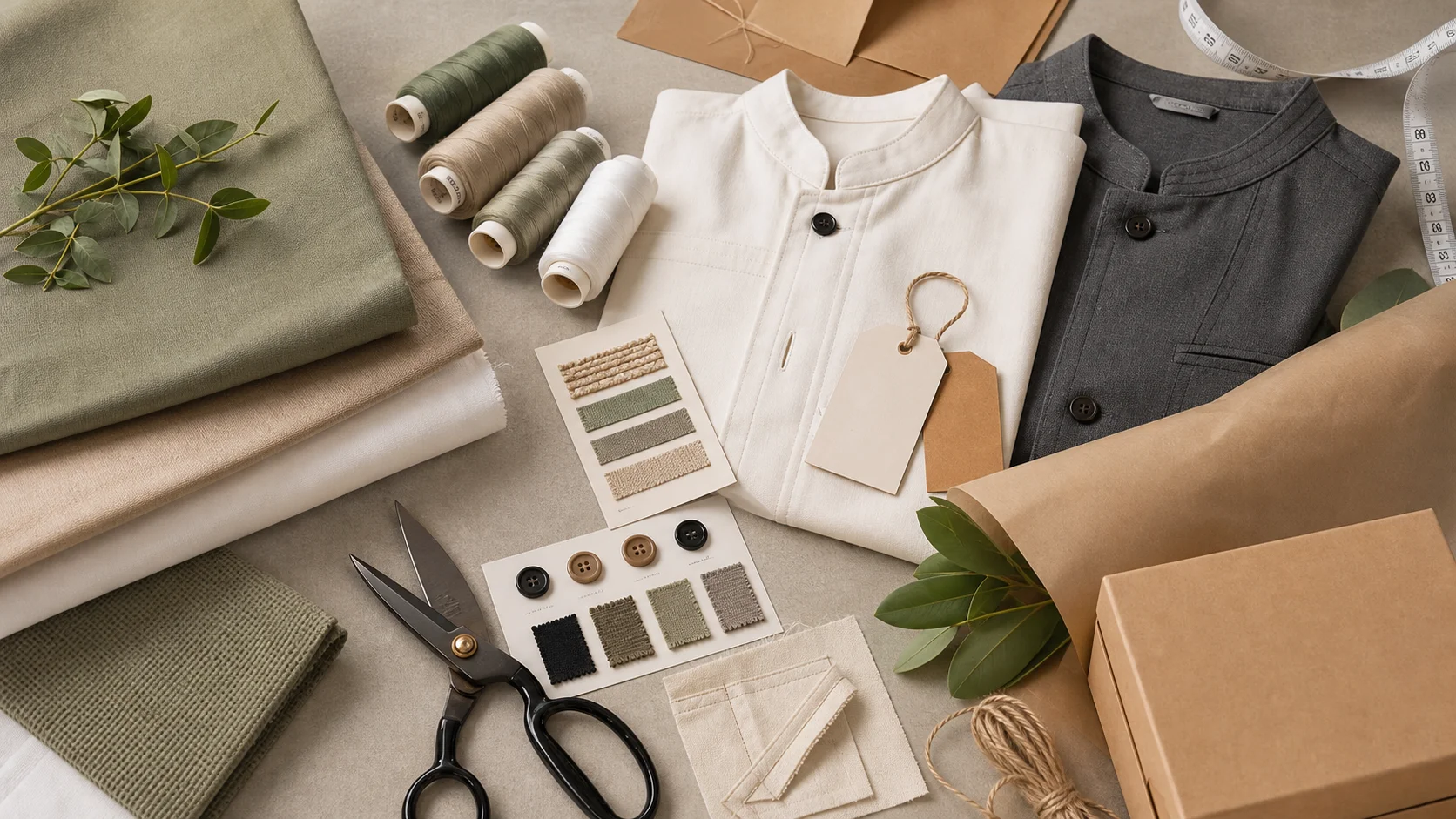
Recycled Kraft Apparel Mailers with checks for samples, fit, MOQ, QC evidence, pricing terms, and delivery risk.
Fast answer: Recycled Kraft Apparel Mailers: Material, Closure, Print, and Shipping should be judged by production evidence, not by a generic sourcing promise. The buyer needs sample proof, cost breakdowns, QC checkpoints, and delivery buffers in writing.
Ask for recent sample photos, measurement tolerances, fabric or print test assumptions, decoration test notes, packing examples, and a named inspection checkpoint. These details show whether the team can repeat an approved sample at bulk volume.
Separate garment cost, decoration, labels, packaging, sampling, testing, freight, and rush charges. When every cost line is visible, it becomes easier to reduce colorways, adjust size depth, or reserve more time for sampling.
The cheapest mailer is rarely the cheapest decision. I watched one brand ship 500 French terry tops in virgin poly mailers, then spend the next two weeks untangling a 12% return rate, scuffed sleeves, and a very public complaint trail that made the packaging look cheaper than the product. By the time they replaced damaged pieces, paid reship freight, and answered 38 customer emails, the bargain had vanished. That is why recycled kraft mailer bags for apparel brands keep turning up in buying meetings.
In factories, the math is blunt. A kraft mailer often weighs 22-45 gsm more than a basic poly mailer, but it can sit flatter around tees, socks, and lightweight knits, which lowers carton voids and improves freight density. I have watched a 1,000-piece order drop from 18 export cartons to 14 simply because the mailer spec matched the garment thickness, not the brand mood board. On a shipment billed at $6.40 per kilogram, every cubic centimeter counted.
According to WRAP, packaging recovery depends on material choice, labeling, and local infrastructure. Kraft wins in curbside recyclability in many markets, while poly mailers only recycle through store drop-off in limited regions. Print quality has also improved: a 2-color flexo logo on 90-120 gsm recycled kraft looks cleaner than many brands expect, and premium perception rises quickly in direct-to-consumer apparel. I have seen brands pay $0.18-$0.32 more per unit and still reduce complaint volume by 9%-15% because the unboxing felt intentional, not disposable.
The counterintuitive part is simple: heavier rigid packaging does not automatically cut emissions. When a brand uses a 300 gsm mailer board with too much filler, the carbon footprint rises faster than with a well-sized recycled kraft envelope. Data from ISO standards work around packaging efficiency points in the same direction. Less material, if engineered properly, often beats more material pretending to be premium.
Most recycled kraft mailer bags for apparel brands use an outer recycled kraft sheet, a recycled or virgin fiber blend for reinforcement, a pressure-sensitive adhesive strip, and sometimes a water-resistant coating. The outer layer usually sits in the 80-150 gsm range, though outerwear shipments may need 170 gsm or more if the contents have zips, hardware, or sharp corners. A bag that feels premium can still fail if the adhesive is weak or the fold lines are cut too tight. I have seen that fail twice in humidity testing at 75% relative humidity, then pass once the flap was widened by 6 mm.
Asia, Europe, and North America do not build these bags the same way. Mills in China and Vietnam often blend higher post-consumer recycled fiber with longer virgin reinforcement fibers, while European converters lean into tighter fiber certification and matte finishes. North American suppliers often offer faster revisions but smaller design libraries. For a brand shipping 300-800 units per colorway, that matters more than people admit. A recycled kraft mailer for knitwear may need a different caliper than one for socks or tote bags, even when both look identical on a shelf.
Performance varies by product type. Tees and socks can ship well in flatter bags; denim, outerwear, and layered knits often need wider gussets and stronger seals. For accessories like belts or caps, puncture resistance becomes the deciding factor, not print finish. If you work with cut and sew manufacturing, ask for product-by-product fit tests before you approve one mailer for the whole range. One size rarely serves six categories well.
Three numbers matter most: burst strength, tensile strength, and seal hold. I ask for drop-test data from 1 meter, humidity exposure of 48 hours, and seal integrity after 10 open-close cycles. If the seal fails once, the customer remembers. If the coating stains after a wet commute, they remember that too. For cross-border apparel parcels, I prefer a bag that survives a 3-4 week transit window without edge curling or adhesive creep. A premium look is useless if the fold opens in a warehouse at customs.
The factory quote is only the first number. A plain recycled kraft mailer bags for apparel brands may land at $0.21-$0.34 each at 10,000 units, then fall to $0.16-$0.24 at 50,000 units, depending on gsm, print coverage, and closure type. Smaller runs at 1,000-3,000 pieces can sit closer to $0.42-$0.68 because setup gets spread over fewer bags. I have watched brands obsess over a $0.05 delta and ignore the $0.80 damage replacement cost that arrives later.
Landed cost includes freight, duties, warehouse space, and damage replacement. A 25,000-unit order may look 11% cheaper per bag than a 5,000-unit order, but if it arrives in 2 oversized cartons and ties up 18 pallet positions, the storage bill shifts the equation. On a recent project for a private label startup, the brand saved $1,900 on unit price and lost $2,700 in rushed replenishment freight. That is why private label clothing brands need packaging modeled against the full fulfillment chain, not the supplier invoice.
Here is a practical comparison I use in sourcing calls:
Custom print lifts the price fastest after MOQ. One-color flexo may add $0.02-$0.05 per unit, while multi-color digital or offset-style finishing can add $0.08-$0.18. Special windows, spot varnish, or foil push costs even higher, and they do little if the bag size is wrong. MOQ 500 pieces is convenient for testing, but MOQ 5,000 or 10,000 usually brings the real savings. A slightly stronger mailer with better seals can reduce total packaging spend because replacement shipments drop by 6%-14%.
I have visited more than 200 factories across 8 countries, and the best converters do not start with selling. They start with test data. Ask for recycled content proof, FSC or equivalent chain-of-custody documents, tensile reports, and QC logs from the last 3 production runs. If the supplier cannot show grammage tolerances within ±5 gsm, that is a warning. If they cannot show drop-test results from 1 meter and 48-hour humidity exposure, I move on.
Good factories show how they pack cartons, not just how they print. I look for clean die-cutting, even adhesive application across a 2-3 mm margin, and no warped stacks after compression. Weak suppliers hide behind vague recycled claims like “eco material” without numbers. In one audit, 7% of bags had crooked folds and the print drifted by nearly 4 mm from panel to panel. That is not branding. That is waste. If your brand also sells technical products like custom bra manufacturing, that level of quality control should feel familiar, because fit and finish carry the same commercial weight.
For international shipping, ask for material declarations, fiber composition statements, and retailer-specific packaging specs. Some retailers want clear recycling instructions, while others require plain-language country of origin labels. Data from Textile Exchange helps brands verify fiber sourcing claims, especially when recycled content sits above 30% or 50%. I also check whether the converter can trace adhesive suppliers and coating chemistry back to batch level. That is where a lot of green claims fall apart. Lead time matters too: local production may take 7-12 days, offshore 20-35 days, and hybrid sourcing can split the difference with more resilience.
For brands buying recycled kraft mailer bags for apparel brands at scale, China remains a major manufacturing hub, but the best supplier is the one that can document quality, meet your MOQ, and support repeat production without surprises. If you need wholesale or bulk pricing, ask for a sample matrix that compares paper grade, seal strength, and print clarity across at least three options. That makes it easier to compare factory quotes on the same basis instead of guessing from photos.
Minimalism usually looks more expensive than crowded graphics. A single deep black logo on natural kraft often feels sharper than six colors fighting for attention, especially for premium basics priced at $38-$68. I have seen DTC brands raise perceived value simply by removing excess copy, cutting the artwork count from 4 colors to 1, and trimming the bag size by 12 mm on each side. That saved filler, improved cartoning, and made the parcel look deliberate.
Flexo works best for 1-2 colors and runs efficiently at 5,000 units and up. Digital printing handles shorter runs and photographic detail, but it can raise unit cost by 18%-30% and soften color consistency on uncoated kraft. Offset-style finishes can look beautiful, yet they demand tighter registration and better paper flatness. For most apparel brands, the sweet spot is a matte kraft surface, one strong brand color, and enough negative space to breathe. Precision beats decoration.
The most persuasive details are tactile. A clean tear-strip, an adhesive that closes with one firm press, and an interior message printed in a single ink do more than a puffed-up welcome card. Size the mailer tightly so the garment does not rattle. A 0.5 cm-1.5 cm fit margin is usually enough for tees and socks. I have seen brands skip tissue paper entirely and still get stronger reviews because the packaging felt tidy, not excessive. That is where sustainability and credibility meet.
Packaging delays usually start with the calendar, not the factory. For a plain stock bag, domestic sourcing can move from spec approval to shipment in 10-18 days. A custom size with one-color print may take 3-5 weeks. Multi-color runs with special coatings can stretch to 5-8 weeks, especially if the supplier needs reproofing. Overseas production typically adds 2-4 weeks for transit, customs, and carton consolidation. I have seen a holiday drop miss its window by 9 days because artwork approval sat in an inbox.
The smart sequence is simple: spec sheet, sample, revision, pre-production proof, then mass run. Test the sample with real garments, not empty bags. A 320 GSM French terry hoodie behaves differently from a 140 GSM jersey tee, and a bag approved for one may fail the other. If the product line includes hard trims or bulky hems, ask for a second sample immediately. Brands that work in private label clothing should build packaging review into the same approval window as fit and label approval, not after it.
Delays hit hardest at three points: artwork approval, recycled fiber availability, and test failures that require a retool. I advise brands to buffer at least 15%-20% more inventory before seasonal peaks, because influencer seeding, Black Friday, and gift-driven drops all consume packaging faster than forecasts suggest. A 2-week buffer is thin; 4 weeks is safer. Relying on one production window is how stockouts happen.
A clean rollout beats a dramatic one. Start with one product line, not the whole catalog. I usually recommend a 30-day plan: week 1 audit current packaging and returns data; week 2 define bag sizes for 3-5 top SKUs; week 3 request samples and test with real garments; week 4 compare damage rates, freight density, and customer feedback. Brands that skip testing tend to overbuy the wrong format, then spend the next season clearing inventory they should never have ordered.
Measure three numbers from the start: damage rate, packaging cost per order, and freight density. I also watch customer satisfaction, because the unboxing can shift review scores by 0.2-0.4 points on a five-star scale when the parcel feels cleaner and less wasteful. If your brand already manages patterned trims or specialty closures through cut and sew manufacturing, your packaging standards should be equally specific. Ask for a pilot of 1,000-3,000 units before scaling to 20,000 or more.
Ask these questions directly: What is the recycled content percentage? Which adhesive is used, and does it hold in 75% humidity? What is the print limit for color accuracy, and how much variation is acceptable between lots? Can the supplier share carbon data, replacement policy, and a clear MOQ by size? If the answers are vague, the relationship will be vague later too. For a fast response and sample request, request a custom quote for recycled kraft mailer bags and compare at least 3 offers before you sign.
My decision rule is simple: switch only after the mailer passes product fit, shipping stress, and cost modeling. If it fails one of those tests, it is not a solution, only nicer waste.
They are usually made from a recycled kraft outer layer, a recycled or virgin fiber reinforcement layer, an adhesive closure strip, and sometimes a water-resistant coating. Typical paper weight ranges from 80 gsm to 150 gsm, with heavier versions used for denim or outerwear.
Small runs of 1,000-3,000 pieces often land at $0.42-$0.68 per unit, while 10,000-unit orders can fall to $0.21-$0.34. Printed, custom-sized, or coated versions cost more, and freight plus damage replacement can change the true landed cost by 10%-20%.
Stock bags can ship in 10-18 days domestically. Custom sizes with print usually take 3-5 weeks, while overseas orders often need 5-8 weeks before ocean or air transit is added. Artwork approvals and test rework are the most common delays.
Yes, but the bag must be specified correctly. Denim, knitwear, and outerwear need stronger gsm, wider folds, and better seal integrity than tees or socks. For bulky pieces, I would request drop tests, humidity tests, and a fit trial with the actual folded garment.
Low-MOQ options usually come from local converters or offshore suppliers offering stock sizes with light customization. MOQ 500 pieces is common for testing, but 5,000-10,000 units usually gives better unit pricing. Ask for recycled content proof, sample packs, and a replacement policy before ordering.