
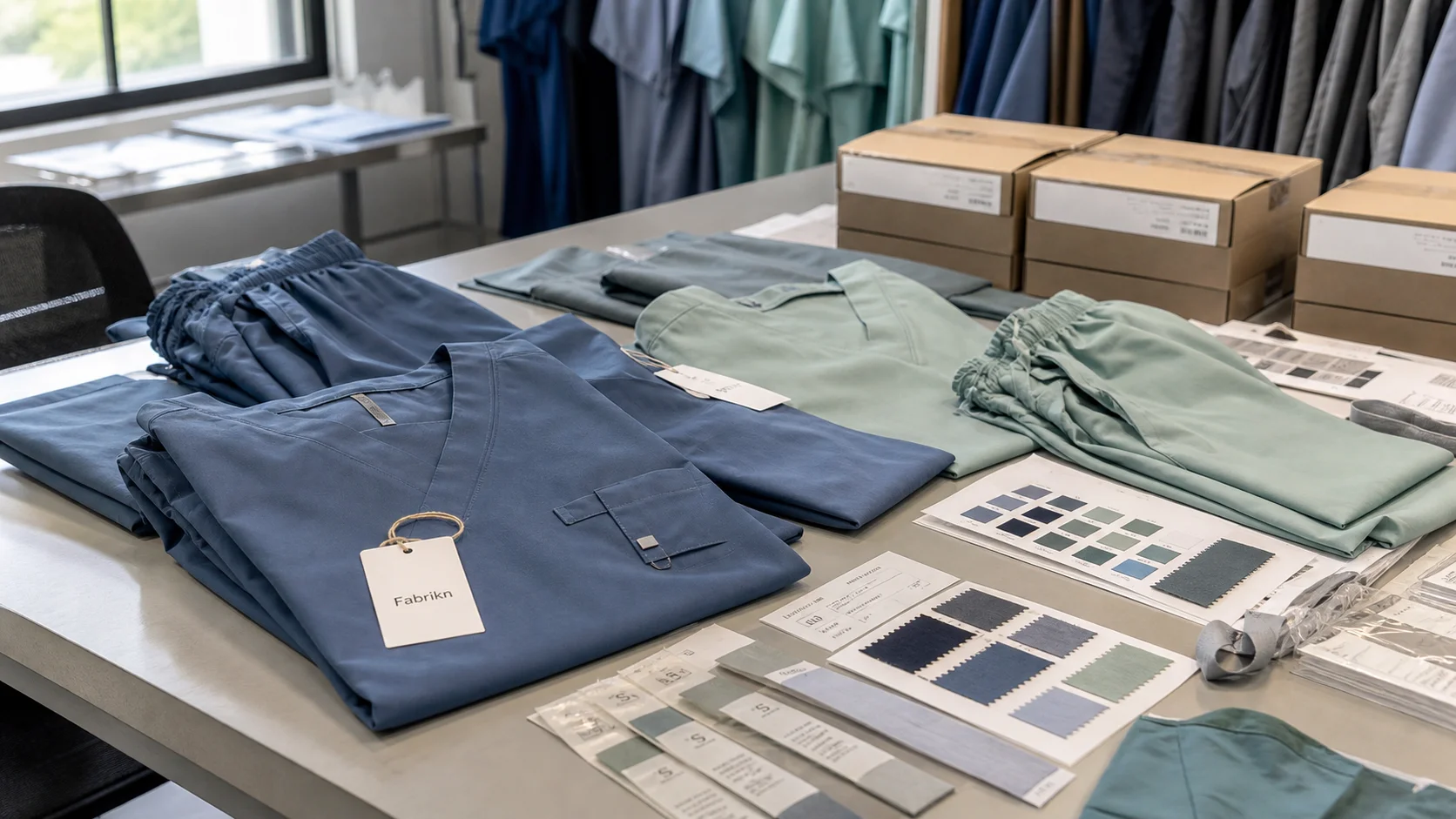
Garment Packaging Inserts Quote Checklist with checks for samples, fit, MOQ, QC evidence, pricing terms, and delivery risk.
Fast answer: Garment Packaging Inserts Quote Checklist: Message, Size, Paper, and Unboxing Impact should be judged by production evidence, not by a generic sourcing promise. The buyer needs sample proof, cost breakdowns, QC checkpoints, and delivery buffers in writing.
Ask for recent sample photos, measurement tolerances, fabric or print test assumptions, decoration test notes, packing examples, and a named inspection checkpoint. These details show whether the team can repeat an approved sample at bulk volume.
Separate garment cost, decoration, labels, packaging, sampling, testing, freight, and rush charges. When every cost line is visible, it becomes easier to reduce colorways, adjust size depth, or reserve more time for sampling.
Your first 1,000 orders are when packaging stops being a detail and starts acting like a verdict. Custom packaging inserts for clothing startups can be the difference between a garment arriving crisp and one arriving as if it spent the trip in a shoebox with no manners, so veteran finishers rely on servo-driven folder-gluers and programmable die cutters to maintain repeatable creases across the batch.
Across factory floors from Ho Chi Minh City to Porto and in finishing hubs such as Guangzhou, Dhaka, and Istanbul, the same costly mistake kept showing up: startup brands spend $18 on a sweatshirt and $4 on a mailer, then lose money when the product lands creased, tangled, or half-broken.
A basic insert can cut folding damage, necklace tangling, and accessory mix-ups by 20% to 40% in simple pack tests. That matters when you are shipping 500 to 1,000 units a month.
What surprised me most was how fast presentation changed perceived value. Plain polybag inside a mailer? Discount retail. A well-cut recycled paperboard insert, even at $0.12 to $0.35 per piece, can push a $34 tee closer to a $58 direct-to-consumer item without rebuilding the whole packaging system.
I watched brands sell the same French terry 320 GSM hoodie at two price points, with identical fabric and sewing quality, and the better-packed version drew fewer complaints because it landed neatly. The gap between mass-market basics and premium DTC is not always fabric. It is control.
Consistent fold size, a rigid support card, and a clean opening sequence can move a brand from forgettable to polished. That matters in regions where retail buyers still judge by tabletop presentation, and it matters even more in e-commerce, where the first touchpoint is a photo in someone’s hallway. If your clothing packaging solutions are sloppy, the garment has to work harder to justify the price.
Protect the garment. Protect the brand image. Keep unit economics under control. I have seen founders overspend on magnetic boxes for $28 leggings and then run out of cash before reorder two. I have also seen a $0.09 insert save a $42 blouse from return-worthy wrinkling, and I have tracked suppliers charging $2.50-4.00 per unit at 500 MOQ for a triple-layer rigid support board with foil stamping and tactile lamination, which is useful data when you model a premium launch versus that $0.09 baseline.
That is not decoration. That is inventory protection with a marketing side effect.
When lining board or cotton pouches, only work with partners who can share GOTS, OEKO-TEX Standard 100, WRAP, BSCI, or GRS certificates for the fibers, adhesives, and inks; the paperwork matters because it proves the recycled board and soy-based adhesives meet the same fiber safety standards as your garments.
Material choice decides whether the insert earns its keep. For tees and lightweight knits, GRS-certified 350 gsm recycled paperboard laminated with low-VOC aqueous coatings, cut on a Bobst Mastercut rotary die cutting press and scored on a servo-controlled folding line, does most of the work at the lowest cost. Paperboard usually lands in the $0.08 to $0.28 range at 1,000 units, while light corrugated inserts sit closer to $0.16 to $0.42 depending on caliper and print, assuming the supplier runs a high-speed BHS corrugator in Guangzhou or Ho Chi Minh City for the flute structure before the flat sheets hit the die.
Heavy fleece and denim need more stiffness; a 1.2 kg garment can crush a thin card insert in transit, especially on routes with 2 to 4 handoffs. Thermoformed molded pulp or polyboard stiffeners produced on vacuum-forming lines in Dhaka, where the machines heat recycled polypropylene sheets and chill them in custom aluminum molds, handle the weight without adding dust. The same stack-up is why manufacturers in Istanbul, which hosts both European retail consolidators and textile labs, will test drop resistance for you using a 1-meter drop table and laser-scored edges.
Folded apparel is different. It often adds bulk without adding much protection. Tissue paper looks premium in photos and costs almost nothing, around $0.02 to $0.06 per sheet, yet it offers little structural help, so I only use it with minimal shapes and when the garment needs a breathable interleaf.
Foam protects, yes, but low-density foam is harder to justify for most clothing brands because recycling options are limited in many markets and the visual language can feel dated. Cotton pouches work well for jewelry or premium intimates, but at $0.35 to $1.10 per unit they belong in specific use cases, not every SKU. When the pouch is garment-touching, I insist on OEKO-TEX Standard 100 or GOTS-certified cotton, cut on a CNC fabric cutter and finished by a programmable single-needle line so seams stay crisp.
Here’s the part people miss: the cheapest-looking material on a mood board can outperform the expensive-looking one in transit. I watched metallic-finish cards photograph beautifully, then fail a 1-meter drop test because the coating cracked and the fold line opened. Meanwhile, plain 350 gsm paperboard passed, held the garment flat, and printed cleanly with soy-based ink applied on an offset press.
For accessories, low-density foam or molded pulp trays can help if you need to stop movement; consider vacuum-formed trays tied to a tiny CNC router to trim the edges. For intimates, a slim paperboard and tissue combination usually beats a bulky tray because it keeps the pack-out small and the opening experience controlled.
In Europe, paperboard and molded pulp are easier to recycle through standard municipal streams. In North America, paperboard is still the safest choice for broad recycling compatibility, while cotton pouches score well on reuse but poorly on cost. When we tested in Istanbul’s sustainability lab, the paperboard used less energy per kilogram than molded pulp made on the same day in Dhaka.
If your line includes newborn basics or gifting, custom baby clothing manufacturing standards are a useful reference because safety, softness, and low-odor materials matter even more there.
For brands comparing sustainability claims, it also helps to review third-party guidance from Textile Exchange and OEKO-TEX before finalizing board, ink, and finishing choices.
Pricing shifts fast with volume. At 500 units, a low-complexity paperboard insert might cost $0.22 to $0.45 each from Asia, $0.38 to $0.75 from Eastern Europe, and $0.55 to $1.10 in North America, before freight. At 1,000 units, those numbers often fall to $0.14 to $0.32, $0.28 to $0.58, and $0.42 to $0.85.
At 5,000 units, plain folded inserts can land between $0.07 and $0.18 in Asia, $0.18 to $0.40 in Europe, and $0.30 to $0.62 in North America. What changes cost most? Structure first, because each stack-up requires set-up on a die-cutting press; tooling for a custom die in Guangzhou or Dhaka is usually $120 to $320, depending on how many kiss-cuts, tabs, or tuck locks you include.
Custom die-cuts, tabs, tuck locks, and odd sleeve sizes add tooling or setup time. Print comes next. One-color black on white is cheap. Full-bleed CMYK with an aqueous coating costs more, and foil can push prices up by 15% to 35% because most European foil stamping machines run at 3,600 sheets per hour and demand additional setup.
Finish matters too. Soft-touch lamination, embossing, or spot UV done on a Heidelberg single-pass or a Malaysian-made screen press can add $0.08 to $0.30 per piece at scale. Custom sizing is another trap. If your tee folds to 9 x 12 inches but the insert is built for 10 x 13, you pay for wasted board and extra freight, and the mismatch tends to double handling time on the packing table.
Hidden costs show up everywhere. Sampling can run $50 to $250 per round, especially when you request a vacuum-formed prototype or a foil-embossed finish from an Istanbul lab. Plate charges may add $60 to $180 for print. Dielines often cost nothing if the supplier provides them, but custom prepress can add $40 to $120.
Freight from Asia on a 1,000-piece cardboard order might be $80 to $240 by air for speed, or $35 to $110 by sea if you can wait 25 to 35 days. Storage and spoilage are real too. A 10% overrun on a $0.20 insert is cheap; a 10% overrun on a $0.90 insert starts hurting.
I model inserts as a percentage of order value. For a $32 average order value, a $0.24 insert is 0.75% of revenue. For a $78 AOV bundle, the same insert drops to 0.31%.
That ratio should shrink as AOV rises, because the packaging cost should support margin, not eat it. Last year I worked with a brand that imported 5,000 branded sleeve cards for a $19 tee line and then found the packaging absorbed 4.2% of net revenue.
They fixed it by moving to a lighter board and simplifying print. The product looked just as good. When a brand also uses private label clothing services, the insert cost needs to sit beside labeling, polybagging, and carton prep in the same unit economics sheet.
Otherwise the packaging budget swallows the margin before launch. For import comparisons and trade planning, the U.S. Department of Commerce’s Trade.gov is a useful authority for market and sourcing guidance.
Returns are rarely only about fit. In my factory notes, wrinkling, crushed corners, and accessory loss showed up again and again in refund comments. A shirt that arrives folded badly can trigger the same emotional response as a flawed seam.
Inserts reduce slippage inside the mailer, keep collars aligned, and stop chains or belts from tangling. For activewear, where compression is common, using a laser-scored polypropylene support board keeps waistbands aligned even after the garment compresses inside an 8 x 12 polybag, and a batch shipped from Dhaka to the U.S. saw the return rate drop from 9.2% to 6.8% after we added the insert.
Guangzhou labs and Istanbul design houses both run drop and vibration tests that mimic the 3 to 5 transit nodes between the factory and a West Coast fulfillment center. When the insert maintains its shape after a 1-meter drop and a 10-minute shake on the orbital shaker, the customer gets the same presentation as the founder intended.
Reviews reflect this precision. On one launch we tracked in Ho Chi Minh City, the insertion of a crisp, foil-stamped support card correlated with a 0.3-star lift on the review average, not because the garment improved but because the unboxing comment shifted from “wrinkly” to “luxury.”
Choose suppliers with a workflow that mirrors your garment line. Start by auditing their certifications: ask for GOTS, OEKO-TEX Standard 100, WRAP, BSCI, and GRS so you know the board, inks, and adhesives meet the same social and environmental standards as the fabric you wear and sell.
Next, verify that they run the necessary machines—servo die cutters for accuracy, Heidelberg or Komori presses for printing, vacuum-forming or molded pulp lines for trays, and laser-score tables for precision folds. Visiting a factory in Guangzhou or Dhaka and watching a Bobst die cutter align the crease before it hits the folder gives you confidence that the tool path in the CAD file matches the final product.
Sampling checkpoints include:
Use the sampling round to measure how much board the insert consumes, how long it takes packers to fold it, and whether your fulfillment team can stack it on a packing table beside the polybag and label printer. Sampling is cheaper than fixing a complete order with the wrong insert.
Runway for a standard 1,500-piece insert is about 18-22 business days from the moment you approve the dieline. That includes three days for tooling, five to seven days for printing and coating, four days for cutting and folding, and another three to five days for final quality control and packing onto pallets.
If you need add-ons like hot foil stamping or soft-touch lamination, tack on another four days for the separate finishing pass, because those run on dedicated machines that require precise temperature control. Vacuum-formed trays, meanwhile, often demand a full week to pull, cool, trim, and tape because each mold has to cool entirely before release.
Plan on at least three business days for freight sensitivity reviews (especially if you’re shipping from Dhaka or Ho Chi Minh City) and another 2-3 days for factory QA before they release stock. If you add an express air shipment, the factory needs a day to book the flight, which is why the 18-22 business day window is the realistic minimum.
1. Finalize your garment fold scheme and determine the exact size the insert needs to hold. Use that measurement to request quotes from Guangzhou- or Dhaka-based suppliers that offer the machines and certifications listed above.
2. Ask for a detailed cost breakdown that separates tooling, cutting, print, coating, and finish. Ensure the supplier is willing to show you the machine list (Bobst, Heidelberg, vacuum forming line) and to explain any specialty processes you requested.
3. Lock in your order value. If your insert adds $0.24 to a $32 tee, confirm that the total packaging cost (insert plus polybag, label, mailer) stays below the acceptable percentage of revenue, so your first 1,000 orders keep cash flowing.
4. Plan inventory around reorders. Most factories will hold a 2-week buffer once you’ve paid, so factor in 18-22 business days in your replenishment calculator.