
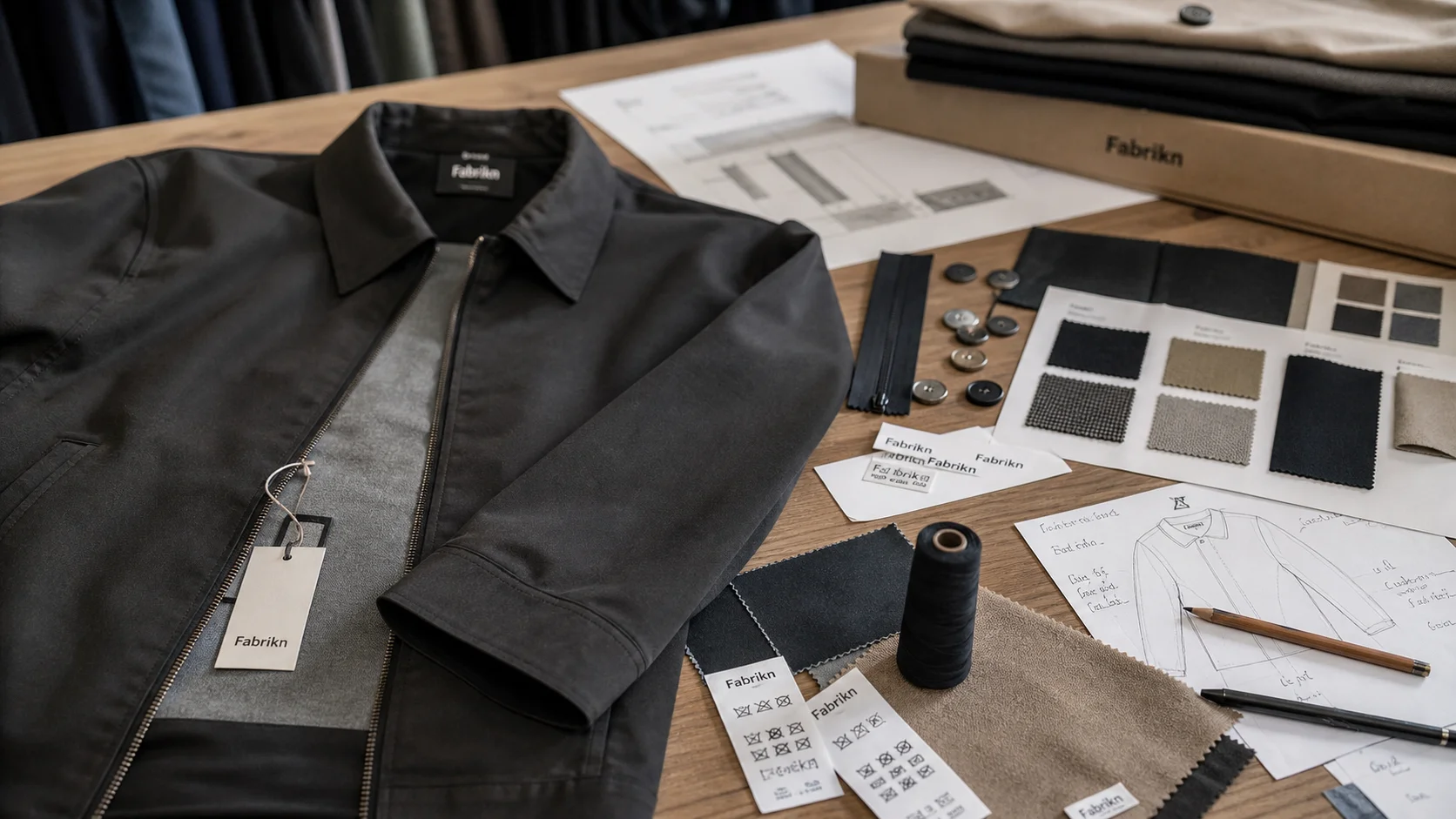
Custom Paper Hang Tags for Fashion Brands China compared by sample evidence, fabric or trim specs, MOQ, AQL terms, cost lines, delivery timing, and rework...
Fast answer: Custom Paper Hang Tags for Fashion Brands China: Material, Print, MOQ, and QC Terms should be judged by production evidence, not by a generic sourcing promise. The buyer needs sample proof, cost breakdowns, QC checkpoints, and delivery buffers in writing.
Ask for recent sample photos, measurement tolerances, fabric or print test assumptions, decoration test notes, packing examples, and a named inspection checkpoint. These details show whether the team can repeat an approved sample at bulk volume.
Separate garment cost, decoration, labels, packaging, sampling, testing, freight, and rush charges. Clear cost lines make it easier to reduce colorways, adjust size depth, or reserve more time for sampling.
The first thing a shopper touches can quietly decide the sale, and custom paper hang tags for fashion brands china are often that moment. Before anyone checks the fabric, the fit, or the price, the tag has already started speaking. I’ve watched a $48 knit sweater look weaker than a $12 tee simply because the tee carried a cleaner tag. On shop floors in Shanghai and Manchester, shoppers flip the garment, glance once, and judge its value in seconds.
Spend $9.20 on fabric, $2.40 on trims, and only $0.14 to $0.38 on the tag, then act surprised when the piece reads cheap? Happens all the time. The tag is small; the signal is not. In premium and mid-market fashion, paper stock, print density, and finish shape perceived price. A well-executed tag can support a $78 retail point. A flimsy one can make a $38 garment feel like clearance.
Across Guangdong, Zhejiang, and Jiangsu, the pattern kept repeating. Chinese suppliers with vetted print lines were turning out low-defect hang tags at 0.8% to 1.5% reject rates on tight runs, while fragmented sourcing in Europe and the US often pushed defects above 3% once printing, cutting, drilling, and stringing were split across vendors. Scale matters. So does coordination.
Retail is only one test. Resale platforms reward presentation too. A garment with crisp labeling, accurate SKU coding, and a durable tag is easier to authenticate and photograph, which matters if the product retails at $120 or more. Luxury buyers expect weight, texture, and restraint. Mass-market shoppers expect clarity and speed. Both groups notice when a tag curls, bleeds, or arrives with ragged edges.
Some of the most expensive-looking tags I’ve handled came from mid-tier factories working at MOQ 5,000 to 10,000 pieces, not from the biggest plants. The reason is simple: those lines often keep more human inspection in the process, so foil alignment, hole placement, and folding consistency stay sharper. A huge factory can be efficient and still feel impersonal. That distinction shows up in the hand-feel.
When a brand already invests in custom bra manufacturing or a highly engineered garment line, the tag should match the same standard. Wrong paper weight, dull print, mismatched finish — all of it drags the collection down. I’ve seen a 300 GSM tag on a $28 casual shirt make the piece feel more expensive than the product itself. That is not vanity. That is merchandising discipline.
Most factories in China can source coated art paper, kraft paper, cotton paper, and textured specialty stocks in 250 GSM to 450 GSM ranges. Coated art paper is the most predictable for color accuracy. Kraft paper brings a natural, matte signal that works for workwear and outdoor labels. Cotton paper feels soft and fibrous, which suits premium basics priced at $60 to $180. Textured stocks, including linen and felt-like surfaces, can make a modest design feel architectural.
Finish choices matter just as much. Matte lamination reduces glare. Soft-touch coating adds a velvet feel, though it can mark under friction if applied too heavily. Foil stamping in gold, silver, black, or holographic tones creates instant contrast. Embossing and debossing add depth without relying on ink density. Spot UV and varnish are useful when a brand wants a visual highlight on a logo or size mark. In factory visits, the weakest results usually came from poor foil adhesion and excessive pressure on emboss plates.
Chinese suppliers often bundle print, die-cutting, drilling, stringing, and carton packing under one roof. That cuts handwork costs compared with fragmented sourcing in Italy, the US, or northern Europe, where one vendor prints, another punches, and a third assembles. For a 10,000-piece order, bundling can save $0.03 to $0.09 per tag, which compounds fast.
Functional details are not minor. Die-cut custom shapes help a tag stand out, but they increase tool cost by $40 to $160 depending on complexity. Standard round or rectangular tags are still the best option for replenishment programs. Hole drilling must be centered within 0.5 mm to avoid crooked hang. Eyelets add durability for heavier strings. String choices include cotton, polyester, waxed cord, and recycled paper string, with costs ranging from $0.01 to $0.06 per piece.
QR codes, barcodes, and care-message panels are now expected on many tags priced above $35. They support traceability, stock control, and aftercare instructions. A tag can also carry security microtext or variable numbering for limited editions. I have seen brands use this for private label clothing where the hang tag doubles as authentication and storytelling in one square of paper.
Where quality slips is depressingly consistent. Paper weight drifts by 10 to 20 GSM between batches. Foil peels when the adhesive is wrong. Tags warp after 48 hours in humid warehouses if the stock was stored badly. A supplier may show you a perfect sample, then run the job on paper that has absorbed moisture and print beautifully but finish badly. The sample is not the order. The warehouse is the truth.
For brands already buying clothing packaging solutions, hang tags should be specified in the same color system and stock family. That avoids the jarring mismatch I still see too often: a refined garment bag paired with a cheap-looking tag that feels borrowed from a discount bin. Consistency is not expensive compared with lost trust.
Not every “factory” is a factory. I’ve met print brokers with glossy websites, sourcing agents with no machines, and actual plants with 18 offset units, 4 digital presses, and a warehouse full of dies. Ask for audit reports, a machine list, and three recent client references with order sizes. A direct manufacturer can usually show production photos with timestamps, an ISO file or social compliance audit, and a real QC log.
Shenzhen is often strongest for fast digital proofing, short lead times, and premium finishing on smaller runs from 500 to 3,000 pieces. Dongguan tends to be stronger on assembly, die-cutting, and mixed-material packaging jobs. Ningbo has reliable paper access and export logistics. Guangzhou often offers broad sourcing, better for buyers who want one contact for tags, woven labels, and packaging inserts. I have seen a 6-day prototype in Shenzhen and a 14-day prototype in a slower inland plant. Geography still matters.
Your sampling checklist should be ruthless. Ask for sample turnaround in 2 to 4 days for digital prototyping, 5 to 7 days for offset proofing. Request Pantone references, FSC paper availability, and a defect policy that states what happens if 2% or more of the run is off-spec. Confirm MOQ. Ask whether the supplier can hold color within Delta E 2.0 or better on reorders. If the answer is vague, expect drift.
Read quotations line by line. Plate fees can range from $25 to $120. Dies may cost $40 to $180. Digital proofs are sometimes free, sometimes charged at $15 to $50. Packing, stringing, inner cartons, export cartons, and freight should be separated. I’ve seen a quote look 18% cheaper only because the supplier excluded packing and assumed the buyer would not notice. That is how margins disappear.
The lowest unit price often comes with the weakest control over color consistency and rework. That is the counterintuitive part. A supplier quoting $0.06 on 20,000 pieces may look better than one quoting $0.09, but if the cheaper plant needs a 3,000-piece reprint because the black shifts toward blue, the “savings” vanish. I would rather pay slightly more for a plant that keeps the same stock, same ink, and same operator notes on file.
When a brand runs cut and sew manufacturing, the tag vendor should read the spec pack with the same seriousness. If they cannot align hang tag dimensions with neck label placement, the whole garment presentation breaks. That is not a paper problem. It is a production control problem.
Pricing starts with stock. Basic coated art paper tags in 350 GSM, 1-color print, no finish, and standard cut usually fall around $0.05 to $0.11 per piece at MOQ 10,000. Kraft or cotton paper can push that to $0.08 to $0.16 because the stock itself is more expensive and less forgiving in print. Add matte lamination, and you may add $0.01 to $0.03. Add foil and embossing, and the jump can be $0.04 to $0.12 per tag, depending on coverage.
Print method changes the economics. Digital is best for 300 to 1,500 pieces, especially when SKU counts are high. Offset becomes efficient from 3,000 pieces upward. Four-color process print costs more than 1-color or 2-color branding, and custom die shapes raise tooling fees. String style matters too. Cotton cord usually costs more than standard polyester. Metal eyelets add $0.01 to $0.03 per unit. A folded tag with a care panel takes longer to assemble than a flat one, so labor rises even when paper cost stays flat.
To make the range real, I split costs into three tiers. A basic tag might land at $0.05 to $0.12 ex-factory. A mid-range branded tag, with matte lamination, one foil hit, and cord attachment, often lands at $0.12 to $0.28. A premium tag with textured stock, embossing, foil, specialty die-cut, and eyelet can reach $0.30 to $0.70, sometimes more for smaller runs. If a brand sells at $22, $58, or $140, those numbers have very different implications for margin.
MOQ affects unit economics brutally. A 1,000-piece order can look expensive because the setup costs are spread thin. The same tag at 10,000 pieces may drop 25% to 45% in unit price. That does not mean the factory is making huge profits. It means plates, dies, proofing, and machine calibration are being amortized properly. Small orders carry hidden efficiency penalties, and that is normal.
Landed cost matters more than ex-factory price. Freight for a few cartons can add $80 to $220. Customs paperwork, brokerage, and carton consolidation may add another $35 to $150. Reprint risk is the real trap. A $0.09 tag that needs a 1,500-piece rework is not cheap. China usually beats India, Turkey, and domestic US print shops on unit cost at scale, but on tiny runs of 300 to 800 pieces, that gap narrows quickly.
For brands balancing packaging and apparel margins, the hang tag should be costed beside labeling and garment construction, not in isolation. A trim budget that ignores tags is incomplete. That is especially true if the garment is built through private label clothing programs where every visible detail carries brand weight.
A realistic production timeline begins with the brief. Day 1 to Day 2 is artwork alignment, size confirmation, and stock selection. Day 3 to Day 5 is proofing. Sampling usually takes 2 to 7 days depending on whether the run is digital or offset. Production then needs 4 to 10 days for standard tags, and 8 to 15 days if the job includes foil, embossing, special die-cutting, or multiple assembly steps. Inspection and shipment add another 2 to 7 days before the cartons leave the warehouse.
Digital prototype runs are fastest because there is no plate-making. I have seen a 500-piece digital tag order move from approved PDF to packed cartons in 5 working days. Offset production is slower but better for larger volumes. If the order includes soft-touch coating plus foil plus stringing, the factory usually needs more drying time. That can add 2 extra days without warning. Drying is where many buyers underestimate the schedule.
Peak season changes everything. Before Chinese New Year, factories are often running 10 to 14 days ahead of capacity, and after the holiday, labor ramp-up can take another week. International shipping congestion can add 4 to 12 days, especially on consolidated freight. A missed Pantone check from the client side can push the job back 48 hours. A late approval on dielines can push it further. The factory is not always the bottleneck.
For fast fashion, I would map a 7 to 10 day internal window and keep artwork simple. Premium labels can tolerate 15 to 20 days if the tag has specialty finishes. Seasonal capsule collections often sit in the middle at 10 to 14 days. The decision tree is straightforward: speed costs simplicity, and complexity costs calendar days.
When a brand is running garments through custom bra manufacturing or tailored knitwear, the hang tag schedule should be locked before trim approval. Otherwise the whole production line waits on a small piece of paper. I have seen that delay cost 3 days on a 12-day program. It is avoidable.
Paper claims deserve proof. FSC certification should come with a valid certificate number and scope. Recycled content should specify post-consumer percentage, not just “eco paper.” Chain-of-custody should be traceable from mill to converter. According to FSC, paper claims only hold value when the material and custody records are documented. A supplier who cannot share documentation within 24 hours is asking you to trust a brochure, not a process.
Inks and coatings matter too. Water-based inks are generally easier to work with in recycling streams than heavy solvent systems. Soy-based inks can be a better-fit narrative, though buyers should still ask about actual drying performance and rub resistance. Plastic lamination weakens recyclability. Metal embellishments, magnetic inserts, and mixed-material constructions make end-of-life processing harder. If the tag is meant to communicate responsible sourcing, the tag itself should not complicate waste handling.
I’ve spent enough time on factory floors to know waste control is rarely glamorous. The good plants optimize sheet usage so die layouts recover 88% to 94% of the paper surface. They collect scrap cleanly, separate trimmings, and reduce carton volume by avoiding oversized packing. Poor plants waste on three fronts at once: paper offcuts, reprints, and bulky shipping cartons. The footprint rises fast.
Data from WTO and customs trade flows also show how scale changes emissions intensity. A simpler tag from a well-run Chinese factory can have a lower footprint than a premium-looking tag made in a smaller facility with short runs, repeated proofs, and air-freighted components. That is not a slogan. That is logistics.
There is room for pragmatism. I have seen a 300 GSM recycled stock with soy ink and no lamination outperform a glamorous laminated tag on durability, recyclability, and cost. The best sustainable result is usually not the most dramatic visual. It is the one that uses fewer materials, fewer steps, and fewer corrections. For broader supply-chain guidance, trade.gov offers useful export and sourcing resources.
Start with a short brief. Define size in millimeters, stock in GSM, finish, string type, hole position, and artwork file format. Set a target unit cost before asking for quotes. Request two physical samples and one digital proof. Confirm FSC or recycled documentation if sustainability claims will sit on the tag. Lock the final artwork dimensions before color approval, because changing size later changes layout and sometimes the die.
To avoid misquotes, include quantity, delivery city, carton count, and whether you want tags packed loose or strung. Put Pantone references in writing. If your brand uses clothing packaging solutions, align the tag stock with the box or sleeve so the set feels intentional. A supplier brief that names the wrong finish can trigger a sample that looks “premium” on screen and wrong in hand.
The three common mistakes are easy to spot. First, approving from screen-only proofs. Second, underestimating freight and local handling. Third, choosing a finish that clashes with the fabric line, like gloss foil on washed denim or soft-touch on raw workwear. Test the tag on the garment, not just on a desk.
My testing sequence is simple. Touch it. Rub it with dry fingers 20 times. Pull the hole gently 10 times. Attach it to a real garment and view it under retail lighting at 1 meter and 2 meters. If the tag fails any of those checks, revise before production. For a first order, keep the style simple. For a repeat order, lock color and stock. For scale-up, ask the factory to archive the exact materials and machine settings.
That approach saves money and avoids embarrassment. It also keeps your trim program aligned with your production model, especially if your collection relies on cut and sew manufacturing and tight calendar control. Get the tag right, and the garment feels finished before a customer even tries it on.
They identify the product, communicate brand value, and support pricing at retail. In many factories, tags also carry barcode, QR code, SKU, and care-message information. A well-made tag can help justify a $38 to $140 price point.
Basic tags usually run about $0.05 to $0.12 per piece at MOQ 10,000. Mid-range branded tags often land at $0.12 to $0.28, while premium tags with foil, embossing, and specialty stock can reach $0.30 to $0.70. Freight, sampling, and tooling are extra.
Standard timelines are 4 to 10 production days after approval, plus 2 to 7 days for sampling and shipment prep. Complex finishing can add 2 to 5 days. Before Chinese New Year, expect schedules to stretch by 1 to 2 weeks.
Ask for audit reports, machine lists, and recent client references. Direct factories should show real production photos, QC records, and sample turnaround times. Compare quotations line by line so you can spot hidden charges for plates, dies, packing, and freight.
Yes. Use FSC or recycled stock, water-based or soy-based inks, and avoid plastic lamination or mixed-material embellishments. Keep the design simple, reduce reprints, and ask for scrap recovery and sheet-optimization data. A smaller, cleaner tag often performs better than a flashy one.