
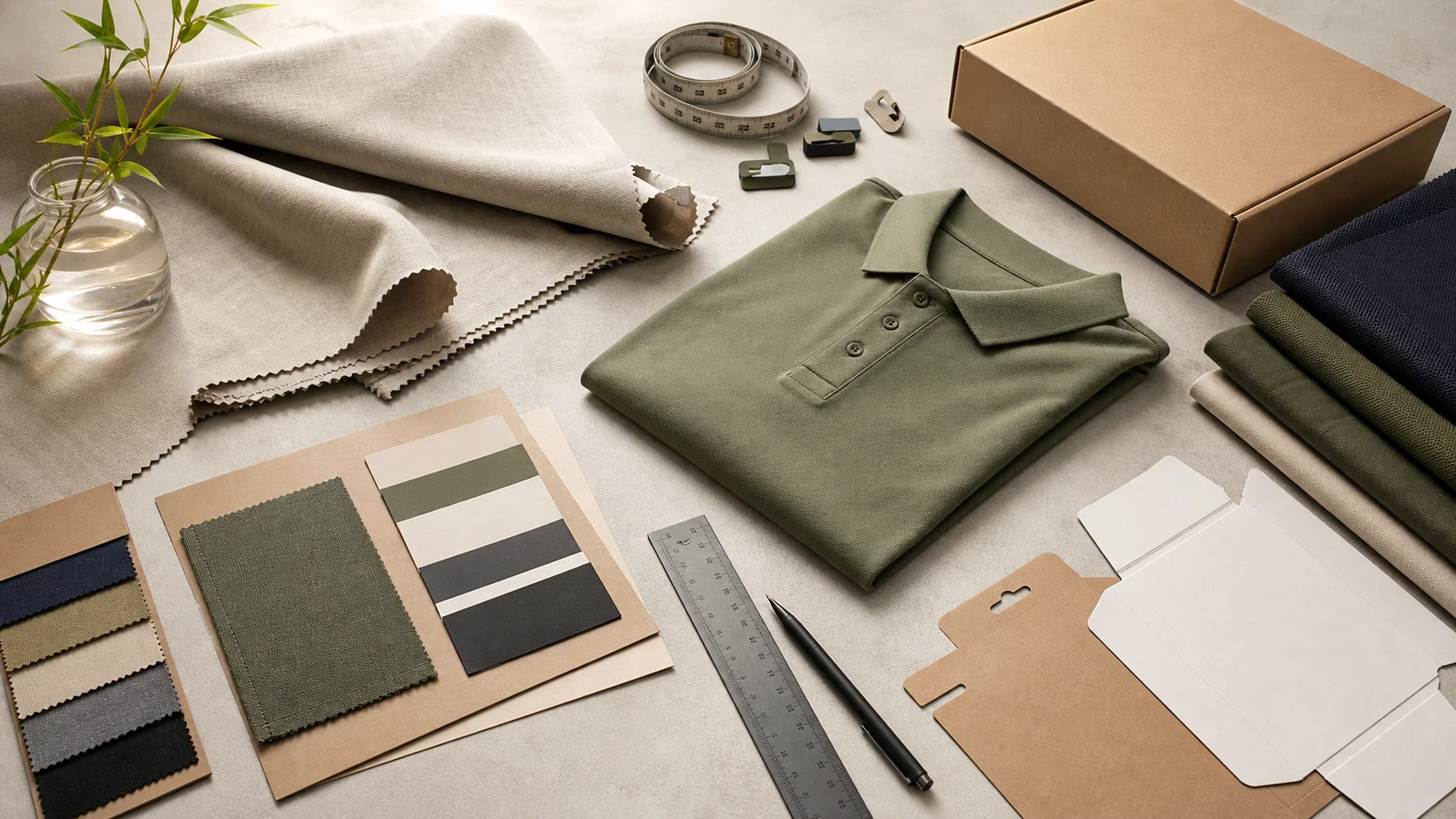
Garment Hang Tags with checks for samples, fit, MOQ, QC evidence, pricing terms, and delivery risk.
Fast answer: Garment Hang Tags: Required Info, Paper Stock, Print, and Attachment should be judged by production evidence, not by a generic sourcing promise. The buyer needs sample proof, cost breakdowns, QC checkpoints, and delivery buffers in writing.
Ask for recent sample photos, measurement tolerances, fabric or print test assumptions, decoration test notes, packing examples, and a named inspection checkpoint. These details show whether the team can repeat an approved sample at bulk volume.
Separate garment cost, decoration, labels, packaging, sampling, testing, freight, and rush charges. When every cost line is visible, it becomes easier to reduce colorways, adjust size depth, or reserve more time for sampling.
Shoppers decide fast. In the blink between curiosity and indifference, the hang tag does most of the talking. When brands ask what information on clothing hang tags matters most, the answer starts with clarity, not decoration. Across factory visits in Vietnam, Turkey, Portugal, India, and Mexico, the same mistake kept resurfacing: brands spent $18 to $42 on a shirt and then buried the details under a tag no one could decode in time. That is retail survival, or retail failure, depending on the typography.
At shelf level, the hang tag acts like a quiet salesperson. Mass retail throws 60 to 120 SKUs at a single fixture. Premium boutiques do something stranger: they ask the tag to compete with silence, lighting, and a buyer who expects confidence from the details. A clean tag gives price, size, care, and origin in one glance. A cluttered one makes the shopper dig, and digging feels like risk.
Regional behavior bends the whole thing. In the U.S., price, size, and care cues usually land first. In the EU, fiber content, country of origin, and compliance marks get more attention, especially on garments above €49.99. A French buyer may inspect both the hang tag and the sewn-in label. An American shopper often wants one thing answered fast: can this go in a 30-minute cold wash without drama? That difference changes tag hierarchy.
Factory reality beats brand assumptions every time. Near Guangzhou, I once saw a premium $96 merino sweater with a tag so dense the size sat hidden behind a flap. The buyer asked three questions in 20 seconds because the information order was wrong. Great garment. Unclear tag. The same mess turns up on a $14 T-shirt and a $240 cashmere knit. Price does not protect poor structure.
So the real question is not whether to include details, but what information on clothing hang tags earns its place first. The answer shifts with the market, the product, and how much trust the tag has to build before anyone touches the garment.
At a Guangzhou finishing facility the team was running a Heidelberg Speedmaster SM 52 at 9,000 sheets per hour, adding foil-stamped season codes and trimming each 350 gsm GOTS-certified board with a Komori die cutter so the tag matched the new store shelving in 18-22 business days. In Ho Chi Minh City, a smaller line was pairing Zünd CNC die cutting with organic cotton cord sourced from a Dhaka spinner; the cords pass WRAP and OEKO-TEX Standard 100 checks before they reach the Istanbul-based brand’s merch desk. Details matter just as much in the logistics corridor as they do on the retail peg.
The legal core usually starts with fiber content, country of origin, and care instructions, though the exact placement can differ between a hang tag and a sewn-in label. In the U.S., fiber names must be truthful and generic, and country-of-origin rules are strict for imported apparel. The EU and UK can be tighter on traceability and language, especially once a retailer adds its own packaging rules. One wrong language line. One missing word. That is all it takes for a tag acceptable in one market to fail in another.
According to ISO, care symbols and labeling systems need consistency because buyers and supply chains depend on the same meaning across markets. For more guidance on accredited textile claims, Textile Exchange standards and preferred fiber resources are also useful. Sounds obvious, but labels still show mixed symbol sets, swapped cotton percentages, or “made in Europe” instead of a specific country. Customs questions follow. So do chargebacks. Sometimes relabeling at the distribution center.
There is also a gap between legal minimums and shopper expectations. Europe, Japan, and higher-end U.S. department stores make that gap matter more, because shoppers use the tag to judge whether the brand knows its own product. A $28 blouse with a vague origin statement can look less credible than a $12 tee with crisp, complete disclosure.
Some low-cost suppliers print more disclosure than premium brands because retailers demand it. I have seen FOB quotes where a supplier included fiber breakdown, care icons, batch code, and carton ID on a hang tag for $0.08 at 10,000 pieces, while a premium label requested a stripped-back tag and spent more on finishing but less on clarity. More print does not mean more control. Usually, it means the retailer is doing the controlling.
Common errors are painfully repeatable. “100% natural blend” is useless. Missing origin statements create border problems. “Organic” or “recycled” without proof invites complaints. A tag should not overstate, improvise, or guess. If the factory source file says 78% cotton, 20% polyester, 2% elastane, then the tag says exactly that — not “mostly cotton” because marketing liked the sound of it. That fact becomes even more critical when the hang tag doubles as the only traceability record the importers have, as we noted on a GF (Global Fashion) load leaving Ho Chi Minh City in November.
Sellable hang tags do one job fast: they reduce hesitation. Price has to be visible in the first scan, size has to be readable without unfolding the garment, and the style code or SKU should help the floor team find the right record in 2 clicks or fewer. Premium units can carry the season name and collection name when those details support the brand story, but they should never bury the basics. Seven fields can work. Fourteen fields starts arguing with the shopper.
Luxury brands often use whitespace as proof of confidence. Mid-market brands need better hierarchy. Value brands need speed. On a $16 tank top, a barcode, size, and price may be enough. On a $185 blazer, shoppers expect fabric, lining, fit notes, and sometimes a QR link to care or styling. The trick is deciding which details belong on the hang tag and which belong on the product page.
QR codes help, but they are not a substitute for clear basics. Brands use them to hide missing fiber content or crowded legal text, and that backfires. A shopper should not need a phone to know whether a knit is 95% modal or 100% cotton. Selling across channels? Pair QR codes with a printed style code and a readable size mark. That supports e-commerce and floor conversion, especially for private label clothing services where assortments often change by color, fit, and retailer.
In factory visits, better-printed tags often signaled stronger merchandiser discipline, not better sustainability. A mill in Prato charged €0.03 more per tag and still outperformed a cheaper supplier 800 kilometers away: cleaner files, fewer revisions, fewer carton mislabels. The tag quality was a clue to process quality. Not always. Often enough to matter. I have also seen Istanbul print houses run a multi-pass UV LED curing process over a 12-point recycled board to keep foam-core display pieces crisp, which makes the tag behave like a mini billboard for the garment.
When teams in Dhaka and Istanbul attach tags at the final assembly line, they often rely on a manual L-seal machine or a hydraulic snap press to secure a double-loop GOTS-certified cotton cord, ensuring the hang tag stays anchored even when dresses move from the packing table to the export pallet. That durability reassures buyers in fast-moving marketplaces.
Printing a hang tag is rarely expensive in isolation, but the details add up fast. A basic card tag on 350 gsm paperboard can cost $0.04 to $0.09 at 10,000 pieces. Add string, a mono-color ink run, and a simple barcode, and the range may climb to $0.07 to $0.14. Move to foil stamping, embossing, or a folded multi-layer tag, and the unit cost can jump to $0.18 to $0.45 depending on volume, finish complexity, and freight. For a brand shipping 50,000 units, that is not pocket change. It is margin.
Small MOQs distort pricing. At 500 pieces, the same tag might cost $0.30 to $0.80 because setup and plate charges are spread across fewer units. At 5,000 pieces, those charges behave better. At 50,000 pieces, the printer starts caring about efficiency, not just survival. Add variable data, QR codes, multilingual copy, or serial numbers, and expect setup time to stretch from 3-5 days to 7-12 days, especially if proofs need multiple rounds.
Single-tag systems are cheaper and faster. Multi-layer tags allow storytelling, legal text, and retail promotions, but they also increase labor at the factory line. Teams in Bangladesh and Cambodia routinely spend an extra 2 to 4 seconds per unit folding, threading, and attaching multi-part tags. On 20,000 garments, that is real labor. On a product with a $9 FOB, the labor can matter more than the print itself.
Sustainability choices affect price too. Using 400 gsm GRS-certified recycled board, aqueous coating, and organic cotton string in a multi-layer format can push production quotes to $2.50-4.00 per unit at a 500 MOQ if the printer must decompress foil stamping, spot varnish, and a serialized hologram. Producers in Guangzhou and Ho Chi Minh City balance those finishes with 18-22 business days of lead time, matching the typical apparel shipment cycle to North America and the EU.
The location of the print partner also shifts the equation. Istanbul houses can handle multi-lingual hang tags with Turkish, English, and German copy before bundling them with a WRAP-certified finishing pass, while Dhaka printers manage the same scope at a slightly lower land rate but with longer inland transit to Chattogram. When you factor in compressed packaging timelines, those extra 2-3 days on the ground turn into meaningful cost.
Before the factory runs the first sheet through a Heidelberg Speedmaster or a Komori Lithrone press, buyers should verify the following:
Work with the factory merchandiser to capture the entire chain—digital proof, plate approval, and final hang tag sign-off—before that 2,000-piece run hits the die cutter in Dhaka or Guangzhou. A well-run hang tag run mirrors the product’s own manufacturing plan.
Buyers distrust unsupported claims more than they distrust an empty tag. When you call something “organic,” “recycled,” or “responsibly sourced,” back it up with a certification and a short narrative that a shopper can read in 3 seconds. That is the difference between an empty promise and a credible story.
Certifications like GOTS, OEKO-TEX Standard 100, WRAP, BSCI, and GRS should appear on the hang tag either as logos or as clearly written statements, together with a QR code that links to the applicable certificate number stored in the brand’s traceability platform. In Istanbul and Ho Chi Minh City, we frequently saw hang tags with the GRS seal printed alongside the fiber breakdown, which helped the wholesale buyer justify the premium to their retail partners.
Materials also support the story. A hang tag made from 100% recycled paperboard with a water-based soy ink and secured with GRS-certified paper cord echoes the story the product is telling. Machines such as Heidelberg’s UV LED unit can cure these eco inks without adding volatile organic compounds, meeting WRAP requirements and keeping site emissions low.
Processes matter: a die-cutting operation that uses a low-energy air compressor and bonded, closed-loop laminators keeps waste minimal; ask your supplier for the waste-reduction log. For adhesives, choose bio-based options that comply with OEKO-TEX Standard 100, or supply your own certified glue dots to prevent off-gassing in-store. When Hong Kong merchandisers visited a Dhaka plant, they asked the QA team to document these adhesives alongside the washing symbols. That commitment makes the sustainability claim tangible.
Build a simple brief that mirrors the product tech pack. Include references to:
Ask for a sample run on your supplier’s best equipment before moving into full production. Use in-line camera systems or ISTA-certified drop tests if the tag will be part of a travel or activewear story. The more precise the brief, the less likely the factory will substitute details during a rush run in Dhaka, Istanbul, Guangzhou, or Ho Chi Minh City.
Expect digital proofs within 2-3 business days after design submission; full color proofs from the press with actual materials take 5-7 days if the printer has the specified board on hand—add another 2-4 days for custom embossing or metallic foil. A well-organized factory in Dhaka or Guangzhou will clarify this in the initial quote.
From sign-off to carton loading, a standard run takes 18-22 business days, including printing, die cutting, stringing, and packing. If you need serial numbers, QR variable data, or multiple languages, add another 3-5 days for extra machine time.
Standardize on a single game-ready template, limit color changes on the press, and batch prints by colorway. Use $0.04-$0.09 uncoated board for basics and reserve the $2.50-4.00 premium range for flagship styles. When a supplier in Istanbul told us it could reuse the same foil setup across 3 SKUs, that saved $0.12 per unit compared to resetting the press each time.
Yes, but only if you tailor the messaging. Include universal info like fiber content and care, then append market-specific sections for EU, US, or Middle Eastern regulations. Tag laminating and coding should be handled near completion so the same board can serve multiple regions without reprint.