
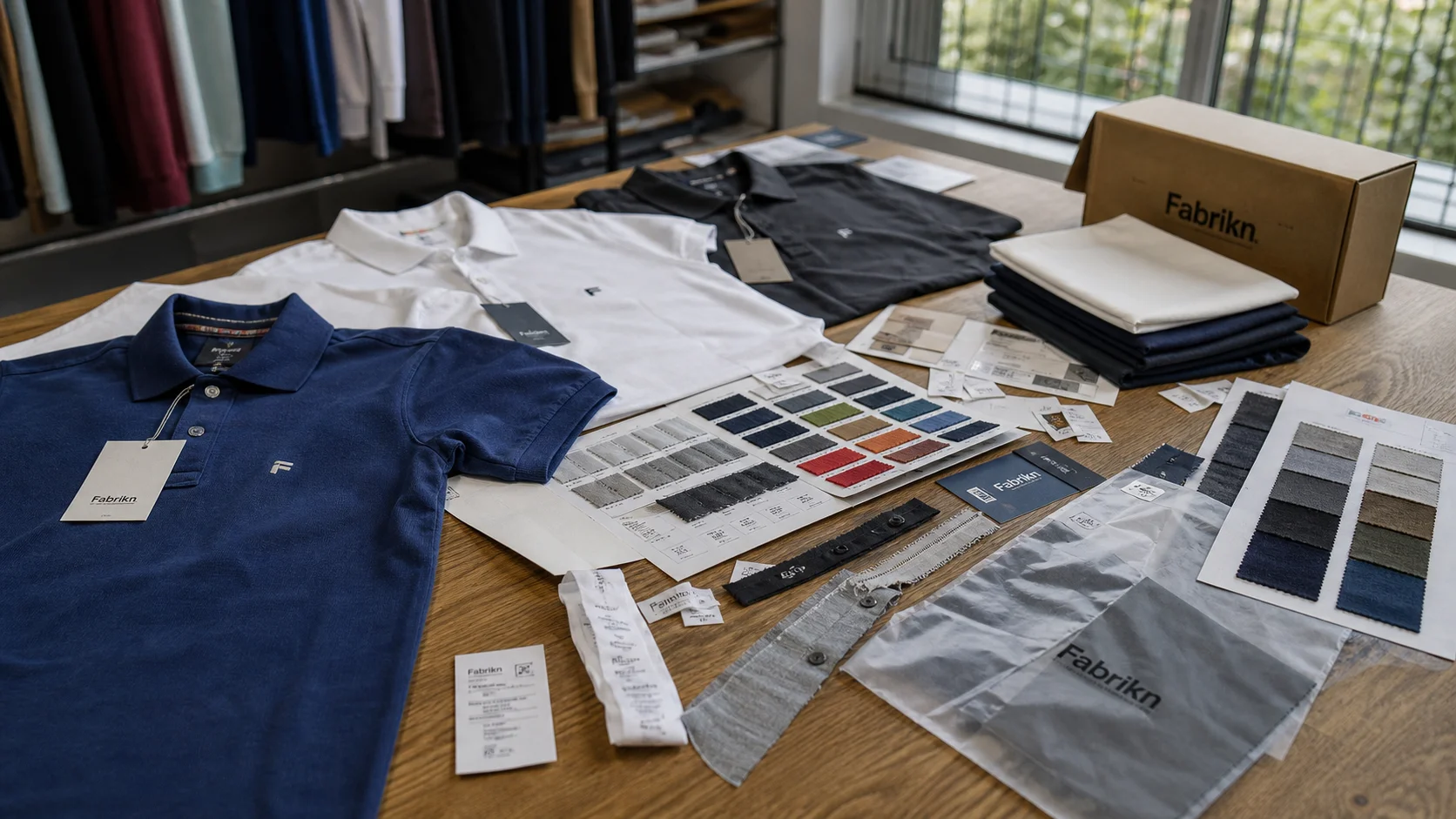
Fashion Ecommerce Poly Mailers with checks for samples, fit, MOQ, QC evidence, pricing terms, and delivery risk.
Fast answer: Fashion Ecommerce Poly Mailers: Film, Closure, Print, and Shipment Fit should be judged by production evidence, not by a generic sourcing promise. The buyer needs sample proof, cost breakdowns, QC checkpoints, and delivery buffers in writing.
Ask for recent sample photos, measurement tolerances, fabric or print test assumptions, decoration test notes, packing examples, and a named inspection checkpoint. These details show whether the team can repeat an approved sample at bulk volume.
Separate garment cost, decoration, labels, packaging, sampling, testing, freight, and rush charges. When every cost line is visible, it becomes easier to reduce colorways, adjust size depth, or reserve more time for sampling.
Fashion packaging has a nasty habit of looking minor right up until it starts eating margin. Apparel returns, repacking, and re-labeling can erase 8% to 18% of gross margin before a customer even touches the product twice. That is why custom poly mailers for fashion ecommerce brands are not packaging vanity; they protect margin and set the tone for the first unboxing moment.
I have watched brands spend $1.20 on a garment bag and lose $6.00 on avoidable damage, slow packing, or a bad first impression at unboxing. The parcel lands, gets opened in 20 to 40 seconds, and starts rewriting the customer’s memory of the product. A flimsy mailer makes the dress inside feel cheaper. Fast.
Walk through enough fulfillment centers in the US and UK and the pattern becomes obvious. Premium DTC labels often pay 12% to 25% more for cleaner print registration, thicker film, and sharper logos because presentation supports repeat purchase. In Southeast Asia, many volume-focused sellers make the opposite call: shave 7 to 15 grams per mailer, shorten lead times by 3 to 5 days, and protect freight economics first. Both strategies can be right.
Some of the strongest brand lift comes from well-printed mailers rather than expensive box systems. I have seen a $0.18 two-color poly mailer outperform a $1.80 rigid box because the logo was crisp, the seam held, and the shipment arrived lighter. A box can signal premium. A dented box signals waste.
This is shipping math, not mysticism. A soft-pack parcel often reduces volumetric weight and cuts packing labor by 10 to 25 seconds per order. In a warehouse shipping 8,000 units a week, that can save 28 to 56 labor hours a month. For labels building out private label clothing, packaging sits inside the promise, not outside it.
Auditing suppliers last quarter in Guangzhou, Dhaka, Ho Chi Minh City, and Istanbul confirmed the same truth: the brands that pre-spec their mailer film, seal strength, and print proof hold the advantage. A regulator-approved sticker in green on that mailer tells the warehouse operator the parcel meets GRS or OEKO-TEX Standard 100 standards, and the customer notices the weight, the feel, and the sound of the peel strip. Those notches in the process are where margin survives.
Base material decides most of the performance. LDPE remains the workhorse because it is flexible, quiet, and comparatively affordable, usually with thicknesses from 50 to 100 microns depending on the supplier. Recycled-content blends are rising fast, especially 30% to 80% PCR mixes, but they can sacrifice opacity or surface smoothness if the resin is poorly sorted. Co-extruded films solve part of that by layering materials so the outer shell prints well while the inner layer improves puncture resistance.
Cast extrusion lines such as Bruckner or Reifenhäuser in Guangzhou drive that layered structure, while the downstream slitter-rewind units trim the edges before the Flexo press. An 8-color Windmöller & Hölscher flexographic machine in Dhaka can print at 200 to 350 meters a minute, matching the demand from fast-fashion partners, whereas gravure lines in Ho Chi Minh City are reserved for deeper saturation, 25,000-unit plus runs, and metallic inks. Digital scopes from HP Indigo add variable QR codes for authentication, but they rarely match the cost curve unless the unit price is a generous $2.50-4.00 per unit at 500 MOQ for limited-edition drops.
Print method changes both price and precision. Flexographic printing is the volume favorite, especially above 5,000 to 10,000 units, because plate costs get diluted and per-unit pricing falls quickly. Gravure can deliver rich ink laydown and sharp saturation, but setup costs are higher and it only makes sense at larger runs, often 25,000 units and up. Digital printing works beautifully for short runs, variable art, and fast sampling, yet unit costs stay higher and color consistency can drift if the supplier lacks disciplined calibration.
Functional details matter more than brand decks admit. A tamper-evident seal protects the garment in transit. A tear strip improves the opening experience and reduces knife damage, which is real when customers slice too deep. Dual adhesive strips help with returns, useful for categories where fit uncertainty drives 20% to 35% return rates. Gusseted formats are useful for bulkier knits, fleece hoodies, and folded denim, especially if the pack-out includes tissue or a hangtag.
Lead times are rarely just about print time. In factories I have walked through in China, India, and Turkey, the bottlenecks were plate setup, ink curing, extrusion capacity, and whether the line was already committed to a 90-ton resin batch. A supplier may promise 12 days, then lose 4 days because the film gauge changes from 60 to 70 microns and the extrusion line needs a reset. Ask for a production calendar, not a guess. Most reliable vendors now quote 18-22 business days for a 25,000-unit custom run, the same window that shipping departments in Istanbul plan around for Ramadan releases.
Before sampling, I ask for five checkpoints: drop tests from 1 meter, seal peel strength, moisture exposure after 24 hours, carton packing efficiency, and a print proof under warehouse lighting. I also ask for the film spec sheet, adhesive type, and a photograph of the actual production line. If a supplier is also handling technical apparel, I want to know whether they understand adjacent categories like custom bra manufacturing or cut and sew manufacturing, because that often signals better fabric handling discipline across the board.
According to ISO, consistent testing standards matter as much as the material itself. That is not paperwork theater. It is the difference between a mailer that survives a cross-border route and one that splits at the seam after 14 hours in a hot container.
Plain stock mailers are cheap for a reason. At scale, I’ve seen generic white or gray mailers land at $0.06 to $0.12 per unit, depending on thickness and region. Stock printed mailers with a simple logo usually sit around $0.10 to $0.18. Fully custom poly mailers for fashion ecommerce brands often start near $0.16 to $0.28 at 5,000 units, then move down to $0.11 to $0.20 at 25,000 units, and can reach $0.08 to $0.15 at 50,000 units if artwork is simple and the spec is stable. Some premium seasonal runs in Guangzhou or Istanbul go even higher—$2.50-4.00 per unit at 500 MOQ—when buyers demand variable foil stamping and ultra-matte lamination.
That spread looks tidy until the hidden costs arrive. Plate fees can add $80 to $300 per color. Setup charges may tack on another $50 to $250. Sample revisions can cost $25 to $100 each round, and if you need three rounds because the mauve on screen turned muddy in print, the “cheap” quote starts to wobble. Freight changes the story even faster. A supplier in India may quote 8% lower on unit price than China, but if lead time slips from 18 days to 31 days and air freight is needed, the saving disappears.
Turkey can be compelling for EU-based brands because transit times are often 5 to 10 days shorter than East Asia, and import friction can be lower for certain lanes. Domestic suppliers can be attractive for urgent restocks, but they often charge 15% to 40% more on unit price. I have seen that premium make sense for dropship-heavy labels that cannot afford a 6-week gap. I have also seen brands overpay for domestic convenience when their forecast was steady enough to support a 45-day sea shipment.
The best rule of thumb is simple: the cheapest quote is not the cheapest order once landed cost, defect rate, and warehouse handling are included. If a supplier rejects 3% to 5% of a run because the seal fails or the print is off-center, your real per-unit cost rises sharply. I ask buyers to calculate cost per usable shipment, not cost per delivered carton. That one shift changes supplier decisions fast.
Before you send a PO, gather three numbers: annual volume, acceptable lead time, and defect tolerance. If you know you will ship 12,000 units across four months, you can negotiate better than if you pretend the run is a one-off. Keep at least 10% buffer in quantity and two extra weeks in schedule. Fashion rarely behaves politely. For brands buying custom poly mailers for fashion ecommerce brands through wholesale packaging solutions, those buffers protect both quality and cash flow.
A mailer has seconds to communicate identity, care, and price positioning. That is a small canvas, but it is not a weak one. I’ve seen minimal layouts with one logo and one line of copy outperform busy graphics because the package reads cleaner at arm’s length and feels more expensive before the customer even touches the seal. A satin-finish BOPP film with dual adhesive strips, produced on vacuum-assisted laminators, feels better than a multi-patterned rail-layout printed on a high-speed gravure roll.
Embossed textures, micro-embossing, or soft-touch coating can all be achieved with chill rolls in the finishing line, yet they deliver a tactile layer of premium at a cost closer to $0.22 per unit at 10,000 MOQ than most expect. Matching that feel with consistent branding requires cross-checking proofs under both D65 daylight tubes and the LED arrays used in the Istanbul third-party packaging lab.
Minimalism does not mean fragility. Consider using gap-free ultrasonic sealing at the bottom with a 12–15 millimeter seal width to protect heavier shipments like denim joggers. A matte, white-on-dark ink palette can be printed on LDPE or co-extruded film via CI flexo machines, while transparent windows for limited collections are typically die-cut using an automated MBO die-cutting press in the same Ho Chi Minh City plant that runs reeded sheets for high-end suiters.
For seasonal campaigns, add discreet call-to-action copy near the peel strip—“Post your look with #Name” printed with UV-curable inks, cured instantly by LED systems on the line so the parcel stays odorless when it arrives at the customer’s door. That way, premium extends beyond material to include the social pulse.
Labels are calling for GOTS, OEKO-TEX Standard 100, GRS, BSCI, and WRAP alignment because customers push for verified supply chains, not vague “eco-friendly” claims. A mailer that boasts recycled content should also come with a certificate, traceable batch, and an explanation of how the PCR resin was sorted, processed, and re-extruded in Dhaka or Guangzhou. Many suppliers now run separate PCR extruder trains with Argon-purged hoppers to meet those standards without contaminating virgin resin.
Recyclability depends on the local waste stream. In the United States and Germany, single-polymer LDPE mailers may be placed in film collection bins, while in Indonesia or Brazil the same mailer ends up in a mixed stream where it becomes a down-cycle feedstock. If the brand wants circularity, consider fully recyclable mono-structures that use low-density polyethylene with solvent-based, solvent-free, or water-based adhesives approved by WRAP auditors in Ho Chi Minh City, and ensure the adhesives meet OEKO-TEX Standard 100 class 1 for baby products.
Clarify claims before the marketing team runs wild. “Compostable” is not the same as “marine degradable,” and both require ASTM D6400 or EN 13432 testing, often performed in European labs. Many factories in Guangzhou and Dhaka can run these tests for a fee, and if you need bottles or tissue paper to match, those are usually handled in the same campus that boasts a BSCI audit for worker welfare. Keep the conversation tied to real evidence, not just nice language.
If you require recycled resin and want to demonstrate it, ask for a third-party mass balance certificate from a GRS-certified facility in Istanbul or Ho Chi Minh City. That level of transparency is increasingly necessary when customers audit your sourcing claims, especially with EU green claims guidance becoming more specific.
Choose a partner with production footprints in Guangzhou, Dhaka, Ho Chi Minh City, or Istanbul that can actually handle the spec. Make sure the supplier shares equipment lists—cast film extruders, high-speed flexo/gravure presses, ultrasonic sealers, die-cutting tables—and that they keep spare parts on hand so a broken doctor blade does not halt the run. Ask for KPIs tied to scrap rate, on-time delivery, and defect percentage.
Insist on certificates and audits. WRAP, BSCI, OEKO-TEX Standard 100, GRS, and GOTS certificates demonstrate factory commitment to quality, worker safety, and environmental management. Demand to see audited social compliance reports, especially if sourcing from Ho Chi Minh City or Dhaka, where the difference between one facility and the next can be dramatic.
Get references and inspect digital proof. See the mailers under fluorescent lighting, hold the peel strip, weigh the package, and run a seal peel test with a tensiometer. Send the supplier a signed document that outlines warranties, lead times (18-22 business days for a standard production window), and penalties for missed delivery dates.
Know your fallback plan. If the Guangzhou line is booked, can the supplier reroute the order to Istanbul? Do they keep resin and additive specifications on file so you can quickly reorder the same batch color and texture six months later? These are the details that separate a reliable packaging partner from a creative contractor.
Day 1-5: Finalize artwork, film spec (LDPE, BOPP, or co-extruded), and adhesives. Confirm certifications such as OEKO-TEX Standard 100 or GRS and validate them with the supplier. Align on MOQ and budget—remember the $2.50-4.00 per unit range for short-run premium campaigns—and include buffer in the PO.
Day 6-10: Sample production. Order a 100-piece sample run, print-proof, and run functional tests (drop test, peel test). Evaluate the mailer under warehouse LED lighting and confirm the adhesive cures are consistent. Schedule an inspection either in Guangzhou or Dhaka, or hire a third-party auditor in Istanbul.
Day 11-20: Review samples, finalize artwork for bulk run, and confirm the production calendar. Pre-book resin if needed. Lock in freight with global forwarders, plan for 18-22 business days lead time, and organize inland pickup from the factory to the port. Schedule a customs broker familiar with EU or US lanes.
Day 21-30: Greenlight production. Monitor extrusion, printing, lamination, and final QC on the automated line. Arrange for packed cartons to go through inspection, check the label data, and release the order once the random 5-piece test passes. Coordinate arrival at the fulfillment center, and plan for distribution uses algined with the upcoming seasonal launch.