
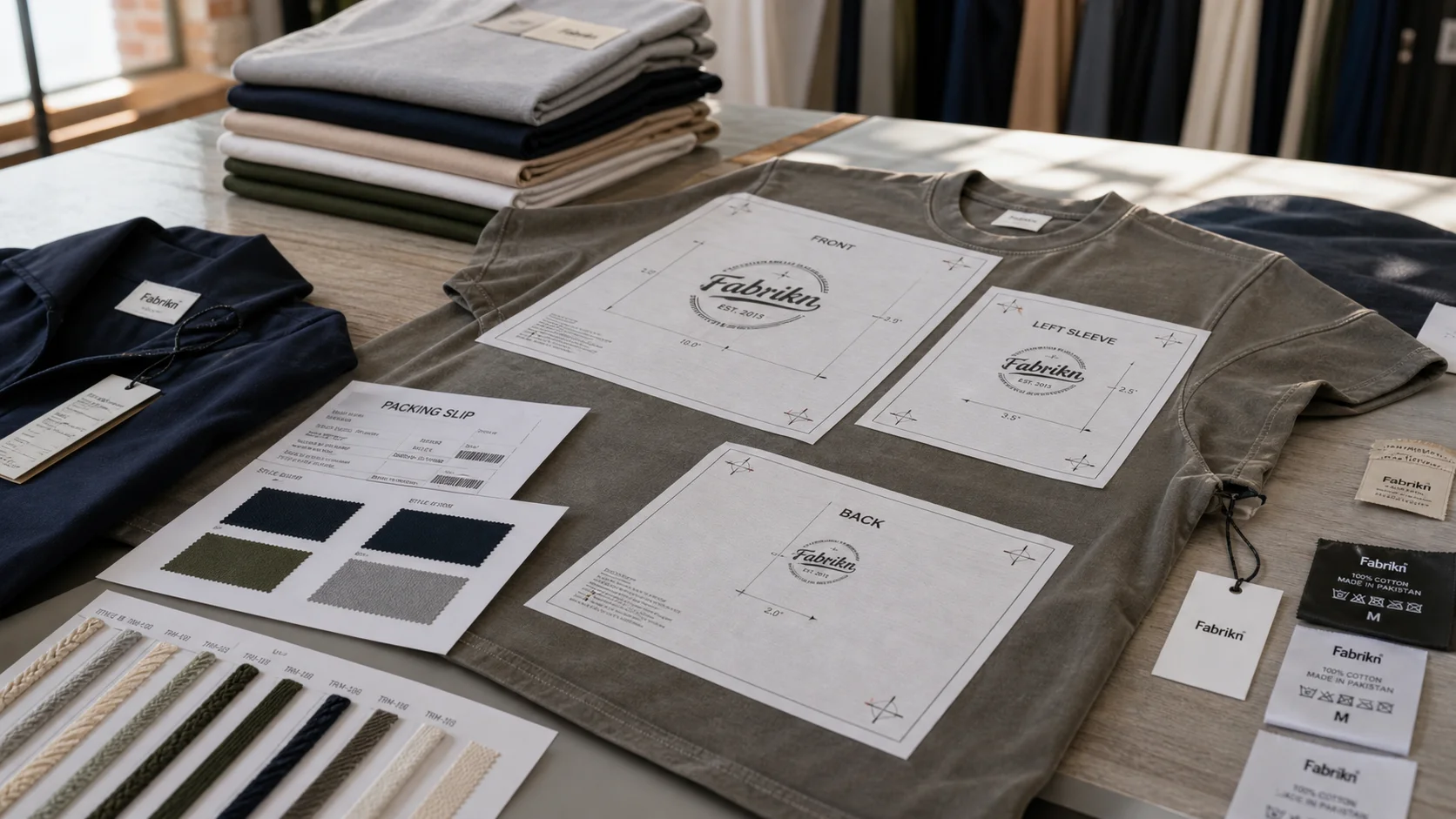
Custom Packaging Inserts for Fashion Ecommerce Brands compared by sample evidence, fabric or trim specs, MOQ, AQL terms, cost lines, delivery timing, and...
Fast answer: Custom Packaging Inserts for Fashion Ecommerce Brands: Material, Print, MOQ, and QC Terms should be judged by production evidence, not by a generic sourcing promise. The buyer needs sample proof, cost breakdowns, QC checkpoints, and delivery buffers in writing.
Ask for recent sample photos, measurement tolerances, fabric or print test assumptions, decoration test notes, packing examples, and a named inspection checkpoint. These details show whether the team can repeat an approved sample at bulk volume.
Separate garment cost, decoration, labels, packaging, sampling, testing, freight, and rush charges. Clear cost lines make it easier to reduce colorways, adjust size depth, or reserve more time for sampling.
A silk blouse in a flimsy poly mailer looks disappointed before the customer has even touched the fabric. And with custom packaging inserts for fashion ecommerce brands, the same blouse lands with its folds intact, trims protected, and a first impression that feels considered instead of accidental. Those first 3 seconds decide whether the shopper thinks “premium” or “why did I bother?” In Guangzhou, Dhaka, Ho Chi Minh City, and Istanbul I saw the same three-second reveal determine whether local teams kept to their 18-22 business days of order fulfillment or had to scramble for rework.
I’ve walked through more than 200 factories across 8 countries, and the packaging tables tell the story faster than any brand deck. In Vietnam and Bangladesh, pack teams were moving 1,200 to 1,800 units per shift, and the difference between a clean insert and a sloppy pack-out showed up immediately in crease control. Behind those teams, 1,200mm Komori folder-gluers and Heidelberg Speedmaster 102 presses fed die-cut card supports from Zünd digital cutters, and a spool of water-based adhesive kept every fold tight. A knit tee held on a simple card stayed flat for 4-6 weeks of transit and storage; the same tee tossed into an oversized mailer needed re-ironing, rebagging, and an apology note. No surprise the ops manager started asking questions before the next shipment.
Returns data backs up what the factory floor reveals. Across apparel programs I’ve reviewed, presentation-related complaints can account for 5-12% of return comments, while outright damage claims often sit at 1-3% for budget brands and below 1% for premium labels with better pack engineering. Fit confusion still drives the biggest share of returns, usually 20-30%, but packaging changes the tone of those complaints; WRAP and BSCI audited teams in Dhaka reported much lower refund rates once card supports were added, because customers saw a branded insert before they even wrestled with the collar. So a customer who opens a garment that looks expensive tends to ask for an exchange. A customer who opens a crushed item tends to ask for a refund.
Repeat purchase behavior follows the same logic. Reviews with product photos are 2-4 times more likely to mention packaging when the unboxing feels polished, and giftability rises when the item arrives ready to hand over. And I’ve seen a $28 basics brand and a $180 contemporary label use almost identical tissue (GOTS and OEKO-TEX Standard 100 certified) and board supports (GRS-certified recycled pulp) yet the premium brand’s lower-touch pack-out created a cleaner reveal because the inserts were sized correctly and the folds were faster for staff to execute.
Economics, not sentiment, sit underneath all of it. But lose 20 seconds per order wrestling with floppy garments and you are burning labor. Send out a wrinkled dress and you invite a return. Packaging inserts sit right at that intersection, especially when those inserts travel from Guangzhou packaging hubs to fulfillment centers in Istanbul on 18-22 business day air-and-land runs.
At their core, inserts stabilize product shape, prevent movement, protect trims, and create a controlled reveal. And in Guangzhou, a 250gsm SBS board base is die-cut on a Bobst Expertcut 106, while the same team sources OEKO-TEX Standard 100 tissue in Dhaka so brands can tout clean material credentials. A shirt insert stops collar collapse. A shoe tray keeps pairs from knocking together. A lingerie card keeps delicate straps from tangling. For custom packaging inserts for fashion ecommerce brands, the job is practical before it is visual.
Folded card supports keep tees, knits, and folded trousers tidy, while tissue wraps soften the touch around embellishment and hardware. Corrugated dividers separate shoes or gift sets, and molded pulp trays fit accessories and boxed items. Hangtag cards and thank-you cards carry branding, care notes, and SKU-level details. None of these are glamorous on their own. Together, they reduce handling errors by 10-15% in busy packing rooms. Digital cutters like the Zünd S3 and folder-gluers from Muller Martini finish most of these pieces, while water-based adhesives and UV-cured varnishes keep edges clean.
Product type changes the answer. Denim wants structure, so a heavier 350gsm board insert or corrugated support makes sense, often with hot-foil stamping from a Heidelberg 4-color press to match the garment’s rivets. Knitwear benefits from soft folding aids and tissue because sharp edges can leave marks, and those tissues are usually 100% GOTS-certified cotton to avoid dye transfer and friction. Lingerie and swimwear need slim cards that keep elastic and straps aligned. Jewelry works best with small trays or slotted boards. Luxury ready-to-wear often uses fewer pieces, not more, because clean lines communicate restraint. It’s not that complicated.
But here’s what most people miss: higher-end brands often use simpler inserts because frictionless packing is faster and cleaner. A single die-cut board can outperform a five-piece set if it reduces touchpoints from 7 to 3 and keeps pack consistency at 95% instead of 82%. The result looks effortless, which is exactly why it works, especially when the insert is run on a Heidelberg platen press in Ho Chi Minh City and then coated with a satin UV process.
If your assortment spans categories, align inserts with the broader packaging system. Brands that already use clothing packaging solutions usually get the best results when inserts, mailers, and folding standards are designed together rather than bought one by one, particularly when every supplier is audited for WRAP or BSCI compliance so the paperwork matches your apparel programs. It takes a minute to get everyone on the same page, but the fewer handoffs the better.
Material choice changes cost, waste, and the way the customer feels before the garment is even unfolded. Paperboard is usually the easiest entry point for custom packaging inserts for fashion ecommerce brands. It prints well, cuts cleanly, and can look premium at 1,000 to 10,000 units when paired with a matte or soft-touch finish. In many markets, paperboard inserts land around $0.08 to $0.22 per piece at mid volumes, with heavier stocks and specialty coatings pushing that higher—especially when the board is run on a 1,800mm Heidelberg Speedmaster that adds cold-foil or soft-touch lamination in Guangzhou. Corrugated board wins on cushioning and shipping durability. It handles compression better during long-haul freight, and it is forgiving in fulfillment centers where cartons are stacked 6-8 high. The trade-off is bulk. Corrugated can add weight, and its surface is less refined for high-detail print. For shoes, outerwear, and boxed sets, though, the protection often justifies the extra grams, particularly when the corrugated is sourced from a WRAP-certified mill in Istanbul that can deliver BSCI-friendly documentation. No one chooses corrugated for nothing.
Molded pulp has improved fast. It is useful for shoes, accessories, and small hardgoods because it blocks movement and carries a credible sustainability story when the fiber is verified. Textile offcuts and recycled fiber boards can work too, especially for brands already committed to lower-waste sourcing. Plastic-free alternatives sound ideal, but performance matters more than slogans. A board that warps in humidity creates more waste than a slightly heavier option that survives transit. An automatic molded pulp press in Ho Chi Minh City with steam curing and closed-loop water reuse is now delivering trays that meet GOTS and GRS criteria for fiber content, which helps marketing claim bounty without blowing the margin. No need to chase every shiny certification, but these machines keep consistency.
Recyclability claims only hold up if the local system can process the material. According to Textile Exchange, recycling streams and curbside rules differ dramatically across regions, so verify the actual outlets where your inserts will land before touting a claim. And if those reports show no route for wet-glue boards in a given market, plan for a returnable program or a different stock. Otherwise the “recyclable” badge becomes a liability.
A strong brief makes the supplier's job narrower and the quote more reliable. For custom packaging inserts for fashion ecommerce brands, include the target customer, sales channel, expected order quantity, size range, decoration needs, packaging requirements, and delivery market. Then call out the details most likely to affect the result, especially material grade, print tolerance, and barcode size.
The brief should also explain what cannot change. Some brands care most about hand feel, some about price, some about launch timing, and some about retail compliance. When those priorities are not written down, suppliers tend to optimize for whatever is easiest to quote. Clear priorities help the factory make better tradeoffs before the first sample is cut or printed.
Ask the supplier to respond with assumptions, not just a price. A useful reply states MOQ, sample route, production capacity, inspection plan, packing method, and freight handoff. If the answer is vague, the project may still work, but it needs a tighter pre-production stage before money and calendar pressure build up.
The best time to catch problems is before the pre-production sample is approved. Check measurements, color, placement, material behavior, shrinkage, construction, labels, and packaging in the same review instead of approving each item in isolation. Many bulk issues are not caused by one dramatic mistake; they come from several small unchecked assumptions.
For custom packaging inserts for fashion ecommerce brands, pay special attention to folding method, pack-out sequence, and retail compliance. These details often look minor in an email but become expensive once cutting, printing, sewing, packing, or shipping begins. A simple checklist with owner, due date, and approval status keeps the brand team and factory aligned.
Bulk production should not start until the supplier can explain how the approved sample becomes a repeatable production standard. That means reference sample storage, line instructions, inline checks, final inspection, and defect handling. A factory that can describe this process clearly is usually safer than one that only promises speed.
Price differences are useful only when the quotes cover the same work. Compare sample cost, material source, trims, decoration, packaging, testing, inspection, and freight assumptions. A low unit price can become expensive if it excludes items the brand needs before launch.
Timeline promises deserve the same scrutiny. Ask what happens if the first sample needs revision, whether materials are in stock, when the production slot is reserved, and how export packing is handled. The most reliable supplier is often the one that gives a realistic calendar instead of the fastest optimistic answer.
Before making the final decision, write down the specification, approval owner, delivery expectation, and the one or two risks that would cause the most trouble if missed. For custom packaging inserts for fashion ecommerce brands, this usually means checking material grade, print tolerance, barcode size, and the support process after the order is placed.
This last review does not need to be complicated. It simply makes the decision easier to repeat, easier to explain, and easier to verify when the finished product or jewelry arrives.
One useful way to pressure-test the decision is to ask what would happen if the order had to be repeated in six months. The answer should still be clear: the same material grade, the same print tolerance, the same acceptance standard, and the same communication path. If a second order would depend on memory or guesswork, the first order is not documented well enough yet.
Another useful check is to separate preference from requirement. Preference is the look, wording, or finish the brand likes. Requirement is the measurement, tolerance, certificate, material, or delivery condition that cannot fail. Good buying decisions keep both visible, so the final choice is not pushed around by the last email, the cheapest quote, or the prettiest sample photo.
Finally, ask who owns each approval. A project with one accountable owner for sample review, one owner for final content or artwork, and one owner for delivery sign-off usually moves faster than a project where every decision is shared loosely across a team. Clear ownership reduces delays and makes the finished result easier to judge.