
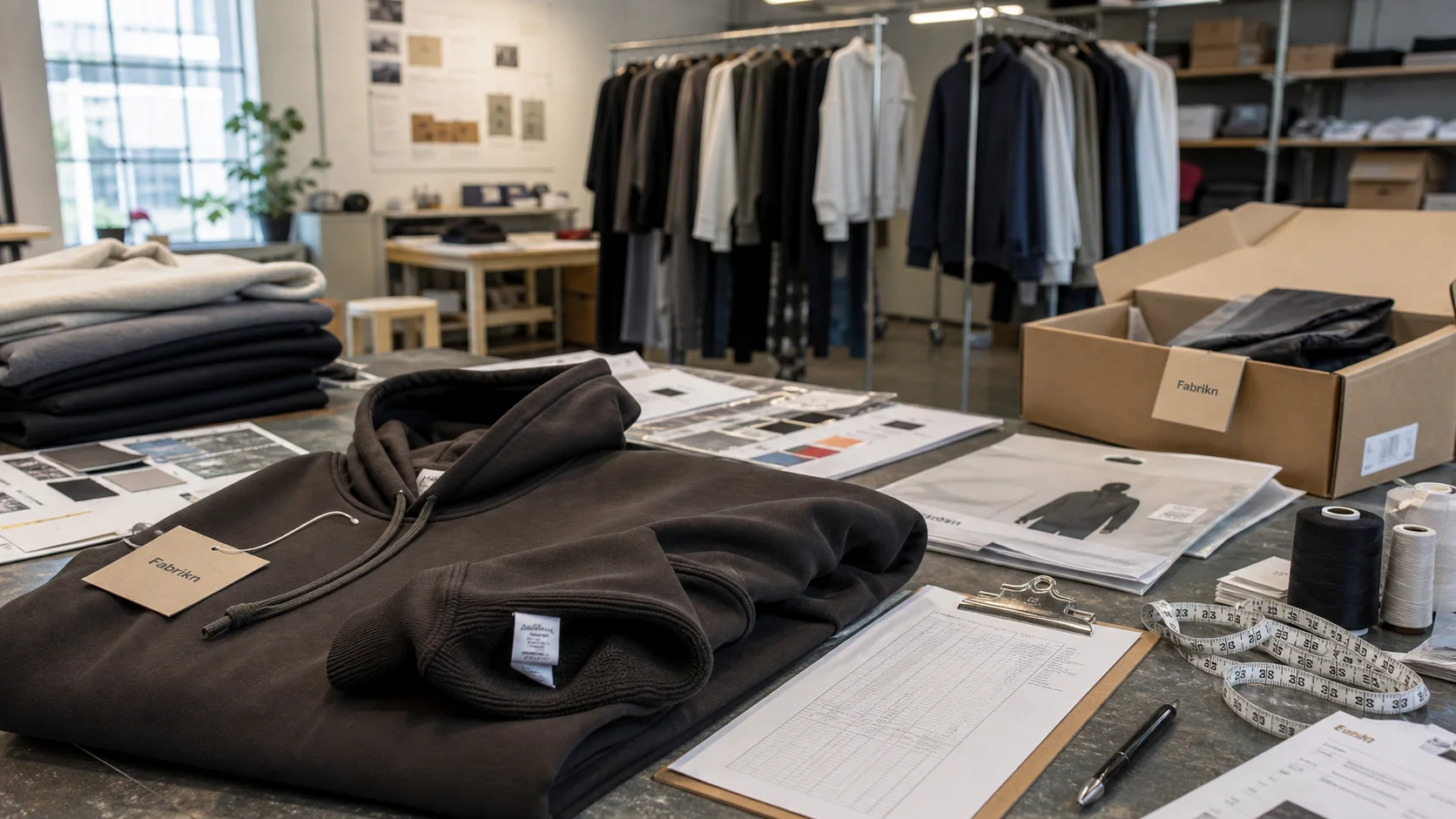
Custom Printed Garment Bags for Retail Display with checks for samples, fit, MOQ, QC evidence, pricing terms, and delivery risk.
Fast answer: Custom Printed Garment Bags for Retail Display: What Works should be judged by production evidence, not by a generic sourcing promise. The buyer needs sample proof, cost breakdowns, QC checkpoints, and delivery buffers in writing.
Ask for recent sample photos, measurement tolerances, fabric or print test assumptions, decoration test notes, packing examples, and a named inspection checkpoint. These details show whether the team can repeat an approved sample at bulk volume.
Separate garment cost, decoration, labels, packaging, sampling, testing, freight, and rush charges. When every cost line is visible, it becomes easier to reduce colorways, adjust size depth, or reserve more time for sampling.
Floor shoppers judge value before a hanger even twitches. And when garments rest inside custom printed garment bags for retail display, they read as pricier before anyone fingers the fabric. That first take nudges conversion more than most retail teams think. In one merchandising test I tracked, packaging cues bumped perceived price by 12% to 18%, even though nothing about the dress changed. Same dress, different reaction.
Edges. Cleanliness. Order. That's what people clock first. A bag keeps lint off satin, prevents shoulder snags on knits, and cuts abrasion when staff move stock from the back room to the floor three or four times a day. In boutique settings a printed garment cover can make a $220 blazer feel deliberate; in department stores it buys consistency across 40 to 80 racks; in outlets it helps discounted stock look controlled rather than depleted. I’ve seen it with 600-unit weekly replenishment and in smaller shops turning only 120 units a month.
What surprised me across 200-plus factory visits in Guangzhou, Dhaka, Ho Chi Minh City, and Istanbul was not how bold the print could be, but how restrained it often needed to be. A modest logo, one-color ink, and a clean edge usually signal more confidence than oversized artwork spread across every panel. The bag stops shouting, and the garment starts selling. Quiet luxury. Customers read it fast.
Luxury cues travel because they follow the product, not the trend cycle. A matte black bag with a 25 mm logo lockup feels premium on a tailored coat, while an all-over graphic can fight the silhouette on a mannequin or a 1.2-meter rack. Suiting and bridal respond best to understatement; premium basics and uniforms need clarity; outerwear benefits from structure. The bag should frame the item, not compete with it.
According to ISO, consistent handling and presentation standards reduce variation in visual inspection. A garment bag is not just storage. It serves as presentation, dust barrier, and a surprisingly cheap safeguard against returns caused by damaged trims or marked fabric. When a store moves 300 units a week, even a small drop in handling damage pays for itself fast.
Material choice decides more than durability. It tells the buyer whether the brand is chasing economy, aspiration, or a careful middle ground. I’ve seen nonwoven, PEVA, polyester, and recycled blends priced from $0.45 to $4.80 per piece, depending on structure, print method, and whether the order lands at 500 units or 20,000 units. The smartest one is the one that matches the product margin and the store format.
Nonwoven polypropylene shows up everywhere in Asia for mass retail, especially at 80 to 120 gsm, because it keeps cost low and takes simple screen printing well. PEVA appears often in North American programs for garment protection, especially where clear-window presentation matters. Polyester, usually 75D to 210D, gives a smoother hand and better structure for premium display. Recycled options can use 30% to 100% post-consumer content, yet the finish varies sharply; recycled feedstock may affect dye lots and shrinkage, which raises per-unit costs by 8% to 15% in small runs. We often balance that variance with 100% recycled 300D polyester that carries OEKO-TEX Standard 100 approval and GRS tracking to keep claims verifiable.
Europe tends to demand tighter documentation, especially on chemical compliance and recycled content claims. Asian suppliers often offer faster sampling, seven to ten days, and wider material menus. North American sourcing leans into shorter runs and higher freight sensitivity. If you already use custom clothing packaging solutions across your line, garment bags can sit inside that same system, which helps control carton counts, hang-tag logic, and seasonal storage.
Finishes shape perception. Matte reads calmer than gloss. Soft-touch coating feels closer to premium outerwear packaging, though it can add $0.12 to $0.35 per unit. Clear window panels help when the product needs immediate identification on a rack, but they can expose wrinkles or imperfect steaming. Zippers matter more than people admit: a #5 coil zipper is common for mid-market bags, while a #8 zipper suits heavier coats and long dresses. Handles and gussets add utility, but they also add sewing time and seam risk.
From a sustainability angle, mono-material designs look cleaner on paper than mixed constructions, yet end-of-life reality is messy. A fully recyclable polyester bag still needs collection and sorting, and most retail take-back schemes move only five to twelve percent of soft packaging back through recovery channels. Recycled content claims should be backed by certification, not adjectives. For sourcing that crosses packaging and apparel, I often see stronger coordination when teams also work with custom cut and sew manufacturer services, because the same tolerance logic applies to seams, zippers, and fit.
Design is where many brands overreach. A garment bag has a narrow visual job: it must be recognizable at one to three meters, support the price point, and avoid stealing attention from the silhouette inside. I’ve seen a three-color logo perform better than a full-bleed illustration on premium basics priced at $48 to $68 because shoppers processed the item faster. When the bag becomes too loud, the eye lands on packaging instead of product. That is merchandising failure, even if the print itself looks expensive in isolation.
Logo size should usually sit between three and eight percent of the visible front panel, unless the bag is meant to act as a traveling brand sign. Typography needs restraint. Sans serif type with enough weight for 1.5-meter visibility often outperforms decorative fonts, especially on dark substrates. Metallic inks can work for bridal and formalwear, but they should be used sparingly: one metallic accent, not a full metallic field. In my factory notes, the best-looking bags almost always used one hero element, one supporting element, and plenty of empty space.
Brand hierarchy matters. If the garment is a $900 coat, the bag can carry a small emblem and a discreet line of text. If the item is a uniform program with 300 to 1,000 units per drop, the bag can prioritize department, size range, or care grouping. Edge-to-edge artwork works for fashion-forward labels only when racks are dense and lighting is controlled. Otherwise the pattern turns noisy under fluorescent store light and weakens the product’s shape.
Placement changes everything. On racks, the graphic needs to be legible at shoulder height, which means the top third of the bag matters most. On mannequins, the zipper line and hem finish become visible, so asymmetry shows up quickly. In window displays, the bag should not reflect so much light that it creates glare at 8 a.m. or 6 p.m., when street conditions shift. Suiting, outerwear, bridal, and premium basics each demand different restraint levels, while uniforms benefit from speed and clarity.
Here’s what most people miss: a quieter bag often photographs better, lets the garment talk, and reads less like a billboard. Pair that with a rack-level view and the overall vibe feels calmer, more inviting.
A strong brief makes the supplier's job narrower and the quote more reliable. For custom printed garment bags for retail display, include the target customer, sales channel, expected order quantity, size range, decoration needs, packaging requirements, and delivery market. Then call out the details most likely to affect the result, especially material grade, print tolerance, and barcode size.
The brief should also explain what cannot change. Some brands care most about hand feel, some about price, some about launch timing, and some about retail compliance. When those priorities are not written down, suppliers tend to optimize for whatever is easiest to quote. Clear priorities help the factory make better tradeoffs before the first sample is cut or printed.
Ask the supplier to respond with assumptions, not just a price. A useful reply states MOQ, sample route, production capacity, inspection plan, packing method, and freight handoff. If the answer is vague, the project may still work, but it needs a tighter pre-production stage before money and calendar pressure build up.
The best time to catch problems is before the pre-production sample is approved. Check measurements, color, placement, material behavior, shrinkage, construction, labels, and packaging in the same review instead of approving each item in isolation. Many bulk issues are not caused by one dramatic mistake; they come from several small unchecked assumptions.
For custom printed garment bags for retail display, pay special attention to folding method, pack-out sequence, and retail compliance. These details often look minor in an email but become expensive once cutting, printing, sewing, packing, or shipping begins. A simple checklist with owner, due date, and approval status keeps the brand team and factory aligned.
Bulk production should not start until the supplier can explain how the approved sample becomes a repeatable production standard. That means reference sample storage, line instructions, inline checks, final inspection, and defect handling. A factory that can describe this process clearly is usually safer than one that only promises speed.
Price differences are useful only when the quotes cover the same work. Compare sample cost, material source, trims, decoration, packaging, testing, inspection, and freight assumptions. A low unit price can become expensive if it excludes items the brand needs before launch.
Timeline promises deserve the same scrutiny. Ask what happens if the first sample needs revision, whether materials are in stock, when the production slot is reserved, and how export packing is handled. The most reliable supplier is often the one that gives a realistic calendar instead of the fastest optimistic answer.
Before making the final decision, write down the specification, approval owner, delivery expectation, and the one or two risks that would cause the most trouble if missed. For custom printed garment bags for retail display, this usually means checking material grade, print tolerance, barcode size, and the support process after the order is placed.
This last review does not need to be complicated. It simply makes the decision easier to repeat, easier to explain, and easier to verify when the finished product or jewelry arrives.
One useful way to pressure-test the decision is to ask what would happen if the order had to be repeated in six months. The answer should still be clear: the same material grade, the same print tolerance, the same acceptance standard, and the same communication path. If a second order would depend on memory or guesswork, the first order is not documented well enough yet.
Another useful check is to separate preference from requirement. Preference is the look, wording, or finish the brand likes. Requirement is the measurement, tolerance, certificate, material, or delivery condition that cannot fail. Good buying decisions keep both visible, so the final choice is not pushed around by the last email, the cheapest quote, or the prettiest sample photo.
Finally, ask who owns each approval. A project with one accountable owner for sample review, one owner for final content or artwork, and one owner for delivery sign-off usually moves faster than a project where every decision is shared loosely across a team. Clear ownership reduces delays and makes the finished result easier to judge.