
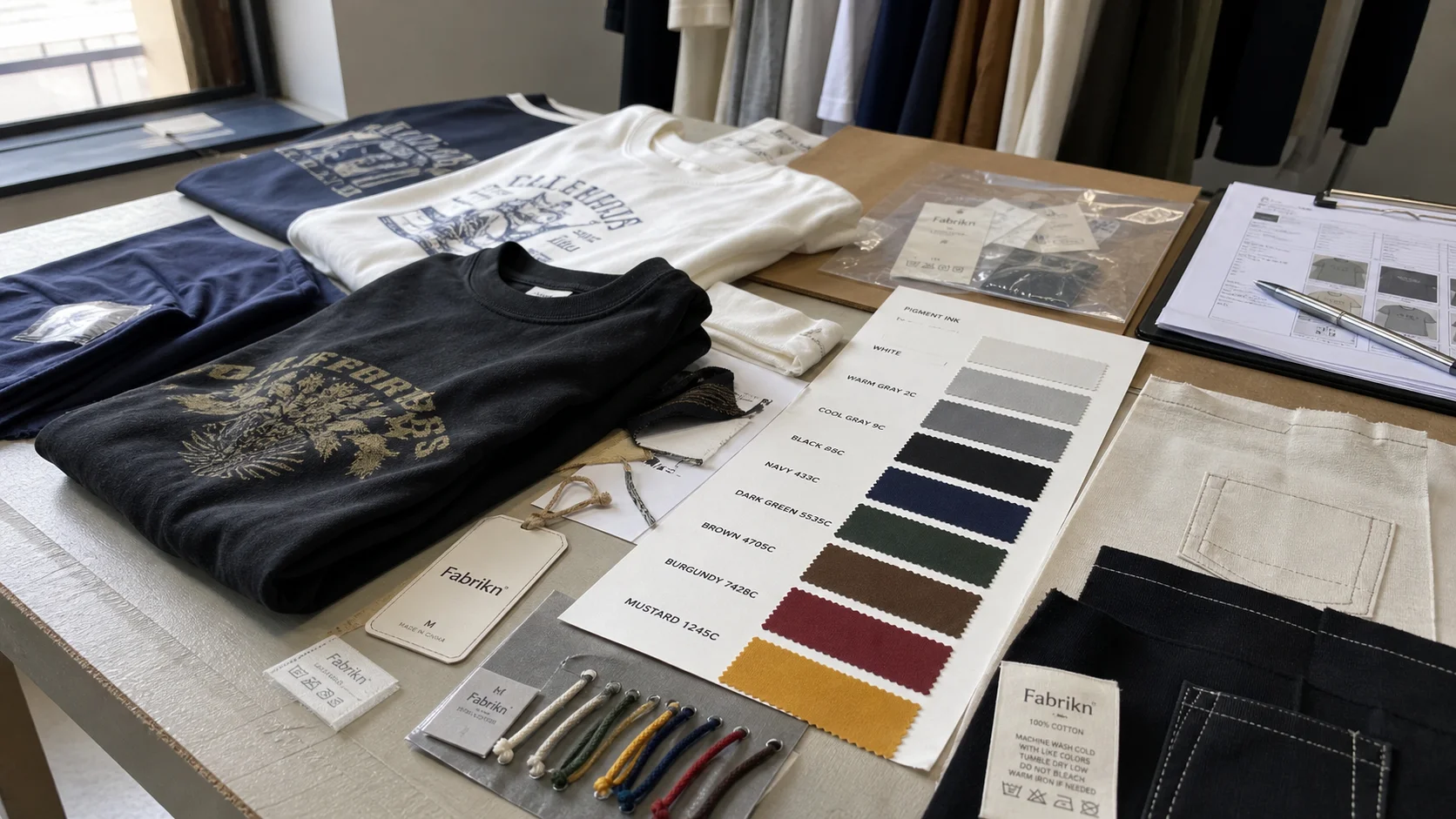
Branded Garment Bags for Retail Clothing Packaging compared by sample evidence, fabric or trim specs, MOQ, AQL terms, cost lines, delivery timing, and...
Fast answer: Branded Garment Bags for Retail Clothing Packaging: Material, Print, MOQ, and QC Terms should be judged by production evidence, not by a generic sourcing promise. The buyer needs sample proof, cost breakdowns, QC checkpoints, and delivery buffers in writing.
Ask for recent sample photos, measurement tolerances, fabric or print test assumptions, decoration test notes, packing examples, and a named inspection checkpoint. These details show whether the team can repeat an approved sample at bulk volume.
Separate garment cost, decoration, labels, packaging, sampling, testing, freight, and rush charges. Clear cost lines make it easier to reduce colorways, adjust size depth, or reserve more time for sampling.
On factory floors, I have watched a $1.20 bag rescue a $120 jacket. No drama, no theory—just the blunt arithmetic of branded garment bags for retail clothing packaging: one item protects fabric, carries a logo, and shapes the customer’s first physical contact with a brand.
Across visits in China, Vietnam, and Turkey, the difference between a low-cost bag and a well-made one showed up fast. A 0.12 mm zipper split after 20 cycles; a 0.22 mm coil zipper held past 200. A 120 GSM non-woven body creased badly. An 180 GSM version stayed flat in transit. Print registration wandered 2-3 mm on bargain units and stayed clean at premium price points.
The retail logic is simple. Basics need trust. Occasionwear needs protection. Premium lines need theatre without waste. A folded dress in a flimsy sleeve says “temporary.” A structured garment bag says “keep me.” That matters for shelf impact, carry-home value, and the unboxing moment, especially in stores where customers leave with the purchase in hand rather than waiting for a courier box.
Boutiques have used bags to lift perceived value on entry-level knitwear priced at $38-$55. Department-store buyers used them to keep suits and outerwear in saleable condition for 30-45 days on the floor. For teams comparing packaging options, branded garment bags for retail clothing packaging are often the piece that bridges presentation and protection.
Factory visits reveal a perception gap. Buyers obsess over hanger shape and tissue paper, then overlook how bags reduce returns caused by dust, snagging, and crushed hems. I measured one mid-market brand that cut “not as expected” complaints by 11% after switching to better closures and stronger seams, with only a $0.18 unit increase.
In another case, a resale-focused label found its garments arrived in better condition, which improved resale photos and reduced steam-and-repack time by 6-8 minutes per item. That is margin, not fluff. For brands already investing in clothing packaging solutions, the garment bag is one of the few packaging elements that keeps working after the sale.
There is also a category nuance. Premium basics in Los Angeles and Madrid often use modest bags because the brand story is quiet. Lower-priced occasionwear in Dubai and Seoul leans into richer finishes to compete with more expensive labels. Price does not always predict packaging quality. Sometimes the $42 blouse gets the better bag because the merchandiser understood that presentation narrows the gap with a $78 competitor.
The bag is not a cost center alone. It is a signal, a shield, and a small operational tool with outsized influence.
An effective bag does four jobs at once. It keeps out dust. It prevents sharp folds. It survives transport from warehouse to store, or store to home. And it helps the rack look organized instead of chaotic.
In practical terms, that means choosing the right body material, closure, and branding method rather than defaulting to the cheapest option on a quote sheet. A good branded garment bags for retail clothing packaging spec starts with how the product will actually be handled.
Non-woven polypropylene is still common because it is light, affordable, and easy to print. I have seen 90-150 GSM versions work for mass retail, though thinner bags at 70-80 GSM can tear at stress points if they are packed tight. PEVA offers clearer visibility and better water resistance, but it can feel plasticky and cost more than non-woven by 15%-30%.
Recycled PET gives a cleaner sustainability story and stronger fabric hand, especially at 120-180 GSM. Cotton blends feel premium but bring higher labor, higher freight, and longer lead times, often 3-4 weeks longer than synthetic equivalents. If you need a benchmark on responsible material claims, see OEKO-TEX standards for textile safety testing and Textile Exchange guidance on preferred fibers.
Brand cues matter more than many teams think. Screen print is economical for 1-2 colors and MOQ 500-1,000 pieces. Woven labels, embossing, heat transfer, and sewn-on patches add texture and durability. In stores, customers notice tactile cues first: zipper pull shape, handle reinforcement, stitched edge quality, whether the logo survives folding.
According to OEKO-TEX, chemical safety claims only mean something when the full material set has been verified, so a pretty print is not enough if odor, coating, or dyes fail testing. That is why a branded garment bags for retail clothing packaging brief should include both appearance and compliance requirements.
Here is the specification list I ask factories for every time: GSM, zipper grade, seam strength, handle bar-tacking, transparency level, water resistance. For mass retail, the bag should be easy to fold and stack in cartons of 50-100 units. For premium boutiques, I prefer heavier fabric, smoother zippers, and cleaner logo placement.
For sustainable collections, I want recycled content certificates, clear claims on end-of-life, and a bag that can realistically be reused 10-20 times before it looks tired. Too many “eco” bags look virtuous on paper and flimsy on the rack.
The sustainability conversation gets messy fast because packaging is judged by intention, not just by performance. Virgin plastic can be cheap and durable. Recycled plastic can reduce demand for fossil feedstock. Natural fibers can feel better in hand. Blended constructions can complicate recycling while improving function.
I have toured plants where a 160 GSM recycled PET bag outlasted a 240 GSM cotton-poly blend in actual retail use, which sounds backward until you remember that friction, moisture, and repeated folding punish some “natural” options more than buyers expect. A reliable branded garment bags for retail clothing packaging program should balance durability, cost, and end-of-life claims.
Thicker bags can create more waste, not less. A 220 GSM bag failed because it was too rigid for the way stores repacked garments, so staff forced zippers, cracked seams, and tossed units after just 6-8 uses. A lighter 140 GSM recycled bag, properly reinforced at stress points, lasted 15-18 uses.
Waste is not only about material input; it is also about failure rate, user behavior, and whether the bag actually fits the workflow. The right factory, production line, and quality checks matter as much as the fabric itself. When evaluating a manufacturer, ask about the process, the supplier’s QC system, and whether the production team can document testing results.
Brands need to check the paperwork. Ask for recycled content certificates, dye safety data, and proof of the testing standard used for claims. If a supplier says “recyclable,” ask where and under what conditions. In many markets, municipal recycling still cannot process mixed-material bags with zippers, laminations, and sewn labels.
I have seen labels promise recyclability when the bag was effectively destined for landfill. That is not a small mistake. It is a credibility problem. For broader sourcing context, the U.S. International Trade Administration is useful for tracking trade and sourcing conditions.
For product planning, I break it down by SKU value and journey. A $28 T-shirt traveling 200 miles from warehouse to store does not need the same bag as a $450 wool coat shipped across continents. Travel distance matters. So does reuse potential.
If a luxury coat bag will be kept in a closet for 2-3 years, a higher-spec construction can make sense. If a promo item will be handed out once, keep the bag simpler and spend the money elsewhere, such as on fit consistency or hangtag quality. For brands that need adjacent manufacturing support, custom bra manufacturing programs often face the same trade-offs: delicate products, high expectations, and packaging that must protect without overengineering.
One principle saves money and waste: match the bag to the product’s real life, not the mood board. The right material is usually the one that survives the number of trips, folds, and storage cycles your SKU actually sees.
Budget garment bags usually land around $0.35-$0.85 per unit at 5,000-10,000 pieces, depending on size, material, and whether the branding is one-color screen print. Mid-range bags run roughly $0.90-$1.80, often with stronger zippers, better handles, and cleaner finishing.
Premium versions can reach $2.20-$4.50 or more, especially if you add woven labels, custom zipper pulls, laminated windows, or heavier recycled PET fabrics. Sample costs often sit at $20-$80 per style, while tooling and print setup can add $50-$300.
MOQs vary sharply. Basic non-woven styles may start at 500-1,000 pieces, but custom shapes, specialty zippers, and full-coverage branding often push orders to 2,000-3,000 pieces. I have seen buyers fixate on a $0.12 difference in unit price while ignoring freight that adds $0.18-$0.40 per bag, or warehouse storage that consumes another 2%-5% of landed cost if cartons are bulky.
Garment bags are light, but they are not free to move. Volume is the hidden bill. For a wholesale or bulk program, especially from China, landed cost should be reviewed before the first order is approved.
The decoration method changes the economics. One-color print is the cheapest path, with the lowest setup and the fastest revision cycle. Full-coverage branding costs more because it raises waste during production and increases rejects if registration is off by even 1-2 mm. Woven labels tend to last longer and look more premium, yet they add sewing labor.
Custom zipper pulls are a small detail that can add $0.05-$0.25, but they have strong shelf impact. If you need another benchmark for packaging-related cost structure, look at brands scaling custom baby clothing manufacturing; their packaging decisions often mirror the same freight and defect math.
I use a simple buyer framework. Spend more on the closure, seams, and logo placement if the garment is expensive, heavy, or frequently handled. Keep costs tight on color count, oversized branding, and decorative extras if the bag will be thrown away quickly or never seen by the customer.
A bag that costs $0.60 but saves one damaged return in every 200 units can justify itself faster than a $0.30 bag that fails quietly.
China still dominates for scale, trim breadth, and rapid prototyping. Vietnam tends to excel in cleaner labor workflows and good consistency on mid-volume runs. India offers strong textile know-how, especially where fabric sourcing and sewing complexity matter. Turkey is fast for Europe-facing replenishment, and Eastern Europe can be excellent for shorter lead times and closer collaboration on premium runs.
Trade data from trade.gov shows how shipping routes and tariffs reshape sourcing decisions just as much as unit price. When comparing suppliers for branded garment bags for retail clothing packaging, geography, compliance, and lead time can be as important as the quote.
On factory visits, the differences show up in the small failures. In one Chinese plant, print registration varied by 2 mm between cartons because operator training shifted between shifts. In Vietnam, odor control was stronger on recycled materials, but a buyer had to watch zipper consistency across multiple subcontractors.
In India, I saw excellent stitching on cotton blends and a 7-10 day longer sample loop because trim approvals moved slower. Turkey often delivered cleaner documentation and faster correction cycles, while Eastern Europe was strong on lower-MOQ premium programs, sometimes at 300-500 pieces.
Labor structure matters. A factory with stable teams and 2-3 dedicated QC checkpoints usually beats a bigger plant that chases volume and uses casual labor during peak season. I care about that more than glossy brochures.
If your season is compressed, a 15-day lead time advantage can matter more than a $0.08 unit saving. If your assortment is broad, supplier diversification reduces the risk of one missed zipper batch taking down an entire launch.
Regional choice should match seasonality, speed-to-market, and risk. For core replenishment, China and Vietnam can deliver scale. For closer-to-market capsule drops, Turkey or Eastern Europe can reduce transit time by 1-3 weeks.
For brands with more complex textile stories, India can pair well with broader private-label programs, including private label clothing services. The smartest teams do not choose one region forever. They split risk across 2-3 suppliers, then compare defect rates, not just quotes.
I have seen polished mockups fool smart teams. A beautiful render can hide weak seams, fuzzy print edges, and zippers that snag after 12 cycles. Before you approve production, ask for a physical sample from each supplier and compare them under the same light, on the same hanger, with the same garment weight.
Place a 1.5 kg coat and a 300 g blouse in each bag. The failure pattern changes fast. This is where quality control separates a good supplier from a weak one.
Your test list should be mechanical, not vague: zipper cycles, seam pull strength, abrasion resistance, fold recovery, print rub resistance. I ask for at least 50-100 zipper cycles on a sample, a seam pull test that exposes weak stitching, and a rub test that checks whether logos smear after friction.
Also confirm handle reinforcement, because thin webbing often fails before the body fabric does. Ask whether the sample reflects final production or just a hand-built prototype; those are rarely the same thing. If a factory cannot explain the difference, keep looking for a better manufacturer.
Artwork prep matters more than brands admit. Request the dieline, confirm file formats, and lock down color standards before a bulk order. Pantone or CMYK should be specified clearly, and any metallic or tonal print needs a reference swatch.
If a vendor cannot explain bleed, safe zones, and zipper placement, the relationship will likely become expensive. Use one approval sheet that records price, quality, speed, compliance, and sustainability, each scored from 1 to 5. Anything below 3 in quality should fail, no matter how attractive the quote looks.
A sourcing scorecard works because it keeps people honest. Buying, operations, and sustainability teams often reward different things, and a shared sheet forces the conversation into numbers: 3-4 week lead time, MOQ 1,000 pieces, 0.8% defect target, and 100% carton traceability.
That is the level of specificity retail teams need before they spend money on packaging that will be touched by every customer. It also makes it easier to compare custom, wholesale, and bulk proposals from multiple suppliers.
The cleanest rollout follows a six-step timeline. Brief the supplier in week 1 with garment weights, bag dimensions, closure type, and target MOQ. Sample in weeks 2-3. Revise in week 4. Approve in week 5.
Production usually takes 2-5 weeks after approval, depending on material availability and decoration complexity. Then allocate 1-2 weeks for quality control and shipping, longer if the route is congested or the order is oversized. In my experience, teams underestimate the approval loop more than the factory time.
Start with a pilot order. Test one or two categories first, not the entire assortment. I prefer a high-volume basic line and one premium or seasonal item, because the packaging stress differs.
A pilot of 500-2,000 units can expose defects, storage problems, and customer reaction without tying up cash in 10,000 units that may need redesign. Track sell-through, return condition, and store feedback for at least 30 days. That is the safest way to validate a branded garment bags for retail clothing packaging specification before scaling.
Set reorder triggers before the first carton lands. If the damage rate exceeds 2%, if zipper failure appears in more than 1 in 200 units, or if stores start replacing bags manually, the spec needs review. Seasonality matters too.
Winter outerwear may justify thicker bags and earlier production, while summer categories can move faster with lighter material. Cashflow matters as well, because a 10,000-piece order at $1.05 is $10,500 before freight, duties, and storage.
Internal alignment keeps the project from stalling. Merchandising should define the product promise. Operations should validate pack-out and storage. Sustainability should review material claims and certificates. Finance should approve the landed cost and reorder threshold.
If those four teams agree on a shared brief, the packaging program runs like a process rather than a rescue mission. That is usually the difference between a bag that sits in a drawer and one that quietly sells the product better.
Basic versions usually cost $0.35-$0.85 each at 5,000-10,000 pieces. Mid-range bags typically land at $0.90-$1.80, while premium styles can reach $2.20-$4.50 depending on fabric, zipper quality, and branding method.
Sampling often takes 2-4 weeks, and production usually takes 2-5 weeks after approval. Add 1-3 weeks for shipping depending on region, season, and whether the order is moving by sea or air.
Non-woven polypropylene suits mass retail, recycled PET works well for stronger sustainability claims, PEVA offers water resistance, and cotton blends feel premium but cost more. For many buyers, 120-180 GSM recycled PET is the best balance of durability and reuse.
Check zipper cycles, seam pull strength, abrasion resistance, fold recovery, and print rub resistance. I recommend testing at least 50-100 zipper openings and comparing samples with the same garment weight, lighting, and packing method.
Yes, especially for wrinkle-sensitive or premium apparel. In one project I reviewed, stronger closures and better seams helped reduce “not as expected” complaints by 11% and kept garments in saleable condition longer during store handling and shipping.