
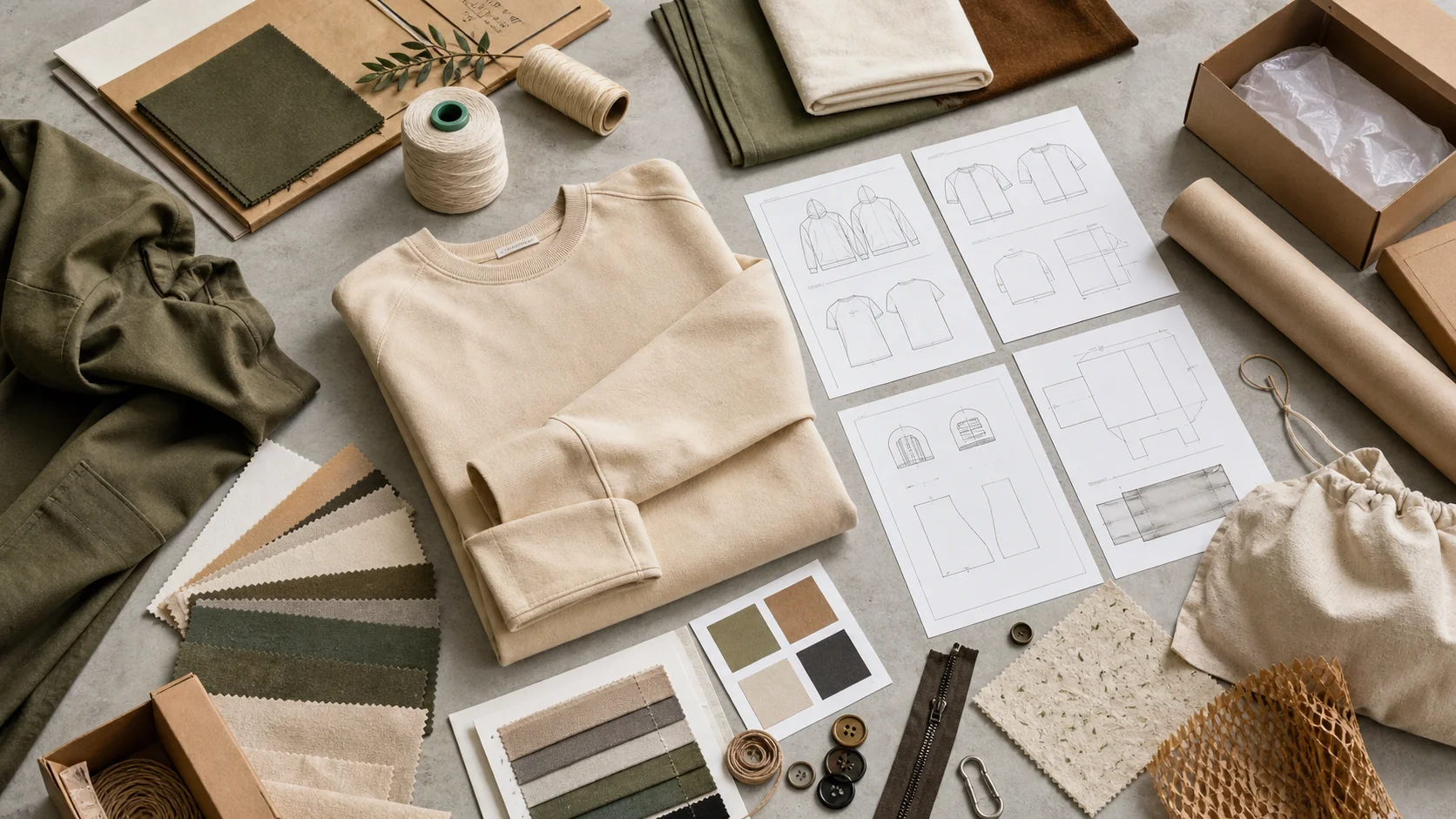
Custom Printed Garment Bags with Logo compared by sample evidence, fabric or trim specs, MOQ, AQL terms, cost lines, delivery timing, and rework responsibility.
Fast answer: Custom Printed Garment Bags with Logo: Material, Print, MOQ, and QC Terms should be judged by production evidence, not by a generic sourcing promise. The buyer needs sample proof, cost breakdowns, QC checkpoints, and delivery buffers in writing.
Ask for recent sample photos, measurement tolerances, fabric or print test assumptions, decoration test notes, packing examples, and a named inspection checkpoint. These details show whether the team can repeat an approved sample at bulk volume.
Separate garment cost, decoration, labels, packaging, sampling, testing, freight, and rush charges. Clear cost lines make it easier to reduce colorways, adjust size depth, or reserve more time for sampling.
I’ve watched a shopper lift a $68 shirt, glance at the bag, and decide in seconds that it belonged at $88 instead. That is the strange power of presentation. For retail teams, custom printed garment bags with logo do the talking before a salesperson gets a chance. In buyer testing, premium packaging has nudged perceived price up by 10-20%, especially when the bag feels structured and the mark sits cleanly at eye level. I have seen a designer's eyes light up when a simple logo finally had enough space to breathe.
On the sales floor, in a studio closet, or at a red-carpet wardrobe station, the package is part of the product. A matte PE sleeve with a crisp one-color mark says practical and controlled. A heavier PP bag with a zipper and hangtag reads more premium. Spend $0.18 more on material and the rack presentation can jump faster than it ever does from adding another ink color. In Guangzhou showrooms that service the Asian and European markets, early-stage brands often pair that zipper detail with a 20-head CHIN FONG ultrasonic sealer to keep the finish consistent for 500-piece MOQs.
First 10 seconds. That is the window.
In my experience, the sales team watches the same clock, so once the bag catches their eye the pitch practically writes itself.
Shoppers notice three things fast: the surface feel, the alignment of the logo, and whether the bag holds shape. If it crumples, the brand feels cheaper. If it stands up straight, even a mid-priced item can borrow a luxury cue. Packaging strategy matters across stores, sample rooms, and event wardrobes. I have visited factories where the print was flawless, yet the bag still looked weak because the film was too thin and wrinkled during folding.
Here’s what most people miss: many low-cost bags do not fail because the print is poor. They fail because thin film wrinkles distort the logo after folding, shipping, and hanging. A perfect print on a 0.04 mm bag can still look worse than a simpler mark on a 0.08 mm bag. In factory audits, that problem shows up more often than ink starvation or press error, especially on order sizes under MOQ 500 pieces.
Material choice changes everything: clarity, reuse, print sharpness, and the way the bag ages after 3-4 handling cycles. For custom printed garment bags with logo, PE is the lowest-cost route, often used at $0.10-0.28 per piece for lightweight covers, and it prints well for simple branding. PP is stiffer and clearer, which helps when the garment inside must stay visible. Nonwoven sits in the middle for feel and cost, while woven fabric or coated fabric pushes the bag into true premium territory, often $1.20-4.50 per piece depending on size and closure (yes, that sometimes means a static cling problem in winter).
A $2.50-4.00 per unit at 500 MOQ rate on polyester oxford 210D with embroidery and internal padding still beats a down-market mailer when the garment is a $400 coat. I have seen clients switch from PE to PP mid-run because the hangers just didn't cooperate, which was a mess to reschedule (not recommended).
For durability, PE wins on price but loses on recovery. It creases faster, tears sooner at the hanger opening, and can feel disposable after one use. PP gives better stiffness and a cleaner look under retail lighting. Nonwoven breathes better, which matters for stored apparel and transit, though its print surface is less sharp than glossy film. Fabric bags, especially polyester oxford 210D or 420D, carry the highest reuse potential and pair well with sewn branding. They also accept embroidery, woven labels, and print better than people expect when the art is large and simple.
Honestly, this approach works better because when a garment bag earns a second use, customers start expecting it to protect their valuables, not just their new blazer.
Sustainability claims need scrutiny. Recyclability depends on local collection systems, not just resin type. A PE sleeve may be technically recyclable, yet have a reuse rate below 15% if shoppers discard it at home. A nonwoven bag can be reused 10-20 times, which often matters more in practice than a better eco label. Data from OEKO-TEX and Textile Exchange shows how material claims must be tied to certification, chemistry, and fiber origin, not marketing language alone. For compliance-focused sourcing, U.S. trade and export guidance is also useful when comparing import rules and documentation.
Regional sourcing shifts price in surprising ways. In Vietnam, China, and Turkey I have seen the same spec quoted at different levels because resin sourcing, energy cost, and MOQ are not identical. A 0.06 mm PP bag with a one-color logo might land at $0.22 in one plant, $0.18 in another, and $0.30 where MOQ 10,000 is required. That spread is not always about labor. It is often about resin contracts, waste yield, and whether the factory can combine your order with existing runs. When evaluating a manufacturer, factory, or supplier, in my experience the best quote is rarely the prettiest spreadsheet; it is the line that balances material grade, production efficiency, unit economics, and reusability over 6-12 months of use. Buyers who also need clothing packaging solutions usually get better results when packaging is planned alongside the garment launch.
Fabric changes the conversation again. If your garments already use technical trims, or if you are shipping premium tailoring, a sewn bag can justify a longer lifespan and a stronger margin story. That is especially true for private label launches that need coherence across hangers, dust covers, and mailers, much like the decisions I see in private label clothing services. When working with a Dhaka-based textile house that holds both GOTS and OEKO-TEX Standard 100 certifications, my clients have leaned into pre-dyed yarns to avoid post-printing VOC issues.
Screen print remains the simplest route for one-color logos on PE, PP, and nonwoven. It is durable, affordable, and stable across 5,000-20,000 pieces. Gravure works better for high-volume film runs, especially when the brand wants finer lines or repeated artwork across 20,000+ bags. Heat transfer is useful for fabric and polyester-based bags when you need more detail, but it can crack if the substrate is soft or the fold line sits directly under the mark. On clear film, sharpness matters most at the edge of the logo, where low-grade plates blur faster than buyers expect.
Adding foil stamping or UV spot coatings means the machine list grows: Komori UV offset presses for film, or Fujifilm Acuity with Konica Minolta heads for fabric panels. In Ho Chi Minh City, a factory I audited used an 8-color Polytouch screen-line rig for tight registration on 200D ripstop panels, while keeping WRAP and BSCI audits current. I have inspected bags where a full-color print looked impressive on a proof but fell apart after folding. Simple logos survive better. A one-color mark on the chest or centered panel usually holds up through abrasion, carton compression, and warehouse handling.
Dense artwork, gradients, and tiny type are where problems begin. In one factory in southern China, the print itself was fine, yet the brand mark looked off because the film stretched 2-3 mm during sealing and nobody had allowed for it in the artwork file. It’s maddening when the art is perfect but sealing warps it (I mean, what else are we supposed to blame—gremlins?).
Brand control is not just ink. It includes Pantone matching, zipper pull color, hangtag integration, and how much bleed you allow near sealed edges. A good tech pack will specify logo size in mm, not just “large” or “small.” If the mark is 60 mm wide on a 500 mm bag, say so. If the hangtag must align with the print panel, draw that relationship. I have seen clients lose an entire sample round because they approved artwork before confirming where the zipper would interrupt the front panel.
In my experience, aligning the packaging graphics with the garment decoration method keeps production runs simpler. For brands that also use printed apparel, it helps to align packaging graphics with garment decoration methods. If your garment line uses heat-applied graphics, compare the pack with the heat unit (for example a 600 x 800 mm M&R HTP-VX press) to avoid temperature incompatibility. Brands shipping from Istanbul to European pop-up stores often coordinate their packaging graphics with the embroidery fixtures already used on their garments to maintain a single color story.
The largest line items are resin, ink, and finishing. Resin costs fluctuate daily; when polypropylene hits $1,250 per tonne, a film line in Guangzhou suddenly needs 40% more raw material dollars. Print colors add roughly $0.03-0.08 each, with metallic inks costing closer to $0.18 per unit. Finishing, from die cutting to zipper insertion, typically runs $0.12-0.25 per bag depending on complexity.
When buyers ask about “low cost,” I always revisit MOQ. A 500 MOQ with a factory in Dhaka may list $2.50-4.00 per unit at 500 MOQ for a 420D fabric bag with matte laminate, while the same bag in Istanbul will hover near $3.20 because of higher labor but faster rail access to EU clients. Shipping from Ho Chi Minh City incurs higher ocean freight but benefits from newer post-press facilities that can stitch laminated panels overnight. In contrast, nonwoven bag orders in southern China often require 1,000 MOQ to reach the most efficient production tier, making smaller runs proportionally expensive when divided by overage. Both GRS and OEKO-TEX Standard 100 certifications demand additional documentation, which typically adds $0.06 per unit for batch testing and tracing systems.
Energy-intensive steps—extrusion, lamination, and printing—can also create spikes. When electricity surcharges rise in Guangzhou over Chinese New Year, a film run may lose $0.12 per bag, so I always recommend building a buffer into the initial quote.
Clear specs keep everyone aligned. Provide actual dielines with seam allowances, reference colors in Pantone numbers, and show details such as zipper teeth size, slider finish, and whether you need hangers reinforced with cardboard inserts. If your brand requires WRAP-compliant labor reporting or BSCI traceability, note that in the tech pack so the factory can attach the right compliance certificates to each shipment.
Some of the best instructions I’ve seen include a short clip showing how the garment sits inside the bag and where creases occur during hanging. That prevents surprises when a PP bag with a zipper needs to clear the collar of a structured blazer. With GOTS-certified cotton muslin interiors, I advise clients to specify dye lot information for the drawstring as well, because a mismatched color is noticeable as soon as the stylist reaches for the bag in the wardrobe room.
For premium packaging, specify the machinery line: for example, “Film to be heat-sealed on a Kaeser SSTL-1200 and printed on a Comexi flexo with 3 mm anilox rollers.” The more precise you are, the better the factory can dial in registration, adhesive spread, and perforation spacing. Insist on inspection reports that reference both visual standards and tensile testing values. The factories in Ho Chi Minh City that handle high fashion orders have dedicated QC lines with Mettler Toledo tensiometers to ensure consistency.
Sampling typically takes 7-10 business days once the factory has the tech pack, dielines, and approved artwork. For PE or PP bags, you can shave time by supplying digital mock-ups that already include stretch adjustments for sealing. Fabric or laminated samples may require 2-3 iterative rounds, especially if the zipper placement changes.
Full production slots in at around 18-22 business days after sample sign-off, assuming the factory is not booked past 65% capacity and raw materials are in stock. In Guangzhou the certainty is higher because these plants keep a 30-40 day resin buffer, whereas in Istanbul or Dhaka delays can stretch out another week if the container stack-up backs up at port.
Shipping adds another 10-18 days, depending on whether you choose air freight from Ho Chi Minh City or ocean freight from Shanghai. Total lead time—from initial enquiry to doorside delivery—can therefore reach 40-50 business days for complex bags, so planning alongside the garment production schedule is non-negotiable.
Use a checklist that covers compliance, materials, branding, and logistics. Confirm that the manufacturer holds current OEKO-TEX Standard 100, GOTS, WRAP, BSCI, or GRS certificates if you require them. Ask for photos of the actual rolls of film, the dye lot number for the fabric, and the spool number for the thread so you can trace back when a batch disappoints.
Talk through shipping options early. If you need bags for a trunk show in Milan, a 500-unit order from Istanbul may arrive faster by rail, while a similar order from Dhaka could be more economical via sea freight. Factor in customs lead times—if Guangzhou factory paperwork is delayed by two days, the ocean vessel might miss its slot, adding another 4-5 days.
Finally, never skip a pre-production sample. Even if the cost is $120 extra for a hand-assembled proof, it is cheaper than redoing 2,500 units after the hangers reveal a fit issue. In my experience, brands that invest in this step avoid 60-70% of the most expensive corrections later.