
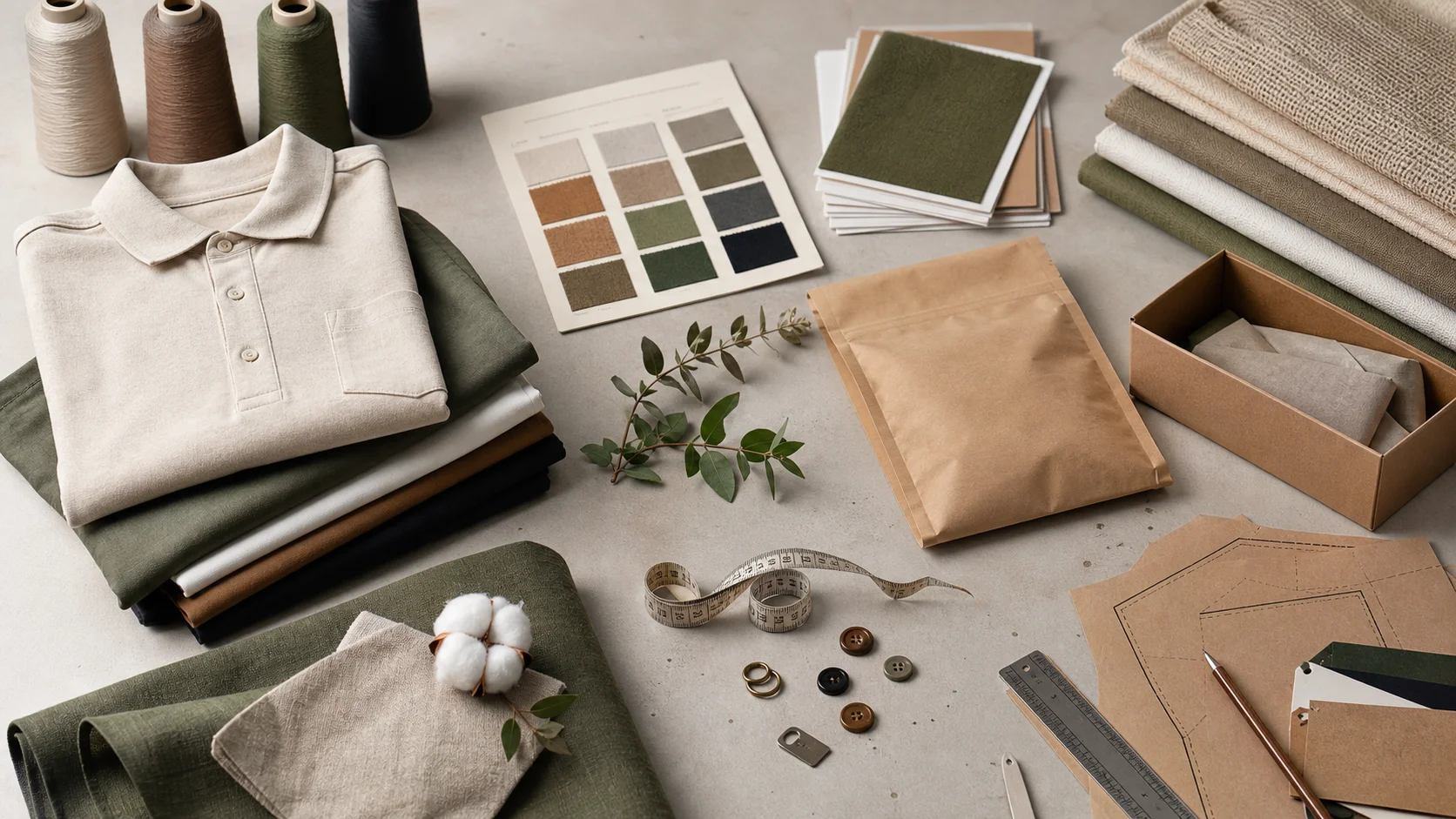
Fashion Startup Logo Mailer Bags with checks for samples, fit, MOQ, QC evidence, pricing terms, and delivery risk.
Fast answer: Fashion Startup Logo Mailer Bags: Material, Closure, Print, and MOQ should be judged by production evidence, not by a generic sourcing promise. The buyer needs sample proof, cost breakdowns, QC checkpoints, and delivery buffers in writing.
Ask for recent sample photos, measurement tolerances, fabric or print test assumptions, decoration test notes, packing examples, and a named inspection checkpoint. These details show whether the team can repeat an approved sample at bulk volume.
Separate garment cost, decoration, labels, packaging, sampling, testing, freight, and rush charges. When every cost line is visible, it becomes easier to reduce colorways, adjust size depth, or reserve more time for sampling.
The shipping bag is no longer the dull bit nobody notices. For fashion startups, it is the first branded object a customer touches, and sometimes the one that decides whether the order feels considered or hurried. Custom mailer bags with logo for fashion startups have moved from “nice to have” to a practical part of the brand experience.
Branded packaging can lift repeat-purchase intent by 20% in direct-to-consumer trials, and that matters when founders are shipping $40-$120 orders. I’ve watched the same scene in factories from Ho Chi Minh City to Prato: a tidy mailer does more persuasion than the invoice, the thank-you card, and the homepage combined.
Plain poly mailers save pennies, yes. But on lower-ticket orders, a few cents can quietly knock perceived value down by several dollars, especially when the garment itself is well made. During visits to packaging lines serving 1,000-unit drops and 25,000-unit runs across Guangzhou, Dhaka, and Istanbul, the pattern kept repeating: the bag was the cheapest item in the order, yet it shaped the customer’s judgment fastest. I’ve seen kamphuisen bearings on blown-film extruders spin for 18 hours straight, then the bags go straight into tint-set rotogravure printers and arrive in a folding and sealing corridor that handles 160 bags per minute.
Factory audits tell a blunt story. Low-cost suppliers frequently deliver inconsistent print registration, off-center logos, and seals that fail after a rough conveyor pass or a 1-meter drop. I’ve watched sleeves wrinkle under heat, ink shift by 2-3 mm, and closures split on bags that looked fine in a product photo. Not dramatic defects. Tiny, annoying ones. That is exactly why they hurt.
Luxury-focused labels often spend 3-6% of order value on packaging, while fast-fashion startups may keep it under 1.5%. The difference is not vanity; it reflects shipping strategy, return expectations, and margin structure. A premium brand selling a $180 dress can justify a $0.85 to $1.40 mailer system if it cuts damage and supports retention. A trend-led label selling a $42 top needs a tighter ceiling, often closer to $0.18 to $0.35 per unit.
I’ve visited enough factories to say this plainly: packaging is not just shipping supplies. It is marketing. It is protection. It is the last production decision customers actually see. If your brand also needs help with product development, private label clothing services and packaging planning should be treated as one commercial conversation, not two disconnected purchases.
Logo mailers change three things at once: recognition at delivery, the feel of unboxing, and the odds that a parcel survives transit in one piece. I’ve seen customers share a delivery on Instagram before they’ve even opened it, and I’ve also seen a well-packed order earn a five-star review because the bag arrived clean, dry, and uncrushed after a 12-day regional line-haul. That is why custom mailer bags with logo for fashion startups are both brand asset and logistics tool.
Here’s what most people miss: in several factories, thicker bags did not outperform well-designed medium-gauge bags in damage tests. A 60-micron bag with good seal geometry and proper gusset control often beat a flimsy 90-micron bag that had poor film blending and weak side welds. Thickness alone does not protect a hemmed knit set or a structured blazer. Design does. Testing does. Bad production does not get rescued by extra grams. During a quality sweep at a Ho Chi Minh City plant, the electrostatic corona treater on the film line was adjusted 0.3 mm to improve ink holdouts on matte black films, showing just how precise the process needs to be.
Logo placement changes perception more than founders expect. Centered marks can read premium in North America, while small repeated marks often feel more current in parts of Europe and East Asia. Matte black with a restrained white logo tends to signal quiet luxury. Bright color-blocked mailers perform better for trend-heavy labels dropping 4-8 micro-collections a year. The finish tells shoppers what kind of brand they have just received.
Recycled PE gives the best balance of print quality and durability for many fashion shippers. Compostable film can work, but it needs careful storage and shorter transit windows. Paper mailers feel refined in hand, yet they can scuff, crease, or soften in wet lanes. I’ve seen a paper-based mailer perform beautifully in Milan and fail after 48 hours of monsoon rain in South Asia. Context matters. A foam-laminated film bag from a Guangzhou line lasted 18-22 business days through the EU parcel system without tears, while a standard kraft flag-seal mailer from the same supplier failed after week-long rain on a Dhaka route.
There’s also a materials bonus many teams overlook. A custom mailer can remove the need for extra tissue, a separate thank-you card, or an oversized carton insert, which lowers overall material use in some setups by 8-15%. That is useful for labels trying to keep presentation strong without inflating outbound weight. If you need to compare packaging against garment specs in one place, cut and sew manufacturing planning helps align the bag with the product rather than with guesswork.
Material choice determines cost, print fidelity, and how often the bag fails before it reaches the customer. Recycled poly mailers often cost 10-25% less than paper-based branded mailers at similar order volumes. That gap widens when you add premium coatings, heavier basis weights, or complex printing. Paper can look rich in a pitch deck. On a wet loading dock, it is a different story.
I have seen paper mailers hold up well for lightweight tops, socks, and accessories under 300 grams, especially in dry domestic shipping. Put a dense terry sweatshirt or a multiple-item order inside, and the risk rises. Humid transit lanes, rainy seasons, and rough last-mile handling create creasing and edge failure that a film-based mailer usually handles better. If a startup ships 2,000 parcels a month, a 2% failure rate means 40 replacement orders. That eats savings quickly.
Finish choice shapes the brand story. Matte suits minimalist labels and natural-fiber stories. Gloss works for trend-driven drops and youth-focused positioning, where color saturation matters and the bag needs shelf pop at the door. Soft-touch gives the richest feel for premium basics, but it adds cost and can show scuffs faster than founders expect. I’ve seen soft-touch mailers look excellent in studio light and tired after a 1.5-kilometer scooter delivery.
Print adhesion and seal strength matter more than surface trendiness. A glossy finish with poor ink bonding will smudge. A matte bag with strong corona treatment, clean registration, and a 10 mm heat seal will usually perform better. This is the kind of detail that separates a packaging supplier from a vendor taking a shortcut. It is also why I pay attention to film composition, seal tests, and drop results before I care about color charts.
My rule is simple. Match material to product weight, transit distance, and return rate. A label shipping 180-gram tees locally can use a lighter recycled poly mailer. A brand sending 900-gram outerwear across borders needs more margin. Do not copy luxury brands blindly. Their unit economics are different, and their packaging budget often starts where yours ends. For a quick range check, you can browse our product catalog and compare constructions before you ask for quotes.
Pricing changes sharply with volume. At 1,000 units, a simple two-color recycled poly mailer might land around $0.28 to $0.55 each, while a paper-based branded mailer can sit closer to $0.45 to $0.80. At 5,000 units, those numbers often improve to roughly $0.16 to $0.32 for film and $0.30 to $0.60 for paper. At 10,000-plus, a narrow print design and standard thickness can push film bags below $0.14 in some factories.
Three variables move the price by 15-40%: print colors, film thickness, and closure type (zip lock, tape, or self-seal). A 500 MOQ run with a full-color print on bio-based LDPE that uses lamination and silver foil accents may start around $2.50-4.00 per unit after you factor in the air freight from Guangzhou, the testing on the winders, and the rotogravure cylinders. That same supplier can drop the price to $0.42 when you hit 10,000 units with a two-color flexo print on 65-micron recycled polyethylene and simple press-to-close sealing powered by a SML three-roll laminator line in their Istanbul facility.
Lead time depends on complexity, but most reliable suppliers quote 18-22 business days from order to shipment when the packaging needs just one die-cut, one print station, and no lamination. Add custom lamination, multilayer films, or hot-stamping, and expect 25-30 business days. Frameworks such as the WRAP and BSCI audits ensure the production line, whether in Dhaka or Ho Chi Minh City, respects the lead time because the documentation on uptime, die changes, and quality checks is already regimented.
Remember tooling: a new die for a unique bag shape can cost between $90 and $220, while rotogravure cylinders are roughly $600 per color. Those charges are amortized over the MOQ. That means a 500-piece batch with die, cylinder, and filament sealing often carries the $2.50-4.00 per unit rate, while a 5,000-piece batch dilutes tooling to $0.15-$0.30 per unit. Ask your supplier for a breakdown that separates tooling, film, ink, and labor, so you know which costs drop as volume rises.
A strong brief starts with the SKU you’re shipping. Weight, foldability, and return rate dictate the film combo. Spell out whether you need 60-micron recycled PE with corona treatment or 80-micron virgin HDPE. Include the finished dimensions, gusset depth, and whether the bag stays flat across pallets or gets stuffed with layered quilts. State the closure: 120 mm peel-and-seal, press-to-close, or zip. Mention the printing treatment—full-color gravure or one-color flexo, and whether you need metallic inks. That lets the supplier allocate specific machines, like a rotogravure press in Guangzhou for gradient matches or a flexo line in Dhaka for solids.
Specify certification expectations. If the garments are GOTS-certified, the mailer should at least comply with OEKO-TEX Standard 100 for azo-free inks and the Global Recycled Standard (GRS) for recycled content. Share your preferred compliance audits, such as WRAP for workplace practices or BSCI for sourcing ethics. When the supplier understands the end-to-end brand promise, they orient their QC tests—seal strength, drop test from 1.2 meters, tensile tests—around those parameters from the first sample.
Include logistics targets. Tell them whether the parcels will travel from Guangzhou to Los Angeles in 18 days, Ho Chi Minh City to Berlin in 22 business days, or Istanbul to Dubai via air in 12. That affects the desiccant requirements, film thickness, and even the adhesive you choose for the closure. The best briefs include a product spec sheet, a packaging layout, and three photos: front, back, and filling mock-up.
1. Align with your production calendar. If you need bags for a drop shipped out of Ho Chi Minh City in February, trigger the brief four weeks earlier to account for the 18-22 business-day lead time and inspection buffer.
2. Collect materials and machines info from the supplier. Ask for the film composition (LDPE/LLDPE blend vs. PLA), lamination layers, the reel width, and the make of the die cutter and sealing jaws. Confirm they have corona treatment, winders, and inline inspection cameras so the print registration stays within 0.3 mm.
3. Build a sample run. Order 10-20 units before committing to MOQ. Use them to verify logo placement, opacity, heat seal strength, and compatibility with fillers such as tissue or garment bags. If the sample fails, adjust the film thickness or seal type before the full 500+ MOQ roll goes into production.
4. Schedule QA. Ask for a fifth-batch check at the supplier’s Istanbul or Dhaka facility. Have your third-party inspector verify everything from laminate adhesion to seal peel force, and ensure the supplier tracks the data in a shared QC form.
Sustainable brands must verify the chain of custody. Demand certificates such as GOTS for organic fiber interior packs, OEKO-TEX Standard 100 for dyes and inks, GRS for recycled resins, WRAP for worker conditions, and BSCI for social responsibility. If you use compostable PLA film, also require certification from TÜV Austria OK Compost Industrial so that your claims hold up on packaging labels. Highlighting certifications early keeps suppliers accountable.
Ask about additives: do they use slip agents that migrate? Are the adhesives solvent-free? The best suppliers can source anti-static films, heat-bonded seals, and biodegradable adhesives that still meet the strength targets you set. You can also request post-consumer recycled film with a documented GRS percentage, and they can demonstrate through their material safety data sheets that the compound is within your desired 10-30% recycled content range.
Transparency in manufacturing is equally critical. Request the supplier share their energy sources and waste handling practices—especially when they operate lines in Guangzhou, Dhaka, Ho Chi Minh City, or Istanbul. A supplier showing monthly emission reports, water reuse statistics, and verifiable third-party audits is easier to trust and helps you explain the ecological impact to your customers.
Q: What minimum order quantities are realistic for a new fashion startup?
A: Many factories will accept 500-piece MOQs if you stick to a simple one-color print and common dimensions. For more complex designs—metallic inks, lamination, or non-standard closures—expect MOQs closer to 1,000-1,500 units. Always ask the factory about tooling amortization and whether they can shuttle smaller runs through an existing die.
Q: How long does production take from order confirmation to shipment?
A: Standard runs take 18-22 business days from a Guangzhou or Ho Chi Minh City plant if you already have approved samples and no extra coatings. If you add special sealants, die cuts, or need inspections at an Istanbul facility, add 5-7 business days for changeover and checking.
Q: Which certifications should I ask for from sustainable suppliers?
A: The core certifications are GOTS if your garments are organic, OEKO-TEX Standard 100 for textiles and inks, GRS for recycled content, WRAP for workplace safety, BSCI for social compliance, and TÜV OK Compost for compostable films. Suppliers familiar with fashion startups usually keep these on file and can attach them to your pack lists.
Q: What machines and processes should I confirm in the supplier audit?
A: Confirm they have modern blown film extruders, corona treaters, flexo or rotogravure printers, lamination lines, die cutters, and heat sealers. Ask for the brand names (SML, Windmöller & Hölscher, Siebeck, etc.), uptime percentages, and how they record quality during each shift. Machines in good order usually translate into consistent mailer quality.