
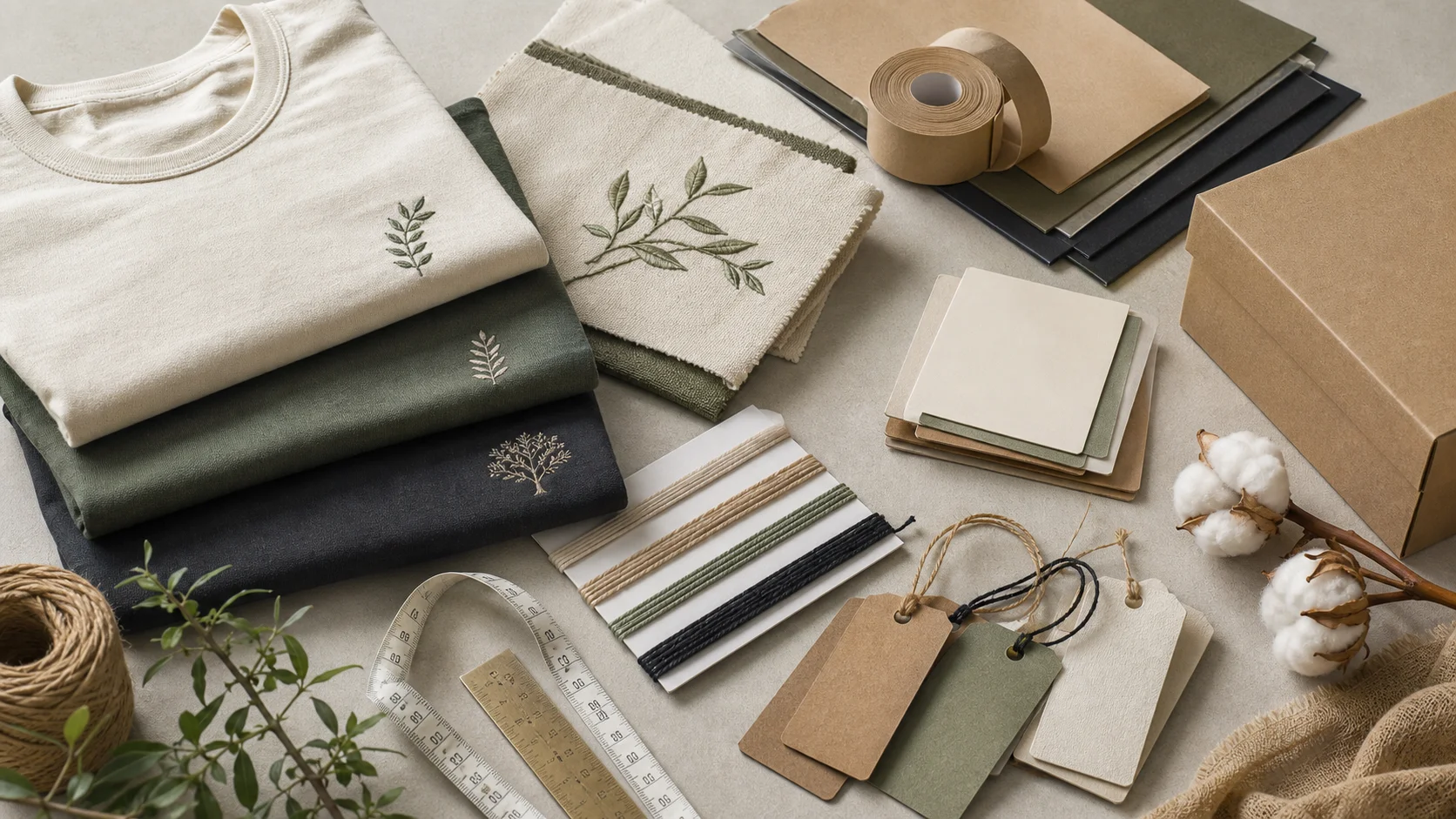
Custom Printed Apparel Poly Bags with checks for samples, fit, MOQ, QC evidence, pricing terms, and delivery risk.
Fast answer: Custom Printed Apparel Poly Bags: Film, Print, Seal, and Shipping should be judged by production evidence, not by a generic sourcing promise. The buyer needs sample proof, cost breakdowns, QC checkpoints, and delivery buffers in writing.
Ask for recent sample photos, measurement tolerances, fabric or print test assumptions, decoration test notes, packing examples, and a named inspection checkpoint. These details show whether the team can repeat an approved sample at bulk volume.
Separate garment cost, decoration, labels, packaging, sampling, testing, freight, and rush charges. When every cost line is visible, it becomes easier to reduce colorways, adjust size depth, or reserve more time for sampling.
A tee can retail for $8 and still live or die by a packaging choice that costs less than 5 cents. That is the real case for custom printed poly bags for apparel shipping: tiny spend, outsized consequences. I have watched claim rates fall, packing floors speed up, and first impressions sharpen simply because the bag did its job cleanly. Apparel is light, but moisture, dust, and abrasion still create returns. On one factory visit in Vietnam, a line packing 12,000 units a day moved basics from boxes to printed poly and cut carton void fill entirely; the labor savings showed up within two shifts.
The first 10 seconds after delivery are brutal. Customers judge the banding, the fold, the print, and whether the package still looks clean after a long trip. I have seen brands lose perceived value because a $34 sweatshirt arrived in a dented mailer with lint on the fold. I have also seen a $12 sports bra feel premium because the bag was crisp, opaque, and sealed properly. This is why many brands work closely with a custom printed poly bags for apparel shipping supplier during launch planning.
Why do factories favor poly over cartons for so many SKUs? Speed and density. A carton may take 8 to 12 seconds to erect and tape; a pre-made poly bag can be loaded and sealed in 2 to 4 seconds on a simple line. That difference compounds. At 3,000 units, a team can save roughly 4 to 6 labor hours. Tare weight matters too. A 28 x 38 cm poly bag might weigh 6 to 12 grams, while even a slim mailer carton can add 45 to 90 grams before inserts. Multiply that across 50,000 units and the freight math becomes hard to ignore.
In narrow-margin categories, brands choose the lighter pack not because it looks flashy, but because a pallet holds 15% to 25% more units when the outer pack is flat. Better pallet density means fewer cube costs, fewer partial pallets, and less damage from box crush. For tees, activewear, intimates, and basics, the packaging choice shapes both logistics cost and brand presentation. If a factory also handles private label clothing services, they usually care even more about a pack format that keeps the line moving without adding a separate folding or boxing station.
“Poly bag” is too vague for a purchase order. The common substrates are LDPE, HDPE, and co-extruded film, and each behaves differently on a press and on a packing line. LDPE feels softer, with better clarity and sealability. HDPE is stiffer, thinner for the same strength, and often more crinkly. Co-extruded film blends layers so a supplier can tune tear resistance, print surface, and seal performance in one structure. When you compare custom printed poly bags for apparel shipping across a factory list, ask which film is best for your closure and product weight.
Thickness matters. I have seen apparel programs specified at 30 microns, 40 microns, and 60 microns, or roughly 120 to 240 gauge depending on how the mill measures. A move from 30 to 50 microns may lift unit cost by 8% to 18%, but it can also reduce puncture failures on metal hangers and sharp trim. Sustainability claims need discipline here. A heavier bag is not automatically better, because more resin means more material. A lighter film that still passes drop and seal tests usually wins on footprint. According to OEKO-TEX, material transparency and chemical control matter as much as appearance when buyers audit packaging inputs.
Opacity versus transparency is not a cosmetic detail. Transparent bags help warehouse staff verify SKU and size at a glance, and they support anti-theft checks in some distribution centers. Opaque or frosted bags hide print inconsistencies and often look more premium for direct-to-consumer brands. I have visited European factories where 70% to 80% of apparel bags are frosted with 20% to 30% recycled content claims, while several North American mills still default to clear LDPE unless a buyer writes exact specs. Asian factories are often faster at offering co-extruded custom print, but they also expect sharper technical direction on vent holes, seal width, and suffocation warnings.
Practical features matter more than buyers expect: adhesive closures, hang holes, reseal strips, and printed warnings are not decorative. A 25 mm flap can improve reclose performance. A 4 mm vent hole can help vacuum-packed knits recover shape. For brands that also use sublimation printing services, packaging color consistency becomes part of the same visual system, because the bag, hang tag, and garment surface all land in the same customer photo.
Print method decides more than decoration. It decides setup cost, sharpness, and whether your logo survives a 6-week production cycle without shifting shade. Flexographic printing is the workhorse for medium to high volume. It handles 1 to 6 colors efficiently, and setup is faster than gravure. Gravure gives richer coverage and very fine detail, but the cylinder cost can be painful for smaller orders. Digital printing is the short-run option, especially for test launches or seasonal drops, because it avoids plate fees and can start at a few hundred to a few thousand units depending on the supplier. The right custom printed poly bags for apparel shipping factory will recommend the method that matches your volume and artwork.
The MOQ conversation changes fast once you add more colors. A one-color bag may begin at 3,000 to 5,000 pieces. Add 3 or 4 colors, a custom size, and a zipper or flap, and the MOQ can jump to 20,000 or even 50,000 pieces. That is not greed. It is setup math. If plate making costs $180 to $400 per color and proofing takes 2 to 3 days, the supplier needs volume to spread that expense. On a 10,000-piece order, a $1,000 setup is 10 cents per bag. On 50,000 pieces, it becomes 2 cents.
Color accuracy is where low quotes often unravel. I have stood in mills that promised Pantone matching on paper, then delivered blue that leaned purple because the film absorbed ink differently after extrusion. Mid-tier suppliers usually have better calibration and more disciplined press checks. A brand mark with a 1.5 mm stroke can disappear if print bleed is not controlled. I ask for a target delta E below 3 for critical brand colors, and I want logo placement tolerance within 2 mm on both axes. If the artwork has fine text, keep the minimum line weight above 0.25 pt and avoid reversing small type out of a dark field.
The cheapest quote is often not the cheapest outcome. A low-cost mill can underbid by 12% to 18%, then lose the batch on shade variation or poor seal registration. That matters more for packaging than for many garments because the bag is the first branded surface a customer touches after delivery. For brands building a broader product line with cut and sew manufacturing, aligning garment shade, packaging ink, and hang tag stock avoids a mismatch that looks accidental even when every vendor “met spec.”
Custom printed poly bags for apparel shipping can cost 2 to 3 times more than stock clear bags, but the spread is narrower than many buyers fear once shipping and damage are included. A starter brand ordering 5,000 units of a 30-micron LDPE bag with 1-color print might pay $0.06 to $0.11 per bag ex-works. A DTC label ordering 25,000 pieces with 3-color print, a reseal strip, and 40-micron film may land closer to $0.09 to $0.16. A larger wholesale program at 100,000 pieces can push unit cost down to $0.04 to $0.08 if the size stays standard and the art is simple.
Freight, duty, warehousing, and carton packing can add 15% to 35% to the landed cost. Artwork revisions can add another $75 to $300 if the supplier has to rerun plates or reproof films. A 1-cent unit saving looks attractive until the defect rate climbs from 1% to 4%. On 50,000 units, that means 1,500 extra bags may need sorting or replacement. I would rather pay 2 cents more for a supplier with a 98% first-pass yield than chase the cheapest line item and burn the team on rework.
Plain stock bags still make sense for test runs, outlet programs, and multi-SKU basics with low visual stakes. They usually cost far less upfront and ship faster. But once a brand is shipping 10,000 to 20,000 units a month, custom print starts to defend itself through lower damage claims, cleaner brand presentation, and less need for inserted marketing cards. A premium packaging partner may quote 8% to 12% above a low-cost supplier, yet their tighter tolerances, better ink adhesion, and clearer documentation often reduce hidden costs. I have seen that difference save more than $2,000 on a 40,000-unit season simply by avoiding one reprint. For bulk and wholesale programs, custom printed poly bags for apparel shipping can also be standardized across sizes to simplify production planning.
The best spec sheet is boring. That is a compliment. Send size in finished and flat dimensions, film type, gauge or micron, print colors, closure style, fold direction, pack format, and whether the bags go on a line by hand or by machine. Include the garment type too. A 320 GSM French terry hoodie needs more room than a 140 GSM tee, and a folded legging pack behaves differently from an oversized sweater. A good manufacturer or supplier will translate that into a cleaner production plan.
Testing should be written down before sampling starts. Ask for seal strength, drop testing, rub resistance, and ink adhesion. If the bag is resealable, check flap retention after 5 to 10 open-close cycles. For export programs, request an ASTM or AATCC reference where relevant, and check the supplier’s claims against the standard body rather than accepting internal jargon. Data from ASTM is useful when you want a common language for physical performance.
Compliance is where small mistakes become expensive. Suffocation warnings may need exact wording and sizing depending on market. Recycled content claims require documentation, not just a green icon. A 2 mm to 3 mm dimension shift can throw off folding on an automated line and create a 7% to 10% slowdown if workers have to re-seat the garment. I visited one factory in India where vague bag width specs led to a batch that looked fine in samples but failed on the packing table because the shoulder seams would not sit flat. The remake cost more than the original order saved. For quality control, ask the factory to confirm inspection checkpoints before production begins.
Sampling to delivery usually runs 3 to 8 weeks, and the difference depends on print method. Digital short runs can move from artwork approval to shipment in 7 to 14 days. Flexo often takes 3 to 5 weeks because plates, proofing, and setup each add time. Gravure can stretch to 6 to 10 weeks, especially if cylinders are new or color approval takes two rounds. For custom printed poly bags for apparel shipping, the fastest production schedules usually come from simpler artwork and a clear approval chain.
Delays usually hide in the same places: plate making, film shortages, color approval, and shipping congestion. A domestic order may arrive in 5 to 12 business days after approval, while overseas production can need 20 to 35 days at sea or 5 to 8 days by air. Cheap quotes often come with slower and less reliable lead times because the factory is slotting your bag order behind larger cartons or garment production. I have seen a 4-week promise become 9 weeks when the film grade was backordered by 18 days.
Here is what the schedule often looks like:
If the supplier also handles seasonal garment programs, their calendar may be tighter than their quote suggests. This is especially true when a China-based factory is balancing production, bulk replenishment, and packaging lines at the same time.
Before you sign a PO, ask for three things: a physical sample, a production timeline with named milestones, and QC documentation from the last 3 orders. I also want a response time under 24 hours during sampling. Slow communication on a 5,000-piece bag order usually signals slow escalation on a 50,000-piece reorder. Check whether the supplier can share certifications, ink specs, and an approved tolerance sheet. If they cannot explain how they handle shade variation, I move on. The best factory partner will be transparent about production risks and corrective actions.
I recommend a pilot run of 1,000 to 3,000 pieces before locking a large MOQ. That small batch exposes printing shifts, seal failures, and pack-line issues without tying up cash in 25,000 units you cannot move. Structure reorders around 6 to 8 weeks of coverage, not 12 months of optimism. For brands shipping into the EU, UK, and North America, keep region-specific warning text ready so one base bag can be adapted without redesigning the whole layout. That saves time and avoids separate inventory piles. If you are buying wholesale or bulk, ask the supplier to quote the same bag in multiple sizes so your production team can standardize handling.
The next move is simple: request a sample pack, compare landed cost line by line, and lock the spec before production starts. If you want a fast starting point, get a free quote and ask the supplier to show plain stock versus custom print pricing, then decide with numbers instead of assumptions. For trade planning and import timing, trade.gov is also a useful authority for market and logistics guidance.
Most orders land between $0.04 and $0.16 per bag depending on film gauge, print colors, size, and closure type. Small runs of 3,000 to 5,000 pieces cost more per unit because setup fees are spread over fewer bags. Freight and duty can add 15% to 35% to landed cost.
MOQ often starts at 3,000 to 5,000 pieces for one-color flexo bags, then rises to 20,000 or 50,000 pieces for multi-color or gravure programs. Digital printing can go lower, sometimes a few hundred units, but the unit price is usually higher. The bigger the print count, the higher the minimum.
Digital short-run bags can be ready in 7 to 14 days after artwork approval. Flexo orders usually take 3 to 5 weeks, while gravure can run 6 to 10 weeks. Ocean freight adds another 20 to 35 days, depending on the route and port congestion.
Send editable vector artwork, usually AI, EPS, or PDF with outlined fonts. Include Pantone references, logo placement, finished size, and a note for bleed. A spec sheet should also list film type, gauge, closure, and packing format so the factory can quote accurately.
Yes, but only if the supplier can document the recycled content and the claim wording matches local rules. Some markets require specific labeling for post-consumer recycled content, while others require suffocation warnings or material identification. Ask for compliance proof before sampling so you do not reprint compliant bags later.