
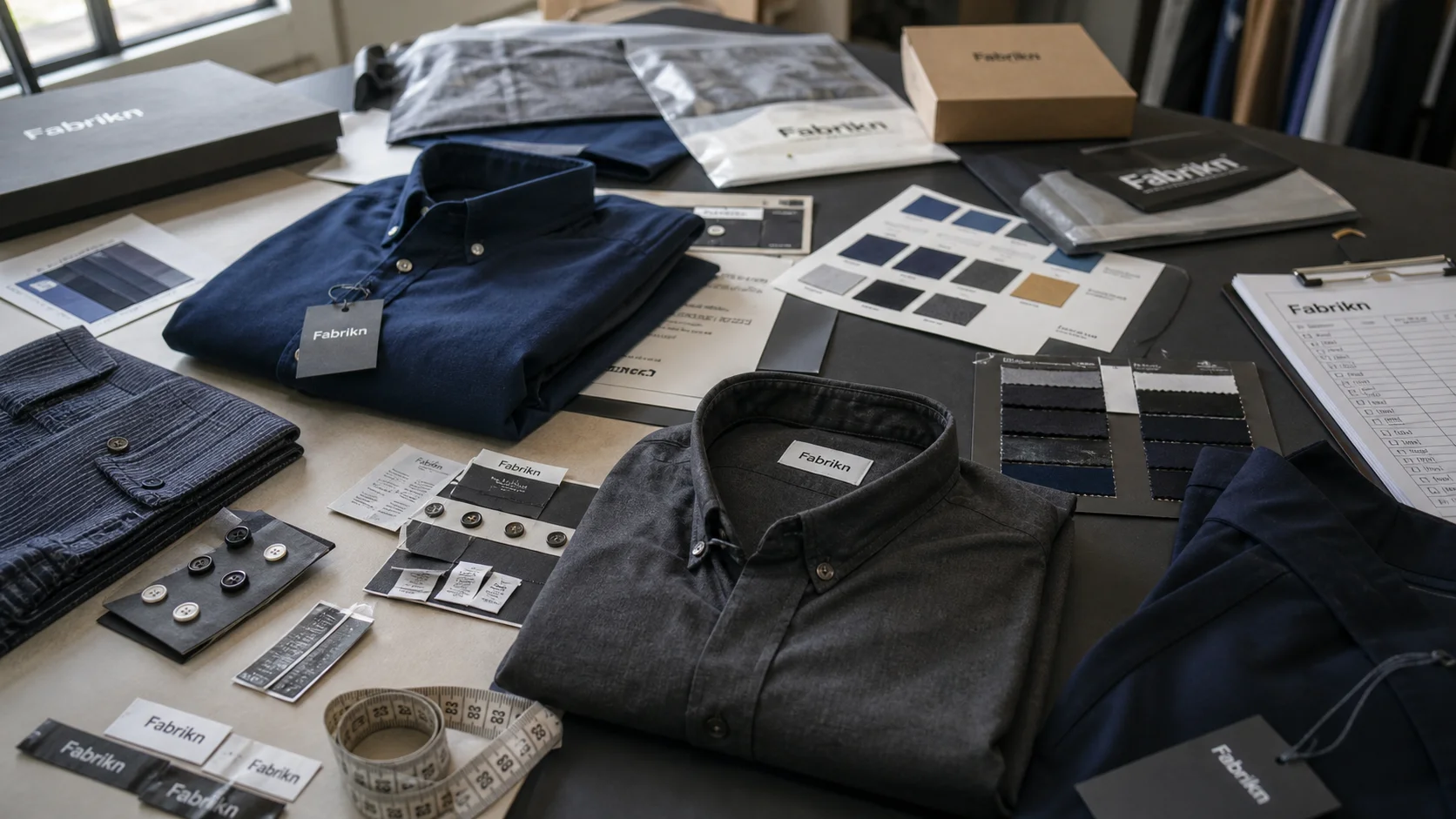
Recyclable Apparel Shipping Boxes with checks for samples, fit, MOQ, QC evidence, pricing terms, and delivery risk.
Fast answer: Recyclable Apparel Shipping Boxes: Board Claims, Print, and Cost should be judged by production evidence, not by a generic sourcing promise. The buyer needs sample proof, cost breakdowns, QC checkpoints, and delivery buffers in writing.
Ask for recent sample photos, measurement tolerances, fabric or print test assumptions, decoration test notes, packing examples, and a named inspection checkpoint. These details show whether the team can repeat an approved sample at bulk volume.
Separate garment cost, decoration, labels, packaging, sampling, testing, freight, and rush charges. When every cost line is visible, it becomes easier to reduce colorways, adjust size depth, or reserve more time for sampling.
I still remember a $18 T-shirt riding home in a carton built for a winter coat. It was a small absurdity with a loud invoice attached. Across denim mills, knitwear lines, and DTC fulfillment centers in eight countries, the same waste kept turning up: lightweight garments packed into oversized boxes, then billed by dimensional weight or cubic volume. Custom recyclable shipping boxes for apparel exist because that waste isn’t cosmetic. It’s money leaking out of the system.
In one export factory in Vietnam, a carton for two folded jeans measured 18 x 14 x 6 inches even though the packed stack needed 14 x 10 x 3.5. Extra air. Extra cost. The box also climbed into a higher dimensional-weight band, which meant the invoice took another hit. On the pallet, it looked tidy. On the freight sheet, it was a mess.
Bangladesh gave me the same lesson with knitwear. Soft goods don’t need the crush protection hard goods do, yet brands keep specifying thick board grades and oversized footprints out of habit. Corners crush in transit, returns rise. A seam splits, customer service gets the call. The outer carton is too large, warehouse labor drags because staff spend longer stuffing, taping, and checking. A $0.28 carton can trigger a $6.00 claim.
Margins feel the pain at every price point. Luxury labels lose money through damage and re-shipping. Mid-market brands lose it through claims and higher freight. Budget brands feel it fastest because one bad box can wipe out the profit on an entire order. Different product. Same failure pattern.
The fix is usually plain: better sizing, smarter board selection, fewer material layers. That’s why custom recyclable shipping boxes for apparel matter. Less empty space, cleaner presentation, fewer defects once the carton leaves the floor. The right supplier can tune the spec so the box fits the garment, the route, and the budget.
Apparel packaging has a narrow job: fit the garment, hold its shape, survive rough handling, and arrive looking deliberate. Easy to say, harder to pull off when the carton moves from a cutting room to a warehouse in 32°C heat, then into an ocean container for 3-5 weeks, then through drops, squeezes, and rain at last mile. The box isn’t carrying machinery. It’s carrying fold memory, presentation, and trust.
Fit comes first. A box that’s 15% too large invites movement, and movement creases collars, shifts tissue paper, and wrinkles pressed trousers. Too tight, and seams bruise while embellishments get crushed. Soft goods need dimensional control, not padding. A structured shirt, a French terry hoodie at 320 GSM, and a three-piece set all need different internal clearances, even though none of them need foam inserts.
Crush resistance matters more than many buyers expect. Parcel networks stack cartons, drop them, and press them against other freight. Edge crush test values and box compression strength sound dull, but they decide whether a shipment keeps its shape after a transshipment hub or collapses on a scooter route. ISO packaging standards treat packaging performance as consistency as much as material type, and that difference matters when brands compare suppliers.
Humidity is the quiet threat. Coastal India. Southern China. Warehouses there can load cartons with moisture before the boxes even leave port. Recycled corrugated board can still perform well, but board choice, flute profile, and glue line quality need to match the route. A coated outer surface can help print quality and scuff resistance, but the coating has to stay paper-based if the carton is meant to recycle cleanly.
Brand presentation shouldn’t need plastic-heavy extras. A sharply printed kraft box, a one-color logo placed well, and a clean folding sequence often look more premium than glossy overpackaging. Textile Exchange sustainability standards and OEKO-TEX certification guidance both reinforce a broader principle brands can apply here: use materials and finishes that support lower-impact production without sacrificing performance.
The best carton balances four things at once:
Kraft corrugated is the workhorse for custom recyclable shipping boxes for apparel. DTC basics, denim, and most mid-market apparel fit it well because it’s predictable, printable, and usually low risk for recycling streams. Outside Ho Chi Minh City, a corrugator manager once showed me 200 lb test board that outperformed a weaker-looking recycled sheet in compression. Stiffness comes from fiber mix, flute design, and moisture control, not looks. High recycled fiber isn’t automatically weak. That myth keeps costing brands money.
White-top corrugated works well for premium apparel, especially when color fidelity matters. Sharper logos. Cleaner photography. Better contrast for minimal branding. The trade-off is obvious. White-top stock can cost 8-15% more per sheet, and scuffing shows faster if the warehouse is rough on cartons. For a luxury blouse or a limited-run capsule, that premium can make sense. For basics shipping 20,000 units a month, kraft usually wins.
Recycled-content board needs a careful read. Many mills can supply 60%, 70%, or even higher post-consumer content and still hit performance specs. The real question is whether the whole construction can recycle cleanly. Plastic lamination, foil-heavy decoration, and non-paper inserts create the problem. In several factories I visited, the board was fine, but the finishing vendor had added a glossy film that complicated recovery. The carton failed the sustainability brief after the paper mill had already done its job.
Inks and adhesives matter more than brands like to admit. Water-based inks are usually the safer route for recyclability, as long as coverage stays reasonable and curing is stable. Heavy UV coatings, metallic foils, and adhesive windows can interfere with pulping. If durability is the concern, ask for a paper-based protective varnish instead of plastic coating. For inserts, use paperboard dividers or molded fiber where needed, not foam or mixed-material trays.
There’s also a sourcing angle. If your supplier can show board specs, glue formulation, and print method together, you’re much closer to a real recyclable carton than if they only mention recycled-content percentages. For brands already refining product construction through cut and sew manufacturing, packaging should follow the same discipline: simple structure, traceable materials, no hidden plastic. Ask the factory for quality records, MOQ details, and sample production data before you place a wholesale or bulk order.
The thing nobody tells you: many mills can make a recyclable carton that passes specs on day one, but the recycling problem usually starts in print and finishing, not in the board itself.
Unit price is the easiest number to see and the least useful one to judge. A stock mailer may cost $0.18 to $0.32, a standard corrugated carton might land at $0.28 to $0.55, and a custom recyclable shipping box for apparel can sit anywhere from $0.36 to $0.90 depending on size, print, board grade, and order volume. That doesn’t settle the decision. Freight, damage, void fill, and rework usually move the total cost far more than the carton itself.
Take a light order: one T-shirt retailing at $24. A stock box that’s 20% too large can push dimensional weight up enough to add $0.40 to $1.20 per shipment in carrier charges, depending on route and zone. Add tissue, paper void fill, and extra tape, and the hidden packaging bill climbs again. If 3% of those cartons arrive crushed and trigger returns or customer service credits, the total cost can double. The carton price never warned you.
Mid-market apparel sees the same math at larger scale. A hoodie order retailing at $68 can absorb a box that costs $0.10 more per unit if the carton cuts cubic volume by 10-20%. Lower volume can reduce freight bands, improve pallet density, and lower storage needs in the warehouse. The surprising part is that a pricier carton can bring down landed cost because it removes enough air from the shipment. I’ve seen brands save $14,000 in a quarter after resizing cartons across just two fulfillment nodes.
Luxury shipments add another layer. A $140 blouse or a $320 dress often ships with presentation requirements, but the box still can’t be oversized. A white-top carton at $0.72 may be cheaper overall than a generic box at $0.46 if the branded version eliminates outer mailers, trims tissue waste, and lowers damage claims. The economics improve when the box does the job once.
Stock cartons make sense for very short runs, price-sensitive basics, or test markets where the order quantity sits under 500 units. For stable programs, custom recyclable shipping boxes for apparel usually pay for themselves once MOQ thresholds reach 1,000 to 3,000 pieces and the route is long enough for dimensional savings to matter. If you need a quote benchmark, you can get a free quote for custom apparel packaging and compare it against your current carton plus freight numbers.
Packaging timelines break when teams treat cartons like a last-minute accessory. In practice, a custom box moves through the same discipline as a garment sample: brief, dieline, prototype, approval, production, freight, receiving. A domestic run can take 2-4 weeks from approved artwork to delivery if the supplier has board in stock. Offshore production usually needs 4-8 weeks, and that window stretches when there’s a port delay, a paper allocation issue, or a seasonal rush before peak shipping months.
Sampling is where time vanishes. A plain structural sample may take 3-5 days. A printed prototype can take 5-10 days if one revision is enough. Add specialty inks, embossing, or an internal insert, and the clock keeps moving. The biggest delay I see isn’t manufacturing. It’s artwork revision. One changed logo file, one missing barcode, one revised legal line — the approval loop resets.
Structural changes are slower than people expect. If the box footprint shifts by even 10 mm, the dieline may need to be redrawn and requalified. That matters for apparel because fold depth, tissue placement, and insert fit all depend on the interior size. In a factory outside Dongguan, I watched a buyer lose 12 days because a sweater program moved from a single-item box to a two-item box after sampling. The board was ready. The measurements weren’t.
Production windows depend on finishing. Basic one-color kraft cartons can move fast. Complex graphics, foil, or specialty coatings can add 1-2 weeks. During Q3 and Q4, paper supply tightens too, especially for white-top liners and higher recycled-content sheets. Ocean freight from Asia to North America often adds 18-35 days door to door, depending on origin, routing, and customs timing. If you source from China, confirm the factory’s production calendar early and ask the supplier to reserve board before artwork is final.
My planning range for apparel teams is straightforward. For a new carton program, allow 30-45 days for domestic sourcing and 45-75 days for offshore sourcing if artwork is clean and structure is standard. If the launch sits near a seasonal drop, order earlier. Packaging delays stay invisible until they stall a product launch. Brands already sorting their assortment through browse our product catalog should sync box development with product buy dates, not after them.
Smart sourcing starts with documents, not promises. Before I approve a box supplier, I ask for the board specification, recycled-content claim, compression test data, and a sample with measured dimensions. I want the flute type, board basis weight, and print process listed on paper. A supplier who can only say “eco-friendly” isn’t ready for a production program.
Factory audits expose what spec sheets hide. Board storage comes first. If sheets are standing in a humid room or stacked against a wall with visible warp, that’s a warning. Moisture control matters, because 5% extra humidity can change board performance enough to affect scuffing and crush resistance. Glue application comes next. Uneven glue lines and poor flap adhesion are small defects that become customer complaints later.
Print consistency matters too. In one factory in Turkey, a premium knitwear brand approved a warm gray logo on one carton, then received a batch where the shade varied by three tones. The board was recyclable. The execution wasn’t. That’s why I ask for production samples from the actual press, not a sales-room mock-up. A serious factory or manufacturer will understand that quality control is part of the product, not an afterthought.
Comparing suppliers across regions means separating labor cost from total value. A carton made in a lower-cost market can still be more expensive once freight, duty, longer lead time, and higher defect rates are added. A local supplier may quote 12% more on paper, then save 20 days and cut damage by half. That difference can matter more than the sticker price. I’ve seen brands buy the cheapest carton and pay for it twice.
Sustainability claims need scrutiny. If the vendor says “70% recycled content,” ask whether that refers to the liner, the flute, or the whole sheet. Ask whether the box uses mixed materials, whether the inks are water-based, and whether any coating blocks curbside recycling. A credible supplier should answer in specifics, not slogans. The strongest programs I’ve seen combine traceable paper sources, simple construction, and accurate testing. That’s the standard I’d use for custom recyclable shipping boxes for apparel from a factory or supplier in China, whether the order is custom, wholesale, or bulk.
A 30-day plan keeps packaging from drifting into endless revision. Week one: measure your top 10 SKUs and record folded dimensions, weight, and fragile details like buttons, chains, or trims. Week two: define the sustainability target in plain language — minimum recycled content, no plastic lamination, recyclable finish. Week three: set print limits. One color. Two colors. No foil if possible. Week four: request samples from at least 3 suppliers and compare them side by side.
Then run a small pilot. I prefer 100 to 300 units across at least 2 regions, because a box that performs well in one warehouse may fail in another with different humidity, parcel handling, or carrier routing. Test compression, scuffing, barcode scanability, and customer unboxing time. If the box saves 0.5 seconds per pack-out over 10,000 units, that’s a labor line worth measuring.
Your internal approval should include operations, marketing, finance, and sustainability. Operations will care about fit and damage. Marketing will care about presentation and color. Finance will care about unit cost, freight, and claims. Sustainability should verify traceability and end-of-life claims. If those four groups don’t sign off together, the box specs will drift after the first purchase order.
The best carton is not the prettiest one. It is the one that protects the product, ships efficiently, and still recycles cleanly. That’s the standard I use after 200-plus factory visits. If your team already knows the garment line and wants a packaging reference point, start by reviewing the production logic that sits behind the clothes themselves through private label clothing services.
Most apparel boxes land between $0.36 and $0.90 per unit at common order volumes, depending on size, board grade, and print. Smaller runs under 500 units usually cost more, while orders above 3,000 pieces can drop by 10-25%.
Domestic production often takes 30-45 days from approved artwork to delivery. Offshore sourcing usually takes 45-75 days, and ocean freight can add 18-35 days depending on the route.
Ask for board specs, recycled-content proof, compression test results, and a printed sample. Also confirm whether the box uses water-based inks, paper-based coatings, and no plastic lamination.
Yes. If the new box cuts cubic volume by 10-20%, dimensional weight charges can fall noticeably. I have seen brands save $0.40 to $1.20 per parcel on lightweight garments.
Start with suppliers that can show testing data, material traceability, and production samples from real runs. If you need a starting point, review a supplier’s range and request a quote, then compare it against your current carton costs and freight.