
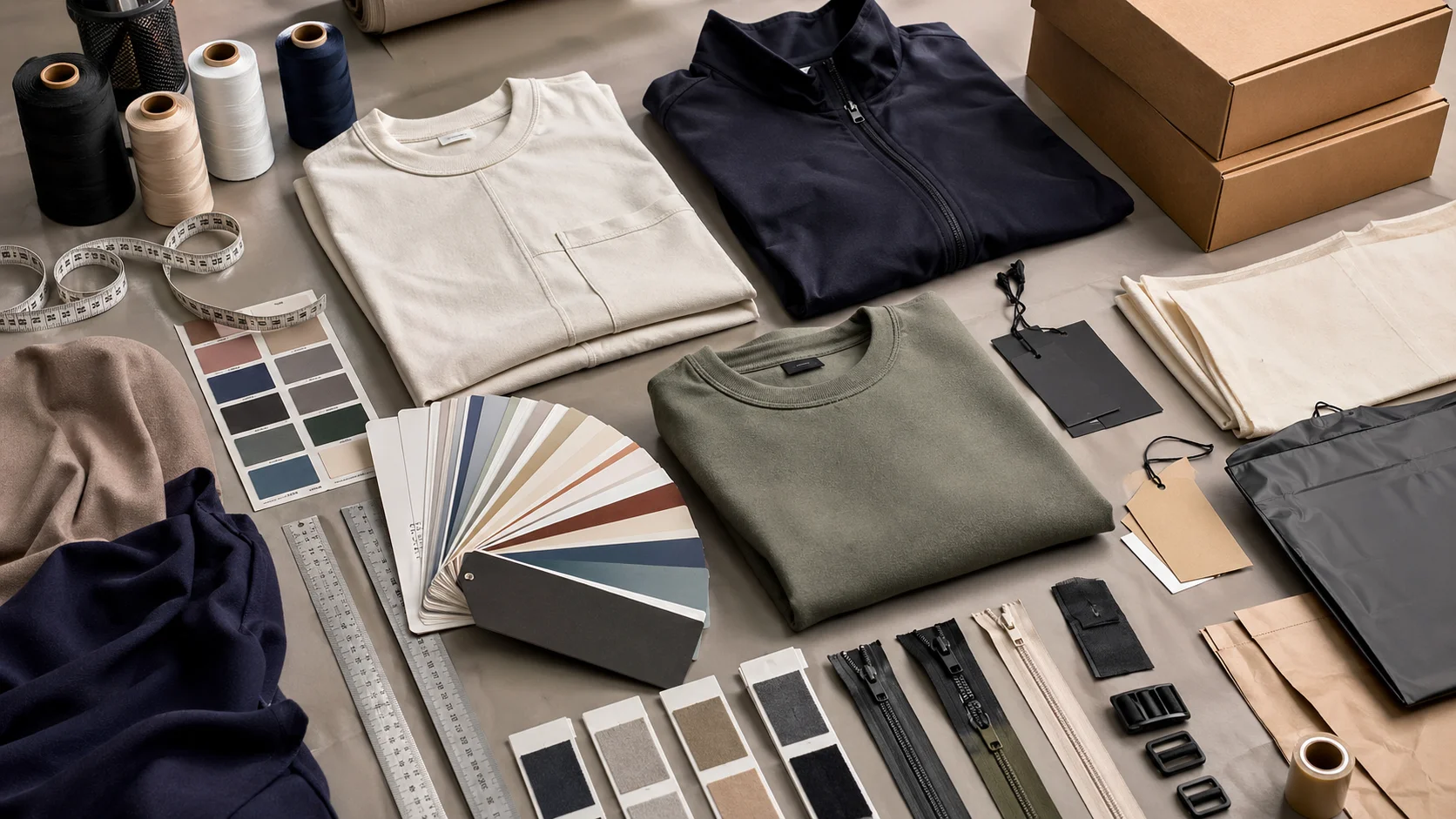
French Terry Hoodie Factory China with checks for samples, fit, MOQ, QC evidence, pricing terms, and delivery risk.
Fast answer: French Terry Hoodie Factory China: Fabric GSM, Fit, Dye, and Lead Time should be judged by production evidence, not by a generic sourcing promise. The buyer needs sample proof, cost breakdowns, QC checkpoints, and delivery buffers in writing.
Ask for recent sample photos, measurement tolerances, fabric or print test assumptions, decoration test notes, packing examples, and a named inspection checkpoint. These details show whether the team can repeat an approved sample at bulk volume.
Separate garment cost, decoration, labels, packaging, sampling, testing, freight, and rush charges. When every cost line is visible, it becomes easier to reduce colorways, adjust size depth, or reserve more time for sampling.
The cheapest hoodie quote is usually the one that hasn’t been interrogated yet. A french terry hoodie factory china price can still land 20-40% under Turkey and 10-25% below many Southeast Asian programs on the same silhouette, but the number only means something after you compare fabric, trims, tests, and approval steps side by side. I’ve watched too many buyers celebrate the first quote and then meet the real bill in lab dips, wash trials, carton labels, and sample-room revisions.
I have seen factories where the paperwork looked flawless until the first wash test blew up; that’s when the true cost hooks you.
French terry wins because the loopback structure behaves differently from brushed fleece. A 280 GSM loopback hoodie for mass retail stays lighter, packs cleaner, and usually hits a sharper price point. A 420 GSM brushed version aimed at premium labels needs tighter shrinkage control, better rib recovery, and more careful finishing. On paper, the heavier one sounds richer. On the floor, it can expose weak knitting in a hurry. Honestly, this approach works better because the lighter-loopback feel keeps logistics from turning into a boxing match (plus the lanes at the port stay calmer).
When I walked through factories in Guangdong and Jiangsu, the lowest quote often skipped the full test package. Landed cost then climbed 8-15% before a single carton moved. Buyers fixate on sewing CM, then get surprised by color approvals, lab dips, wash trials, carton labeling, and the third round of fit comments. Compare like for like on fabric weight, trim quality, and approval steps, not just the garment line.
In my experience, those skipped tests are the same ones that trigger a 3-day panic once the order is already at the sewing line (and yes, I swear I can already hear the tech saying “more color approvals?” before we even email them).
China still wins on scale because yarn, knitting, dyeing, cutting, sewing, and packing sit inside one industrial network. For brands that need 1,000 pieces now and 10,000 next season, that density matters. Read the quote like a contract, not a promise. If your team also needs custom hoodie manufacturing, ask early about rib specs, drawcord sourcing, and whether the mill already runs a comparable 320 GSM program. That is where “feels expensive” gets decided.
A reliable french terry hoodie factory china program starts with yarn count and knitting gauge, not a sales pitch. I want to know whether the factory is knitting compact ring-spun cotton, a cotton-poly blend, or recycled content yarn, because each choice changes pilling, shrinkage, and recovery. Yarn selection decides how the loopback behaves after five washes and whether the fabric spirals on the body.
Spinning feeds knitting. Knitting feeds dyeing. Dyeing feeds cutting, sewing, and finishing. Simple on paper. In reality, each stage hides a trap. Fabric needs 24-48 hours of relaxation after dyeing before cutting. Rush it, and the side seams twist, hoods miss by 0.5-1.0 cm, cuffs lose symmetry (and then the showroom wonders why the hood looked drunk).
I’ve seen more defects from sloppy panel management than from broken stitching. Spirality shows up when the knit construction is unstable. Puckering appears around pocket openings and hood seams when thread tension drifts. Twisted side seams happen when fabric grain gets ignored. Even rib cuffs can fail if recovery is weak after a 30-degree wash. Know the failure, ask the right question. In my experience, if the knit line is rushed, panel alignment stays inconsistent (and the sewing foreman always blames the fabric, which gets old fast).
A serious factory-floor checklist should include roll inspection, inline QC, size-set approval, needle checks, and metal detection before packing. Knitting and dyeing often take 10-18 days. Sewing usually takes 7-12 days. Finishing and packing add another 3-6 days, depending on order size and how many wash tests are still pending. For tighter programs, I push for cut and sew manufacturing records so the buyer can trace which line, operator, and bundle produced each size run. Traceability beats a polished showroom.
A factory that can explain panel relaxation time, seam allowance tolerances, and color lot separation in plain language is usually safer than one that only talks about low MOQ and fast turnaround. If the process sounds vague, the hoodie will likely be vague too.
Sample-room perfection is easy. Repeatability is hard. So I never approve bulk payment on eye appeal alone. A french terry hoodie factory china supplier should show test results for GSM tolerance, shrinkage after wash, pilling, colorfastness, seam strength, and dimensional stability before a buyer signs off. A hoodie can look immaculate on the table and still fall apart after two laundry cycles.
I usually set the pass line at shrinkage under 5%, pilling at grade 3.5 or higher, and shade variation inside a Delta E range both sides agree on before production starts. According to AATCC test methods and color evaluation practices, repeatable measurement is the only way to compare lots from different dye runs. I also ask for seam strength and recovery figures, especially when the hoodie has oversized shoulders or heavy drawcord hardware that strains the neckline.
Glossy samples can hide weak wash performance. I’ve handled premium-looking hoodies with dense face yarns that felt beautiful on day one, then sagged after a 40-degree wash because the loopback structure lacked recovery. Heavier fabric is not automatically better. It’s maddening (like watching a cat try to fold laundry) when the gloss is only skin-deep. A 420 GSM build with poor elasticity can wear worse than a well-balanced 320 GSM hoodie with tighter construction and better finishing.
Ask for three documents, always. First, fabric test reports. Second, batch inspection records. Third, sample-to-bulk approval photos with date stamps and color lot references. If a factory can’t produce them, I treat that as a warning sign, not a clerical issue. The best suppliers can send test data within 24 hours and explain exactly which batch used which dye lot. Personally, I think requiring the three documents is non-negotiable because it forces the supplier to show how consistent they really are before money moves.
Buyers who manage private label clothing services as a process, not a logo exercise, catch more defects before they become chargebacks. I’ve watched brands save entire seasons by rejecting a first bulk lot that missed the shrinkage target by 1.8%. Small on a spreadsheet. Not small in a warehouse.
Two identical hoodies can land at very different costs because the quote hides more variables than most buyers expect. Fabric weight matters. Fiber blend matters. A zipper adds cost over a pullover. Embroidery, print, rib quality, packaging, and carton labeling all pile on. In a french terry hoodie factory china quote, the same silhouette can swing wildly if one version uses standard drawcord tips and another uses custom-dyed aglets and woven labels.
For 300-500 pieces, setup charges are spread across a small run, so the unit cost climbs. I typically see $2.50-4.00 per unit at 500 MOQ on a basic 320 GSM loopback pullover with standard ribbing and no embellishment when the factory is shipping FOB Guangzhou. That price assumes compact ring-spun cotton or an 80/20 cotton-poly blend, standard ribbing, and a basic woven label. Add recycled cotton (GRS certified) and the unit price jumps $0.15-0.25, unless the factory already stocks the yarn in their warehouse.
That’s why I always ask for a trim list: drawcord (nylon braid or cotton tubular), slider (zinc alloy or recycled plastic), zipper brand (YKK Vislon or Talon), and woven label (pre-printed satin vs. heat-seal). The machines affect price too—if the factory relies on Juki lockstitch and overlock, there’s less risk than a secondary line run by a manual Seiko 15 needle, especially when the bundle size grows past 30 pieces. A factory that can describe its Shima Seiki circular knitting gauges, Dymatrix K45 dyeing line, and automatic cutting with Lectra Vector simply proves they have invested in process discipline.
Trims and freight are where surprises live. A branded hangtag from Istanbul or Dhaka can tack on $0.20 per piece when it needs lamination, and the letterbox-style carton label from Ho Chi Minh City can add another $0.05 after printer setup. Freight from Guangzhou to Los Angeles on a 20-ft container typically runs $1,400-$1,650 when you book 25-30 days in advance, while a freight forwarder from Ho Chi Minh City might quote $1,200 but require 6 more days at sea. The only real leverage is understanding which items change based on location and then choosing the best blend of price and control.
Lead time is where honesty matters most. A supplier will happily quote 14 business days if you ignore the fact that yarn and fabric need to be registered, knit, relaxed, dyed, inspected, and prepared for cutting. A genuine timeline for a 1,500-piece order usually looks more like 18-22 business days from yarn release to FOB Guangzhou once you include lab dips, color approvals, and fit samples. That counts the five business days for fabric relaxation, the 7-10 days at the dye house (often in Huiyang or Jiangmen), and the sewing-room capacity the supplier actually has, not the one on their brochure.
Sampling cycles are nested inside that timeline. A first fit sample made on a Stoll CMS 530 flat knitting machine followed by 2-3 wash samples on the DyeVantage 3000 will consume at least 10 business days. When the construction includes ribbed cuffs, I insist on pre-production samples for all sizes. A size set run on Juki DX-7 overlock with thread specs documented in the cutting ticket prevents bundle rework down the line. Without that discipline, the sampling phase drags, and the 10-day buffer erodes, which is where 4-day rush charges show up on the invoice.
To keep the plan honest, I insist on color lab dips, CAD hand-drafted pattern marks, and inline QC sign-offs. If a factory in Guangzhou, Dhaka, or Ho Chi Minh City can’t give me the sequence (knitting → inspection → dyeing → cutting → sewing → pressing → labeling → packing), I treat that as an unscheduled slip. When things do slide, it’s usually because a phase with multiple approvals (like color or trims) happened concurrently with a new production order. That’s why the best factories maintain a visible whiteboard of progress for each bundle from A to Z.
Choosing a partner is not the same as buying from a catalog. You should visit—or at least audit—the factory. Guangzhou, Dhaka, Ho Chi Minh City, and Istanbul each host serious players, but the deciding factors are certifications, process transparency, and shared KPIs. Ask to see GOTS or OEKO-TEX Standard 100 certificates for organic cotton options, WRAP documentation for ethical compliance, BSCI reports for social accountability, and GRS certificates if you are sourcing recycled fibers. Suppliers with this paperwork tend to have stronger QC, environmental controls, and HR discipline than those who only boast about low CM.
Next, verify the plant’s machines: a modern knitting line with Shima Seiki or Mayer & Cie circular machines, an IKG Kuster dyeing tunnel, and Lectra Vector cut-to-shape cutters usually deliver better gauge control and panel consistency than older manual setups. Ask for the maintenance logs, especially on tension-critical machines like the Juki and Brother sewing lines. The goal is to tie every stitch to a documented process so that when a defect appears, you know whether it originated in yarn, knit, dye, seam, or finishing.
Finally, demand process KPIs: roll inspection acceptance rate, inline sewing defect rate, and final carton audit score. A factory that publishes these weekly and shares them with you proves they’re not hiding anything. If their best response is “we always fix it in trim,” walk away.
Start with a technical package that includes graded specs, wash instructions, trim tables, and approved lab dip swatches. Send that to two or three factories in Guangzhou and ask for their process map, certifications, machine listing, and typical cycle times. Schedule a video call with the QC lead and ask them to walk you through a recent shipment’s documents, including the GRS traceability log or OEKO-TEX report if you’re prioritizing eco-standards.
Book an audit with a third-party service or a trusted advisor familiar with the region—someone who knows the difference between a well-run floor in Jiangsu versus a reactive line in Dhaka. Use that audit to validate whether the factory follows the process you expect and whether they keep digital records for each bundle. If the supplier hesitates or adds unexpected surcharges, push back.
Once you’re satisfied, lock in the MOQ pricing (remember, $2.50-4.00 per unit at 500 MOQ for a basic 320 GSM hoodie is a realistic range). Agree on payment terms, typically 30% deposit, 70% against B/L or inspection report. Set up a shared timeline so every color approval, lab dip, and pre-production sample has a due date—and don’t hesitate to gate payments if those milestones slip.
Q: What lead time should I expect for a 1,000-piece order?
A: Plan for 18-22 business days from yarn release to FOB Guangzhou if everything goes smoothly. That includes 7-10 days for knitting and dyeing, 5-7 days for cutting and sewing, and 3-5 days for finishing, pressing, and packing. If you add complex trims or oversized embroidery, tack on another 3-4 days.
Q: Which certifications should I demand?
A: For French terry hoodie programs, insist on GOTS for organic fibers, OEKO-TEX Standard 100 for chemical safety, WRAP/BSCI for ethical compliance, and GRS if you’re using recycled yarn. Without these, you can still produce good garments, but you lose the ability to prove compliance to eco-conscious retailers.
Q: How do I validate a factory’s material sourcing?
A: Ask for yarn specs and mill certificates. The factory should tell you whether the yarn is 100% combed cotton, blended 80/20 cotton poly, or GRS-certified recycled cotton. Confirm the knitting machines (e.g., Shima Seiki 30-inch circular with 24-gauge needles) and dyeing process (e.g., winch dye or beam dye, CRTK machine). If they can’t provide the documentation, move on.
Q: What about trims and finishing?
A: Get a detailed trim list with aglet style (zinc alloy or recycled brass), drawcord material, zipper specs (YKK Vislon for lasting pull), and label method (woven vs. printed). Confirm finishing machines—whether they use a steam tunnel for heat-set washes or a manual press—because that impacts shrinkage and recovery. Once you have that, match it to your QA plan.
Q: How can I minimize freight surprises?
A: Use a freight forwarder familiar with Guangzhou shipping windows, and compare FOB quotes from Istanbul and Ho Chi Minh City if you need alternates. Ask the factory to consolidate cartons onto euro pallets, add RFID tags if needed, and schedule a pre-shipment inspection for a final check. That way you can reconcile $2.50-4.00 per unit with the total landed cost before you accept delivery.