
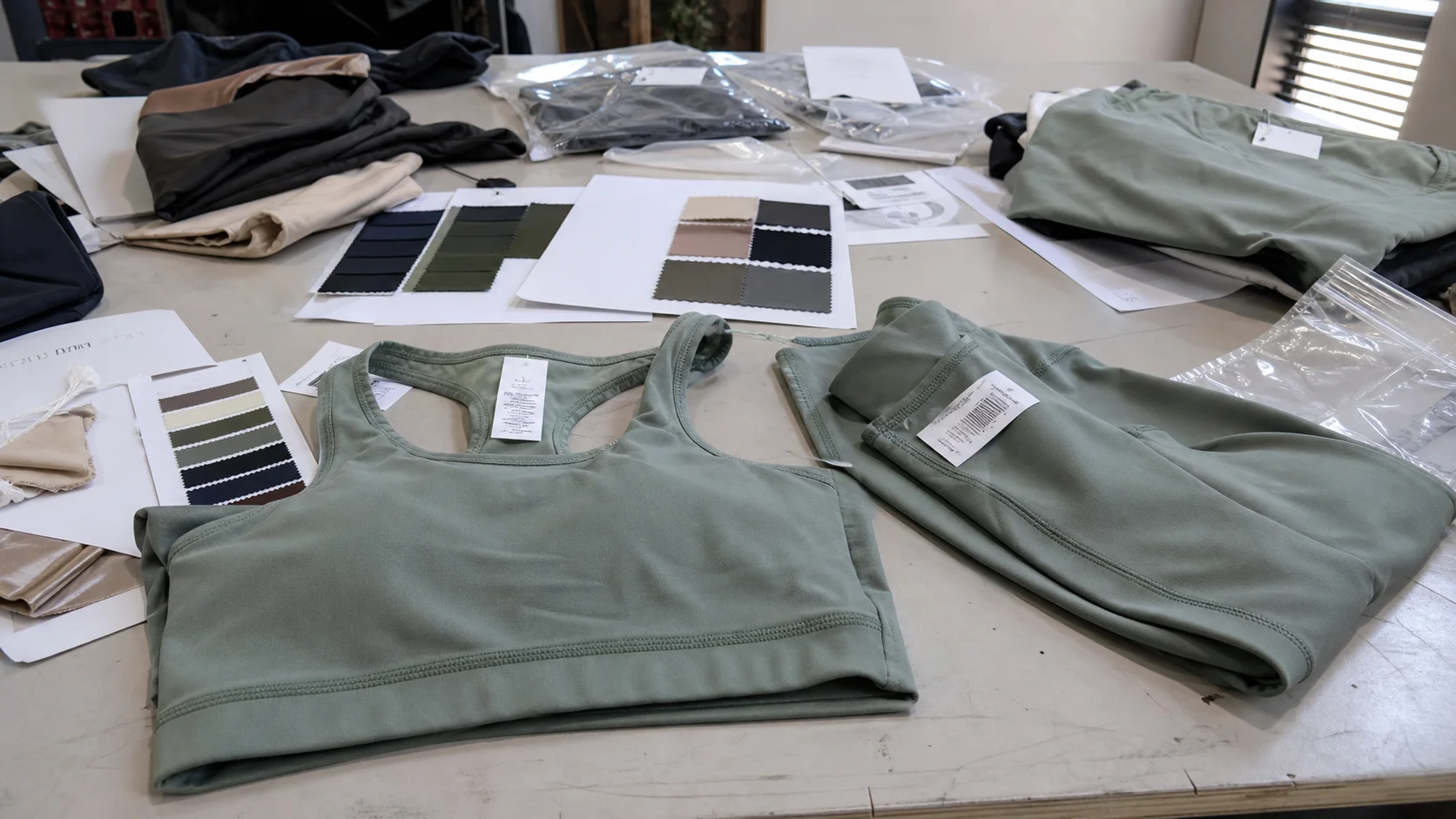
A focused outline for fitness chain buyers evaluating custom screen-printed activewear sets, covering garment specs, ink performance, production approvals, sustainability, and procurement planning.
Custom Screen-Printed Activewear Sets for Procurement - Fabrikn production reference
For fitness chains, branded activewear is not just merchandise. It can sit at the intersection of retail margin, brand visibility, staff uniform consistency, franchise alignment, and member retention. That is why custom screen printing for activewear sets fitness chain procurement has become a more specialized sourcing category than many buyers first expect.
A basic T-shirt print program is relatively forgiving. Activewear sets are not. Stretch fabrics, sweat exposure, repeated laundering, colorfastness demands, and size consistency all raise the technical bar. Procurement teams that treat leggings, sports bras, tanks, shorts, and zip jackets like ordinary promo apparel often run into preventable issues: cracking prints, poor opacity on dark fabrics, uncomfortable hand feel, misaligned logo placement, and unstable replenishment pricing.
Screen printing remains one of the most practical decoration methods for larger activewear orders, especially when brand marks are simple, repeatable, and needed across multiple SKUs. It is often cost-efficient at scale and can deliver strong color saturation. Still, it is not automatically the right choice for every set, every fabric, or every logo position.
That tradeoff matters in procurement. The best purchasing decisions usually come from balancing decoration durability, garment performance, minimum order quantity, replenishment speed, and total landed cost. Buyers also need to factor in sustainability goals, because branded fitness apparel programs increasingly face internal scrutiny on fabric selection, overproduction, and chemical inputs.
Companies evaluating manufacturing support for these programs often begin by reviewing a supplier’s broader production capabilities and development process. A useful starting point is the overview of services, followed by direct program discussions through the contact page once product scope is clearer.
Fitness chains usually buy activewear sets for one or more of four reasons: staff uniforms, promotional launches, retail resale, or multi-location brand standardization. Each use case changes the sourcing brief.
That distinction is important because screen printing decisions should follow the end use. A front chest logo on a staff tank top may be straightforward. A large print on high-stretch leggings intended for resale is a different technical risk. Procurement teams that define use case early tend to reduce resampling cycles and avoid decoration mismatches later.
Buyers also need to decide whether they are sourcing coordinated sets as matched color stories or as separately purchased pieces sharing the same brand identity. Matching sets can strengthen presentation and raise retail conversion, but they also increase development complexity. Shade consistency across bras, leggings, and outer layers can be difficult when fabrics differ in composition and weight.
From a purchasing perspective, custom sets make the most sense when:
If those conditions are weak, a simpler decorated basics program may be safer than a full coordinated activewear set launch.
Screen printing pushes ink through a mesh stencil onto the garment surface. In procurement terms, its main advantages are consistency, scalable unit economics on larger runs, and strong brand color reproduction. It is especially useful for logos, typographic marks, team names, and limited-color graphics.
For activewear, the print system matters as much as the artwork. Standard plastisol inks may be used in some cases, but stretch fabrics often require formulations and additives designed for elasticity and adhesion. Water-based systems may offer a softer hand feel, though actual suitability depends on fabric blend, artwork, and production controls.
Buyers should not reduce the conversation to “screen print or not.” The better question is which print construction fits the garment.
Print location affects stretch stress. A small logo placed on a lower-stretch zone generally performs better than a large graphic positioned across high-expansion areas. That is one reason experienced buyers often reject oversized artwork on compression leggings unless testing data is convincing.
Screen printing also becomes more economical as quantity rises. For many suppliers, MOQ for custom screen-printed activewear can start around 150 to 300 pieces per style-color for simpler programs, while more specialized cut-and-sew set programs may begin around 300 to 600 pieces per style or higher. Exact thresholds depend on fabric sourcing, panel printing needs, and the number of print positions.
Small orders are possible in some supply chains, but unit cost rises quickly. Procurement teams should be cautious about pilot quantities that are too low to reflect real production conditions.
Activewear procurement lives or breaks on fabric choice. Decoration comes second, even if branding is the most visible part of the product. A print that looks sharp on day one but fails after ten wash cycles can erase the value of a well-priced order.
Most activewear sets are built from polyester-spandex, nylon-spandex, recycled polyester-elastane, or blended knits with moisture-management finishes. Each reacts differently to heat, ink cure conditions, and stretch recovery.
Buyers should request clear fabric specs, not broad descriptions like “premium performance blend.” At minimum, ask for:
The biggest technical risk in custom screen printing for activewear sets fitness chain procurement is often stretch failure. Ink may crack, distort, or lose adhesion if the print is too rigid for the garment’s expansion. Dark synthetic fabrics also present dye migration risk, where heat can cause color bleed into lighter inks.
That is why pre-production testing matters. Procurement should request wash tests, stretch checks, and cure verification on actual fabric, not just on a similar swatch. Performance claims based on non-matching fabric are weak evidence.
Purchasing judgment: if a supplier is confident on activewear printing but vague on stretch recovery, cure temperature, or migration control, treat that as a warning sign. Decoration quality on performance knits depends on process discipline, not just artwork setup.
A procurement brief for custom activewear should be far more detailed than logo size and Pantone reference. Incomplete tech packs create delays, inconsistent quotes, and sampling rounds that could have been avoided.
Trim details are often underestimated. For sports bras and leggings, buyers should define elastic width, elastic composition, removable cup requirements, lining fabric, waistband construction, seam type, gusset requirements, and needle specifications where relevant. For tops and jackets, zipper quality, puller finish, reflective details, thumbholes, and ventilation panels may also need approval.
Even when the garment body is straightforward, trim inconsistency can derail bulk approval. Waistband elastic with poor recovery or an incompatible heat-transfer care label can produce complaints that look like garment defects even when the fabric is acceptable.
Artwork specification should include exact placement tolerances. A chest logo that shifts 1.5 cm across a retail program can be visible on the sales floor. Buyers should set measurable tolerance ranges and confirm whether placement is referenced from high point shoulder, center front, waistband seam, or another fixed point.
In the sustainable fashion category, activewear procurement is under pressure for good reason. Performance apparel is often synthetic, chemically finished, and difficult to recycle at end of life. That does not mean procurement teams should avoid the category. It means sustainability claims need to be specific and operational.
The most practical sustainability improvements usually come from four areas: better material choices, tighter forecast control, more durable decoration, and reduced packaging waste.
There is a practical tradeoff here. Recycled content can support sustainability targets, but buyers still need to evaluate opacity, recovery, pilling resistance, and print behavior. A sustainability claim does not offset a poor-wearing garment. For procurement teams, the stronger approach is to define minimum performance standards first, then source the most responsible material that meets them.
Overproduction is another overlooked sustainability issue. Fitness chains sometimes overcommit to trend-led styles without a replenishment model or location-level demand data. Unsold coordinated sets then become discounted inventory or write-offs. From a sourcing standpoint, a disciplined assortment with clearer reorder triggers is often more sustainable than a wider initial launch.
Brands that want to understand supplier positioning, production scope, and development approach before entering technical discussions can also review the company background at about us. That context helps procurement teams judge whether a supplier is aligned with long-term program building rather than one-off sampling.
Cost planning for custom screen-printed activewear sets should never rely on garment price alone. The real landed cost depends on development rounds, screen charges, fabric commitments, trim minimums, packaging choices, freight mode, and failure risk.
These are working ranges, not universal rules. Buyers should verify whether MOQ applies per color, per print design, or per total style. That distinction changes the economics quickly.
Skipping any of these steps may save time early and lose more time later. Print strike-offs are particularly important in activewear because ink behavior on stretch fabric is not always obvious in digital mockups or paper approvals.
Lead time depends on whether fabric is in stock, whether colors are custom dyed, how many print screens are required, and whether fit corrections are still open. As a practical range, simpler repeat programs may move in 45 to 75 days after final approval, while new custom set developments can stretch to 75 to 120 days or more. Freight choice can add another major variable.
Procurement teams should also build contingency for resampling. Activewear is sensitive to fit comments, and one extra size-set or print test round is common when a set is being developed for retail rather than uniforms.
Purchasing judgment: if launch timing is fixed and non-negotiable, reduce style complexity before cutting approval steps. Compressing the technical process is usually riskier than simplifying the assortment.
Inspection standards should be written into the buying process, not introduced after production starts. For activewear sets, buyers need to inspect both apparel construction and decoration performance.
Set programs introduce a coordination risk that single-SKU orders do not. A legging may pass inspection independently, yet still fail the commercial brief if it does not visually match the sports bra or jacket intended to sell with it. Buyers should inspect the collection as a set, not only as separate units.
For larger fitness chain programs, in-line inspection and final random inspection are both useful. In-line checks help catch print placement drift or sewing issues before full output is completed. Final inspection helps confirm packaging, assortment ratios, and AQL performance before shipment.
One common procurement mistake is accepting a visually good print without asking how it was cured and tested. A print can look fine at packing and still fail in customer use if cure control was inconsistent. Ask for process clarity and, where appropriate, testing records tied to the approved construction.
Not every apparel supplier that offers screen printing is equipped for activewear set procurement. Fitness chain buyers should compare suppliers across technical capability, sourcing discipline, communication clarity, and reorder support.
Procurement should also listen for what is not being said. If a supplier is eager to quote but avoids specifics on technical testing, approval stages, or tolerance control, pricing may be outrunning execution capability.
The best supplier is not always the one with the lowest FOB. A slightly higher unit cost can be justified if it reduces rework, shrinkage risk, returns, or launch delays. That is especially true in fitness chain procurement, where a failed rollout can affect multiple locations at once.
Buyers should prefer suppliers that can explain tradeoffs plainly. For example, a supplier that recommends limiting large prints on compression panels, adjusting artwork for better elasticity, or raising MOQ to secure the right fabric lot is often showing stronger production judgment than one promising unlimited flexibility.
Custom screen printing for activewear sets fitness chain procurement works best when buyers treat it as a technical apparel program rather than a simple branding exercise. Screen printing can be cost-effective, durable, and visually sharp at scale, but only when matched to the right fabric, print location, and approval process.
The strongest procurement outcomes usually come from a few disciplined habits: define end use early, lock fabric specs before decoration approval, test prints on actual production materials, set realistic MOQ and lead-time expectations, and inspect complete sets instead of isolated pieces.
In sustainable fashion terms, the smarter strategy is not to chase broad claims. It is to build a durable, right-sized, well-specified program that reduces waste, improves wear life, and supports repeatable sourcing decisions. For fitness chains, that approach is usually better for brand control and better for cost management.
When evaluating potential manufacturing support, buyers should focus on suppliers that can discuss construction details, trim limitations, print risks, and sampling discipline with clarity. That is where procurement value is created: not in the first quote, but in the reliability of the full program.
Get a free quote from Fabrikn — your trusted B2B clothing manufacturer with 10+ years of experience. MOQ as low as 200 pieces.
Get a Free Quote →Yes, often for larger orders and simpler graphics. It is usually most effective for logos and limited-color artwork when the ink system is compatible with stretch fabric. Large prints on high-compression zones need extra caution and testing.
Many programs start around 150 to 300 pieces per style/color for simpler items, while fully customized set programs often begin around 300 to 600 pieces per style. Fabric mill minimums and trim commitments can push those numbers higher.
A typical sequence includes development sample, fit sample revision, color approval, print strike-off on actual fabric, pre-production sample, and size set. Skipping print testing on the actual activewear fabric is a common mistake.
The most common risks are print cracking, poor stretch recovery, dye migration on dark synthetics, logo misplacement, shade mismatch across coordinated pieces, and inconsistent sizing. Elastic recovery and seam performance also deserve close inspection.
Start with durable garments, realistic demand planning, and materials that meet both performance and responsible sourcing goals. Recycled fibers can help, but they still need to pass opacity, recovery, and wear testing. Overproduction control is one of the most practical sustainability improvements.
If order volume is uncertain, launch timing is tight, or the team has not finalized fit and fabric standards, a simpler branded top program may be safer than a fully coordinated set. Full sets deliver stronger presentation, but they require more development control.