
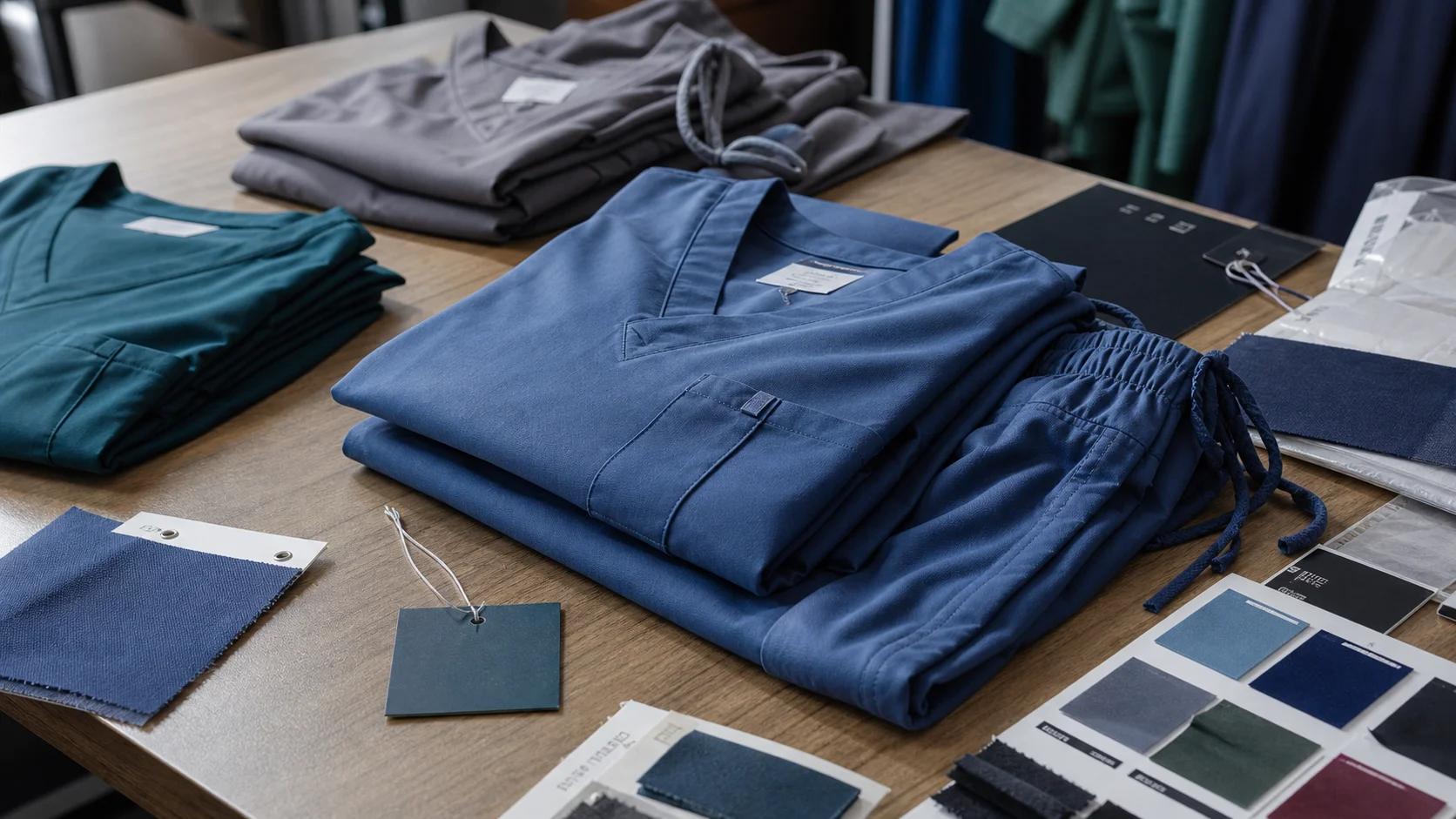
A practical risk map for retail operations teams managing custom scrubs bulk orders, covering sizing, decoration, compliance, replenishment, and...
Category: MOQ, Cost & Sourcing
Bulk ordering custom scrubs looks straightforward on paper. A retail team selects styles, approves colors, locks in trim, and places a production order. The real work starts after that. Scrubs sit at the intersection of fit consistency, fabric performance, color control, and replenishment timing. One weak decision in the sourcing chain can show up as margin loss, returns, delayed launches, or stock gaps that are hard to recover from.
This risk map is written for retail operations teams that need to source custom scrubs in volume without turning every order into a firefight. The goal is not to chase the lowest unit price. The goal is to buy a product that can be repeated, inspected, re-ordered, and sold with fewer surprises. That requires a disciplined view of MOQ, sample approvals, cost drivers, production timing, and quality control.
For teams building or expanding a program, it helps to review the broader sourcing structure first. A supplier’s service model, compliance approach, and communication rhythm matter as much as the final quotation. The right starting point is usually a clear brief and a realistic conversation with the factory or sourcing partner. Useful reference points include the company’s services page, the about page, and the contact page for the first qualification pass.
Custom Scrubs Bulk Order Risk Map for Retail Buyers - Fabrikn production reference
Custom scrubs are not a generic blank garment with a logo added at the end. They are a specification-heavy product. Retail buyers often need a consistent color standard, durable stitching, stretch recovery, pocket placement that works in daily use, and fabric that survives repeated laundering without shrinking out of tolerance. Each of those requirements creates risk if it is not written into the order properly.
A risk map forces the team to identify where the order can fail and what control belongs at each point. That makes budgeting more accurate and avoids the usual trap of treating all suppliers or all styles the same. A poly-cotton basic top and a stretch woven cargo jogger may both be called “scrubs,” but they do not carry the same cost structure, lead time, or inspection risk.
Retail operations also need to think beyond initial landing cost. If the first production run is difficult to repeat, the program becomes fragile. A slightly cheaper order can become expensive when a replenishment misses its fit spec, a trim gets discontinued, or a dye lot shifts enough to create customer complaints. The correct way to judge a scrub program is by repeatability, not just the first invoice.
In scrub sourcing, the lowest quote is often the one with the most assumptions hidden inside it. Clarify those assumptions before treating any price as final.
MOQ shapes nearly every buying decision. For custom scrubs, the minimum order quantity usually depends on fabric type, color requirements, print or embroidery complexity, and whether the factory is cutting from stocked cloth or developing a custom material package. Retail buyers often see MOQs in the range of 100 to 300 pieces per style per color for simpler programs, while more specialized fabrics or bespoke trims can push the threshold higher. Small test programs may be possible, but they usually carry a higher unit price and fewer negotiation options.
MOQ should never be treated as a single number detached from the rest of the order. Ask whether the minimum applies per style, per color, per size run, or per total order across a collection. A supplier that quotes a low MOQ may still require a large fabric purchase or a narrow size ratio that does not match retail demand. That creates inventory imbalance even when the headline quantity looks manageable.
Retail teams should also check whether the MOQ is linked to raw material procurement. Custom-dyed fabric often requires mill minimums that are separate from sewing minimums. The same issue appears with zippers, snaps, drawcord tips, woven labels, and size chips. A supplier may accept a small garment MOQ but still require component buys that make the total project uneconomical.
When the MOQ is too high, buyers sometimes try to compress the style count instead of lowering the risk. That can work if the assortment is disciplined. It fails when the team over-concentrates demand into too few SKUs and ends up with a narrow offer that does not fit the channel. A better approach is often to reduce fabric variables, not the entire assortment logic.
Fabric is the biggest technical variable in custom scrubs. It drives hand feel, opacity, stretch, wrinkle resistance, drying behavior, and wash durability. Buyers should specify fiber content, yarn type if relevant, fabric weight, weave or knit structure, finish, color tolerance, and shrinkage expectation. A vague instruction such as “soft stretch fabric” leaves too much room for interpretation.
Typical scrub programs may use poly-rich blends for durability and easier care, cotton blends for a more natural hand, or stretch-infused fabrics for mobility. Each choice creates tradeoffs. Higher cotton content can improve comfort but raise shrink risk and ironing requirements. More polyester can improve stability and color retention but may feel less breathable in warm conditions. Elastane improves movement but can also raise cost and complicate wash performance if the quality is weak.
Trim selection carries its own risk. Zippers, snaps, reflective piping, rib knit cuffs, drawcords, labels, and embroidery backing all affect final quality. A low-cost trim can create failures later, especially when laundries or high-wear conditions are part of the end use. Buyers should ask for exact trim references, not generic descriptions, and confirm whether substitutions are allowed during production.
Color is a common failure point. Scrub collections usually need a controlled palette rather than fashion-driven color freedom. Even a minor shade shift can break the program if stores or healthcare groups expect matching sets. Buyers should require lab dips, strike-offs for printed elements, and a clear sign-off process before bulk fabric cutting begins. If the factory proposes to skip color approval to save time, that is a risk, not an efficiency.
Sampling is not a formality. It is the cheapest place to discover where the order will fail. A sound approval process usually starts with a proto sample, then moves to a fit sample or size-set sample, then a pre-production sample once the final fabric and trims are confirmed. Some programs also need wash-tested samples before bulk release.
Fit matters more in scrubs than many buyers expect. End users wear the garments for long shifts and need enough room for movement without looking oversized or sloppy. Armhole balance, rise depth, thigh ease, pocket placement, and hem length all affect perceived quality. Retail teams should insist on a size specification chart with clear tolerances rather than relying on a “close enough” approval based on one sample size.
Sample approval should also check construction details. Seams must be stable, pocket corners should not distort, bartacks need to be placed in high-stress areas, and stitch density should be appropriate for the fabric weight. A sample can look clean on a hanger and still fail after laundering or repeated movement. Buyers should include a wash test in the approval sequence whenever the program depends on performance claims.
A recurring mistake is treating the sample as a representative garment when it is actually a hand-built prototype made with substitute materials. That sample can still be useful, but only if the team understands what is provisional. If the approved sample uses different trim, a different dye lot, or a lighter fabric than bulk, the team should not expect production to match it perfectly without documenting the gap.
Unit cost is driven by more than fabric consumption. For custom scrubs, the main variables usually include fabric price, garment complexity, trim count, decoration method, labor intensity, order quantity, packaging requirements, and shipment mode. A lower base price may disappear once the buyer adds embroidery, custom labels, retail folding standards, and individual polybagging.
Complex construction raises labor time quickly. Cargo pockets, reinforced seams, hidden snaps, utility loops, and shaped waistbands all add machine operations. A simple V-neck top with a single chest pocket will almost always price below a fitted top with double pockets and shaped side panels. Buyers should model cost by construction step, not just by style category.
Logistics also change the landed cost. Freight can become material when the order is split into multiple partial shipments or when air freight is used to rescue a delayed bulk run. Customs, duties, carton charges, and warehouse handling all belong in the total cost view. Teams that stop at ex-factory price usually underestimate the actual cost per sellable unit.
The right buying judgment is to compare suppliers only after the scope is standardized. If one supplier is quoting a basic set and another is quoting a retail-ready packaged program, the lowest number is not a fair comparison. Standardized specs reveal the real gap.
Lead time for custom scrubs depends on how much of the program is standard versus newly developed. Stock fabric with simple branding can move faster than a custom color, custom trim package, or new fit block. Buyers should separate development time from production time, then layer in freight and receipt-to-shelf time. A production timeline that ignores approvals is usually unrealistic.
The main dependencies are fabric booking, lab dip approval, trim sourcing, sample approval, bulk cutting, sewing capacity, finishing, inspection, and shipping. Delays in the first two steps often cascade through the entire order. A buyer who waits too long to approve a lab dip or changes the color reference after sampling can lose weeks even when sewing capacity is available.
Retail operations teams should also factor in seasonality and factory load. Apparel factories work within capacity limits, and scrub orders are not exempt from congestion. Promotional calendars, healthcare procurement cycles, and back-to-school retail windows can all compress demand at the same time. Early booking matters when the product must arrive by a fixed date.
Lead time is usually controlled by the slowest unresolved dependency, not by the sewing line. A clean approval chain is often more valuable than a small price concession.
It is worth confirming whether the supplier offers partial shipment, buffer stock, or staged delivery. These tools can reduce retail risk, but they only work if the product is stable and the factory can maintain lot consistency. Splitting a weak order into multiple shipments does not fix quality problems. It only delays the moment the issue becomes visible.
Inspection should focus on the failure modes most likely to affect retail sell-through and re-orderability. For scrubs, that typically includes measurement variance, stitch quality, seam strength, fabric defects, color mismatch, trim inconsistency, and packing accuracy. Buyers often think in terms of visible defects alone, but dimensional consistency is just as important. A top that loses size stability after wash can generate returns even if the stitching looks clean at delivery.
Quality risk rises when the style uses multiple fabric panels or multiple trim sources. Every extra material introduces another point where shade variation, hand-feel variation, or supplier substitution can appear. A strong inspection plan should verify fabric lot consistency, check critical measurements, test closure function, inspect pocket security, and confirm packaging counts against the purchase order.
AQL-based inspections are common, but they are not a substitute for clear product standards. If the tech pack does not define the acceptable tolerance for chest width, inseam, rise, or sleeve length, the inspection result will be too soft to manage. Retail buyers need a standards document that is strict enough to hold the factory accountable and clear enough for inspectors to apply consistently.
When a batch fails inspection, the cost is not limited to repair or replacement. There is also the risk of missed launch windows, additional freight, and channel damage if inventory arrives in uneven stages. Buyers should ask in advance how the supplier handles rework, replacement, and defect accountability. The answer should be practical, not generic.
Retail operations teams need a short list of questions that force the commercial and technical issues into the open. A good supplier should be able to answer these clearly before the order is placed. If the answers are vague, the buyer should treat that as a sourcing risk.
These questions do not slow the process down. They reduce avoidable rework. Buyers who ask early usually get better quotations because suppliers can price the order against a real scope rather than a guess.
A strong scrub program usually starts with fewer variables, not more. That means using a limited number of fabrics, a controlled color range, and a fit model that is repeatable across sizes. The more the program depends on custom exceptions, the harder it becomes to maintain quality and margin. Retail teams should favor a specification that can survive a second and third purchase order without redesign.
There is also a difference between a product that is acceptable and a product that is scalable. Acceptable means the first order can be sold. Scalable means the program can be repeated with manageable variance, consistent landed cost, and predictable customer response. Buyers should aim for the second outcome. The cheapest path to a one-time order is often the wrong path for a retail category that needs continuity.
When comparing suppliers, look beyond promise language. A quotation that includes clear fabric specs, defined sample stages, and realistic timing is usually more valuable than a vague low number. The best sourcing decision is often the one that reduces unresolved decisions before production begins. That is where margin protection really happens.
For retail teams planning a custom scrub rollout, the useful benchmark is not “Can this be made?” It is “Can this be made consistently, inspected properly, and reordered without rebuilding the spec from scratch?” That is the standard that protects the business.
Get a free quote from Fabrikn — your trusted B2B clothing manufacturer with 10+ years of experience. MOQ as low as 200 pieces.
Get a Free Quote →Many custom scrub programs fall somewhere around 100 to 300 pieces per style per color for standard constructions, though exact minimums vary by fabric, trim, and decoration. Custom-dyed fabrics or special components can increase the effective MOQ even when garment minimums look lower.
At minimum, the buyer should approve the tech pack, measurements, fabric reference, lab dip or color standard, trim specifications, and a pre-production sample. Programs with performance claims should also include wash testing before release.
Fiber content, fabric weight, stretch recovery, shrinkage, colorfastness, and hand feel are the main controls. Those factors affect comfort, durability, and whether the style can be reordered without unexpected fit changes.
Quotes differ because some suppliers are pricing basic sewing only, while others are including development, custom fabric, trims, packaging, inspection, and freight assumptions. A quote is only comparable when the scope is fully standardized.
Measurement inconsistency, color variation, weak seams, trim defects, and packing mistakes are common issues. Any style with multiple panels, stretch content, or custom branding has more chances for variation and should be checked carefully.
Lead time should include development, sample approval, fabric booking, trim sourcing, production, inspection, and transit. The slowest approval step usually controls the schedule, not the sewing stage itself.
Not automatically. Lower-cost fabric can reduce durability, color stability, or wash performance. The better choice is the fabric that matches the channel, wear cycle, and reorder plan without creating avoidable returns or replacement costs.
For teams building a broader sourcing program around custom apparel, it is worth reviewing supplier capability, communication process, and service scope early. The right partners make the order easier to control, which matters more than squeezing out a small upfront discount. Start with the supplier’s services, then use contact-us to test response quality, and compare that against the background details on about-us.