
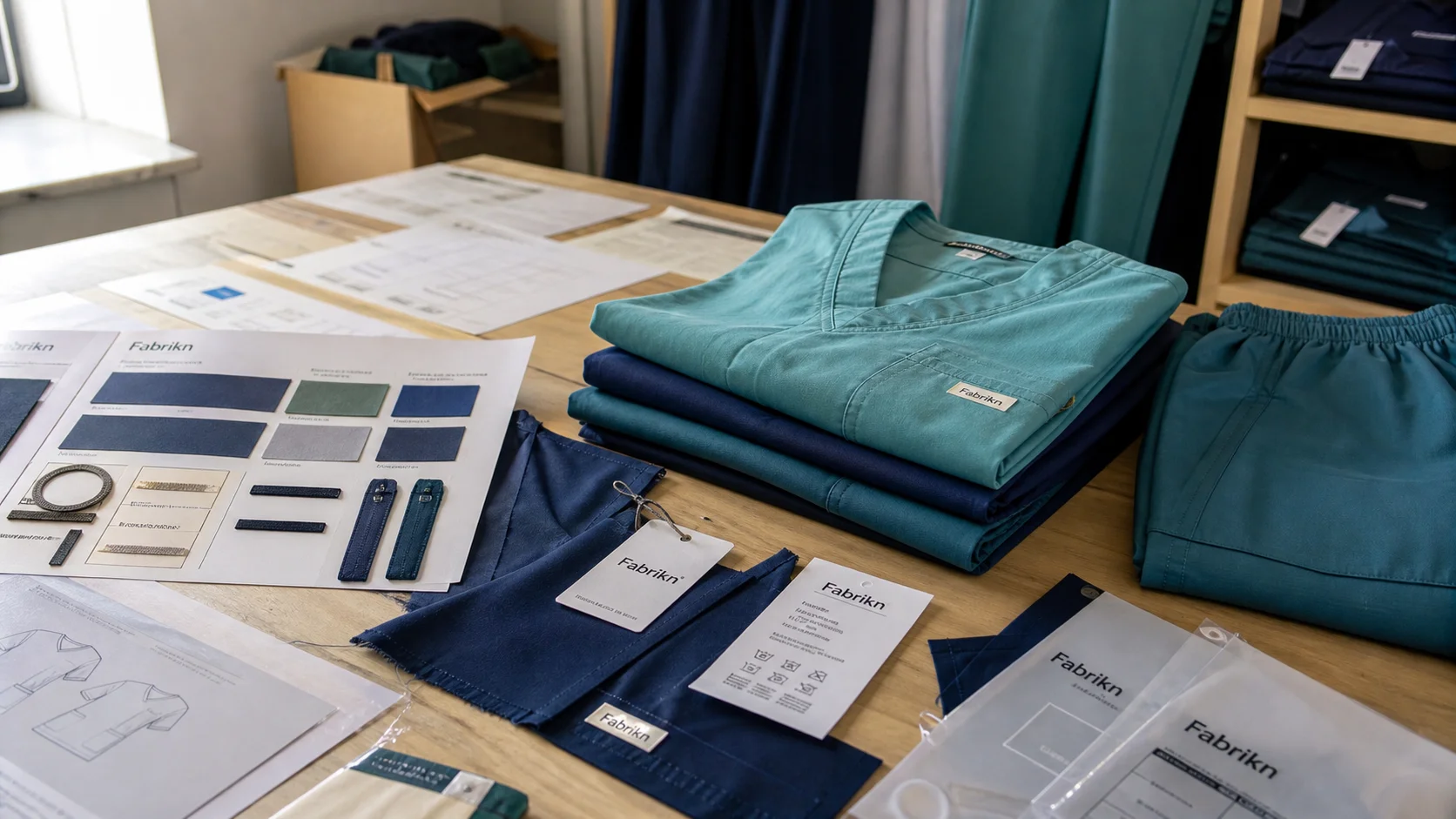
A buyer-focused outline for clinic purchasing teams evaluating custom scrubs compliance documentation, including the records, proofs, and production...
Custom Scrubs Compliance Documentation Buyers Need - Fabrikn production reference
Clinic purchasing teams usually do not need a pile of paperwork for its own sake. They need proof that the custom scrubs they approve can be ordered repeatedly, worn safely, decorated consistently, and shipped with fewer surprises. In practice, that means asking suppliers for a clean documentation set before you commit to a program.
For custom compliance documentation for scrubs clinic purchasing teams, the goal is simple: reduce ambiguity. A scrub top that looks fine in a sales mockup can still fail later if the fabric is too sheer, the decoration method distorts after laundering, the color drifts between lots, or the trims do not hold up to repeated disinfectant washing. Documentation is where those risks are identified early.
Healthcare apparel is not high fashion. It is a repeat-buy item with operational consequences. If a custom scrub program misses the mark, the cost shows up in returns, reorders, staff complaints, inconsistent branding, and avoidable delays in rollout.
Purchasing teams should treat documentation as a control tool. The better the paperwork, the easier it is to compare suppliers on equal terms. It also helps internal stakeholders decide whether a program is acceptable for frontline use, department branding, or uniform standardization across locations.
A weak documentation package usually signals one of three problems: the supplier does not understand the end use, the product has not been fully developed, or the factory is relying on flexible promises instead of fixed specs. All three raise risk.
Not every custom scrub order needs a regulatory dossier, but most programs should include a minimum file. Buyers should ask for the following items before issuing purchase approval.
For many clinic programs, the most useful document is the spec sheet. It should read like a manufacturing instruction, not a marketing flyer. If the supplier cannot document exact measurements and tolerances, the order is not ready for repeat production.
Document What Buyers Should Verify Common Risk If Missing Specification sheet Exact measurements, tolerances, size run, construction Fit inconsistency across sizes or replenishment lots Fabric sheet Fiber content, GSM, finish, shrinkage, hand feel Unexpected opacity, discomfort, or wash performance problems Decoration sheet Logo size, placement, stitch count or print method, thread colors Brand inconsistency or decoration failure after laundering Test evidence Wash durability, colorfastness, pilling, seam performance Premature wear and rejection at inspection Approval record Version control and sign-off trail Disputes over what was actually approvedFor custom scrubs, a vague brief is expensive. A strong brief closes the gap between what a clinic expects and what a supplier builds. The most important specifications are usually the ones buyers assume are “obvious.” Those are the details that get missed.
Most clinic buyers prefer a fabric that balances comfort, durability, opacity, and easy care. Common blends include polyester-rayon-spandex or polyester-cotton-spandex. Typical fabric weights for scrubs often sit in the moderate range, roughly 140 to 220 GSM depending on hand feel, opacity target, and seasonality. Lighter fabrics can improve comfort, but they may be less forgiving on sheerness and wear life. Heavier fabrics tend to look more substantial, though they may feel warmer during long shifts.
The fabric sheet should state fiber percentages, construction type, finish, and expected shrinkage after washing. If the garment is stretch-based, buyers should ask how recovery is measured after repeated wear. A fabric that feels good on day one may bag out at the knees or elbows after a few wash cycles.
Color matching is a recurring failure point in branded uniforms. Buyers should ask for a defined color reference, not a verbal description. Pantone references can help for decorated items, while lab dips or approved strike-offs are often more practical for fabric color control. The documentation should also explain whether the supplier will match the same color across future replenishment orders or only against the current production lot.
Purchasing teams should be careful with darker shades and saturated colors. They often expose dye inconsistency, shade banding, and washing variation faster than mid-tones. If the clinic needs exact brand alignment across tops, pants, and outerwear, that requirement should be documented up front.
Custom scrubs often require embroidery, printed logos, or heat-applied branding. Each method carries tradeoffs. Embroidery is durable and usually looks premium, but dense stitch counts can distort lightweight fabrics. Heat transfers can deliver finer detail, yet they may not age as well under aggressive laundering. Screen print can be efficient for larger runs, though it depends heavily on fabric type and placement.
The decoration spec should define logo size, position from seams, number of thread colors, backing requirements, and any restrictions around pocket placement or ventilation panels. Buyers should also confirm whether the decoration method affects comfort or breathability in the exact garment zone where it is applied.
Trims are small, but they cause large problems when they are wrong. Buyers should document zipper grade, snap style, elastic width, drawcord finish, label type, and pocket reinforcement. If the scrub design includes antimicrobial claims or special performance trims, those claims should be supported by supplier documentation rather than assumed.
Loose threads, weak pocket corners, or cheap zipper pulls may not show up in a showroom sample. They do show up after repeated use. That is why trim specs belong in the approval file, not just in a design conversation.
A sample process should be treated as a formal checkpoint, not a courtesy. The fastest way to create a repeatable custom scrub program is to define approval in stages.
Each stage should have a written decision. Approved, approved with revisions, or rejected. Buyers should avoid verbal sign-off without a documented version reference. A lot of disputes in custom apparel begin with a sentence like, “That is not the sample we approved.”
For clinic purchasing teams, the strongest practice is to require a sealed sample or a clearly marked reference sample that sits with the purchase file. That becomes the comparison point for inspection, replenishment, and future reorder matching.
Inspection teams can only verify against what is documented. If the buyer cannot point to a signed sample, a measured spec, and a dated decoration reference, the program becomes much harder to control.
Custom scrubs are usually not fast, especially when the order includes logo decoration or special fabric development. Typical MOQ ranges vary by supplier and complexity. For standard decorated scrubs, buyers may see minimums in the low hundreds per style or color. More customized programs, especially those involving multiple sizes, special trims, or new fabric sourcing, may push minimums higher.
Lead time depends on how complete the information is at the start. A straightforward repeat order with approved fabric may move in a relatively predictable production window. A new style with custom knit fabric, lab dips, embroidery approvals, and packaging changes can extend significantly. Buyers should plan for sampling time, approval cycles, raw material booking, bulk production, inspection, and shipping clearance.
Several dependencies usually slow the clock:
A purchasing team that wants a reliable calendar should ask for lead time by stage, not just a single promised ship date. A one-line date often hides the real schedule risk.
Scrub programs fail in predictable ways. The issue is rarely one catastrophic defect. It is usually a cluster of small misses that add up to an unacceptable bulk lot.
The most common inspection risks include measurement drift, shade variation, decoration misplacement, poor seam finishing, weak pocket construction, and wash failure. Color problems are especially painful because they are often visible immediately, while some performance problems only emerge after laundering.
Buyers should pay attention to the following risk areas:
Inspection should be tied to the approved sample and written spec. A supplier that is asked to “make it look right” will usually define right differently from the clinic buyer. That is a sourcing problem, not a production problem.
The best supplier for custom scrubs is not always the one with the lowest quote. Buyers should compare suppliers on documentation discipline, not just price. A cheaper offer can become costly if the vendor cannot control fit, shade, or decoration quality.
Useful questions include whether the supplier issues version-controlled spec sheets, whether they can provide test evidence for the chosen fabric, whether they separate sample approval from bulk approval, and whether they can support repeat orders without remaking the entire setup each time. Those details matter more than polished sales language.
It also helps to evaluate responsiveness. A supplier who answers technical questions quickly and in writing is usually easier to manage during production. The same is true of suppliers who confirm tolerances, material sources, and decoration limits before the PO is issued.
For teams that need support across product development, decoration coordination, and purchase planning, it is worth reviewing a supplier’s service structure before committing. Fabrikn’s services page is a useful starting point for understanding the scope of support, while the about us page can help procurement teams gauge the company’s orientation and working style. When the brief is ready, the contact us page is the practical next step for asking for documentation, samples, and lead-time guidance.
Clinic purchasing teams should not treat custom scrub documentation as a back-office formality. It is the control layer that helps a repeat uniform program stay consistent across departments, seasons, and reorder cycles. The right file set reduces arguments, shortens approval loops, and makes inspection less risky.
In buying terms, the tradeoff is straightforward. More documentation takes more time at the start, but it usually saves time and money later. Less documentation can speed up a quote stage, but it often creates problems when the order is already in motion and the team has less leverage.
Get a free quote from Fabrikn — your trusted B2B clothing manufacturer with 10+ years of experience. MOQ as low as 200 pieces.
Get a Free Quote →Start with the spec sheet, fabric sheet, trim sheet, decoration details, test evidence where available, and a signed sample approval record. Add packing and carton details if distribution goes to multiple locations.
MOQ varies by supplier and customization level. Many programs start in the low hundreds per style or color, while more complex programs with custom fabrics or special trims may need higher minimums.
Lead time depends on fabric sourcing, sample approvals, decoration setup, and bulk production scheduling. A simple repeat order is usually faster than a new style with multiple approval steps.
The usual issues are measurement drift, shade variation, decoration misplacement, weak seams, and fabric performance problems after laundering. Missing or vague specifications make these more likely.
No. A showroom sample can be useful as a starting point, but buyers should approve against a documented spec, a pre-production sample, and a clear sign-off record. That is the only practical way to control repeat production.