
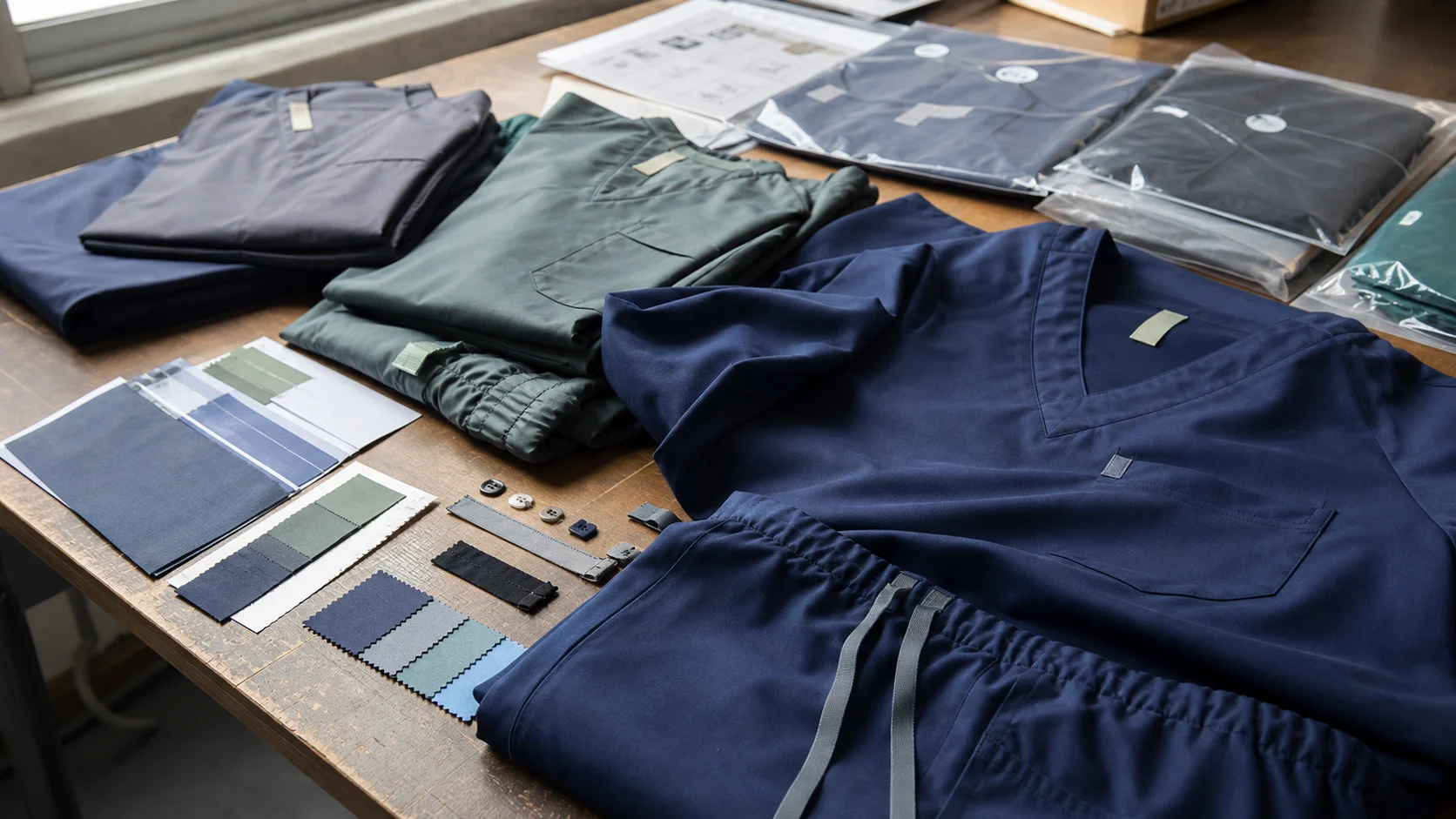
A practical SEO outline for hotel procurement teams calculating landed costs for custom scrubs, with quality checkpoints, inspection artifacts, freight...
Custom Scrubs Landed Cost Guide for Hotel Buyers - Quality & Inspection manufacturing guide
Hotel procurement teams buying custom scrubs for spa, wellness, housekeeping support, medical concierge, or back-of-house care roles need a landed cost view before they approve a uniform program. Unit price alone is not enough. A scrub top quoted at a low factory price can become expensive once fabric changes, embroidery, testing, freight, duty, packaging, inspection, and rework are included.
This guide explains how to calculate the landed cost of custom scrubs, what cost drivers matter most, and where quality inspection risks usually appear. It is written for hotel buyers comparing suppliers, setting annual uniform budgets, or preparing a sourcing brief for a private-label apparel manufacturer.
Landed cost is the total cost of getting finished scrubs from the supplier to the hotel’s receiving point, ready for internal distribution or staff issue. It includes the garment cost, customization, packaging, compliance, inspection, logistics, duties, taxes where applicable, and any other charges tied to delivery.
For hotel procurement, landed cost is more useful than FOB or ex-factory pricing because uniforms are operational assets. They need to arrive on time, fit consistently, wash well, and match brand standards across departments. A landed cost model helps purchasing teams compare suppliers on the same basis and avoid surprises after the purchase order is issued.
Custom scrubs are often used in hotels for spa attendants, wellness clinic staff, housekeeping supervisors, laundry teams, childcare areas, eldercare hospitality settings, or properties with medical tourism services. These uniforms need comfort and easy care, but they also carry brand value. Color consistency, fabric handfeel, logo placement, and pocket construction can matter as much as price.
Hotels buy custom scrubs when off-the-shelf medical uniforms do not match the property’s look, service level, or operational requirements. Standard scrubs may be too clinical, too loose, or inconsistent in color. Custom production allows the buyer to specify fabric, fit, branding, pocket layout, sleeve length, inseam, labeling, and packaging.
Common reasons include:
The tradeoff is that customization increases sourcing complexity. Every custom decision affects landed cost and inspection scope. A procurement team should treat scrubs as a controlled uniform program, not a simple commodity purchase.
A practical landed cost formula for custom scrubs is:
Landed Cost per Set = Garment Manufacturing Cost + Customization + Packaging + Testing + Inspection + Inland Transport + Export Charges + International Freight + Insurance + Duty/Tax + Destination Charges + Local Delivery + Rework/Contingency Allowance
For hotel buyers, it is better to calculate landed cost per set and per wearer. A “set” usually means one scrub top and one scrub pant. A “wearer allocation” may include three to five sets per employee depending on laundry frequency, shift structure, and replacement policy.
For example, if a spa team has 60 staff and the property issues four sets per person, the initial order is 240 sets before spare stock. A sensible spare stock allowance may be 5% to 15%, depending on turnover and size curve reliability. In that case, procurement may need 252 to 276 sets.
This is where many budgets fail. The buyer prices 240 sets but later adds spare stock, name embroidery, higher freight, size exchanges, and replacement units. A landed cost plan should include these items before supplier selection.
The base manufacturing cost includes fabric, trims, cutting, sewing, pressing, and basic packing. It is usually the largest component. Cost varies by fabric weight, fiber content, garment complexity, and production quantity.
A basic scrub set in a standard poly-cotton fabric will normally cost less than a premium stretch set with shaped seams, contrast panels, multiple pockets, reinforced bartacks, and branded trims. Small styling changes can also add sewing time. Curved pockets, hidden zippers, side vents, elastic waistbands with drawcords, and knit panels all influence labor cost.
Fabric often drives the cost gap between budget and premium scrubs. Common scrub fabrics include:
For hotel use, the best fabric is not always the cheapest or most technical. A mid-weight stretch woven may give a better staff experience, while a stable poly-cotton may survive industrial laundering more predictably. Buyers should request fabric swatches and wash test results before approving bulk.
Customization includes embroidery, heat transfer logos, woven labels, printed neck labels, contrast trims, custom buttons, zipper pulls, or department color coding.
Embroidery is durable and suitable for premium uniforms, but it can pucker on lightweight fabric if backing and stitch density are not managed. Heat transfers can look clean but may crack or peel if the wrong transfer type is used for high-temperature laundering. Woven labels are useful for brand control, while printed care labels can reduce irritation but must remain legible after washing.
Logo size and placement should be approved on a physical sample. A digital mockup is not enough for a hotel uniform program because body position, pocket placement, and fabric drape affect the final look.
Packaging may include individual polybags, size stickers, barcode labels, department labels, carton markings, recycled packaging, or set packing.
Hotels often benefit from set packing by size and department. It reduces receiving time and helps uniform teams issue garments quickly. The extra packaging cost may be justified if the property has multiple departments or if scrubs are being shipped directly to several hotels.
Buyers should define whether the supplier packs tops and pants separately or as complete sets. Separate packing improves size flexibility, while set packing simplifies distribution. The better choice depends on whether staff frequently need mixed top and bottom sizes.
Testing may include colorfastness to washing, colorfastness to rubbing, dimensional stability, seam strength, pilling resistance, and fabric composition verification. If the scrubs carry specific claims such as antimicrobial, recycled content, or fluid resistance, testing requirements become more important.
Hotel buyers should be cautious with unverified claims. A scrub described as “antibacterial” or “eco-friendly” should have supporting documents if those claims will be used internally or externally. In many cases, performance and wash durability matter more than marketing language.
Inspection can be handled by the factory, the buyer’s nominated inspector, or a third-party inspection company. For custom scrubs, pre-shipment inspection is strongly recommended, especially for first orders or new suppliers.
AQL inspection adds cost, but it reduces the risk of receiving garments with size variation, shade mismatch, loose threads, incorrect logos, or poor packaging. For hotels, defective uniforms create operational disruption because staff issue dates are often fixed around opening schedules, seasonal hiring, or renovation launches.
Procurement teams that need support with apparel production and quality planning can review the manufacturing services offered by Fabrikn services.
Freight can change landed cost sharply. Ocean freight is cheaper for larger orders but slower. Air freight is faster but can make the final cost uncompetitive, especially for bulky uniform shipments.
For custom scrubs, shipment weight and carton volume depend on fabric weight, packing method, and whether hangers or special packaging are used. Most hotel programs can avoid hanger packing unless garments require presentation for retail-style issue.
A split shipment can be useful. The buyer may air ship a small urgent quantity for launch while sending the balance by sea. This protects the opening schedule without applying air freight cost to the full order.
Duties depend on HS classification, country of origin, fabric composition, and destination market. Destination charges may include customs clearance, port fees, handling, warehousing, and final delivery.
Hotel procurement teams should confirm whether the supplier quote is EXW, FOB, CIF, DAP, or DDP. These terms change who pays freight, insurance, customs clearance, duty, and final delivery. A low FOB price may not be the lowest landed cost if destination charges are poorly controlled.
A clear technical specification prevents cost creep and quality disputes. For custom scrubs, the spec should define fabric, trims, construction, branding, sizing, packaging, and testing requirements.
Specification Area What to Define Cost and Quality Impact Fabric composition Poly-cotton, polyester-spandex, rayon blend, recycled content Affects price, comfort, shrinkage, and duty classification Fabric weight GSM or oz/yd² Heavier fabric may last longer but increases freight and heat retention Stretch Mechanical stretch or elastane percentage Improves comfort but can raise fabric cost and testing needs Color Pantone, lab dip, or approved fabric standard Poor color control creates visible shade variation across staff Seams Stitch type, seam allowance, bartacks, reinforcement Directly affects durability under laundry and movement Pockets Number, size, placement, closure type More pockets add sewing time and inspection points Logo Embroidery, transfer, woven badge, size, placement Branding errors are high-visibility defects Labels Main label, care label, size label, department label Supports compliance and internal inventory control Packaging Individual, set pack, carton assortment, barcode Can reduce hotel receiving labor but adds supplier handling costDo not leave fabric weight, color, and trims as open supplier choices. If the supplier substitutes fabric to hit a target price, the hotel may receive uniforms that look similar at delivery but fail after laundering.
Minimum order quantity depends on fabric availability, dyeing requirements, trim customization, and factory production setup. For custom scrubs, typical MOQ ranges may look like this:
These ranges are indicative. Actual MOQ can be lower or higher based on the supplier’s sourcing network, fabric stock, and production schedule. Buyers should ask whether MOQ is per style, per color, per fabric, or per size range. This detail matters.
Hotels with multiple properties can reduce unit cost by consolidating demand. A group program may order one core style and color, then customize by property through embroidery or department labeling. That approach usually produces better pricing than separate small orders.
For boutique hotels with smaller teams, the purchasing judgment is different. A lower MOQ supplier may be worth a higher unit price if it avoids overstock. Excess inventory in the wrong sizes is not a saving.
Sampling is where a hotel buyer controls fit, fabric, color, and branding before bulk production. Skipping steps to save time can lead to expensive corrections later.
A pre-production sample is especially important when a hotel uses brand colors. Lab dips on small fabric pieces may look acceptable, but finished garments reveal shade, drape, and logo contrast more clearly.
Buyers should keep one approved sample sealed as the production standard. The supplier should also retain an approved sample. This avoids disputes during inspection because both sides can compare bulk garments against the same reference.
Custom scrub lead time depends on fabric, sampling, approvals, production capacity, inspection, and freight mode. A simple reorder in stock fabric may move quickly. A first order with custom color, embroidery, and size-set approval takes longer.
Stage Typical Time Range Key Dependency Design and quotation 3 to 10 business days Completeness of tech pack and quantity plan Fabric sourcing and lab dips 1 to 3 weeks Stock fabric versus custom dye Fit sample 1 to 2 weeks after fabric confirmation Pattern complexity and sample room capacity Pre-production sample 1 to 2 weeks Final trims, labels, and logo approval Bulk production 4 to 8 weeks Order size, fabric availability, factory schedule Inspection and packing 2 to 7 days Inspection result and defect corrections Freight Several days by air; several weeks by sea Destination, shipping mode, customs clearanceFor opening orders, procurement teams should not plan only around sewing time. Fabric booking, sample comments, logo approvals, carton labeling, and customs paperwork can all affect the timeline.
A realistic first-order timeline for custom scrubs is often 10 to 16 weeks from concept approval to hotel delivery if sea freight is used. Air freight can reduce transit time, but it will raise landed cost. Reorders can be shorter if fabric, trims, pattern, and packaging remain unchanged.
Custom scrubs look simple, but they carry several inspection risks. A hotel team sees these garments in groups, which makes inconsistencies more visible. One shade mismatch or logo placement error can stand out immediately when staff are lined up at a spa reception or wellness desk.
Inspection should include visual checks, measurement checks, workmanship review, packaging verification, and comparison with the approved sample. If possible, wash testing should be done before bulk production or during sample approval. A garment that looks good before washing may shrink, fade, or lose shape after repeated laundry cycles.
For industrial laundry, buyers should ask for care instructions that match the hotel’s real process. Low-temperature domestic wash guidance may not be enough if the property uses commercial laundering, stronger detergents, or tumble drying.
Many apparel inspections use AQL sampling. Common levels include general inspection level II with major and minor defect limits agreed in advance. The exact AQL level should be based on risk, order size, and brand expectations.
Hotel buyers should define critical defects clearly. Wrong logo, wrong color, severe measurement failure, fabric holes, open seams, and contamination are not minor issues in a uniform program. The inspection checklist should reflect how the garments will be used, not just generic apparel criteria.
The following table shows how landed cost can be structured. The numbers are illustrative only. Actual cost depends on country, supplier, volume, fabric, customization, freight market, duty rate, and delivery terms.
Cost Element Example Cost per Set Notes for Procurement Base scrub top and pant $18.00 Mid-weight stretch fabric, basic pockets Embroidery $1.20 One chest logo; cost changes by stitch count Custom labels and packaging $0.60 Size label, care label, individual polybag Testing allocation $0.35 Allocated across order quantity Inspection allocation $0.45 Third-party or buyer inspection allocation Export and inland charges $0.75 Depends on supplier terms International freight $1.80 Sea freight allocation; air would be higher Duty and destination charges $2.25 Varies by destination and classification Local delivery $0.40 To hotel warehouse or property Contingency allowance $0.80 Useful for small corrections or unplanned handling Estimated landed cost $26.60 Use for supplier comparison and budget controlThis example shows why the cheapest factory price is not always the best offer. If a supplier quotes $17.00 but has poor packing control, higher defect rates, or unclear freight terms, the final landed cost may exceed a more disciplined supplier quoting $18.50.
Good supplier questions help procurement teams uncover hidden cost and quality risk before issuing a purchase order.
Supplier answers should be documented in the quote sheet or purchase order. Verbal assumptions create avoidable disputes, especially around packaging, logos, and inspection standards.
Hotel buyers who want to discuss a custom apparel project or clarify sourcing details can use the Fabrikn contact page to start a conversation.
The right buying decision depends on order size, launch deadline, staff expectations, and brand positioning. There is no single best scrub specification for every hotel.
A lower-cost poly-cotton scrub may make sense for back-of-house teams, high-turnover roles, or properties that need frequent replacements. It is easier to control cost and may be more resistant to heavy laundering. The tradeoff is comfort and perceived premium value.
A premium stretch scrub is better for spa, wellness, and guest-facing care teams where movement, appearance, and comfort are important. Staff are more likely to accept the uniform, and the garment may support a higher service image. The tradeoff is higher fabric cost and more attention needed during wash testing.
Full custom development is not always necessary. If the hotel only needs a brand color and logo, a stock fabric and adjusted styling may be more efficient. Full customization should be reserved for programs with enough volume, long-term replenishment needs, or strong brand requirements.
Inspection is worth the cost when the order is large, the supplier is new, the hotel has a fixed opening date, or the scrubs include custom color and logo work. It is less tempting to pay for inspection on small repeat orders, but even then, basic measurement and packaging checks should not be skipped.
Strong procurement is not about forcing the lowest unit price. It is about buying the correct product at the lowest reliable landed cost. For hotel scrubs, reliability includes fit, wash performance, color consistency, logo accuracy, and on-time delivery.
Custom scrub sourcing should involve more than purchasing. The procurement team should collect input from operations, housekeeping, spa management, laundry, HR, and finance before final approval.
This coordination reduces late changes. Late changes are expensive because they can restart sampling, delay fabric booking, or force air freight. A practical uniform brief should be approved internally before supplier development begins.
Quote comparison should use a landed cost matrix, not a simple unit price column. Ask each supplier to quote the same fabric weight, same styling, same quantity, same packing, same logo placement, and same delivery terms. If one supplier quotes with testing and inspection included while another excludes them, the comparison is not valid.
Procurement teams should normalize all quotes into one table with the following fields:
A supplier with a slightly higher garment cost may still offer better value if they provide stable fabric, clearer documentation, lower defect risk, and more reliable lead times. For hotel uniform programs, consistency is a commercial advantage.
To understand the broader manufacturing approach and company background, buyers can review Fabrikn’s about page.
A custom scrubs landed cost guide is most useful when it turns a vague uniform request into a controlled buying plan. Hotel procurement teams should define the scrub set, approve fabric and fit, understand MOQ, build a realistic timeline, and inspect against clear standards.
The best value is rarely the lowest quoted unit price. It is the lowest reliable landed cost for garments that staff will wear comfortably, laundry teams can maintain, and hotel managers can issue without operational disruption.
For most hotel buyers, the safest approach is to start with a clear specification, request comparable quotes, approve physical samples, include inspection, and calculate landed cost before purchase order release. That discipline protects the budget and reduces the chance of uniform problems appearing after delivery.
Get a free quote from Fabrikn — your trusted B2B clothing manufacturer with 10+ years of experience. MOQ as low as 200 pieces.
Get a Free Quote →Landed cost is the full cost of receiving finished custom scrubs at the hotel or warehouse. It includes garment production, customization, packaging, testing, inspection, freight, duty, destination charges, local delivery, and any contingency allowance.
Typical MOQ may range from 100 to 300 sets for stock fabric with logo customization, 300 to 800 sets for custom colors, and 800 to 1,500+ sets for fully custom fabric or performance finishes. Actual MOQ depends on the supplier, fabric mill, trim requirements, and order structure.
Many hotels plan three to five sets per wearer, depending on shift frequency and laundry turnaround. A spare stock allowance of 5% to 15% is often useful for new hires, size exchanges, damage, and emergency replacements.
The best fabric depends on the role. Poly-cotton blends are usually durable and cost-efficient. Stretch blends offer better comfort and a more premium feel. For hotel laundry, shrinkage, colorfastness, pilling resistance, and seam strength should be checked before bulk approval.
Inspection is strongly recommended for first orders, large orders, custom colors, and branded uniforms. It helps catch shade variation, measurement problems, logo errors, sewing defects, and packing mistakes before shipment.
A first order may take around 10 to 16 weeks from concept approval to delivery when sampling, production, inspection, and sea freight are included. Reorders can be faster if fabric, pattern, trims, and packaging remain unchanged.
Embroidery is durable and often preferred for premium uniforms, but it must be tested to avoid puckering. Heat transfers can look clean and lightweight, but they need to be compatible with the hotel’s laundering process. The best option depends on fabric, logo design, and wash conditions.
Hotels can reduce landed cost by standardizing styles, consolidating orders across properties, limiting custom colors, approving realistic size curves, planning early enough to avoid air freight, and specifying packaging that supports efficient receiving without unnecessary cost.