
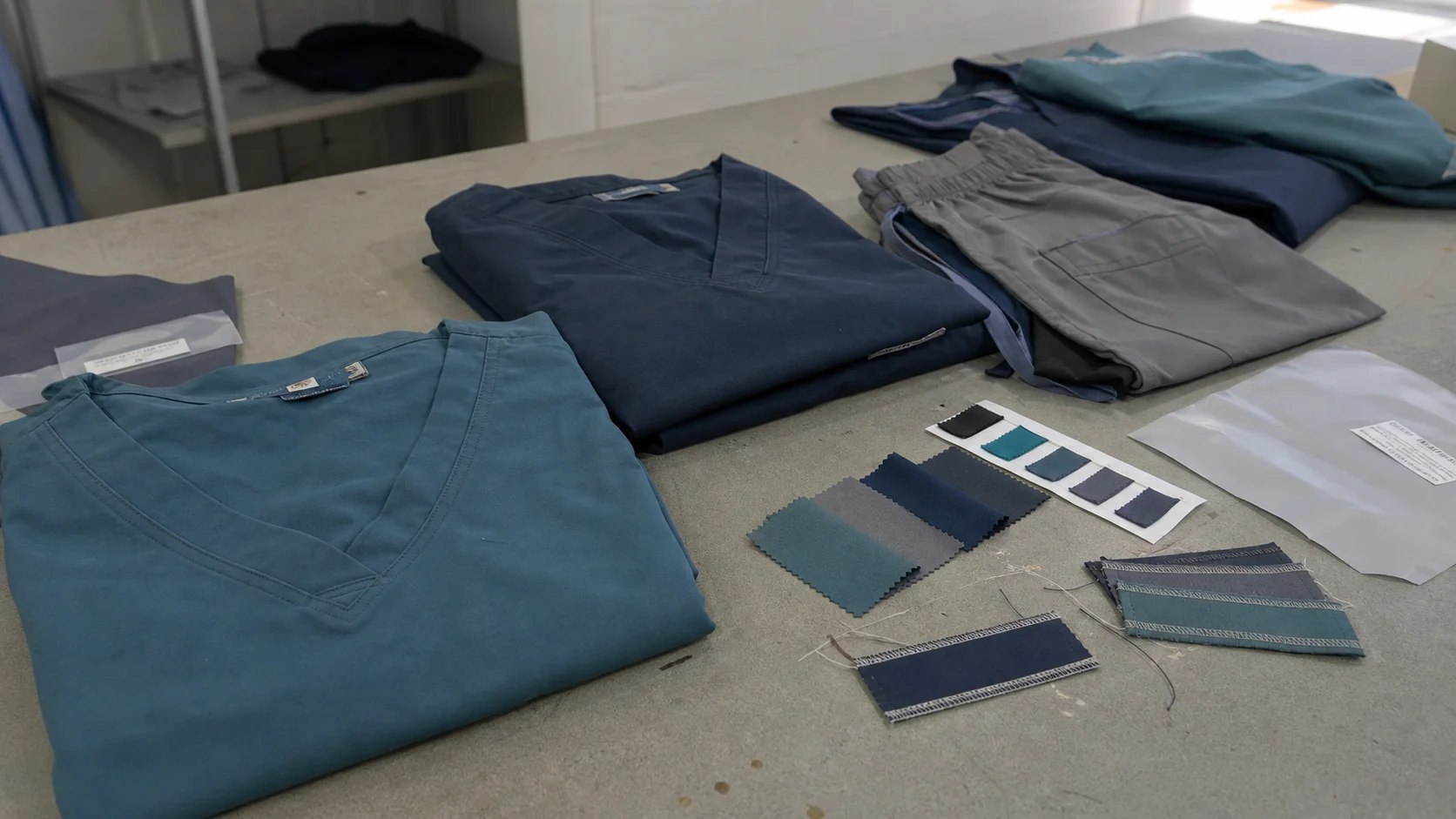
A product-specific outline for medical apparel distributors evaluating custom scrubs with MOQ requirements, covering fabric, fit, decoration, labeling, packaging, compliance, and production planning.
Custom Scrubs MOQ Options for Medical Distributors - Fabrikn production reference
For medical apparel distributors, MOQ is not just a factory number. It is a planning tool that affects cash flow, SKU strategy, fabric commitments, replenishment speed, and margin control. In private label scrub production, MOQ usually means the minimum order quantity a manufacturer requires to produce a style, a color, a fabric program, or a complete purchase order at a workable cost.
When buyers search for custom scrubs with MOQ for medical apparel distributors, they are usually trying to solve one of two problems. The first is access: they need branded scrubs without committing to overly large runs. The second is scalability: they want a supplier that can start with moderate volumes and support higher reorder volumes once sell-through is proven.
MOQ in this category can be structured several ways. Some suppliers quote per style, such as a scrub top and scrub pant counted separately. Others quote per color, per fabric, or per total order. A low advertised MOQ can sound attractive, but buyers should check what is actually included. A 300-piece MOQ may only apply if the order uses stock fabric colors, standard trims, and one simple logo application. A truly custom program with dyed-to-order fabric, branded labels, and multiple size splits often moves the minimum higher.
Distributors evaluating private label partners should look past headline numbers. The useful question is whether the MOQ fits your channel, your pricing strategy, and your reorder rhythm. That is where the sourcing decision becomes commercial rather than cosmetic.
Medical distributors operate differently from fashion retailers. They often serve clinics, hospitals, dealers, uniform resellers, and regional wholesale accounts that need consistent sizing, repeatable colors, and dependable restocks. That operating model makes MOQ a serious purchasing variable.
A high MOQ can improve unit cost, but it also increases inventory exposure. Scrubs are size-sensitive products. If a distributor buys too deeply before confirming demand by fit, color, and department usage, slow sizes can sit in stock while fast sizes go out of inventory. That issue is common in unbalanced size curves, especially when end users need extended sizes or unisex fits.
Low MOQ programs reduce risk, but they come with tradeoffs. Unit prices tend to be higher. Fabric and trim choices may be narrower. Packaging customization may be limited. Production slots can also be less flexible if the supplier is grouping small orders into shared fabric or sewing schedules.
The practical objective is not always to find the lowest MOQ. It is to find the MOQ structure that matches the distributor’s route to market. A regional distributor testing a new in-house line may benefit from a moderate launch quantity with room for color expansion later. A larger distributor supplying healthcare groups may prefer a committed fabric program with higher opening MOQ because consistency and replenishment matter more than initial caution.
Buyers comparing suppliers can review private label support options through pages such as /services/ to understand whether development, sourcing, and production are structured for distributor-scale programs rather than one-off apparel projects.
MOQ models in custom scrubs usually fall into a few workable categories. Each one has cost and flexibility implications.
This is common when a scrub top and scrub pant are treated as separate products. Typical starting points may range from 200 to 500 pieces per style for simpler constructions using stock fabric. If the top and pant are part of a set, some suppliers will allow combined volume across both styles, but many will not.
Color-specific minimums are common because cutting and production planning are tied to fabric availability. A supplier may accept 600 pieces for one style, but require at least 200 pieces per color. This can become restrictive if the distributor wants broad color variety for a smaller launch.
This model matters when fabric is custom dyed, finished, or blended to specification. Typical minimums can begin around 800 to 1,500 yards per color for dyed fabric, depending on mill policy and fabric type. Once fabric minimums are triggered, garment MOQ is effectively tied to that fabric commitment.
Some manufacturers are more flexible and look at the total order volume across multiple styles and colors. This model can work well for distributors launching a small coordinated collection. It is often the most commercially useful structure, especially if the supplier allows mixed size ratios and shared trims.
Reorders are often easier than first orders. Once patterns, graded specs, labels, packaging, and fit approvals are complete, some suppliers will accept smaller repeat quantities. Buyers should confirm this early. An initial MOQ may be acceptable if the reorder threshold drops to a practical level.
There is no universal benchmark for custom scrub MOQ. As a rough commercial guide, distributors often see entry ranges such as:
Program Type Typical MOQ Range Notes Stock fabric, basic private label 200–500 pieces per style Often limited customization Multi-style collection 600–1,200 pieces total order May allow mixed styles/colors Custom dyed fabric program Higher due to mill minimums Fabric MOQ usually drives garment MOQ Repeat orders Lower than opening order in some cases Depends on fabric carry stockMOQ is not chosen at random. It is usually the result of cost recovery and production efficiency. Distributors can negotiate more effectively when they understand what is behind the number.
From a buyer’s perspective, the strongest leverage usually comes from simplifying variables. If you accept stock colors, standard trims, and shared packaging, MOQ often becomes more negotiable. If you request custom fabric, contrast panels, antimicrobial claims, and retail-ready branding across several SKUs, the minimum will usually climb.
Scrubs are technical basics. They are not highly complex garments, but performance expectations are high. End users expect comfort, durability, easy care, and color consistency across repeat purchases. Those expectations make fabric selection central to MOQ planning.
These specs influence MOQ because custom testing and finishing are not free. A distributor asking for a specific hand feel, anti-wrinkle finish, moisture management, or antimicrobial treatment should verify whether the claim is standard from the mill or requires special production. Many buyers over-customize early, then discover the volume does not justify the complexity.
Trim choices matter too. Branded neck labels, size tabs, care labels, hangtags, polybags with suffocation warnings, barcode stickers, and carton marking are all manageable, but every custom component adds another minimum or setup cost. In smaller programs, it is often smarter to customize labels and packaging first, while keeping the body fabric and core hardware closer to standard options.
Practical buying judgment: if your launch volume is still uncertain, spend your customization budget on fit, fabric reliability, and labeling accuracy before investing in decorative trim complexity.
Sample approval is where many scrub programs either stabilize or drift into delays. Medical distributors should treat the approval path as a control process, not a formality.
A typical development sequence may look like this:
Distributors should not compress these steps casually. A rushed approval process often leads to costly bulk issues such as neckline shape inconsistency, pocket depth variation, tight thigh measurements in jogger scrubs, twisting side seams, or mismatched top and pant color shading.
Approval documents should be specific. Do not approve a sample based only on appearance. Confirm measured spec tolerances, fabric composition, stitch type, bartack placement, logo method, care label content, and packing instructions. If the order includes women’s, men’s, unisex, or plus sizing, size grading should be reviewed carefully because fit issues multiply quickly in broad size runs.
For distributors building a long-term private label line, it is useful to align development expectations early through supplier communication channels such as /contact-us/, especially when MOQ decisions depend on how much customization the first launch really needs.
Lead time in custom scrubs depends less on sewing complexity and more on inputs, approvals, and fabric readiness. Buyers should separate sample lead time from bulk lead time.
Sample development may take several weeks depending on the number of revision rounds. Bulk production often falls in a broad range such as 45 to 90 days after final approvals, but that range can move significantly based on fabric sourcing, dyeing, embellishment, and booking pressure.
A common mistake is assuming simple garments always mean short timelines. Scrubs may be straightforward to sew, but distributor programs often involve many size ratios, colorways, and pack assortments. That operational detail can extend pre-production time even when the garment itself is basic.
Buyers should also ask whether the supplier carries greige or finished base fabric for common scrub shades. If yes, MOQ and lead time may both improve. If not, a low MOQ promise may lose value once the dyeing timeline is added.
Inspection risk in scrub production is usually concentrated in consistency, not novelty. The garment may look simple, but repeatability matters. Distributors shipping to institutional or wholesale accounts should define inspection checkpoints before bulk begins.
Final inspection should cover both garment quality and packing accuracy. In distributor programs, carton marking and assortment errors can be just as disruptive as sewing defects. If a hospital group receives the wrong size ratio or mislabeled cartons, the commercial damage can exceed the cost of the garments themselves.
A practical control method is to align on acceptable tolerances, testing points, and pack rules before the pre-production sample is approved. Buyers should also confirm whether the factory performs inline inspections, end-line checks, and final random inspections. Low MOQ orders are not automatically lower risk. In some cases they are riskier because small runs may be inserted into busy schedules where control discipline weakens.
MOQ negotiation works best when it is tied to production logic, not just price pressure. Suppliers are more flexible when the buyer helps simplify the order.
Distributors should also negotiate on total program value, not only unit price. A supplier that offers realistic MOQ, disciplined sample management, and predictable restock planning may outperform a cheaper source that agrees to very small runs but struggles with consistency.
One sensible tradeoff is to begin with semi-custom rather than fully custom scrubs. That might mean using an existing block and stock fabric while adding private labels, custom packaging, and selected logo placements. This route often lowers opening MOQ and shortens development time without compromising brand ownership in the market.
The best MOQ program depends on the distributor’s stage, sales model, and inventory tolerance.
If you are launching a new scrub label, the safest route is usually a moderate MOQ with controlled customization. Focus on one or two core silhouettes, commercially proven colors, and a disciplined size curve. That approach protects working capital and gives clearer sell-through data.
If you already have account coverage and predictable demand, a broader private label program can make sense. In that case, slightly higher MOQ may be commercially justified if it delivers better costing, stronger color continuity, and cleaner reorder planning.
If you supply coordinated uniforms to healthcare groups, reliability often matters more than chasing the smallest minimum. Fabric continuity, approved shade standards, and replenishment capacity should be weighted heavily. A higher MOQ can be acceptable if the supply chain is built for repeatability.
Supplier selection should reflect that business reality. Buyers can review a manufacturer’s positioning, development capabilities, and sourcing scope through pages like /about-us/ before moving into detailed MOQ discussions.
In practical terms, the strongest custom scrubs with MOQ program for medical apparel distributors usually has four traits:
That is the commercial balance buyers should look for. Low MOQ by itself is not a strategy. It only becomes valuable when the product, supply chain, and reorder model are aligned.
Custom scrub sourcing is often presented as a simple branding exercise, but for distributors it is really an inventory and operations decision. MOQ sits at the center of that decision because it shapes cost, flexibility, development scope, and replenishment planning.
For most medical apparel distributors, the smartest path is to start with a realistic private label program rather than a highly customized one. Keep fabric dependable, trims controlled, approvals disciplined, and reorder terms clear. Once demand is proven, expansion into additional colors, silhouettes, and custom fabric programs becomes much easier to justify.
Buyers who treat MOQ as a negotiable supply-chain structure rather than a single number usually make better long-term decisions. That approach helps reduce stock risk, improve supplier alignment, and build a scrub line that can actually scale.
Get a free quote from Fabrikn — your trusted B2B clothing manufacturer with 10+ years of experience. MOQ as low as 200 pieces.
Get a Free Quote →Typical MOQ can range from about 200 to 500 pieces per style for simpler stock-fabric private label programs. More customized programs may require higher minimums, especially when fabric is dyed to order or trims are custom-made.
Yes, but low MOQ usually comes with limits. Buyers may need to choose stock fabrics, standard colors, simpler trims, or existing fit blocks. Unit pricing is also often higher at lower volumes.
It depends on the supplier. Some quote MOQ per style, others per color, per fabric, or per total purchase order. Buyers should confirm the exact structure before comparing offers.
Custom fabric often triggers mill minimums for dyeing or finishing. Once that happens, the garment MOQ is driven by fabric yardage requirements rather than sewing capacity alone.
Start with fewer styles, use commercially proven colors, standardize trims, and confirm whether repeat orders can be placed at lower quantities. A semi-custom launch is often safer than a fully custom one.
At minimum, buyers should approve fit, measurements, fabric composition, color, labels, logo placement, packaging details, and pre-production samples. Skipping these checkpoints can create expensive bulk issues.
Bulk production often takes around 45 to 90 days after final approvals, though timelines vary with fabric readiness, trim sourcing, testing needs, and factory capacity.