
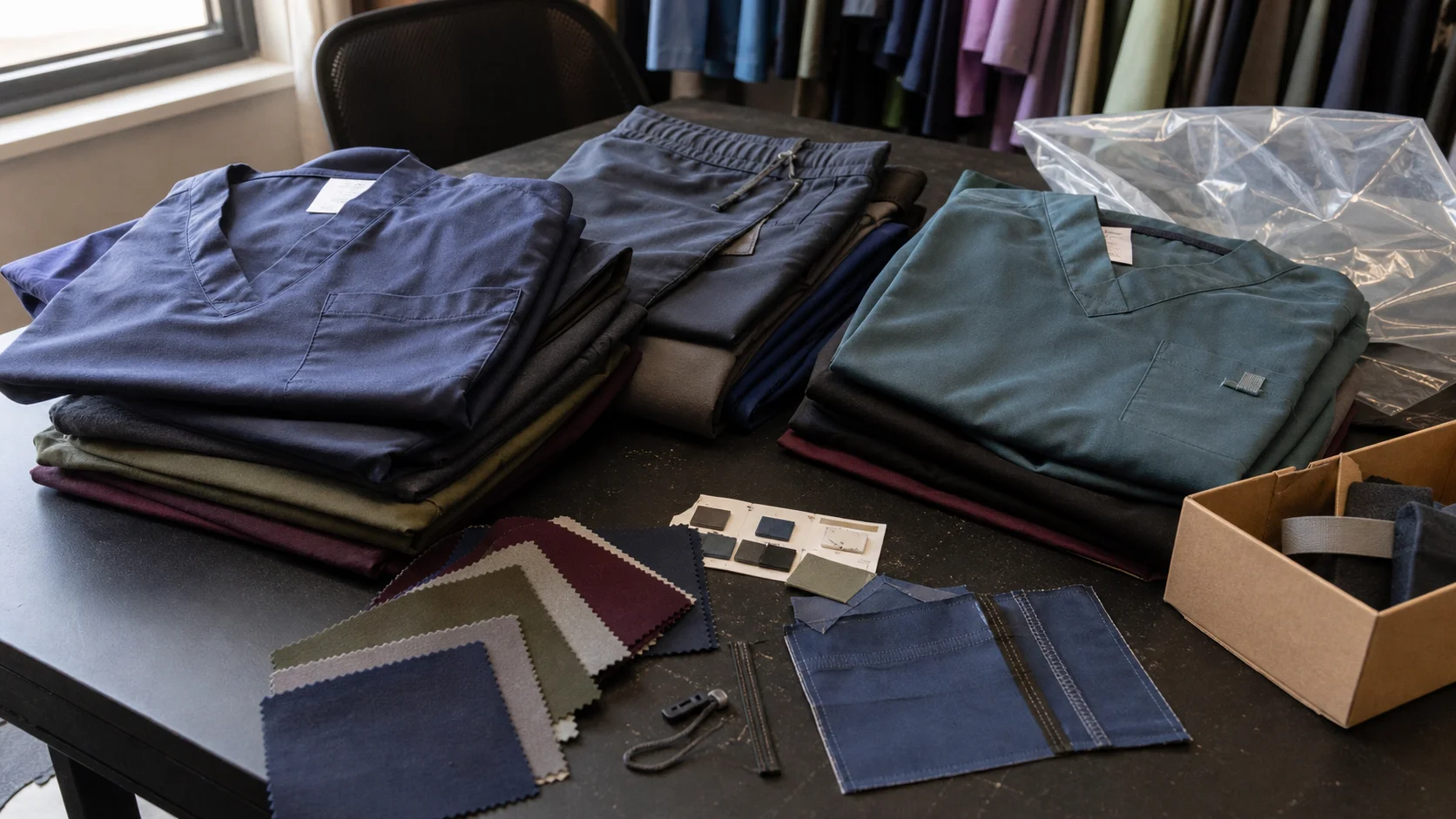
A sourcing-focused audit outline for gym program buyers evaluating custom scrubs vendors, covering garment specs, decoration quality, MOQ math, compliance,...
Custom Scrubs Audit Brief for Gym Buyers - MOQ, Cost & Sourcing manufacturing guide
Gym program buyers are used to sourcing performance tees, staff polos, compression pieces, towels, and promotional apparel. Custom scrubs sit in a different risk category. They look simple on a line sheet, but they carry more fit, fabric, laundering, colorfastness, and compliance exposure than many basic gym uniforms. For wellness clubs, recovery studios, medical fitness centers, spa-gym hybrids, physiotherapy programs, and corporate health facilities, the wrong scrub supplier can create inconsistent staff presentation, uncomfortable shifts, high replacement rates, and avoidable purchasing disputes.
This audit brief is written for buyers who need practical sourcing control before placing a bulk order. It focuses on custom scrubs vendor audits for gym program buyers: what to ask, what to verify, where costs hide, and when a quote is too thin to trust. The goal is not to turn every gym buyer into a factory auditor. The goal is to make vendor selection sharper, reduce preventable production issues, and create a cleaner path from sample approval to repeat orders.
Custom scrubs are not only for hospitals. Gym-adjacent programs increasingly use them for wellness staff, recovery technicians, med-spa teams, massage therapists, physiotherapists, in-house clinic personnel, and cleaning or hygiene teams who need a more clinical look than standard activewear. A custom scrub set can support a polished brand environment, but only if it holds up under long shifts, repeated washing, stretching, bending, and close customer contact.
A vendor audit helps buyers separate three very different supplier types: a true cut-and-sew apparel manufacturer, a stock scrub distributor offering decoration, and a trading company coordinating production elsewhere. Each can be useful. Each has limits. A stock decorator may be fast but limited on fabric, pocket layout, and sizing. A cut-and-sew factory may offer deeper customization but require higher MOQs and longer lead times. A trading company may simplify communication but can blur accountability if specifications are loose.
The audit should confirm what the vendor actually controls. Ask whether patternmaking, cutting, sewing, embroidery, printing, packing, and final inspection happen in-house or through subcontractors. If subcontractors are used, the buyer should know which processes are outsourced and how quality is checked before shipment. That is not an unreasonable request for a uniform program. It is basic purchasing discipline.
A low scrub quote is not automatically good value. If the supplier cannot explain fabric composition, shrinkage tolerance, seam construction, pocket reinforcement, and inspection method, the buyer is accepting risk instead of buying savings.
For buyers building multi-location gym programs, vendor reliability matters as much as garment price. A scrub top that looks acceptable in the first order but cannot be repeated in the same shade six months later creates brand inconsistency. A pant pattern that fits only one body type increases wearer complaints. A weak waistband or poor bartack at pocket corners raises replacement cost. These are audit issues, not random production bad luck.
Before auditing a vendor, define the intended use. Scrubs for a clinical recovery room have different expectations than scrubs for front-of-house wellness staff. A gym buyer should not approve a spec only because it looks professional in photos. The garment must match the work environment.
This use-case definition affects nearly every sourcing decision: MOQ, fabric weight, stretch percentage, pocket layout, decoration method, wash testing, and packaging. A vendor that pushes one standard scrub fabric for every program may still be useful for simple orders, but it may not be the best partner for a gym chain building a branded uniform system.
Buyers planning a broader apparel program can also compare scrubs against related staff uniform categories through sourcing partners that manage multiple product types. For example, a custom apparel development partner such as Fabrikn services may help align scrubs with other gym uniform pieces so color, branding, and reorder logic do not drift across categories.
A vendor audit starts with capability, not price. Many scrub quotes look similar until the buyer asks what is included. A serious vendor should be able to document product category experience, customization limits, size grading, fabric options, sample process, lead time assumptions, packaging options, and defect handling.
Audit Area What to Ask Buyer Judgment Business model Are you a manufacturer, distributor, decorator, or trading company? Match the vendor type to the customization level and timeline. Production control Which processes are in-house and which are outsourced? Outsourcing is acceptable when responsibility and inspection are clear. Scrub experience Can you produce tops, pants, joggers, jackets, and unisex or gendered fits? A narrow supplier may struggle with a full uniform rollout. Technical documentation Can you work from a tech pack, or do you build one from reference samples? Weak documentation increases repeat-order risk. Quality system What inspections are performed before packing and shipment? Final inspection alone is often too late for complex custom orders.Buyers should also check communication behavior. Slow or vague responses during quotation usually predict problems during production. A vendor does not need to answer every question instantly, but the answers should be specific. “Good quality fabric” is not a specification. “72% polyester, 21% rayon, 7% spandex, 180 gsm, four-way stretch, enzyme washed, colorfastness target grade 4” is closer to a usable sourcing note.
If the vendor cannot provide a clear measurement chart, fabric card, trim list, labeling options, and sample cost breakdown, the order should stay small or remain at the sampling stage. Large uniform programs should not move into bulk production on trust alone.
MOQ is one of the first friction points in custom scrubs sourcing. Gym buyers often want size variety, color control, logo placement, and several role-based designs, but they may not have hospital-level volume. The audit should test whether the vendor’s MOQ structure fits the program size.
Typical MOQ ranges vary by supplier type and customization depth:
The best MOQ is not always the lowest MOQ. A very low custom MOQ may mean the vendor is using available fabric lots, simplified cutting, limited size grading, or manual processes that are hard to repeat. That can be fine for a pilot program. It is weaker for a brand rollout across locations.
Buyers should ask for MOQ by style, color, fabric, size, and decoration. The quote should state whether the MOQ applies to total units, sets, tops only, pants only, or combined garments. Scrubs are often purchased as sets, but production may treat tops and pants as separate styles. A buyer ordering 300 sets may actually be ordering 300 tops and 300 pants, which changes material yield, cutting ratios, packing, and inspection scope.
Size ratio planning is another MOQ issue. Gym staff bodies vary. A vendor may propose a standard ratio such as S-2, M-4, L-4, XL-2, with limited XS or XXL coverage. That may reduce production complexity, but it can leave the buyer short on fringe sizes. For staff uniform programs, buyers should collect real wearer size data before bulk order approval. Guessing size ratios is one of the most common ways to create expensive reorders.
A custom scrub quote should be broken down enough for a buyer to understand what is being paid for. The lowest unit cost may exclude sampling, freight, labeling, polybags, carton marks, duties, testing, or inspection. Those missing items turn into surprises later.
Cost Component Typical Influence Buyer Check Fabric composition Polyester blends are usually more cost-efficient; rayon, nylon, and high-stretch blends can raise cost. Confirm fiber content, gsm, stretch direction, and laundering performance. Garment complexity Multiple pockets, contrast panels, vents, jogger cuffs, and shaped seams add labor. Remove features that do not improve function or brand value. Decoration Embroidery, heat transfer, woven patches, and silicone badges have different setup and durability costs. Test decoration after washing and stretching. Order size Higher volume spreads setup, cutting, and sample costs over more units. Compare price breaks against inventory risk. Packaging Individual sets, size stickers, barcodes, and location sorting add handling cost. Pay for packing that reduces receiving labor if rollouts are multi-site. Testing and inspection Lab testing and third-party inspection add upfront cost. Use testing selectively for larger or repeat programs.For many gym buyers, the real decision is not “cheap versus expensive.” It is “basic stock program versus custom uniform system.” A stock scrub with a logo may be enough for a pilot or small studio team. Full custom development is stronger when the gym needs exclusive colors, distinct staff roles, consistent brand presentation, or long-term reorder control.
Ask vendors to quote at two or three volume tiers. For example, compare 300 sets, 600 sets, and 1,200 sets. The price curve can reveal whether the supplier has efficient production access or is simply adding markup to small-batch work. A modest unit price reduction at higher volume may be normal. A dramatic drop may require closer review of fabric substitution, sewing standard, or packing assumptions.
Cost discipline also means avoiding unnecessary customization. A hidden inner label, premium zipper pull, or complex contrast stitch may not matter to staff or customers. Spend where the garment earns value: fabric comfort, fit consistency, pocket function, durable seams, strong waistband recovery, and wash performance.
Fabric is the core of a scrub program. Gym environments add movement and body heat, so fabric choice should be more active than traditional stiff clinical scrubs. Buyers should still avoid over-specifying performance claims that cannot be verified. Words such as antimicrobial, moisture-wicking, wrinkle-free, sustainable, and premium need evidence, not just sales language.
Common scrub fabric options include:
Trim specifications deserve the same attention. Waistbands, drawcords, snaps, zippers, pocket bags, labels, neck tape, and cuffs all affect wear. A pant with good fabric but weak elastic will still fail in staff use. A top with clean sewing but scratchy labels can create complaints during long shifts.
A practical scrub tech pack should include fabric content, fabric weight, stretch percentage, color standard, shrinkage tolerance, seam type, stitch density, pocket measurements, pocket reinforcement, waistband construction, drawcord type, label placement, logo placement, packaging instructions, and measurement tolerances. If the vendor does not request these details, the buyer should provide them or ask the vendor to create a formal specification for approval.
For wash performance, buyers should request test expectations before bulk production. Reasonable checks include dimensional change after washing, colorfastness to washing, colorfastness to rubbing, seam slippage, pilling resistance, and decoration durability. Not every small order needs full lab testing, but larger programs should not rely only on a hand-washed sample.
The sample process protects both buyer and vendor. It should not be rushed unless the order is extremely simple. A clear sample workflow reduces misunderstanding and creates a record for bulk production.
For simple stock scrubs with embroidery, the process may only require a blank garment approval and a logo strike-off. For full custom cut-and-sew, skipping fit and pre-production samples is poor buying practice. The cost of an extra sample is usually lower than the cost of a bulk order with wrong proportions or inconsistent branding.
Sample approvals should be written, not casual. “Looks good” is not enough. Buyers should approve specific points: fabric hand feel, garment measurements, logo size, logo position, thread color, pocket shape, waistband, drawcord, label, packaging, and carton marking. Comments should identify whether requested changes require a revised sample or can move directly to bulk with a production note.
Sample timing depends on vendor workload and customization depth. Stock sample review may take a few days after shipping. Proto samples commonly take 7 to 14 days once details are confirmed. Custom fabric, custom dyeing, or complex trims may push sampling to 3 to 6 weeks or longer. A vendor promising full custom scrubs in a few days should be asked exactly what is custom and what is stock.
Scrub fit is a purchasing issue because fit problems become HR, operations, and reorder problems. Gym teams move differently from desk staff. They bend, squat, stretch, clean equipment, assist clients, carry supplies, and may work long shifts in warm spaces. A scrub that fits neatly while standing may pull across the back, thigh, shoulder, or rise during active work.
Buyers should decide whether the program needs unisex sizing, gendered sizing, or a mixed approach. Unisex sizing can simplify inventory, but it often fits fewer people well. Gendered or body-shape-specific fits improve comfort but add SKUs and inventory complexity. Jogger pants may feel modern and active, but cuffs are not ideal for every role or body type. Straight-leg pants may be easier to standardize, though they can look less contemporary.
Key fit points to check include shoulder width, chest ease, sleeve opening, armhole depth, top length, side vent height, pant rise, thigh ease, knee mobility, inseam, waistband recovery, cuff opening, and pocket access while moving. Wearer trials should include sitting, reaching overhead, squatting, walking stairs, and carrying equipment. Gym buyers do not need a theatrical wear test. They need enough real movement to catch obvious failures before production.
Measurement tolerance should be agreed before bulk production. Common apparel tolerances may range from plus or minus 0.5 inch to 1 inch depending on the measurement point and garment type. Tight tolerances across every point can raise rejection rates and cost. Loose tolerances can make staff uniforms look inconsistent. The buyer should focus strict control on visible and comfort-critical areas: chest, waist, hip, inseam, length, and sleeve.
Branding on scrubs should look professional and survive repeated washing. Gym buyers often default to embroidery because it feels durable and premium. That is often true, but embroidery can pucker lightweight fabric, irritate skin if backing is rough, and distort small lettering. Heat transfers can look clean and lightweight, but they must be tested for wash durability and stretch cracking. Woven patches and silicone badges can look distinctive, but they add cost and may not suit all roles.
Logo placement should be functional. Common positions include left chest, sleeve, back neck, hip pocket, or pant leg. Large back logos can look promotional rather than professional. Low-contrast tonal branding may suit premium wellness environments. High-contrast branding may be better for large gyms where staff visibility matters.
Color control is a major audit point. A buyer should provide a Pantone reference or physical color standard, but fabric type affects final shade. The same navy can look different on polyester-rayon versus nylon-spandex. Piece-dyed and yarn-dyed fabrics also behave differently. Lab dips should be reviewed under consistent lighting, and bulk fabric should be checked against the approved standard.
Colorfastness matters in gyms because scrubs may be washed frequently with other uniforms or towels. Dark colors should be checked for rubbing transfer, especially if staff interact with light upholstery, towels, or treatment tables. White or pale scrubs can look clinical but may show stains quickly. Black can look sharp but may reveal lint and fading. Mid-tone blues, greys, greens, and deep neutrals often balance professionalism with practicality.
For buyers still defining the broader brand story around uniforms, supplier background and service scope can help. Reviewing a partner’s company positioning through pages such as Fabrikn about us can clarify whether the vendor is built for transactional decoration, product development, or full sourcing support.
Lead time is not one number. It is a chain of dependencies. Buyers should ask vendors to break timing into sample development, sample shipping, buyer review, fabric booking, lab dips, trims, cutting, sewing, decoration, finishing, inspection, packing, export documentation, and freight.
Typical timing ranges are cautious estimates:
The approval clock is often controlled by the buyer, not only the vendor. Slow artwork approval, delayed sample comments, late size ratios, and changing color choices can push delivery. A disciplined buyer locks specifications before bulk production. Changing a pocket, logo, or fabric after cutting starts is not a minor edit. It can create waste, delay, and dispute.
Freight mode should match the program timeline. Air freight may rescue a launch but can erase savings on heavier scrub orders. Sea freight is more economical for larger programs but requires planning. Split shipment can be a sensible compromise: air a small launch quantity and send the balance by ocean or deferred freight. The vendor should quote freight assumptions clearly instead of blending them into a vague delivered price.
Scrubs inspection should focus on defects that affect appearance, comfort, durability, and consistency. A buyer does not need to inspect every technical feature personally, but the purchase order should define acceptable quality expectations and defect handling.
Inspection Risk Why It Matters Buyer Control Shade variation Different panels or sizes can look mismatched. Approve bulk fabric shade and check garments by lot. Measurement variation Staff may receive garments that do not fit like samples. Use a measurement chart with agreed tolerances. Seam weakness Active movement can stress crotch, underarm, pocket, and side seams. Check stitch density, bartacks, seam strength, and stress points. Decoration defects Logo issues are highly visible in staff-facing programs. Approve strike-offs and inspect logo position, color, and durability. Shrinkage Garments may pass initial fitting but fail after washing. Request wash testing or at minimum washed sample comparison. Pilling and abrasion Scrubs can look old quickly in high-use environments. Review fabric test data and conduct practical wear checks. Packing errors Wrong size allocation delays staff rollout. Require size stickers, packing list by carton, and location sorting if needed.For larger orders, buyers may use an AQL inspection framework. Common general apparel inspections use sampling rather than checking every piece. The acceptable quality level should be agreed before production, with definitions for critical, major, and minor defects. Critical defects may include unsafe trims or contamination. Major defects may include wrong logo, severe measurement failure, holes, open seams, or visible stains. Minor defects may include small thread ends or slight cosmetic issues within tolerance.
Pre-shipment inspection is valuable, but earlier checks can be more useful. Fabric inspection catches shade, stain, and defect problems before cutting. Inline inspection catches sewing issues before the whole order is finished. Final inspection confirms packed goods match the purchase order. If the vendor only checks at the end, the buyer should decide whether the order complexity justifies third-party inspection.
Defect resolution should be written into the purchase terms. The buyer should know whether the vendor will repair, replace, discount, or credit defective goods. Vague promises create weak leverage after delivery. Clear defect handling is especially important when staff uniforms must be ready for a location opening or program launch.
A simple scorecard helps gym buyers compare suppliers without being pulled toward the lowest quote too early. The scorecard should reflect the actual program priorities. A small wellness studio may weight MOQ and speed higher. A national fitness group may weight repeatability, inspection, and size management higher.
Category Suggested Weight What Good Looks Like Product capability 20% Can produce required scrub styles, sizes, fabrics, and trims with documentation. MOQ fit 15% MOQ supports pilot, rollout, and reorder needs without excessive inventory. Cost transparency 15% Quote separates garment, decoration, sampling, packing, testing, freight, and extras. Sample discipline 15% Clear proto, fit, and pre-production approval process. Quality control 15% Defined inspections, measurement tolerances, defect categories, and corrective action. Communication 10% Specific answers, realistic timing, and written confirmation of changes. Scalability 10% Can manage repeat orders, multiple locations, replenishment, and consistent materials.Do not score a supplier only from a sales call. Use real evidence: sample quality, fabric cards, quote detail, response speed, revised sample accuracy, and willingness to document production assumptions. A vendor that asks detailed questions may feel slower at the start, but that can be a positive sign. A vendor that accepts every request without clarifying tradeoffs may be avoiding hard conversations until after payment.
Good sourcing decisions are rarely perfect. They are controlled tradeoffs. For custom scrubs, the buyer usually balances MOQ, cost, speed, customization, and quality assurance.
If the program is small and urgent, stock scrubs with logo decoration are usually the cleanest choice. The buyer gives up exclusive color, unique patterning, and deeper brand control, but gains faster delivery and lower commitment. This is suitable for pilot teams, temporary wellness events, or early-stage programs still testing staff needs.
If the program is growing and repeat orders matter, semi-custom development may be better. The buyer can use an existing pattern with approved fabric, color, and branding adjustments. This reduces development risk compared with a fully custom pattern while giving more control than stock decoration.
If the program is large, brand-sensitive, or multi-location, full custom cut-and-sew can make sense. The buyer gains fit ownership, exclusive styling, stronger brand consistency, and better reorder planning. The tradeoff is higher MOQ, longer sampling, more technical decisions, and greater responsibility to approve details correctly.
The weakest purchasing choice is often the middle ground done casually: a buyer asks for custom features, accepts a low MOQ, skips proper samples, and expects retail-grade consistency. That combination is fragile. Customization requires documentation. Low MOQ limits efficiency. Fast approval reduces error checking. One of those pressures may be manageable. All three together create unnecessary risk.
Buyers should also consider total program cost. A scrub set that costs slightly more but lasts longer, fits better, and reduces staff complaints may be cheaper over the season. A cheap scrub that fades, pills, or loses waistband recovery quickly becomes expensive through replacements and operational friction.
When a buyer is ready to formalize requirements, it is useful to send a clear sourcing brief rather than a loose inquiry. Include target quantity, launch date, staff roles, size range, preferred fabric feel, color references, logo files, decoration preference, packaging needs, inspection expectations, and reorder outlook. Suppliers can quote more accurately when the brief is concrete. If support is needed to shape that brief, buyers can contact a sourcing partner through Fabrikn contact us.
The following checklist can be used before approving a custom scrubs vendor for a gym program:
This checklist will not remove every production risk. Apparel production always involves tolerance, material variation, and timing pressure. It will remove many avoidable risks that come from vague specifications and weak vendor qualification.
A custom scrubs vendor audit is not paperwork for its own sake. It is a buying tool. Gym program buyers operate in environments where staff appearance, comfort, mobility, hygiene, and brand consistency all matter. Scrubs used in these settings must do more than look clean on delivery day. They need to perform through repeated wear, washing, movement, and public-facing service.
The strongest purchasing approach is simple: define the use case, match the vendor type to the program, control MOQ expectations, document fabric and trim specifications, approve samples properly, and inspect against written standards. A supplier that supports those steps is more likely to deliver a stable program. A supplier that avoids details may still be useful for basic stock orders, but should not be trusted with a complex custom rollout without tighter controls.
For gym buyers, the right scrub program sits between apparel sourcing and operational planning. Fit affects staff morale. Fabric affects replacement cycles. Packing affects rollout efficiency. Color affects brand consistency. Audit the vendor before the order, and the bulk production process becomes far less dependent on hope.
Get a free quote from Fabrikn — your trusted B2B clothing manufacturer with 10+ years of experience. MOQ as low as 200 pieces.
Get a Free Quote →It is a structured review of a supplier’s ability to produce, decorate, inspect, and deliver scrubs for gym-related staff programs. It usually covers vendor type, MOQ, pricing, fabric, trims, samples, fit, quality control, lead time, packing, and defect handling.
Stock scrubs with logo decoration may start around 25 to 100 pieces. Custom colors or cut-and-sew programs often start around 300 to 1,500 pieces per style or color. Fabric development or custom mill orders can require 1,000 to 3,000 pieces or more, depending on material and supplier.
Small programs usually benefit from stock scrubs with strong branding rather than full custom development. Full custom scrubs make more sense when the buyer needs exclusive colors, repeatable fit, multi-location consistency, or a long-term uniform system.
There is no single best fabric. Polyester-rayon-spandex blends often provide soft drape and comfort. Nylon-spandex can feel more performance-oriented. Polyester-cotton blends may be durable and cost-efficient. Buyers should test stretch, shrinkage, pilling, colorfastness, and wash performance before committing to bulk.
For stock decoration, a blank garment and logo strike-off may be enough. For full custom scrubs, buyers should expect at least a proto sample, fit sample, and pre-production sample using actual fabric, trims, color, labels, and decoration.
Common risks include shade variation, poor fit grading, weak seams, pocket failure, waistband issues, decoration defects, shrinkage, pilling, and packing errors. These risks can be reduced with clear specifications, sample approvals, and inspection standards.
Stock decorated scrubs may take 1 to 3 weeks after approval. Custom cut-and-sew using available fabric often takes 5 to 8 weeks after pre-production approval. Custom dyed fabric or complex programs may take 8 to 12 weeks or longer.
Third-party inspection is worth considering for larger orders, first-time suppliers, custom fabric, tight launch deadlines, or multi-location programs. Smaller stock orders may rely on vendor inspection, but the buyer should still define defect expectations in writing.
A useful brief includes target quantity, scrub styles, staff roles, size range, fabric preference, color references, logo files, decoration method, sample requirements, launch date, packing needs, inspection expectations, and reorder plans.
Reduce unnecessary design complexity, use existing patterns where possible, limit colors, consolidate size ratios with real staff data, choose durable standard trims, and spend budget on fabric, fit, seams, waistband recovery, and wash performance.