
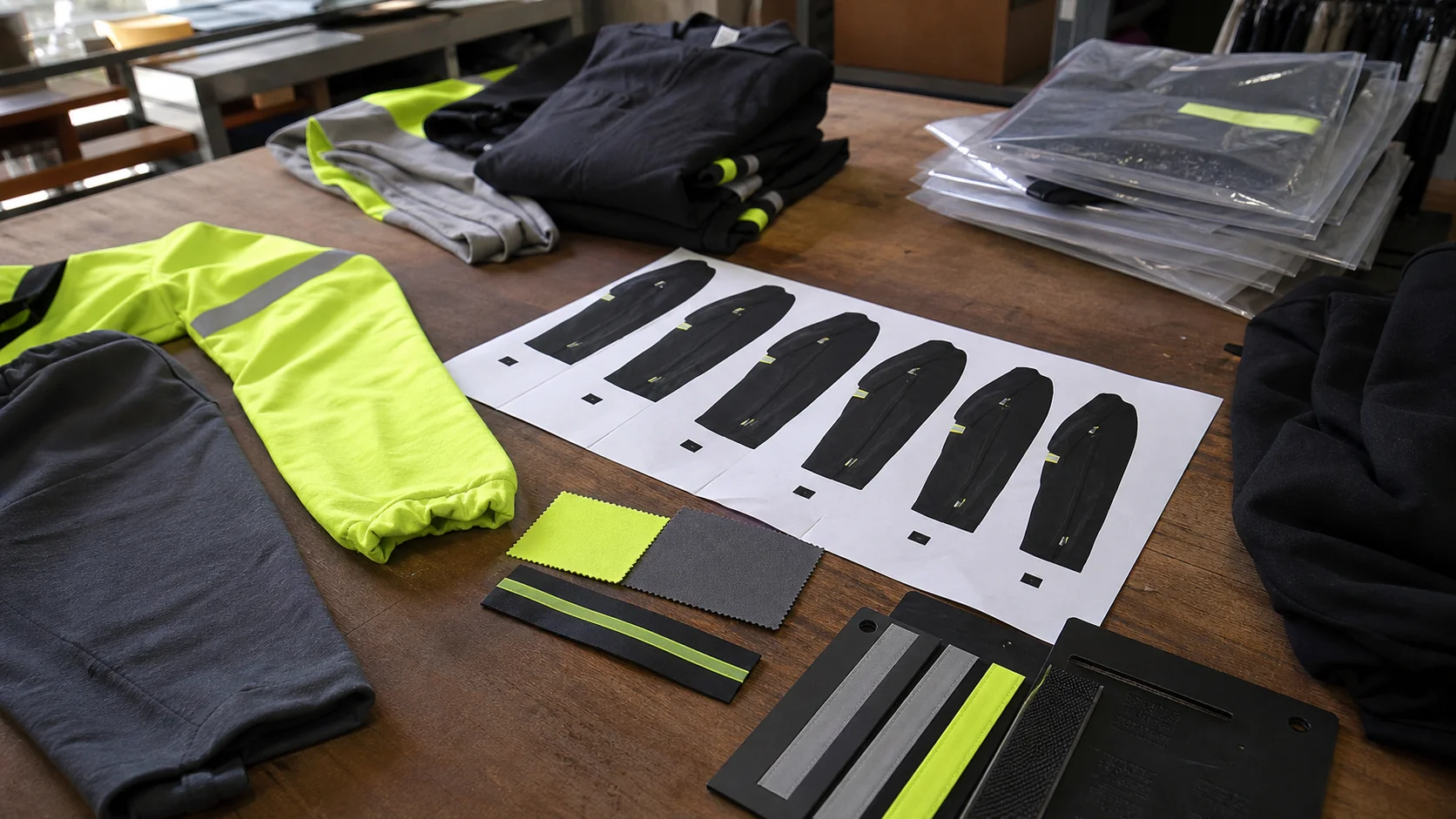
A focused review of sleeve print maps, size grading, and production checks for cleaning crew apparel, with practical guidance on placement, consistency,...
Custom Sleeve Print Map Size Grading Review - Decoration & Printing manufacturing guide
Custom sleeve print map size grading review sounds like a narrow production topic, but it sits at the center of clean, repeatable garment decoration. For cleaning crews, uniforms and workwear are often expected to do more than look tidy. They need to carry a logo, job identifier, safety message, or department mark that stays readable across a full size run, survives repeated washing, and remains consistent on every sleeve from XS through 5XL.
That is where sleeve print maps and size grading reviews become useful. A sleeve print map defines where the print sits on the garment. A size grading review checks how that placement changes, or should not change, as the garment scales up or down through the size range. In practice, the best results come from combining decoration decisions with garment fitting logic early, not after sampling has already drifted off target.
For cleaning crews, the stakes are practical. Sleeves are high-friction zones. They bend, fold, contact carts and chemicals, and get washed more often than fashion garments. A print that looks fine on one sample can become awkward when the elbow shifts, the cuff changes proportion, or the sleeve seam runs directly through the artwork. That is why a disciplined review matters more than a decorative mockup.
If you are sourcing this kind of program, the right mindset is simple: treat sleeve print placement as a production spec, not a graphic afterthought. That approach reduces rework, protects margin, and makes the final uniform easier to wear and easier to maintain. For broader support on garment decoration and production planning, see Fabrikn services, or reach out through the contact page.
A sleeve print map is the technical layout that shows the print position on the sleeve body. It usually measures distance from the shoulder point, sleeve seam, cuff edge, or centerline, depending on the garment construction and the print method. A size grading review asks whether that map still works when the pattern changes by size.
That review has three jobs. First, it checks visual balance. The logo should look centered and proportionate, not crowded near the seam or floating too low on the arm. Second, it checks manufacturability. The placement should be printable without distortion, heat damage, or movement during pressing. Third, it checks repeatability across the size curve so the same brand impression appears on every unit in the order.
For cleaning crews, uniform orders often include polos, T-shirts, fleece tops, coveralls, or lightweight jackets. Each garment type behaves differently. A cotton jersey sleeve can tolerate one print approach, while a softshell or polyester knit may require a different ink system, different curing settings, or a more conservative placement window. One map rarely fits all styles, and that is where many sourcing problems begin.
There is also a commercial reason to review grading carefully. If the print map is too rigid, the decoration may fail on large sizes or look disproportionately small. If it is too loose, production loses control, and the brand receives inconsistent placement. Buyers should expect that a serious supplier will treat the map as part of the tech pack, not as an informal artwork note.
Cleaning crews do not wear uniforms for decoration alone. Sleeves are often used for quick identification, role marking, department labels, or safety messaging. In facilities work, healthcare support, hospitality cleaning, and commercial janitorial settings, the sleeve can carry a visible code that helps supervisors and clients identify staff at a glance.
That puts pressure on the print to stay readable. A sleeve logo that is too close to a seam can twist when the arm bends. A print that sits too low can disappear under a glove cuff or get hidden when the wearer reaches forward. A print that is too large can become uncomfortable under outerwear or create a stiff panel on a garment that needs flexibility.
Cleaning crews also need durability. These uniforms go through frequent laundering, stain exposure, and repeated abrasion. That makes decoration method selection important. Screen print can be cost-effective on larger runs, but it needs careful ink choice and curing. Heat transfer can improve detail control, but some transfer systems can crack or edge-lift sooner under heavy wash conditions. Embroidery is durable, yet it may be less suitable for thin sleeves or stretch fabrics because of weight and puckering.
Buyers should ask whether the sleeve print is meant to be purely visible, or whether it must remain legible after months of service. That single question changes the spec. For a quick visual identifier, a simpler print may be enough. For long-service uniforms, the order should lean toward stronger testing, more wash validation, and a tighter approval path.
Size grading changes body dimensions, sleeve length, bicep circumference, shoulder slope, and armhole depth. Each of those shifts can affect where a print visually lands. A logo placed 80 mm from the shoulder point on a medium may sit very differently on a 5XL if the sleeve expands more than the placement map does.
There are two common approaches. One is fixed placement, where the print stays at the same measured distance from a key point across all sizes. The other is proportionate placement, where the print moves with grade rules to preserve visual balance. Neither is universally right. The choice depends on garment style, artwork size, decoration method, and how the customer expects the range to look on the body.
For cleaning crews, a balanced approach is usually safest. The print should be stable enough to control production, but not so fixed that the larger sizes appear under-decorated or the smallest sizes become crowded. A small left-sleeve badge may work better as a fixed placement. A larger vertical text mark may need proportional adjustment to avoid running into the armhole or cuff.
The grading review should also account for print-safe zones. Any area near sleeve seams, underarm panels, cuffs, zippers, reflective tape, or pocket openings is a risk zone. If the garment has segmented construction, the print may need to move away from the highest-tension points. Buyers who skip this step often discover that the sample looks fine flat on the table but awkward on body or during movement.
Different garments create different sleeve print problems. A short-sleeve cotton T-shirt gives you a relatively simple canvas. A long-sleeve polo has more moving parts, including cuff ribbing and a closer fit through the forearm. A fleece top introduces pile texture, which can affect print sharpness. A lightweight jacket may have lining, seams, and zippers that limit available placement.
For cleaning crews, the most common practical choices are these:
T-shirts and polos: Often the easiest to decorate, with lower setup complexity and broad print method options.
Long-sleeve knits: Need more care around elbow movement and cuff clearance.
Fleece and midlayers: Can support decoration, but pile and stretch may reduce fine detail.
Work jackets: Require conservative placement because seams, pocketing, and zippers limit the print area.
The tradeoff is clear. The more complex the garment, the more likely the decoration position will need adjustment by size or by style. Buyers sometimes insist on one universal placement for every garment in a program to save time. That can be efficient on paper, but it often produces uneven results. A better sourcing decision is to separate styles by decoration logic instead of forcing one map across the entire range.
When the uniform program includes multiple garment types, the tech pack should list each sleeve print map separately. That keeps the production line from guessing and gives the buyer leverage if the sample arrives with inconsistent placement. It also makes approval faster because the supplier knows exactly what “correct” means for each style.
Strong sleeve printing starts with artwork that is suitable for the substrate. Fine lines, small reversed text, and tightly packed details are all more vulnerable on sleeves than on chest prints because sleeves move more and often offer a narrower visible area. Cleaning crews usually need direct, readable branding, so simple graphics often perform better than intricate logos.
Artwork specs should define final size in millimeters, not just in vague visual terms. That is especially important in size grading review, because the same logo may need to scale slightly for larger and smaller garments. The spec should also define whether the print is to stay inside a fixed width, whether height can change, and whether the orientation follows the sleeve grain or remains parallel to the hem.
Fabric matters just as much. Cotton, cotton-poly blends, polyester knits, fleece, and coated fabrics each take decoration differently. Print adhesion, ink spread, and cure performance can vary depending on fabric finish and fiber content. Moisture-wicking fabric may reject certain inks or require a different pretreatment. Stretch fabrics can distort under heat, so the buyer needs to confirm whether the supplier is using a process suited to the base material.
Trim specs also affect the final result. Sleeve rib, elastic, reflective tape, piping, and pocket placement can all shrink the usable print zone. A print map should note those obstacles explicitly. If the garment includes a woven label near the sleeve seam or a heat-sealed size label inside the arm, the buyer should confirm that production heat and pressure will not affect those components.
Inspection risk rises when the artwork spec is vague. If the buyer says “logo on left sleeve” without measurements, every factory may interpret the placement differently. That creates avoidable approval cycles. A cleaner spec includes print size, distance from seam, top point reference, alignment direction, and tolerance range. Good suppliers welcome that level of detail because it reduces disputes later.
Sample approval should happen in stages, not as a single yes-or-no moment. The first stage is artwork confirmation. The buyer checks the print file, size, color references, and placement map. The second stage is a decorated sample on the chosen garment size, ideally the base size and at least one larger or smaller test size if the order spans a broad range.
Once the sample is decorated, the buyer should review it flat and on body. Flat review catches measurement errors and seam conflicts. On-body review shows how the print behaves when the sleeve bends and rotates. A sleeve print that looks centered while lying flat may shift toward the back arm once worn. This is a common miss in rushed approvals.
The pre-production stage should also include wash and rub testing when the end use is demanding. Cleaning crews place unusual stress on uniforms, so the buyer should ask how the decoration holds up after repeated laundering. Even a low-cost job can justify a basic test if the garment will be used daily. If the print is expected to survive industrial wash cycles, the process needs to be validated before bulk production.
Approval documents should record the accepted artwork version, placement measurements, color standard, print method, and any size-specific changes. Without this record, the buyer may struggle to prove whether a later deviation was a production error or a spec change. That is especially important when the order is split across multiple sizes or multiple delivery dates.
Custom sleeve print programs rarely move faster than the weakest step in the chain. Lead time depends on artwork finalization, sample approval, fabric availability, print method, and factory workload. A simple screen print on stock garments can move quickly, but a customized garment with a graded sleeve map and wash testing can extend the schedule.
Typical MOQ ranges vary by supplier and garment type. For decorated basic tees or polos, a practical MOQ may start around 100 to 300 pieces per color or style for some programs, while more complex cut-and-sew or specialty garment orders may require higher volumes. If multiple sizes need unique placement adjustments, the supplier may push for a larger order to justify setup time. Buyers should not assume low MOQs are impossible, but they should expect price penalties when the run is small or highly customized.
Lead time dependencies are worth spelling out early:
Artwork lock: Delayed approval pushes every downstream date.
Fabric booking: Specialty or color-specific fabric can add waiting time.
Print method setup: Screens, transfers, or heat settings may need test runs.
Sampling cycle: Extra rounds are common if placement or color shifts.
Inspection window: Final checks can delay shipping if issues are found.
Buyers should also think in terms of production dependency, not just calendar time. A factory can promise a fast turnaround, but if the artwork changes after sample approval, the schedule may reset. If the order includes multiple sleeve placements by size, the risk of rework rises. The safer route is to define the grading logic before bulk approval and keep changes to a minimum after the sample is signed off.
Sleeve decoration fails in predictable ways. The first is misplacement. A logo may be too close to the seam, too low toward the cuff, or too far back on the arm. The second is distortion. A print can warp when applied to a curved sleeve or when heat and pressure pull the fabric during transfer. The third is inconsistency. One size may look correct while another size lands outside the expected range.
Color mismatch is another common problem. This matters less when the print is a simple single-color identifier and more when a brand requires a precise logo tone. On dark uniforms, underbase opacity and edge sharpness become critical. On light uniforms, thin or translucent ink can look weak under bright facility lighting. The buyer should not rely on screen proofs alone when the real garment fabric changes the appearance.
There is also the wash risk. Some sleeve prints survive first inspection but fail after laundering. Cracking, peeling, fading, and edge lift all show up in service use. For cleaning crews, that failure can look worse than a chest print failure because sleeves are highly visible during work tasks. A poor sleeve print can undermine the appearance of the entire uniform program.
Good inspection covers both placement and construction. Check whether the sleeve print overlaps any seam or stitch line. Check whether the print sits flat without bubbling. Check whether the decorative area interferes with stretch. Check whether the garment still feels comfortable when the arm is raised. Those checks are simple, but they prevent expensive complaints after delivery.
The best purchasing decision is rarely the cheapest decoration option. Buyers should weigh readability, durability, wash performance, and consistency across the size curve. For a cleaning crew uniform, a low-cost print that fails after several washes is not a savings. It is replacement cost, complaint handling, and avoidable brand damage.
When evaluating suppliers, ask practical questions. Can they show sleeve print placements by size? Do they understand how grading affects the visible position? Can they recommend a print method based on fabric content? Do they give a measurable tolerance for placement? These are stronger buying questions than asking only for a unit price.
It also helps to separate what must be exact from what can flex. The logo shape and brand color may need tight control. The distance from seam to print may have a modest tolerance. The print method may need to vary by fabric. That kind of judgment lets the buyer protect the core brand standard while still leaving room for efficient production.
If your team is building a repeat program, supplier communication matters as much as the initial order. A good partner will document the final print map, note the approved size adjustments, and retain the approved sample reference for repeat orders. If you need a broader production conversation or want to compare decoration options, the services page, about us page, and contact page are sensible starting points.
For cleaning crews specifically, the right approach is usually conservative. Keep the graphic simple, use measurable placements, approve by garment size, and verify durability before scaling up. That reduces surprises and keeps the uniform looking professional through actual use, not just in a sales sample.
Get a free quote from Fabrikn — your trusted B2B clothing manufacturer with 10+ years of experience. MOQ as low as 200 pieces.
Get a Free Quote →A sleeve print map is the technical placement guide that shows where artwork should sit on a sleeve, measured from fixed garment reference points such as the shoulder, seam, or cuff.
Size grading changes the sleeve shape and proportions. If the print map is not reviewed by size, the decoration can look off-center, too small, too large, or too close to seams in certain sizes.
It depends on the fabric and wash demand. Screen print is often efficient for larger runs, while transfers or embroidery may suit certain fabrics or branding needs. The best choice balances durability, cost, and comfort.
Typical MOQ ranges vary by supplier and garment complexity, but many custom decorated programs begin around 100 to 300 pieces per style or color. Highly customized grading or specialty fabrics may require higher minimums.
Artwork size, print position, color, fabric compatibility, size grading rules, and a decorated sample should all be approved before bulk production. Wash testing is advisable when the garments will see heavy use.
Misplacement, distortion, weak adhesion, color mismatch, and wash failure are the main risks. The safest way to reduce them is to review the print map by size and approve a physical sample on the actual garment.