
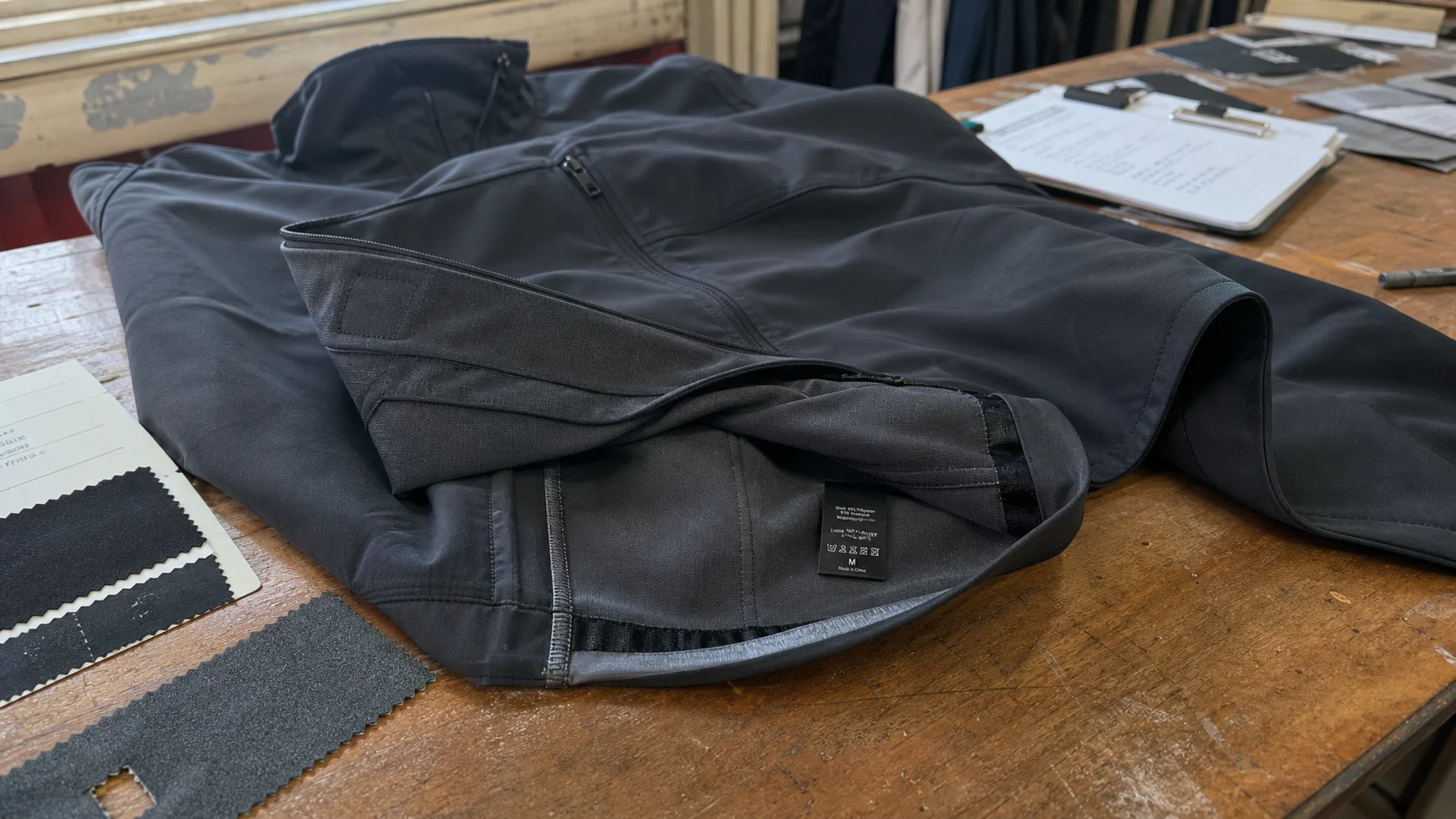
A buyer-focused quality checklist for testing custom softshell jacket fabrics, with the performance, durability, and inspection checks fitness clubs need...
Custom Softshell Jacket Fabric Testing Guide - Fabrikn production reference
For fitness club buyers, a custom softshell jacket is rarely a fashion-only purchase. It sits in a practical middle ground: warm enough for cool mornings, flexible enough for active staff, and presentable enough for branded front-of-house use. That combination is useful, but it also makes fabric testing more important than many buyers expect. A jacket can look polished on a sample rack and still fail in real use if the laminate delaminates, the fleece pills, the water-repellent finish fades quickly, or the fit loses shape after repeated wear.
This guide focuses on the fabric testing decisions that matter most when ordering custom softshell jackets for fitness clubs, gyms, studios, and wellness chains. The goal is not to over-spec a garment that becomes too expensive or too stiff to wear. The goal is to buy the right fabric, confirm it performs consistently, and reduce avoidable disputes after production starts.
For buyers comparing suppliers, it helps to think in terms of use case first. A sales desk jacket used indoors needs a different balance than an outdoor coaching jacket used for early-morning sessions. If you also need help with broader manufacturing support, review the options on fabrikn.com/services/ before you lock the spec.
Softshell fabric is usually built as a performance composite rather than a single woven cloth. Many versions use an outer woven face, a bonded membrane or film, and an inner brushed fleece or jersey back. That layered structure gives softshells a familiar selling point: they are more comfortable and stretchable than a hard rain shell, while offering more weather resistance than a sweatshirt.
That structure also creates testing complexity. Each layer can fail differently. The face fabric can snag or abrade. The membrane can lose breathability or peel. The inner layer can pill. The bonding can weaken after repeated washing or exposure to heat. In other words, fabric testing for softshell jackets should not stop at a single weight or color check. It needs to look at durability, handfeel, water resistance, stretch recovery, and laundering stability as a package.
Fitness club buyers often prefer softshell because it projects a cleaner image than fleece alone. Staff can wear it at the reception desk, on the gym floor, or outside during classes without looking too technical or too casual. That broad use case is exactly why the fabric needs disciplined testing. A club team may wear the jacket five days a week, wash it often, and expect it to keep its shape through an entire season.
Not every lab result matters equally. For fitness club programs, the highest-value tests are the ones that predict day-to-day wear. A buyer usually does not need military-grade weather performance. A buyer does need a jacket that stays neat, resists light moisture, and remains comfortable through repeated movement and laundering.
The practical priority order usually looks like this:
That list can shift depending on the club’s climate and usage pattern. A colder market may care more about warmth retention and wind resistance. A warm-weather club may care more about breathability and light layering. If staff work outdoors for class setup or member greeting, water repellency becomes more important than if the jacket is mainly worn indoors.
A useful sourcing rule is simple: only pay for tests that support the actual wearing environment. A long report filled with niche performance claims can look impressive, but it may not reduce risk where it matters. Buyers should spend budget on repeatable checks, not marketing language.
Softshell fabric testing should start before bulk production, ideally with both mill data and third-party verification where the order size justifies it. The exact standards can vary by market and supplier capability, but the test categories below are the ones most buyers should request or at least review.
Check the GSM and confirm the fiber blend. Softshells often sit in a wide range, roughly 240 to 380 GSM depending on stretch, warmth, and structure. Lower weights can feel more flexible, but may sacrifice warmth and wind resistance. Heavier constructions often feel more premium, though they can become bulky for staff who need mobility.
Fiber composition matters because performance claims should match actual content. A polyester-spandex outer with a bonded fleece back behaves differently from a nylon blend with a membrane. Buyers should confirm the yarn makeup, elastane percentage, and whether the fabric is one-layer or bonded multi-layer.
For branded club uniforms, color consistency is part of the product. Request colorfastness to washing, rubbing, perspiration, and light. Dark colors often show rubbing risk more clearly, especially around cuffs, hems, and side panels where staff move and carry equipment. If the garment includes contrast panels or logo placements, check that the color range does not bleed during wash.
Softshell jackets are usually expected to handle light rain or splashes, not severe downpours. That said, water repellency should still be measured. Ask for results on the DWR finish and whether the finish is durable through washing. A jacket that beads water well on day one can lose that behavior quickly if the surface treatment is weak or poorly cured.
Buyers should treat DWR as a wear feature, not a permanent guarantee. If the jacket will be washed often, ask how many wash cycles the finish is expected to tolerate before visible decline. That question is often more useful than a generic water-repellent claim.
The inner face of softshell fabric, especially brushed fleece, is vulnerable to pilling. This is one of the fastest ways a jacket starts to look old. Ask for Martindale or similar abrasion and pilling-related results, and review actual sample photos if available. A club uniform should still look tidy after repeated workouts, not after only a few washes.
Softshell is chosen partly because it moves with the body. That is only useful if the fabric recovers well after stretching. Poor recovery can lead to bagging at elbows, sagging at hems, and distorted pocket openings. For staff uniforms that are worn through classes or member service duties, recovery is more important than extreme stretch.
Fabric performance is not isolated from garment construction. If the cloth is too slick, too dense, or too stretchy, seam integrity can become a problem. Ask the factory to check seam strength and seam slippage so the garment can survive repeated wear, laundering, and movement. This matters more where pockets, zippers, and logo placements create stress points.
A club team may move between cool outdoor air and warm indoor spaces. If the fabric traps too much heat, staff may stop wearing the jacket. Breathability and moisture management are harder to judge by touch alone, so it is worth asking for structured performance data and wear testing feedback from samples.
Test Area Why It Matters Typical Buyer Concern GSM and composition Defines weight, warmth, stretch, and cost Too heavy, too thin, or wrong fiber blend Colorfastness Protects brand presentation and uniform consistency Fading, rubbing, or bleeding after washing Water repellency Supports light-weather use and surface protection DWR fails too quickly in real wear Pilling resistance Preserves a new-looking appearance Visible wear on cuffs, sleeves, and inner fleece Stretch recovery Maintains shape during active movement Bagging or distortion after useFabric testing is only half the story. The jacket’s construction can either support the fabric or expose its weaknesses. Buyers should review key trims and garment details at the same time they review fabric data.
Zipper choice matters. A smooth coil zipper may be preferable for comfort and lighter weight, while a more robust zipper may suit outerwear-style use. If the club wants a cleaner appearance, the factory may suggest concealed zippers or storm flaps, but those can add cost and labor. Pockets should be checked for reinforcement and the pocket bag fabric should not distort the shell.
Trim specs deserve careful attention. Elastic bindings, drawcords, toggles, heat-transfer logos, and reflective details all affect wear and wash durability. A good-looking sample can hide weak trim decisions. For example, a low-grade zipper pull or unstable heat transfer can fail long before the softshell fabric itself shows damage.
Pay attention to thread, seam type, and finishing. A flat, neat seam is not only cosmetic; it helps reduce chafing for staff who wear the jacket all day. If the garment will be embroidered, the buyer should ask how embroidery density may affect fabric stretch and hole stability. Too much logo stitching on a stretch shell can create puckering or localized distortion.
For many fitness club orders, a balanced spec is better than an aggressive one. A mid-weight softshell with moderate stretch and stable water repellency often outperforms a premium technical fabric that looks great on paper but feels too rigid in daily use. Buyers should judge the jacket as a uniform item first and a technical garment second.
The sample stage is where most softshell problems can be caught cheaply. A disciplined approval process usually includes the proto sample, salesperson sample if needed, fit sample, and pre-production sample. Some programs compress these steps, but the risk rises quickly when the order is branded, size-sensitive, or time-critical.
At the first sample stage, check only the basics that can be assessed quickly: fabric handfeel, weight, color direction, logo scale, and overall styling. At the fit sample stage, focus on movement, sleeve length, hem balance, and whether the jacket works over typical club uniforms or polos. The pre-production sample should match the final fabric, final trims, and final measurements as closely as possible.
Buyers should insist on wash testing of sample garments before approving bulk. A jacket can fit well before laundering and become a problem afterward. Look for shrinkage, twisting, surface changes, zipper distortion, and logo degradation. If the factory is using bonded fabric, review edge stability closely because lamination issues may not appear until wash or heat exposure.
Practical sourcing rule: do not approve a softshell jacket based on appearance alone. If the fabric, trims, and decoration are not tested in the same configuration that will be produced in bulk, the approved sample is only a visual reference, not a reliable production standard.
If your team needs support with sampling, sourcing coordination, or production planning, see fabrikn.com/services/ or contact the team directly through fabrikn.com/contact-us/.
Fitness club buyers often work with tight budget windows and seasonal launch dates. That means MOQ and lead time need to be handled carefully. For custom softshell jackets, typical MOQ ranges can start around 300 to 500 pieces per style for more flexible suppliers, though some factories may request 800 to 1,000 pieces or more if custom fabric development, special trims, or multiple colorways are involved.
Lead time depends heavily on fabric availability, dyeing, lab testing, sample revision cycles, and decoration method. A straightforward repeat order using stocked fabric may move faster than a new fabric development with custom colors and branded trims. Buyers should also account for inspection and shipping buffers. If the club wants delivery before a new season or event launch, the calendar should include room for sample approval delays.
There is usually a tradeoff between cost, speed, and specification control. A faster program may mean using a supplier’s existing softshell fabric instead of developing a custom one. That can save time and reduce risk, but it may limit the exact handfeel or color match. A fully customized fabric gives more control, yet it raises minimums, testing burden, and lead time. For most club buyers, the smart approach is to define the few features that truly matter and keep the rest standard.
If you are comparing supplier credentials and want to understand the team structure behind the program, visit fabrikn.com/about-us/. That is often a quicker way to judge whether a vendor is set up for repeatable program work rather than one-off sample making.
Even when fabric testing looks strong, bulk inspection can still uncover problems. Buyers should expect to check both fabric and garment-level defects. Softshell jackets are especially sensitive to appearance issues because the fabric surface is smooth and uniform; small flaws stand out more clearly than on textured knits.
Common risks include shade variation between rolls, inconsistent DWR performance, pilling on the fleece back, stitching waves on stretchy panels, zipper snags, and crooked logo placement. If the order includes multiple sizes, make sure grading is verified because shape issues often appear more strongly in larger sizes. For club staff uniforms, consistency across size runs matters nearly as much as performance.
Moisture and heat during storage can also affect the goods. Bonded fabrics can show edge curling or bond stress if handled poorly in transit or warehouse conditions. Packaging should protect the garment from pressure marks and contamination. If hang tags, polybags, or carton labels are part of the presentation, they should be reviewed early so they do not interfere with final packing quality.
A standard inspection plan should cover measurement tolerances, visual defects, seam strength signs, zipper performance, and random wash checks where practical. Buyers should be cautious about accepting broad pass claims without seeing defect categories and quantities. For a uniform program, the real question is not whether the shipment is “mostly okay.” The question is whether the goods are consistent enough that staff will look and feel uniform in daily use.
A strong spec sheet reduces confusion and prevents expensive back-and-forth later. For a custom softshell jacket program, the buyer should include both performance targets and appearance requirements. The more precise the brief, the easier it is for the supplier to source the right cloth and trims.
Buyers should also note any operational use case. For example, if staff will wear the jacket while lifting equipment, opening doors, or moving between indoor and outdoor spaces, the spec should prioritize mobility and easy care. If the jacket is mainly for front-desk presentation, the look and color stability may matter more than technical weather protection.
A supplier for custom softshell jackets should be judged on more than price. The better question is whether the vendor can translate a fitness club’s practical needs into repeatable production. A supplier with decent fabric options but weak quality control can create more work later than a slightly higher-priced factory with a tighter process.
Look for clear answers on fabric sourcing, testing capability, sample turnaround, trim control, and change management. Ask whether the supplier can hold the same fabric quality across replenishment orders. Ask how they handle shade continuity and what happens if a trim is discontinued. Ask what inspection checkpoints are built into the process rather than assumed at the end.
For buyers new to outerwear programs, a supplier that asks practical questions is often a better sign than one that only quotes quickly. Good questions include the jacket’s wear environment, wash frequency, target season, and whether the club wants uniformity or technical performance as the lead priority. That kind of discussion usually produces a better-fitting specification.
A disciplined supplier should also be comfortable discussing reasonable limitations. If a factory promises very low MOQ, very short lead time, and highly customized fabric all at once, the buyer should be cautious. In apparel manufacturing, those three goals often conflict. A stable program usually comes from balancing them, not chasing all of them at once.
Get a free quote from Fabrikn — your trusted B2B clothing manufacturer with 10+ years of experience. MOQ as low as 200 pieces.
Get a Free Quote →Dimensional stability after washing and colorfastness are usually the most important because they affect how the jacket looks and fits after regular use. Water repellency and pilling resistance are also high priority for club uniforms.
Many programs use three to four stages: proto sample, fit sample, sales sample if needed, and pre-production sample. The exact number depends on how much custom development is involved and how strict the buyer is about fit and finish.
Typical MOQ ranges often start around 300 to 500 pieces per style, but some factories require 800 to 1,000 pieces or more, especially if custom fabric, special colors, or unique trims are involved.
Yes, but there is a tradeoff. Higher water resistance can reduce breathability if the fabric structure is too dense or the membrane is too restrictive. Buyers should choose the balance based on actual use conditions.
For larger orders or repeat programs, third-party testing is a sensible safeguard. For smaller orders, mill test reports and well-controlled sample approval may be enough, but the buyer should still verify key claims before production.
Do not approve it just because the appearance is right. Ask the supplier whether a different fabric weight, stretch blend, or bonding structure can improve comfort without losing the required performance.
Start with fabrikn.com/services/ for service details, then use fabrikn.com/contact-us/ to request follow-up. For supplier background, fabrikn.com/about-us/ is also useful.