
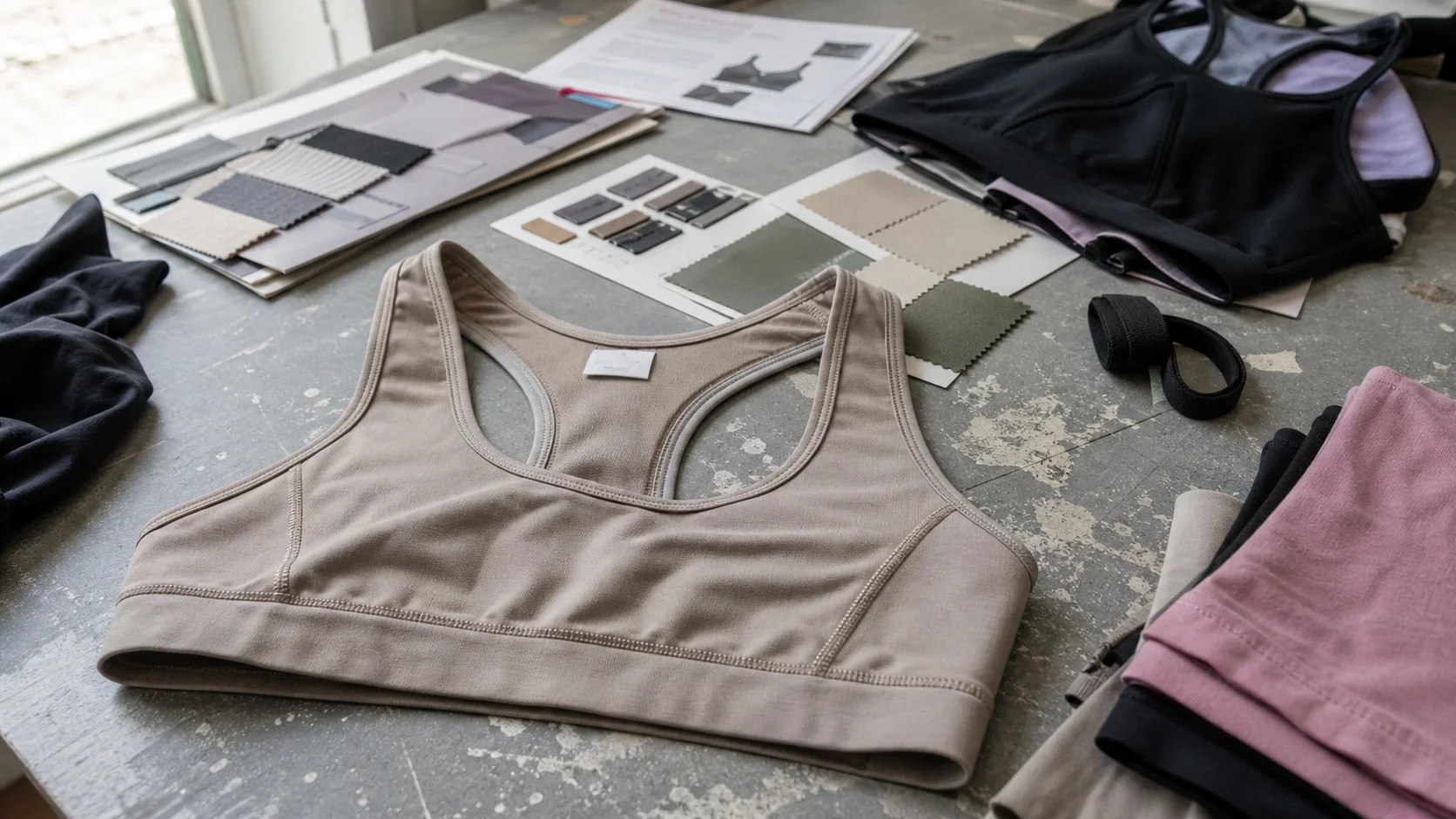
A retail operations-focused outline for auditing custom sports bra vendors, covering fit consistency, support testing, decoration durability, labeling,...
Custom Sports Bra Audit Brief for Retail Buyers - Activewear & Teamwear manufacturing guide
A custom sports bra vendor audit brief helps retail operations teams decide whether a supplier can deliver consistent fit, safe materials, repeatable production quality, and commercially realistic lead times. For activewear buyers, this is not a paperwork exercise. Sports bras carry more fit risk than basic tees, more performance claims than casual tops, and more return exposure than many other apparel categories.
The audit should test how the vendor manages development, fabric sourcing, pattern control, grading, lab testing, bulk production, packing, and final inspection. A supplier may show attractive samples and competitive unit prices, but retail teams need evidence that the same standard can be repeated across sizes, colors, cup constructions, and replenishment orders.
This brief is written for retail buyers, sourcing managers, merchandising teams, QA leads, and operations teams preparing to qualify or re-qualify custom sports bra vendors. It focuses on practical audit points that affect purchase decisions: MOQ, sample approval, fabric and trim specifications, fit consistency, lead-time risk, inspection failures, and the tradeoffs between cost, support level, and production flexibility.
Sports bras are small garments with a large number of failure points. A buyer is not only purchasing fabric, stitching, and packaging. The buyer is purchasing support, recovery, stretch behavior, cup shape, seam comfort, opacity, wash durability, and size consistency. Those factors directly affect customer satisfaction and return rates.
A vendor audit brief gives retail teams a consistent way to compare suppliers before issuing a large purchase order. It reduces the risk of choosing a factory based only on price or a polished sales presentation. It also helps align merchandising, technical design, QA, and logistics before development starts.
For custom sports bras, the audit should answer six core questions:
Retail buyers should treat the audit as a decision tool, not a formality. A supplier that is strong in sublimated teamwear may not be the best option for compression bras. A cut-and-sew activewear factory may be reliable for leggings but weak on removable pad alignment. A low-cost vendor may be acceptable for a simple training bra but risky for bonded, molded, or high-support styles.
A good sports bra audit separates sample-room capability from bulk-production reliability. Retail buyers need proof of repeatability, not only a good prototype.
The first section of the audit should confirm whether the vendor fits the retailer’s business model. Not every capable manufacturer is suitable for every retail program. A premium activewear brand, a gym chain, a school teamwear supplier, and a mass retail private-label buyer may all need different vendor strengths.
Retail teams should be cautious when a supplier claims to do every category equally well. Sports bras require closer control than loose tops and basic uniforms. If the vendor’s main business is unrelated apparel, the audit should dig deeper into pattern capability, elastic handling, and stretch fabric sewing.
For buyers looking for broader manufacturing support beyond one product line, it can be useful to compare the supplier’s offer with a structured production partner model. Fabrikn’s apparel manufacturing services page is a useful reference point for the types of development, sourcing, and production support retail teams often need when building a custom activewear program.
A supplier with a low quoted MOQ may still be unsuitable if it cannot manage formal approvals. A larger factory may have strong systems but little patience for frequent design changes or small colorway runs. The audit should identify that fit early, before sampling costs and calendar time are committed.
Sports bra audits should start with the intended product scope. A low-support yoga bra and a high-support running bra are different manufacturing challenges. Buyers should not evaluate every vendor with one generic checklist.
Support Level Typical Use Common Construction Main Audit Risk Low support Yoga, barre, lounge, light studio activity Simple pullover, soft elastic, light lining, removable pads Fit looseness, poor recovery, pad movement, transparency Medium support Gym training, cycling, dance, general fitness Compression fit, racerback or crossback, wider underband, power mesh panels Underband tension, seam chafing, inconsistent grading High support Running, HIIT, court sports, higher-impact training Compression plus encapsulation, adjustable straps, hook-and-eye closure, molded cups Cup shape, strap strength, hardware durability, bounce control claimsLow-support bras are easier to sample and may allow more fabric experimentation. They are also more exposed to fashion-driven color changes and lower margins. Medium-support bras are often the most commercially flexible for retail assortments because they balance performance, comfort, and manageable construction. High-support bras require the strictest development discipline and usually need more testing, more fit sessions, and more supplier capability.
Retail buyers should avoid vague briefs such as “premium gym bra” or “high-performance bra” without measurable specifications. The supplier needs target compression, fabric weight, stretch and recovery expectations, strap type, underband width, padding type, and size range. If those details are missing, suppliers may quote based on assumptions, which makes price comparisons unreliable.
MOQ is one of the first buying questions, but it should not be assessed in isolation. Sports bra MOQ depends on fabric sourcing, dyeing method, elastic customization, pad shape, logo application, packaging, and whether the style uses stock components or custom-developed materials.
These are general commercial ranges, not fixed rules. Some vendors may accept lower quantities with surcharges, while others may require higher MOQs due to fabric mill minimums or line setup efficiency. Buyers should ask vendors to separate garment MOQ from fabric MOQ, elastic MOQ, pad MOQ, and packaging MOQ. This prevents surprises later.
The cheapest unit price often removes flexibility. Low-cost quotes may rely on thinner fabric, basic elastic, uncontrolled pad quality, or minimal inspection. That may work for promotional merchandise, but it is risky for retail operations where returns, reviews, and markdowns cost more than the initial savings.
A buyer should compare landed cost, not only FOB cost. Include sampling, testing, inspection, freight, duty, packaging, relabeling risk, and potential air shipment if the vendor’s calendar is aggressive. A slightly higher unit price from a more disciplined supplier may be the better purchasing decision for a core retail style.
Sports bra sampling should move through controlled approval stages. Skipping steps may save two weeks early in the calendar but create bulk production problems later. Retail teams should define which approvals are mandatory before purchase order release and which are required before cutting bulk fabric.
Buyers should require the vendor to keep sealed approval samples. One should remain with the supplier and one with the buyer or inspection team. The approved sample becomes the reference for production, inspection, and dispute resolution.
Sports bra fit comments should be specific. “Make it better” is not useful. Better comments include “reduce front neckline drop by 1 cm,” “increase underband tension by 5 percent,” “move strap join point 1.5 cm toward center back,” or “change pad opening placement to reduce pad escape during wash.”
Retail teams should also track sample material differences. A proto made with substitute fabric can help speed development, but it cannot validate final compression, opacity, or recovery. The pre-production sample should use bulk-correct fabric, elastic, pads, labels, and trims.
Fabric and trim control is central to a sports bra audit. The garment’s performance depends on how materials behave together. A strong pattern cannot compensate for poor elastic recovery or unstable fabric stretch.
Compression fabrics are commonly nylon/spandex or polyester/spandex. Nylon often gives a softer handfeel and premium stretch, while polyester can support sharper sublimation prints and stronger colorfastness in some applications. Recycled yarns can be attractive for brand positioning, but buyers should check certification claims, dye consistency, and cost impact.
The underband is one of the most important components in a sports bra. It affects support, comfort, size perception, and durability. Audit questions should cover elastic width, modulus, recovery, edge softness, shrinkage, colorfastness, and whether the elastic is encased, exposed, brushed, jacquard, or plush-backed.
Too-soft elastic feels comfortable in fitting but may fail after repeated wear. Too-firm elastic can cause digging and size complaints. The better audit question is not “is the elastic good?” but “does the elastic match the support level, size range, and customer expectation?”
Removable pads are common in sports bras, but they create operational risks. Pads can fold, migrate, shrink, yellow, or vary in shape. Pad pocket openings can be too large, too small, or poorly placed. A supplier should confirm pad thickness, shape, foam density, wash performance, and replacement availability.
Fixed cups, molded cups, and encapsulated constructions can improve stability but increase development complexity. They may also raise MOQ because cup molds and specific foam components are harder to source in small volumes. Retail buyers should confirm whether cup components are standard shapes or custom-developed.
Branding choices affect both cost and durability. Heat transfers are common for activewear, but they must be tested for wash resistance, cracking, peeling, and stretch compatibility. Embroidery can look premium but may irritate skin or distort stretch fabric if placed poorly. Jacquard elastic can create strong branding but usually increases MOQ and lead time.
The audit should require physical samples of trims, not only photos. Color, texture, edge feel, and stretch behavior are difficult to judge remotely. Retail operations teams should also confirm barcode labels, care labels, country-of-origin marking, and packaging labels early to avoid shipment delays.
Fit is the main commercial risk in custom sports bras. A customer may forgive a slightly different shade; she is less likely to forgive straps that dig, cups that gape, or an underband that rolls during exercise.
The vendor audit should review how the supplier controls patterns, grading, and fit approvals. Ask whether patterns are created digitally, how revisions are logged, and who authorizes final pattern release. A buyer should also ask how the vendor prevents outdated patterns from being used in production.
Size grading needs special attention. A style that fits well in medium may not work in extra small or extra large. Underband tension, strap length, cup coverage, and armhole shape do not scale evenly if the grading rule is too basic.
Buyers should request a size set for at least core sizes before approving bulk. For extended sizes, more live fit checks are usually worth the calendar time. If a retailer plans to sell inclusive sizing, the vendor must show capability beyond simply enlarging the base pattern.
For retail operations teams, a sports bra size set is not optional quality control. It is a commercial risk control step.
Testing requirements depend on market, retailer standards, product claims, and materials. Buyers should define mandatory tests before requesting final quotes. If testing is added after pricing, the supplier may resist, delay production, or increase cost.
Performance claims need extra caution. “Moisture-wicking,” “antibacterial,” “UV protection,” “squat proof,” and “high support” should not be used loosely. Some claims require testing, legal review, or careful wording. Retail buyers should avoid marketing claims that the vendor cannot substantiate with data.
For children’s teamwear or youth activewear, compliance requirements may be stricter. Drawcords, small parts, chemical restrictions, labeling, and flammability standards should be reviewed by the retailer’s compliance team. A supplier’s general assurance is not enough.
Audit the vendor’s testing process. Ask which labs they use, when they test, who pays for retesting, and what happens if results fail. Strong suppliers understand that testing before bulk shipment protects both parties. Weak suppliers treat testing as an inconvenience or ask to ship before results are available.
Lead time is often quoted too simply. A supplier may say “45 days,” but that number may exclude fabric booking, lab dips, sample revisions, test failures, holiday closures, packaging approvals, and freight booking. Retail operations teams need a detailed calendar.
Simple stock-fabric programs may ship faster, sometimes within 30 to 45 days after approval. Custom-developed sports bras can easily require 90 to 150 days from concept to shipment, especially if multiple sample rounds or lab tests are needed.
Buyers should ask the supplier to identify bottlenecks. Fabric can be one bottleneck. Elastic can be another. Molded cups, branded trims, custom packaging, and third-party testing may also drive the critical path. A credible vendor can explain the calendar. A risky vendor gives a short lead time without assumptions.
A buyer should be careful with vendors that accept every order regardless of capacity. Late delivery often starts with overbooking. A disciplined supplier may reject an unrealistic shipment date, which can be a positive sign.
Sports bra inspection must cover measurements, workmanship, materials, trims, and functional risks. AQL inspection alone may not catch every fit or performance issue, but it is still an important control point for retail operations.
Inline inspection is especially useful for sports bras because many defects can be corrected before the full order is completed. For example, if underband attachment tension is inconsistent, the line can be adjusted early. If the issue is discovered only at final inspection, repair may be costly or impossible.
Measurement tolerance should reflect stretch fabric behavior. Overly tight tolerances can create unnecessary inspection failures, while loose tolerances can allow poor fit consistency. Buyers should set practical tolerances and make sure the inspection team measures garments the same way the factory does.
Retail buyers should also require a stretch recovery check during inspection. This does not replace lab testing, but it can reveal obvious elastic or seam issues. Inspectors should gently stretch key areas and check whether seams crack, thread pops, or elastic fails to recover.
Packaging is often treated as the last step, but retail operations teams know it can create serious delays. A well-made sports bra can still miss a delivery window because of incorrect carton marks, missing barcodes, wrong size stickers, or non-compliant care labels.
Padded and molded sports bras need careful folding. Poor packing can deform cups, crease pads, or create pressure marks on fabric. If the product uses removable pads, the audit should confirm whether pads are inserted, packed separately, or secured inside the garment. Each choice affects labor, customer presentation, and return risk.
Retail teams should approve a packing sample before bulk packing begins. The packing sample should show exact labels, tags, stickers, bags, carton marks, and folding method. If the retailer uses warehouse automation or strict receiving rules, barcode and carton compliance should be checked before shipment.
A scorecard helps buyers compare vendors objectively. It should not replace judgment, but it prevents a low price from overshadowing quality and operational risk. Weightings can be adjusted based on business model.
Audit Area Suggested Weight What to Evaluate Product capability 20% Sports bra experience, support-level capability, construction range Fit and pattern control 20% Pattern system, grading, size-set process, fit revision discipline Material sourcing 15% Fabric, elastic, pads, trims, testing support, shade control Quality management 15% Inline QC, final inspection readiness, defect tracking, corrective action Commercial fit 10% MOQ, pricing transparency, payment terms, sample fees Lead-time reliability 10% Capacity planning, realistic calendar, critical path visibility Retail operations support 10% Packaging, labeling, documentation, routing guide awarenessBuyers should score vendors after reviewing actual documents and samples, not only supplier claims. The strongest evidence includes approved samples, test reports, material swatches, measurement charts, production calendars, inspection templates, and corrective action examples with sensitive client details removed.
If a vendor scores low on fit and material control, a cheap quote should not rescue the decision. If a vendor scores high on capability but has high MOQ, the buyer must decide whether the product has enough sales confidence to justify the commitment. That is the real value of the audit: it makes tradeoffs visible.
Some supplier issues can be corrected through clearer specs and better communication. Others signal deeper risk. Retail buyers should watch for red flags before placing bulk orders.
A buyer does not need to reject every supplier with one weakness. The decision depends on product risk. A simple low-support bra for a limited promotional run can tolerate a less sophisticated supplier if the buyer controls expectations. A high-support retail bra with wide sizing, strict returns policy, and performance marketing needs a stronger vendor.
Retail buyers should be direct about tradeoffs. Lower MOQ usually means fewer custom options or higher unit cost. Faster delivery usually means stock materials or less development time. Premium fabric increases cost but may reduce returns and improve customer reviews. Complex construction can improve support but increases sampling time and inspection risk.
If the retail team does not have enough technical bandwidth to manage development, supplier selection becomes even more important. A vendor that can guide fabric selection, sample iterations, and production controls is worth more than a vendor that simply follows a sketch. Teams evaluating broader sourcing support can review Fabrikn’s company background to understand how a manufacturing partner positions its role across development and production.
The following structure can be used as a working brief when sending audit questions to potential custom sports bra vendors.
Clear briefs produce better quotes. Vague briefs produce low prices that often change after development begins. Retail operations teams should standardize this information so every supplier is quoting the same product assumptions.
A custom sports bra vendor audit should protect the retailer from fit failures, material substitutions, late shipments, and inspection disputes. The strongest vendors are not always the cheapest. They are the suppliers that understand stretch fabric behavior, control elastic and pad quality, manage sampling carefully, accept inspection, and communicate lead-time dependencies before problems appear.
For retail buyers, the best purchasing decision is usually based on risk-adjusted value. A low-cost vendor may be suitable for a simple low-support bra with stock materials. A technical sports bra program needs stronger fit development, material testing, and production discipline. The audit brief helps teams make that decision with evidence.
If your team is preparing a custom activewear brief and needs production guidance, you can contact Fabrikn through the contact page to discuss development, sourcing, and manufacturing requirements.
Get a free quote from Fabrikn — your trusted B2B clothing manufacturer with 10+ years of experience. MOQ as low as 200 pieces.
Get a Free Quote →A custom sports bra vendor audit brief is a structured document used by retail buyers and operations teams to evaluate whether a supplier can develop and produce sports bras to the required fit, quality, compliance, MOQ, and delivery standards.
Typical MOQs range from about 100 to 300 pieces for stock-fabric styles with simple branding, 300 to 800 pieces for custom colors, and 800 to 2,000 pieces or more for custom fabrics or complex performance specifications. Actual MOQ depends on fabric, trims, color, pad type, packaging, and supplier capacity.
Most custom sports bra programs need at least a proto sample, fit sample, size set, and pre-production sample. Complex high-support bras may need more rounds, especially when molded cups, adjustable straps, or special compression fabrics are involved.
The biggest risks include inconsistent underband tension, poor stretch recovery, pad movement, seam cracking, shade variation, logo failure, inaccurate grading, and incorrect packaging or labeling. Fit issues are especially costly because they often lead to returns and negative customer feedback.
Yes, lab testing is recommended for retail sports bras, especially for colorfastness, dimensional stability, pilling, stretch recovery, seam strength, and restricted substances where applicable. Performance claims such as moisture-wicking or UV protection should be supported by appropriate testing.
No. A low-cost supplier may be suitable for simple, low-support styles using stock materials and basic packaging. The risk increases when the product needs technical fit, custom fabric, high support, extended sizing, strict testing, or retail-ready logistics.
Buyers should approve the final pre-production sample, bulk fabric, elastic, pads, trims, color, logo method, labels, packaging, measurement chart, size set, and testing plan. Bulk production should not begin until these items are confirmed in writing.
Size-set approval shows whether the grading works across the range. Sports bras must control underband tension, strap length, coverage, and compression in multiple sizes. A good medium sample does not guarantee that extra small or extra large will fit correctly.