
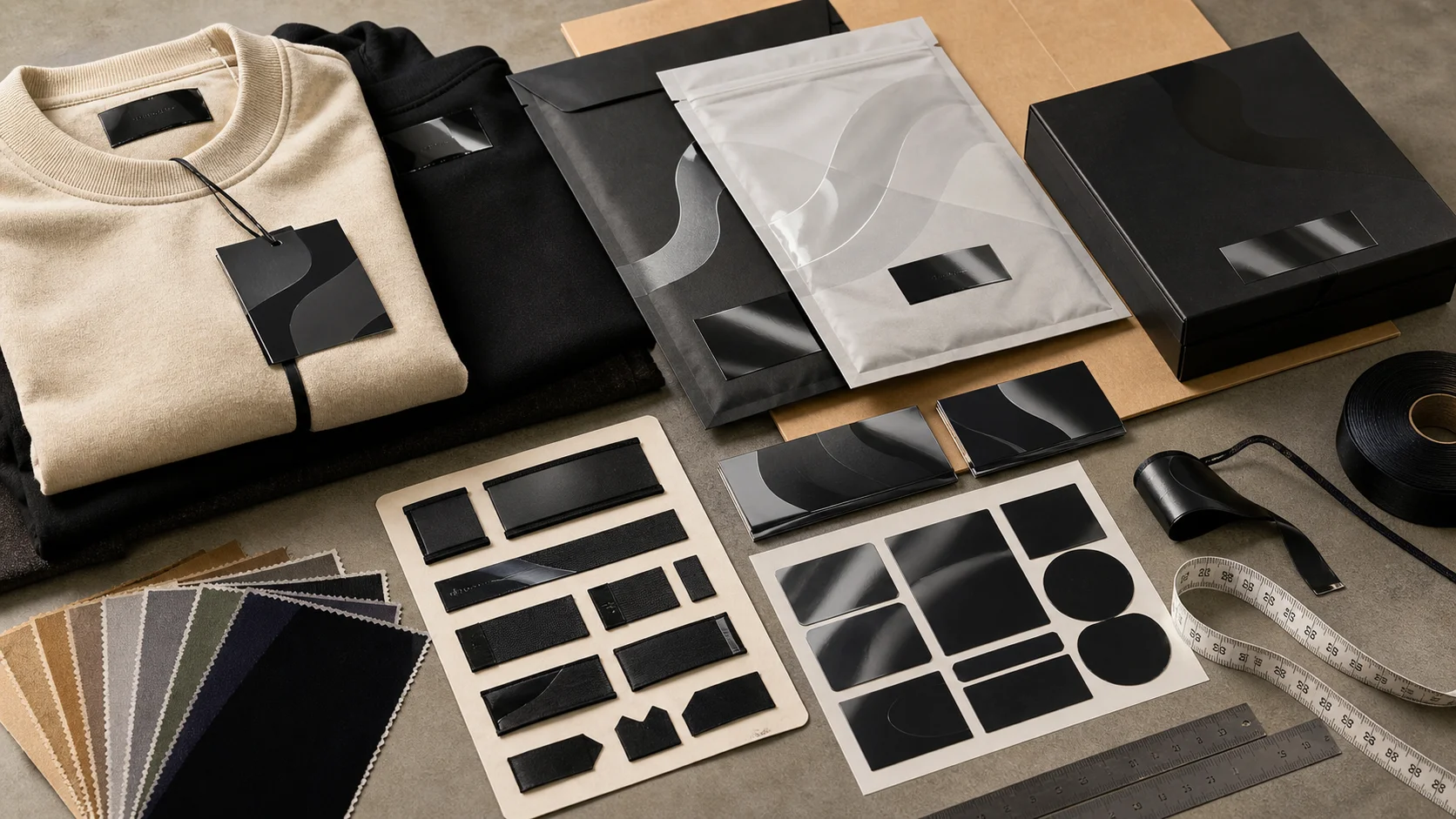
Custom Sticker Seals for Fashion Packaging Boxes compared by sample evidence, fabric or trim specs, MOQ, AQL terms, cost lines, delivery timing, and rework...
Fast answer: Custom Sticker Seals for Fashion Packaging Boxes: Material, Print, MOQ, and QC Terms should be judged by production evidence, not by a generic sourcing promise. The buyer needs sample proof, cost breakdowns, QC checkpoints, and delivery buffers in writing.
Ask for recent sample photos, measurement tolerances, fabric or print test assumptions, decoration test notes, packing examples, and a named inspection checkpoint. These details show whether the team can repeat an approved sample at bulk volume.
Separate garment cost, decoration, labels, packaging, sampling, testing, freight, and rush charges. Clear cost lines make it easier to reduce colorways, adjust size depth, or reserve more time for sampling.
On a packing line, a seal is often the last two-second decision before a carton disappears into the world. For brands choosing custom sticker seals for fashion packaging boxes, that tiny motion can decide whether a box arrives pristine, opens in transit, or triggers a costly QC hold. I have watched teams apply 1,500 to 3,000 units an hour, then lose 10 to 15 minutes because a roll jams or a die-cut is off by 2 mm. That is not decoration. That is control.
When I visited factories in Vietnam and Portugal, the pattern was consistent. Premium lines used seals to communicate restraint; mid-market teams used them to signal care; value brands treated them as an authenticity marker that had to do a little more work. In the premium lane, a seal might be 30 mm wide, printed one color on matte stock, and placed dead-center. In the value lane, the same box might get a larger 45 mm label because the seal also has to hide a closure gap or carry a promotional message.
Failure points are boring until they get expensive. Weak adhesive on recycled board can lead to 3 to 5 percent relabeling. A print mismatch on a 5,000-piece run can force full rework if the brand insists on exact Pantone control. I have seen a misplaced seal send boxes back to the packing table, adding 20 to 30 seconds per unit while operators peel, reapply, and recheck. Multiply that across 8,000 cartons and the cost stops being theoretical.
The cheapest seal often becomes the most expensive once misprints, weak adhesion, and manual relabeling are counted. A label that costs $0.02 less can still add $150 to $400 in labor and spoilage on a modest order. That is before damaged presentation enters the picture. Buyers notice immediately.
For brands building clothing packaging solutions, custom sticker seals for fashion packaging boxes sit at the intersection of operations and perception. They are branding, yes. They are also a packaging discipline.
A seal changes how a box feels in the hand. Soft idea, hard numbers. Across several ecommerce programs I reviewed, consistent seal placement cut customer-service tickets tied to “opened on arrival” by 12 to 18 percent over 2 to 3 months. The reason is simple: the customer sees order, not improvisation. A seal centered 6 to 8 mm from the flap edge reads as intentional. A crooked one reads as rushed.
Luxury labels know this well. Their custom sticker seals for fashion packaging boxes are often small, restrained, and nearly quiet. A white-on-black mark, a blind emboss, or a one-color foil stamp says confidence without shouting. DTC brands, by contrast, often use bolder seals because the box has to work as a social object. If the packaging is going to appear in a reel, the seal needs to hold attention for two seconds and still look clean after the parcel has crossed 1,200 kilometers.
Regional preference matters. In parts of Europe, I saw cleaner, minimal seals used on rigid boxes and garment sleeves, especially among brands selling at €80 to €250 retail. In some U.S. channels and fast-fashion programs, promotional labels were louder: larger type, sharper contrast, and more overt sustainability claims. Neither approach is universally better. A Paris showroom and a Los Angeles fulfillment center do not reward the same visual language.
Brand trust also moves with material choice. Paper seals, especially recycled or FSC-certified options, often improve credibility with eco-conscious shoppers. Plastic-heavy seals can backfire if the outer box is otherwise presented as low-impact. I have seen a brand spend $0.04 more per box on a paper seal and reduce negative comments about “too much plastic” by a noticeable margin across a six-week launch.
For labels that combine packaging with garment programs, private label clothing services often pair best with understated seals, because the seal becomes part of the product story rather than a loud ad stuck on cardboard.
Material choice decides how a seal behaves after printing, storage, and shipment. Coated paper is the budget workhorse. Uncoated paper feels softer and accepts handwriting or batch stamps more naturally. BOPP and matte film handle scuffing better, which matters if cartons travel 5 to 12 days through humid lanes or pass through automated conveyors. Foil adds shine, but it also adds risk if the brand expects easy recycling.
In warehouses with 60 to 75 percent humidity, I have seen paper labels edge-lift within 48 hours on lightly textured board. In dry storage, the same label may hold perfectly for four weeks. That is why climate testing matters. A seal that survives a showroom table may fail after a freight cycle. Cold exposure and heat exposure both matter. Adhesive that performs at 20°C can behave differently at 35°C or in a cold-chain transfer.
Permanent adhesive is the safer option for tamper evidence and shipping security. Removable adhesive works when the seal is meant to be decorative or when the box must be opened and reused. The box surface matters just as much. Kraft board, coated cartons, recycled board, and textured luxury boxes each react differently. On rough kraft, a stronger tack is usually necessary. On glossy coated board, too much tack can wrinkle the label on first contact.
Testing should be practical, not theoretical. I ask for peel strength, edge lift after 24 and 72 hours, smudge resistance after rubbing with dry and damp cloths, and performance after two days in heat and two days in humidity. For fashion packaging, a seal must hold through handling, returns, and storage, not just a clean studio photo.
Sustainability claims need discipline. A seal described as recyclable should not hide a film laminate, metallic layer, or mixed adhesive structure that complicates recovery. According to Textile Exchange, brand claims are increasingly scrutinized across the supply chain, and packaging claims face the same skepticism. Keep the message honest. Mixed materials can turn a green story into a credibility problem.
When you compare a manufacturer, factory, or supplier, look at how they explain production, quality, and testing—not just price. A reliable custom run should include the substrate, adhesive type, finish, and expected performance in transit. If you are buying custom sticker seals for fashion packaging boxes in bulk or wholesale, ask for real samples made on the same press line, not a generic mock-up.
China is often the most competitive source for large runs, especially when the factory already produces label rolls at scale. That said, the best supplier is the one that can document quality control, provide clear production timelines, and support MOQ targets without hiding setup costs. If a quote sounds too simple, it usually is.
For technical claims, third-party guidance helps. Oeko-Tex explains chemical safety expectations for textile-related products and supply chains, which is useful when your packaging story touches sustainability or material transparency: Oeko-Tex standards and certification guidance. If your sourcing team needs broader trade context, the U.S. government also provides useful export and sourcing references at Trade.gov international trade resources.
Seal pricing is rarely about the artwork. It is about run size, material, finish, adhesive, and freight. A simple design on paper stock can still cost more than expected if the order is only 500 pieces and the press setup absorbs a big share of the unit price. Once you move to 5,000 or 10,000 seals, the price curve drops quickly. The artwork may be the same, but the economics are not.
Here is the useful framework I use when reviewing quotes:
Those ranges change with foil, varnish, die-cut shape, and shipping lane. A small order can also get hit by setup fees of $60 to $250, which distort the first quote badly. I have seen buyers celebrate a low unit cost, then discover the true landed cost jumps once customs, split cartons, and express freight are added. For orders under 1,000 pieces, total cost often matters more than unit cost.
Hidden costs are where teams lose money. Color mismatch can spoil 200 to 500 labels before approval. Manual application can add 1 to 3 seconds per box, which becomes real labor across 4,000 cartons. A box redesign can force replacement of the entire seal run, especially if the old artwork was tied to a seasonal campaign or a limited collection. If the seal has to match a new closure size, scrap rises fast.
For some production programs, cut and sew manufacturing teams coordinate seal specs alongside trims and folding instructions, because packaging errors are cheaper to prevent than to fix after warehousing has already started.
Mailer boxes, rigid boxes, tuck boxes, and garment sleeves do not need the same seal. A DTC mailer often benefits from a wider seal, 35 to 50 mm, because the flap overlap and shipping abuse are both higher. Rigid boxes for luxury can use a smaller, elegant seal, sometimes 20 to 30 mm, placed where it preserves symmetry. Tuck boxes for accessories need a label that will not interfere with opening mechanics. Sleeves for folded apparel often work best with a long, narrow seal that bridges two layers without buckling.
Seasonal drops and subscription programs add another layer. A launch campaign might need a seal that carries a batch code, a QR code, or a short message tied to a six-week promotion. Subscription boxes often need consistency across three to four monthly cycles, which means the seal must stay readable and easy to apply at volume. For ecommerce returns, anti-tamper use is crucial. If the customer can reseal the box without evidence, the seal has failed its job.
Factory visits showed a stark regional split. In small European ateliers, packers may handle 200 to 600 units a day, so they can tolerate more manual alignment and serial numbering. In high-speed Asian fulfillment centers, I saw lines pushing 4,000 to 8,000 units per shift, which requires larger label rolls, faster release liners, and less fiddly placement. The same seal design can behave well in one environment and fail in the other.
Print details matter operationally. Barcodes should scan on glossy or matte finishes. Batch codes help with recalls and QC tracking. Serial numbering can support limited editions and resale authentication. If a brand sells 500 numbered units, the seal can carry that identity without extra insert cards. That matters for premium gifting and for resale verification, where a visible code can support the item’s chain of custody.
For special editions, I often pair seal planning with packaging and merchandising briefs, because the seal should match the box geometry, the packing speed, and the seasonal story. That is especially true for gift sets, where presentation carries real commercial weight.
Proofing is where weak buying decisions become visible. Start with the dieline. Measure the closure area on the final box, not the mock-up, because a difference of 3 to 4 mm can change whether the seal bridges a flap cleanly. Then check Pantone targets against the actual substrate. A seal printed on white paper and one printed on natural kraft will not read the same, even if the ink formula is identical.
I ask for sample approval on the final carton, not just on a flat sheet. Adhesion testing should happen on the exact box stock, with the same fold pressure and the same operator motion. A label that sticks in the studio may fail after 72 hours in a warehouse at 65 percent humidity. That is the kind of mistake that shows up only after the purchase order is signed.
Supplier vetting should go deeper than price. Ask for FSC paper documentation if the brand markets responsible sourcing. Ask whether any chemical claims are supported by REACH-related declarations where relevant. If the seal touches products or sits near sensitive items, confirm whether food-contact relevance is being claimed, and if so, prove it. Recycled content proof matters too, but it should not be used loosely. Claims without documentation can damage trust quickly.
Request a spec sheet, test report, material declaration, and production sample photos before approval. I also want traceability on the print run, especially for repeat orders over 2,000 pieces. According to ASTM, standardized test methods help make material comparisons meaningful, which is exactly what you need when one supplier says “strong adhesive” and another says the same thing.
Domestic suppliers usually give faster communication, often within 24 hours, and tighter QC feedback. Offshore suppliers may offer better pricing on 5,000 to 20,000 pieces, but communication gaps can add 3 to 7 days to approval if the first proof misses the mark. Last year I worked with a brand that saved $180 on print cost and lost $1,100 in delay because no one clarified the box finish before production.
Before you place a bulk order, ask the factory for a simple checklist. Confirm the exact MOQ, the available production slots, the lead time after proof approval, and the quality checks used on press and during packing. If you are working with a supplier in China or another offshore market, ask how they handle reprints when a first run misses color or edge alignment.
For repeat programs, build a master spec sheet that lists the size, adhesive, finish, substrate, and approved artwork version. That makes wholesale reorders easier and reduces mistakes when a new merchandiser or production manager takes over. Custom sticker seals for fashion packaging boxes should be easy to reorder without starting from zero every season.
If you are comparing manufacturers, request references from similar fashion packaging projects, not just general label work. A supplier with strong production capability but weak packaging experience can still cause delays if they do not understand box closure pressure, anti-tamper requirements, or premium presentation standards.
The best buying process is short, disciplined, and unglamorous. On day one, define the box stock, the closure area, and the role of the seal. Is it tamper evidence, decoration, or both? On day two, choose the finish and adhesive. On day three, request samples in at least two material options. On day four, test them on final cartons. On day five, run a transit test for 48 to 72 hours. On day six, confirm production quantities and lead time. On day seven, approve only after packaging, merchandising, operations, and sustainability have signed off.
I use a simple workflow because it keeps teams honest:
Ask vendors direct questions. What is the MOQ? What is the real lead time with proofing included? What happens if the first print misses color by one Delta E? Can they supply material declarations within 48 hours? Can they rerun the same spec in three months if your seasonal pack changes? If the answers are vague, the project will be vague too.
To keep teams aligned, packaging should own the dieline, merchandising should own the visual message, operations should own application speed, and sustainability should own claim accuracy. That division sounds tidy, but it saves brands from expensive overlap. If your box program changes often, tie the seal spec to a master sheet so future reorders do not start from zero.
For brands ready to move, request a free quote for custom packaging seals after you have final box measurements and two sample references. Spending a little more on the seal can prevent much larger costs in damaged presentation, relabeling, and rework.
When a brand sources custom sticker seals for fashion packaging boxes at wholesale scale, the decision usually comes down to speed, price, and control. A domestic supplier may be better for urgent launches, while a China-based factory can be the stronger choice for larger production runs and tighter unit economics. The best partner is the one that balances quality, MOQ, and communication without making the project harder than it needs to be.
Ask for proof of production capacity, sample turnaround, and print consistency across repeat orders. A good manufacturer should be able to show how they manage bulk scheduling, material changes, and finish consistency across seasons. If they cannot explain their process clearly, that is a warning sign.
They secure box closures, signal tamper evidence, and shape how the package looks on arrival. In my experience, they also reduce reopening complaints when placement and adhesion are consistent across 1,000 to 10,000 units.
Economy seals often run $12 to $28 per 1,000 pieces, mid-tier seals $28 to $55, and premium seals $55 to $140. MOQ usually starts at 500 to 1,000 pieces, and setup fees can add $60 to $250 on small orders.
Typical lead time is 5 to 10 days for basic runs, 7 to 14 days for mid-tier orders, and 14 to 21 days for premium finishes. Sample approval and shipping can add 2 to 7 days depending on supplier location.
Yes, many can use paper stocks and recyclable adhesives, but the whole structure matters. Foil layers, plastic films, and mixed adhesives can complicate recovery, so ask for a material declaration before approving a sustainability claim.
Domestic suppliers often win on communication speed and faster proofing, while offshore suppliers can be cheaper on runs above 5,000 pieces. The right choice depends on your timeline, quality tolerance, and how many revision cycles you can afford.