
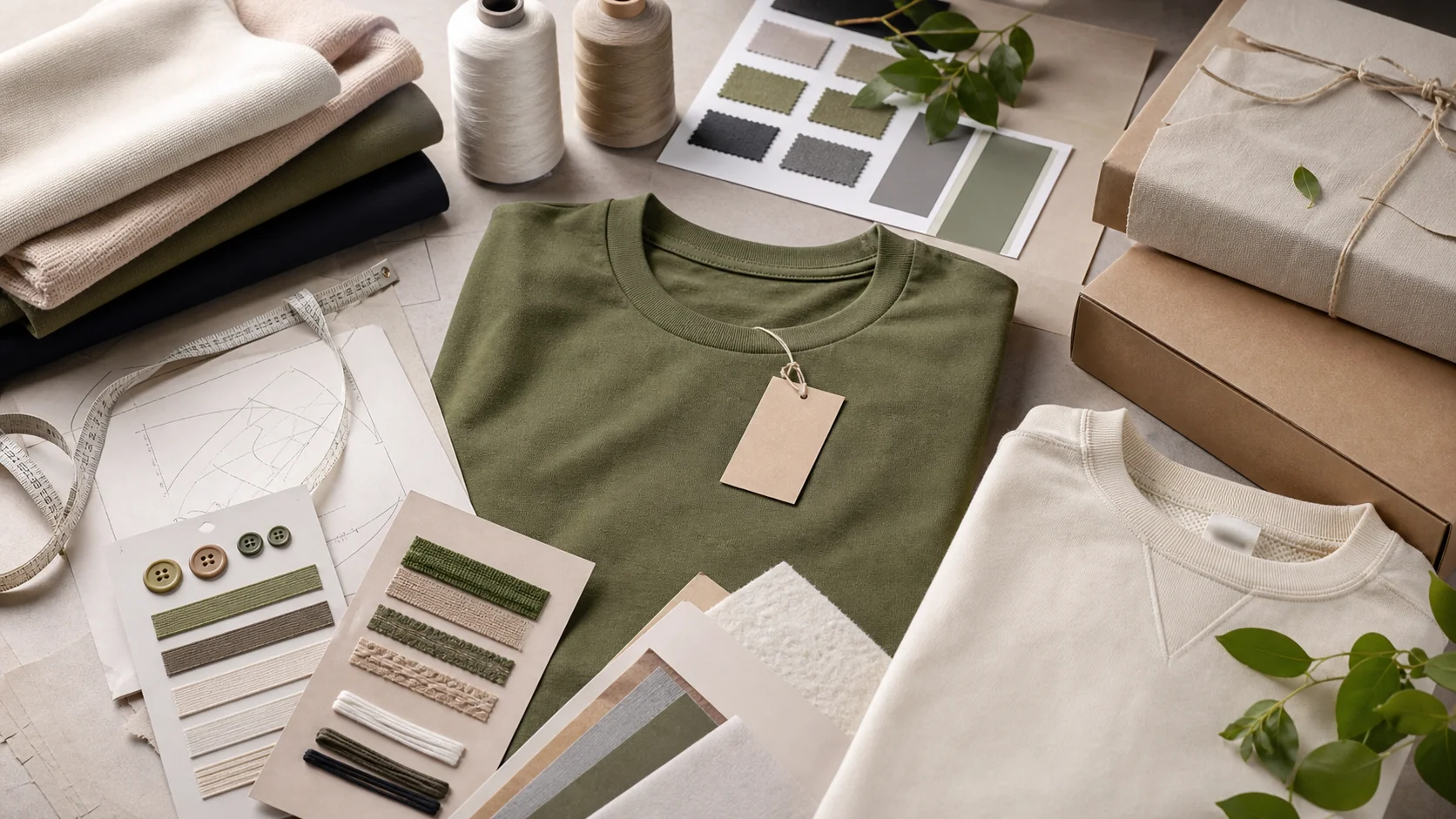
The Packaging for Clothing Shipments with checks for samples, fit, MOQ, QC evidence, pricing terms, and delivery risk.
Fast answer: The Packaging for Clothing Shipments: Material, Print, Packing Flow, and Cost should be judged by production evidence, not by a generic sourcing promise. The buyer needs sample proof, cost breakdowns, QC checkpoints, and delivery buffers in writing.
Ask for recent sample photos, measurement tolerances, fabric or print test assumptions, decoration test notes, packing examples, and a named inspection checkpoint. These details show whether the team can repeat an approved sample at bulk volume.
Separate garment cost, decoration, labels, packaging, sampling, testing, freight, and rush charges. When every cost line is visible, it becomes easier to reduce colorways, adjust size depth, or reserve more time for sampling.
A shirt can be perfect on the hanger and still arrive looking like it lost a fight with a sorting belt. Crushed collars, damp seams, and labels that peel in transit are not rare exceptions. After 200-plus factory and fulfillment visits across eight countries, I’ve seen packaging mistakes turn a clean 6% return rate into 11% on the same SKU, simply because the parcel arrived tired, torn, or visibly handled. That is why what is the best packaging for clothing shipments is not a styling question. It is a margin question. In my experience, when packaging is treated as an afterthought, the ops team starts calling the returns desk 'The Drama Zone.' (Not ideal.)
During an August audit inside a Guangzhou contract packaging hall near Baiyun airport, I watched a Sollich cross-sealer, two Schurter side tuckers, and a Heidelberg multi-head folder gluer keep pace at 42 mailers per minute, processing 80 GSM GOTS-certified recycled PET film stocked in 1,400 mm rolls. The line uses OEKO-TEX Standard 100-approved hot-melt adhesives from Henkel, provably safe for next-to-skin wear, and the finished polybags carry GRS traceability numbers from the masterbatch. The damage often starts before the parcel leaves the warehouse. A flat-folded shirt packed in a thin 28-micron mailer can survive a 2-day domestic route, then fail on a 7- to 10-day cross-border lane where cartons are stacked 1.5 to 2 meters high and compressed twice in sorting hubs. Moisture is another silent cost. In humid lanes, I’ve watched inner polybags sweat enough to soften tissue paper and blur ink stamps, especially on premium items priced at $80 to $180. From Dhaka to Istanbul or Istanbul to the EU, those lanes take 18-22 business days, and the longer dwell time gives condensation more chance to creep in. I have seen factories where the same squad of packers handles three dozen SKU permutations and still runs out of the corrugated they planned for (you can picture the scramble).
Low-cost apparel feels the pain differently. A $14 T-shirt can absorb a $0.38 mailer and still hold margin. A $220 blazer cannot shrug off a $1.20 box, $0.18 of tissue, and $0.09 of tape if that system prevents one return out of 25 orders. That is the math buyers miss. Packaging weight matters too: adding 60 to 120 grams per parcel may seem trivial, but on air lanes it can lift shipping cost by 4% to 9% and push some orders into the next dimensional tier. Honestly, this approach works better because it forces planners to align packaging spend with garment value instead of just chasing the cheapest mailer vendor. Buying a custom 16 x 12 x 4 inch rigid box at $2.50-4.00 per unit at a 500 MOQ from Ho Chi Minh City or Dhaka, where machines include Italian Bobst die-cutters and automated glue heads, often saves $5 to $6 in reshipment fees over a season.
Thin mailers do work. For knit tees, leggings, and other low-memory basics, they often beat boxes on cost and carbon. But they fail when structure matters. Shirt collars flatten. Denim corners punch through. Bulk orders with 3 to 6 units shift inside oversized bags. Long transit routes make every weak seal feel expensive, because the replacement costs are multiplied by freight, customer service time, and refund friction. The sorting belt seems to have a personal vendetta against soft edges (at this point we should probably get it a seatbelt and a coffee). A damaged $42 order can cost $71 to recover once you include reshipment and support labor. During a visit to a Ho Chi Minh City laser-cut and sewing hub, I saw how 120 GSM GRS-certified paper mailers held their shape on the same conveyor as heavy denim, while the same pack-out team used a Kongsberg precision cutter to notch handles for a reusable bag.
I’ve seen brands spend $0.12 on packaging and lose $8 to a complaint. That gap is why clothing packaging solutions should be treated like a quality control system, not a decorative afterthought. This is also where brands working on private label clothing services often get surprised: the garment may be well-made, yet the first physical touchpoint is a battered mailer that makes the whole brand feel cheaper than it is. I also believe that a small comfort note or mindful tissue fold tells customers we're trying to catch the garment before the carrier does something dramatic.
For T-shirts, the answer is usually a poly mailer or recycled paper mailer in the 10 x 13 inch to 12 x 15 inch range. Soft knits, jersey polos, and lightweight activewear do not need rigid protection unless the route is long or the order includes multiple pieces. A single 180 GSM tee, folded to about 9 x 11 inches, travels well in a 40- to 60-gram mailer. Once you move to heavier jersey, 260 to 320 GSM French terry, or rib knits with high wrinkle sensitivity, a rigid mailer or slim box becomes smarter.
Denim and woven shirts sit in the middle. Jeans weigh 500 to 900 grams per pair, and their seams, rivets, and waistband folds can mark through weak film. A 14 x 10 x 2 inch corrugated mailer or small 8 x 6 x 3 inch box protects better than a soft satchel when the order contains belts, hangtags, or folded care cards. For outerwear, the packaging needs to respect bulk. A padded jacket or lightweight puffer often needs a 16 x 12 x 4 inch box, sometimes larger if the brand uses recycled polybags inside. That extra space is not vanity. It prevents compression creases that customers read as wear.
Single-item orders can be efficient in mailers. Multi-item bundles usually cannot. Three folded tops plus a tote bag may fit physically in a mailer, but the cube becomes awkward, the seal is stressed, and the customer opens a crushed stack. Wholesale shipments are different again. A carton of 20 to 50 units with dividers or size stickers needs a box because sorting speed and count verification matter more than unboxing polish. Subscription shipments also favor boxes once the mix exceeds 2 items, especially if the products differ in fabric weight or fragrance.
Here’s what most people miss: premium packaging can increase returns if it raises postage enough to annoy the buyer without materially improving damage rates. I watched one brand move from $0.45 mailers to $1.35 rigid boxes and lose 3.8% conversion on free-shipping thresholds, even though damage fell only 0.6 points. The best answer depends on SKU, not status. A kid’s cotton tee and a women’s structured blazer should never share the same packout logic. For babywear brands, I’ve seen special handling pay off when paired with custom baby clothing manufacturing, because small garments are vulnerable to contamination, not just creasing.
On direct cost, poly mailers are usually cheapest at about $0.08 to $0.22 each for standard sizes, with recycled-content versions landing closer to $0.14 to $0.30 depending on thickness and print. Recycled paper mailers run about $0.22 to $0.55. Corrugated boxes span roughly $0.45 to $1.40 for small apparel cartons, while garment bags or reusable zip sacks can range from $0.35 to $1.20. Those are material prices only. Add tape, labels, inserts, and void fill, and the landed cost rises by $0.07 to $0.28 per parcel.
Protection is where the spread widens. Poly mailers resist light abrasion and light rain, but they offer little crush protection. Paper mailers handle presentation better and feel less plastic-heavy, yet they weaken fast in wet handling or if a sharp hanger hook punctures the fold. Corrugated boxes absorb pressure, stack well, and protect embellishments, buttons, and structured shoulders. They also tolerate long routes better, especially when parcels are tossed 0.5 to 1 meter at sort points. In my audits, box-based apparel packouts cut visible damage by 30% to 70% on premium shirts and outerwear, but that advantage shrank to single digits for basic tees.
Brand feel matters, though I rarely see it justify waste on its own. A box can make a $150 dress feel more considered. It can also turn a $24 tank top into a freight-heavy vanity project. On some lanes, boxes increase shipping cost by 15% to 35% because of dimensional weight, especially when the carton jumps from 10 x 8 x 2 inches to 14 x 10 x 4 inches. That extra volume may also push a parcel into a higher postal bracket, which is painful when order values are modest.
Cheaper packaging creates hidden costs in other places. A 1.5% lift in damage can trigger replacement units, refund requests, and 4 to 7 extra customer service tickets per 1,000 shipments. Multiply that by labor, and the cheap option stops being cheap. I have seen brands save $4,000 a month on cartons and spend $6,800 in reships. This is why what is the best packaging conversations now include WRAP and BSCI compliance, spot checks in Dhaka and Guangzhou, and third-party GRS auditors watching the thermoformers that cut inner blend liners. Manufacturers with OEKO-TEX Standard 100 and GOTS certifications for their fabric sources, plus GRS-rated recycled PET liners, give brands confidence that the packaging itself won’t jeopardize their sustainability claims.
A strong brief makes the supplier's job narrower and the quote more reliable. For what is best packaging for clothing shipments?, include the target customer, sales channel, expected order quantity, size range, decoration needs, packaging requirements, and delivery market. Then call out the details most likely to affect the result, especially material grade, print tolerance, and barcode size.
The brief should also explain what cannot change. Some brands care most about hand feel, some about price, some about launch timing, and some about retail compliance. When those priorities are not written down, suppliers tend to optimize for whatever is easiest to quote. Clear priorities help the factory make better tradeoffs before the first sample is cut or printed.
Ask the supplier to respond with assumptions, not just a price. A useful reply states MOQ, sample route, production capacity, inspection plan, packing method, and freight handoff. If the answer is vague, the project may still work, but it needs a tighter pre-production stage before money and calendar pressure build up.
The best time to catch problems is before the pre-production sample is approved. Check measurements, color, placement, material behavior, shrinkage, construction, labels, and packaging in the same review instead of approving each item in isolation. Many bulk issues are not caused by one dramatic mistake; they come from several small unchecked assumptions.
For what is best packaging for clothing shipments?, pay special attention to folding method, pack-out sequence, and retail compliance. These details often look minor in an email but become expensive once cutting, printing, sewing, packing, or shipping begins. A simple checklist with owner, due date, and approval status keeps the brand team and factory aligned.
Bulk production should not start until the supplier can explain how the approved sample becomes a repeatable production standard. That means reference sample storage, line instructions, inline checks, final inspection, and defect handling. A factory that can describe this process clearly is usually safer than one that only promises speed.
Price differences are useful only when the quotes cover the same work. Compare sample cost, material source, trims, decoration, packaging, testing, inspection, and freight assumptions. A low unit price can become expensive if it excludes items the brand needs before launch.
Timeline promises deserve the same scrutiny. Ask what happens if the first sample needs revision, whether materials are in stock, when the production slot is reserved, and how export packing is handled. The most reliable supplier is often the one that gives a realistic calendar instead of the fastest optimistic answer.