
A sourcing-focused outline for resort uniform buyers comparing MOQ tiers, tracksuit construction choices, decoration costs, sizing risks, and production...
For resort uniform programs, custom team tracksuits sit in a practical middle ground: they are more polished than basic loungewear, easier to standardize than many tailored garments, and flexible enough for staff mobility, cooler-weather service, travel days, and branded team presentations. The purchasing question is usually not whether the style works, but what the minimum order quantity means for pricing, size breaks, decoration, fabric choice, and replenishment planning.
This review is written for resort buyers comparing custom team tracksuit MOQ pricing in a sourcing context. The key issue is that MOQ is rarely just a factory rule. It is tied to fabric mill minimums, trim allocation, print or embroidery setup, color commitment, and the cost of making a consistent uniform program across multiple sizes. Buyers who understand these drivers usually negotiate better, avoid expensive reorders, and reduce fit complaints after delivery.
Custom Team Tracksuit MOQ Pricing for Resort Buyers - Fabrikn production reference
MOQ, or minimum order quantity, is the smallest production volume a supplier will accept for a given style, color, fabric, or decoration method. For resort buyers, the MOQ matters because team tracksuits are rarely one-size-fits-all. A housekeeping team may need more bottoms than jackets, a spa team may want a different hand feel, and front-of-house staff may require a more refined look. Those variations can push a program into multiple SKUs and separate MOQs.
It is common to think only in terms of total pieces. That can be misleading. A factory may accept 300 sets in total, but still require 150 pieces per color or 100 pieces per size curve. If the design uses custom-dyed fabric, special zippers, or complex logo placement, the effective MOQ can rise even when the garment itself looks simple.
For resort buyers, the cheapest quote is not always the best value. A lower unit price can hide a higher risk of fit inconsistency, slower approvals, or a MOQ structure that makes reorders expensive.
Custom team tracksuit pricing usually comes down to five main cost buckets: fabric, labor, decoration, accessories, and production efficiency. The more standardized the garment, the easier it is to hold price at lower MOQs. The more custom the details, the more every small choice affects cost.
Polyester interlock, polyester-spandex blends, brushed fleece, French terry, and bonded knits all sit at different price points. Lightweight polyester tricot is usually cheaper than heavier double-knit or premium stretch blends. Resort buyers often prefer a cleaner, smoother surface for embroidery and logo clarity, while operational teams may prefer softer or warmer fabrics. Those priorities do not always align with the lowest cost option.
Embroidery often adds setup and needle time but can offer a premium finish for small logos. Screen printing can be economical on larger runs, though it is not always ideal on stretch or textured fabrics. Heat transfer may suit smaller runs and finer logo detail, yet it introduces durability questions if the garment is washed frequently or exposed to high heat.
A basic zip jacket and straight-leg pant are easier to price than a panelled tracksuit with contrast inserts, piping, hidden pockets, lined collars, thumbholes, or reflective details. Each added seam means more sewing time and a greater chance of variation during production.
Zippers, drawcords, cord ends, elastic, labels, main tags, size pip labels, and branded hangtags all contribute to the final cost. YKK-type zippers or equivalent branded hardware can lift pricing, but they may be worth it when the resort expects frequent laundering and long wear life.
The cleanest pricing usually appears when the buyer keeps colors limited, combines sizes intelligently, and confirms artwork early. Splitting a small order into multiple colorways or logo variants often pushes the supplier into inefficiency, which gets reflected in the quote.
Actual MOQ levels vary widely by factory, fabric source, and embellishment method. Still, resort uniform buyers can use the following ranges as a practical guide when requesting quotes for custom team tracksuits.
Tracksuit Type Typical MOQ Range Pricing Note Stock fabric, simple logo embroidery 100 to 300 sets Often the easiest route for smaller resort orders Custom color, stock-pattern construction 200 to 500 sets MOQ may be driven by fabric availability or dye batch minimums Fully custom fabric and trims 500 to 1,000+ sets Better for larger uniform rollouts, higher setup cost Printed or heat-transfer logo on basic knit set 50 to 200 sets Lower entry point, but durability must be checked carefully Premium fleece or technical performance tracksuit 300 to 800 sets Material and testing requirements often raise the entry thresholdThese are not fixed rules. A supplier may quote a lower MOQ if the fabric is already in stock, the design is uncomplicated, and the buyer accepts a less customized trim package. The reverse also happens. A modest-looking tracksuit can become expensive if the buyer asks for custom-dyed panels, branded zipper pullers, and multiple logo placements.
Resort programs should be planned around actual staff usage rather than retail-style size distribution. Uniform buyers often need fewer extras in uncommon sizes and more precision in the most-worn sizes. If a supplier quotes a low MOQ but requires evenly split size runs, that may create dead stock in small or large sizes that are hard to redistribute later.
A better approach is to map the workforce by department, climate, and shift pattern. A coastal resort may use tracksuits mainly for early-morning duties, transport, or cooler months. A mountain resort may use them for daily uniform wear. The quantity plan should reflect whether the tracksuit is a primary uniform layer or a supplementary garment.
Buyers should also decide whether the tracksuit is issued as a set or bought as separate jacket and pant pieces. Sets simplify appearance control but can be awkward when different departments have different size needs. Piece ordering can reduce waste, yet it may complicate inventory and tracking.
Sample approval is one of the most important cost controls in a custom tracksuit order. A poorly managed sample stage can create repeat sampling charges, delayed production slots, and avoidable fabric waste. Resort buyers should expect at least three checkpoints: fit sample, fabric or lab dip approval, and pre-production sample or sealed sample approval.
The fit sample confirms silhouette, length, mobility, and overall proportion. For resort staff uniforms, the practical test is whether the wearer can move, lift, bend, and work comfortably. A tracksuit may look correct on paper and still fail in service conditions if the armhole is too tight, the rise is too low, or the waistband twists after movement.
Color and hand feel matter. If the tracksuit uses dyed fabric, the buyer should review lab dips or strike-offs before bulk production. If the fabric is pre-dyed stock, the buyer should still check shade consistency from batch to batch. Slight shade variation can be noticeable across a front desk team or housekeeping group.
The pre-production sample should reflect the final bulk materials, trims, labels, and decoration. This is the stage to confirm zipper quality, logo placement, stitch density, seam alignment, and packaging details. Once this sample is signed off, changes can be expensive.
Every sample round adds time. Buyers who want low MOQ pricing but leave artwork and size specs unresolved usually pay for that delay later in rush charges or missed delivery windows.
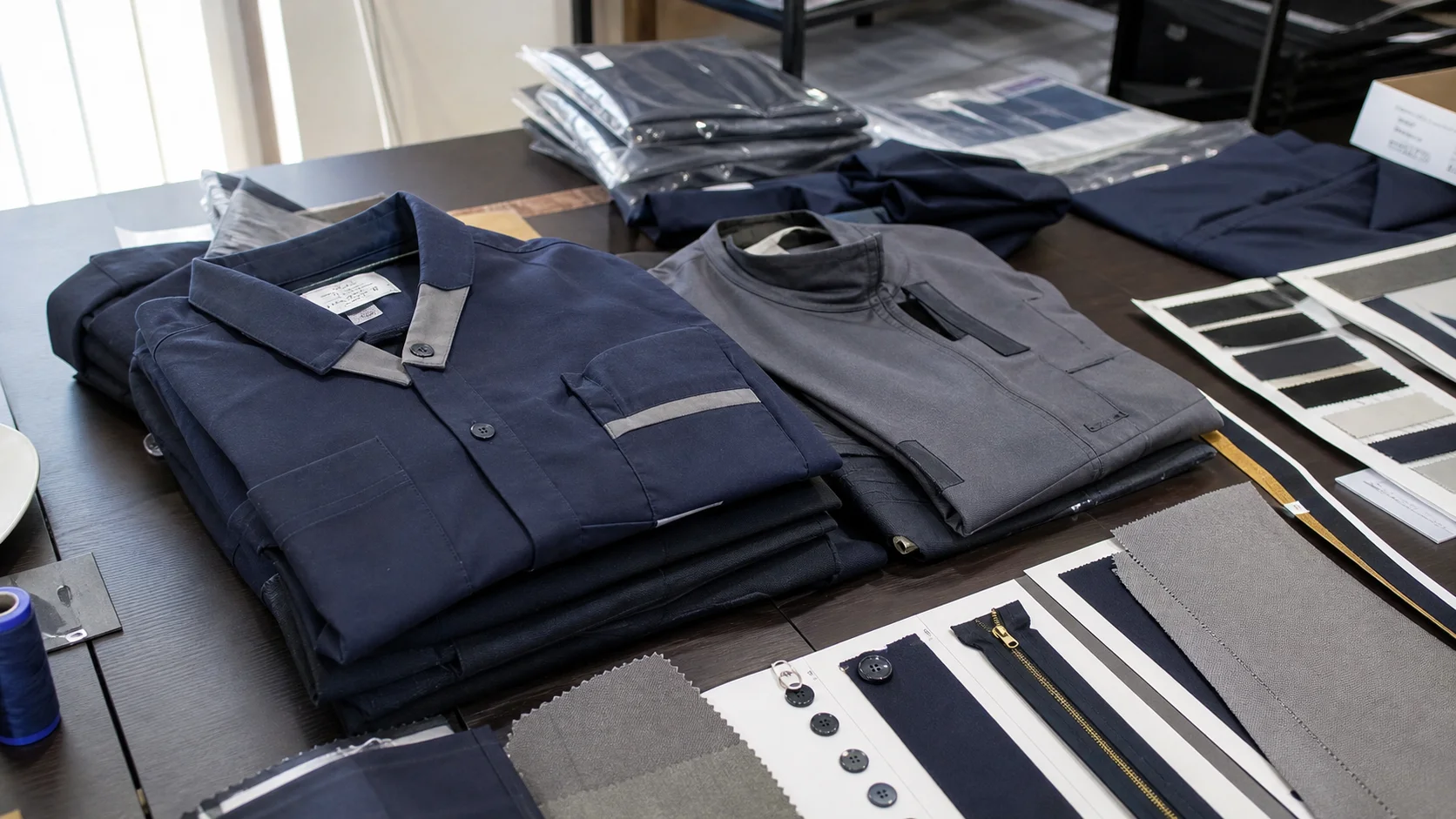
For resort uniform buyers, the spec sheet is where most pricing surprises begin. A tracksuit can look simple in a presentation image while hiding a long list of cost-bearing details. A disciplined buying team should compare each spec line, not just the final photo.
Small trim changes can affect both MOQ and price. For example, switching from a standard zipper to a branded zipper may improve durability and presentation, but it can also require a separate sourcing line. A similar issue appears with custom woven labels or printed neck labels when the factory’s standard package would have been cheaper.
Tracksuit orders fail in predictable ways. The main risks are not usually dramatic design flaws. They are consistency problems: shade variation, crooked logo placement, inconsistent seam tension, poor zipper alignment, and size drift across production lots. These issues matter more in resort settings because staff uniforms are seen together and judged as a set.
Inspection should focus on workmanship, measurements, and appearance consistency. Buyers should not wait until the end of the order to discover that the jacket and pant shades are slightly different or that one size runs short in the sleeve and long in the torso.
For larger orders, buyers should consider in-line inspection during production rather than relying only on final random checks. That is especially useful when the style is new, the factory is using custom colors, or the order includes multiple size ratios.
Good MOQ pricing comes from smart tradeoffs, not just hard bargaining. Resort buyers often get better unit pricing by simplifying the design, consolidating orders, or agreeing to a sensible fabric alternative. The goal is to protect brand image while avoiding unnecessary complexity.
A useful approach is to ask for three quote scenarios: a value version, a standard version, and a premium version. That makes it easier to see which design element is driving the price. In many cases, the resort can keep the outer look consistent while changing an internal trim or fabric spec to reduce cost.
Buying teams should be cautious about chasing the lowest MOQ if the supplier has weak communication or limited quality control. A slightly higher price from a more organized source can be a better business decision if it reduces sample revisions, late delivery, and replacement claims. For buyers comparing sourcing support options, it can help to review the supplier’s service scope at fabrikn.com/services/ and company background at fabrikn.com/about-us/.
Lead time depends on more than the sewing schedule. Fabric sourcing can take longer than the actual garment assembly. If the order uses custom-dyed fabric, specialized zippers, or a new logo method, lead time can expand quickly. Resort buyers planning seasonal uniforms should build in enough margin for sample revisions, approval delays, and shipping time.
A typical production timeline can include inquiry, quotation, sample development, sample approval, fabric reservation, bulk production, inspection, and shipment. Each stage has its own risk of delay. The most common issue is late approval from the buyer’s side, followed by trim or color substitutions that require re-confirmation.
For time-sensitive programs, it is wise to ask the supplier what material is already available, what must be custom ordered, and which elements are on the critical path. This can reveal whether a lower MOQ quote is actually realistic or merely theoretical.
Custom tracksuits make sense when the resort needs brand consistency, better fit control, or longer garment life than off-the-shelf alternatives can provide. The value is strongest when the uniform will be worn often, seen by guests, or used across multiple departments with a coordinated look.
Custom is less compelling when the order is very small, the wear period is short, or the resort only needs a temporary seasonal layer. In those cases, buyers may be better served by a stock program with light branding. The right answer depends on whether image, durability, or price is the main objective.
From a sourcing perspective, the decision should be based on total cost of ownership. A slightly higher MOQ may still be worthwhile if the tracksuit has better retention, fewer replacement claims, and cleaner presentation across the staff team.
If a resort wants to move from concept to quotation, the fastest path is a complete spec package: target quantity, size breakdown, logo files, fabric preference, color references, and required delivery window. Buyers can start that process through fabrikn.com/contact-us/.
Custom team tracksuit MOQ pricing for resort buyers is shaped by a combination of material choice, decoration method, trim package, size plan, and factory efficiency. The best sourcing results come from clear specifications, realistic quantity planning, and sample approvals handled early. Buyers who treat MOQ as part of the full sourcing equation, rather than as a standalone number, are usually in a stronger position to control cost and avoid uniform inconsistency.
For resort uniform programs, the practical question is not simply how low the MOQ can go. It is whether the supplier can deliver a consistent product at a quantity that fits operational needs, brand standards, and replenishment planning. That balance is where value is usually found.
Get a free quote from Fabrikn — your trusted B2B clothing manufacturer with 10+ years of experience. MOQ as low as 200 pieces.
Get a Free Quote →Common ranges are 100 to 300 sets for simpler stock-fabric styles and 300 to 1,000+ sets for more customized constructions. The exact MOQ depends on fabric sourcing, decoration, and trim complexity.
Initial quotes may exclude sampling, artwork setup, custom trims, special packaging, or freight. Costs also rise when the buyer changes specs after the first sample review.
Embroidery usually gives a more durable and premium look, especially for small logos. Printing can be cheaper and lighter, but its wash durability depends on the method and fabric surface.
Use stock fabrics, limit color options, simplify the design, and consolidate sizes and departments into one program where possible. Reusing approved patterns can also help on repeat orders.
Fit, fabric color, artwork placement, trims, measurements, and packaging should all be signed off before bulk cutting. Skipping any of these steps increases the risk of costly corrections later.
The most common issues are shade variation, uneven stitching, misaligned logos, zipper defects, and size inconsistency between production batches.