
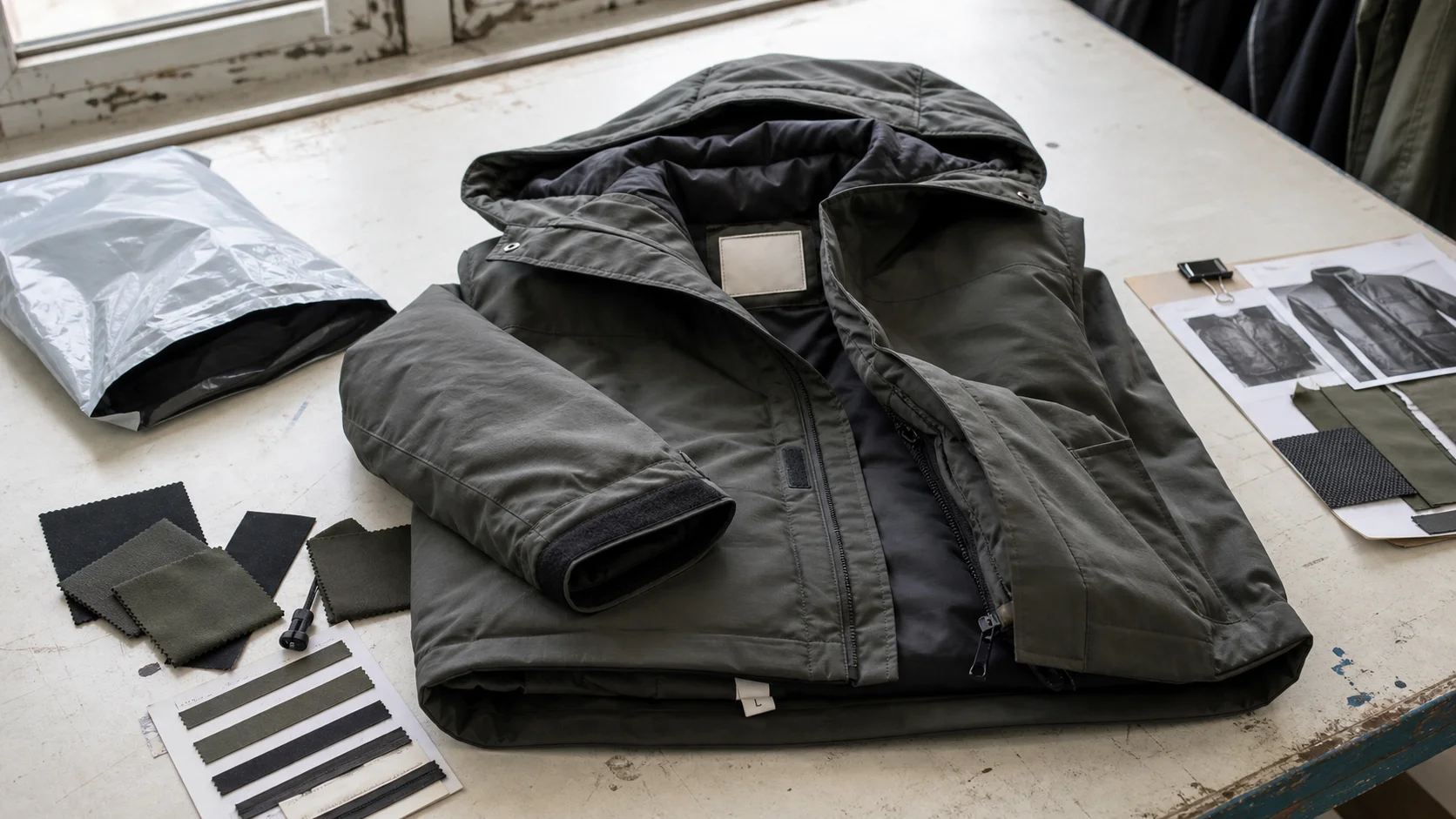
A quality and inspection-focused compliance checklist for gym program buyers sourcing custom thermal parkas, covering materials, decoration, labeling,...
Custom Thermal Parka Checklist for Gym Buyers - Quality & Inspection manufacturing guide
Custom thermal parkas look simple on a purchase order: pick a shell color, add the gym logo, choose insulation weight, and ship before the winter program starts. The real sourcing work is less tidy. A gym buyer is often purchasing for staff, outdoor training groups, coaches, athletes, retail members, or seasonal merchandise. That means the parka must be warm, durable, brand-correct, safe, legally labeled, and consistent across sizes.
A custom thermal parka compliance checklist for gym program buyers helps prevent the usual failures: jackets that arrive too late, insulation that shifts after washing, zippers that snag, embroidery that puckers the chest panel, care labels that miss required fiber content, or sizing that creates avoidable returns. In a gym environment, the garment is not only outerwear. It is part uniform, part performance product, part brand advertising, and sometimes part retail inventory.
The purchasing judgment is straightforward: if the parka is for a short promotional giveaway, the buyer may accept a simpler construction and lighter testing package. If it is for staff uniforms, outdoor coaching, winter boot camps, or paid retail, the quality and compliance bar should be higher. The cost difference is not only in fabric and insulation. It is in development discipline, inspection, documentation, and the willingness to reject weak samples before bulk production.
Buyers planning a broader apparel program can review production support options through Fabrikn services. For custom outerwear, the earlier the technical requirements are clarified, the fewer surprises appear at inspection.
Thermal parkas carry more production risk than basic T-shirts, tanks, or fleece hoodies. They use multiple layers, heavier trims, quilting or channel stitching, waterproof or water-resistant shell finishes, insulation, lining, hood components, drawcords, snaps, zippers, and branded decoration. Each added component creates another failure point.
For gym program buyers, risk usually sits in five areas: warmth claims, durability, fit, decoration quality, and documentation. A parka described as “thermal” should have a defined insulation specification. A jacket described as “water-resistant” should be supported by fabric performance targets. A garment sold to consumers should carry correct care, fiber, country-of-origin, and legal labeling for the market where it will be sold.
Good outerwear sourcing is not about adding every possible test. It is about matching testing, inspection, and documentation to the real use case, selling market, and order value.
Low-price quotations often hide missing details. A supplier may quote “polyester shell, polyfill, custom logo” without stating fabric weight, coating type, insulation grams per square meter, zipper grade, lining quality, seam construction, packing method, or acceptable tolerances. That quote may be useful for early budgeting, but it is not enough for a purchase commitment.
The first checkpoint is the program brief. Many quality issues begin because the buyer asks for a sample before defining the product properly. The factory then interprets the parka based on its own stock pattern, available fabrics, or prior customer styles. That can save time at the beginning and waste weeks later.
A gym buyer should define who will wear the parka, where it will be used, how it will be sold or distributed, and what level of warmth is expected. A staff parka for trainers walking between facilities may need moderate insulation and strong branding. A winter sideline parka for coaches may need longer body coverage, a hood, better wind protection, and more pocket function. A retail parka sold to members needs tighter cosmetic consistency because customers will compare garments on racks and online.
Typical custom thermal parka MOQs vary widely. For a fully custom cut-and-sew parka, many suppliers may require about 300 to 800 pieces per color, sometimes more if fabric dyeing or custom trims are involved. For semi-custom stock-based parkas with logo decoration, MOQs may start around 50 to 150 pieces, depending on color and size availability. Buyers should treat any unusually low MOQ for a fully custom insulated parka with caution unless the supplier is using available fabrics and existing patterns.
The tradeoff is clear. Stock-based customization is faster and safer for small programs, but offers less control over fit, fabric, and construction. Fully custom production gives better brand control, but it requires longer development, higher MOQ, and stronger inspection planning.
The fabric package is the core of a thermal parka. A vague shell description is not enough. “100% polyester” can mean a thin woven fabric, a dense taslan, a coated ripstop, a mechanical stretch plain weave, or a brushed fabric with very different handfeel and performance. The buyer should request a proper fabric and trim specification before approving a price.
Common shell fabrics for gym parkas include polyester pongee, polyester taslan, nylon taslan, polyester oxford, ripstop polyester, and coated woven fabrics. For moderate-use gym programs, shell fabric weights often sit around 90 to 160 gsm. Heavier workwear-style outerwear may use higher weights, but that can reduce softness and increase cost.
If water resistance is required, the specification should state whether the finish is DWR, PU coating, TPU membrane, or another construction. Buyers should ask for target performance, not only marketing language. For example, a basic water-resistant parka may use a DWR finish and coated backing, while a higher-spec jacket may require a water column target and seam-sealing strategy. Seam sealing adds cost and production complexity. It is not automatically needed for gym staff or general winter merchandise, but it matters for prolonged rain exposure.
Most custom gym parkas use synthetic insulation because it is more practical for bulk uniform and team programs than down. Polyester padding is common, relatively economical, and easier to care for. Typical insulation weights may range from 120 gsm to 220 gsm for moderate warmth, with heavier builds used for colder sideline or outdoor conditions. The right number depends on body length, shell density, lining, quilting design, and climate.
A buyer should specify insulation type, weight, distribution, quilting method, and tolerance. Poorly controlled insulation can create cold spots, bulky seams, uneven panels, or migration after washing. For long parkas, channel quilting or internal tack points may be needed to keep fill stable. If a smooth non-quilted exterior is desired, internal quilting or scrim-backed padding can help reduce shifting.
Lining affects warmth, comfort, and ease of movement. Common options include polyester taffeta, pongee lining, brushed tricot in selected zones, fleece-lined pockets, or mesh in limited applications. A slick lining makes the parka easier to pull over training apparel. Brushed or fleece lining feels warmer but can grab against base layers and add bulk.
Component Typical Specification Range Buyer Risk Recommended Check Shell fabric Polyester or nylon woven, about 90-160 gsm for many gym programs Weak tear strength, poor water resistance, shade variation Confirm fabric weight, coating, color standard, and test targets Insulation Synthetic padding, often 120-220 gsm depending on warmth target Uneven fill, cold spots, migration, bulky seams Check insulation weight, panel distribution, quilting, and wash stability Lining Polyester taffeta, pongee, tricot, or fleece zones Seam slippage, static, poor comfort, weak pocket bags Review lining handfeel, seam strength, and pocket construction Water resistance DWR, coating, or membrane depending on program need Overstated performance claims Define water-repellency or hydrostatic target if claimedFor technical or high-volume programs, buyers should request fabric test reports from the nominated fabric mill or approved lab. Small programs may not justify a full testing package, but the purchase order should still include measurable specifications. A basic spec sheet is better than relying on sample appearance alone.
Fit problems are expensive in gym programs because order quantities are often split across many sizes. Staff and members may wear parkas over hoodies, uniforms, compression tops, or training layers. A parka that fits correctly over a T-shirt may feel tight over a fleece. Buyers should define the intended layering system before approving measurements.
The most important measurements usually include chest width, sweep, body length, shoulder width, sleeve length, armhole, bicep, cuff opening, hood opening, neck width, and pocket placement. For long parkas, sitting comfort and two-way zipper function may also matter. A parka used by coaches or outdoor trainers should allow arm movement without pulling across the upper back.
For fully custom production, a fit sample in one base size is not enough. A buyer should normally approve a size set before bulk cutting, especially for orders with multiple gender fits or extended sizes. Size set approval helps catch grading issues such as sleeves becoming too long in larger sizes, body length jumping unevenly, or armholes becoming restrictive in smaller sizes.
Typical measurement tolerances for outerwear may be wider than lightweight apparel because padded garments are bulkier and harder to measure consistently. Even so, tolerances must be written. Common finished garment tolerances may be around plus or minus 1 cm for small points and plus or minus 2 cm for larger body measurements, depending on the measurement point and garment construction. The exact tolerance should be agreed with the supplier before production.
The purchasing tradeoff is between speed and return risk. Skipping a size set can save one to two weeks. It can also create a bulk shipment with avoidable fit complaints. For gym retail programs, size set approval is usually worth the time.
Thermal parkas depend heavily on trims. A good shell fabric cannot rescue a weak zipper, brittle snap, loose cord stopper, or poorly placed logo. Trim quality is one of the most common places where suppliers reduce cost to meet a target price.
Front zippers should be matched to garment weight. A lightweight coil zipper may work on a thin padded jacket, but heavier parkas often need stronger molded, vislon-style, or heavy-duty coil zippers. Two-way front zippers are useful for long parkas because they improve sitting comfort and movement. They also add failure risk if the zipper quality is weak or the sewing alignment is poor.
Buyers should specify zipper color, tape quality, puller design, slider type, and whether the zipper is branded or generic. If the parka includes storm flaps, snaps, hook-and-loop tape, or magnetic closures, these should be checked for alignment and durability. Hook-and-loop tape can catch on knits and collect lint, while snaps can pull out if reinforcement is inadequate.
Drawcords at the hood and hem can improve warmth, but they raise safety and compliance questions, especially for youth products. Many markets have strict rules or standards for cords and drawstrings in children’s clothing. If the gym program includes youth sizes, the buyer should review applicable drawcord requirements before sampling.
Cuffs may use elastic, rib, hook-and-loop tabs, inner storm cuffs, or adjustable snaps. Rib cuffs feel warm but can pill. Hook-and-loop tabs offer adjustability but can irritate or snag. Elastic cuffs are economical but may relax over time. The best choice depends on program use and price point.
Gym branding must be planned around insulation and fabric construction. Embroidery on a padded parka can compress insulation and create puckering, especially on lightweight shell fabric. Large embroidery may also allow water to penetrate through needle holes. Heat transfers can look clean, but adhesion depends on shell finish, coating, temperature, pressure, and dwell time. Silicone patches, woven badges, rubber patches, and reflective prints each carry different risks.
Branding Method Best Use Main Risk Approval Step Embroidery Staff uniforms, premium club identity Puckering, insulation compression, water entry Approve strike-off on actual shell and padding Heat transfer Clean logos, retail graphics, sleeve marks Poor adhesion on coated or DWR fabric Test wash, rub, stretch, and peel resistance Woven patch Classic badge look, team programs Uneven stitching, wrong placement, fraying edges Approve patch artwork and bulk placement tolerance Reflective print Outdoor training, early morning visibility Cracking, dull reflectivity, compliance overclaim Confirm reflectivity requirement and durabilityArtwork approvals should include logo size, Pantone or color reference, placement from fixed measurement points, stitch count if embroidered, backing type, and acceptable placement tolerance. A common tolerance for logo placement may be around plus or minus 0.5 to 1 cm, but this should be confirmed based on garment complexity.
Compliance is not a final paperwork exercise. It needs to be built into the product brief, supplier selection, material ordering, sample approval, and inspection plan. Gym buyers should distinguish between legal compliance, performance compliance, restricted substance compliance, and brand requirements.
Most apparel markets require accurate fiber content, country of origin, care instructions, and responsible party information depending on the jurisdiction. If the parka is sold online or in stores, product descriptions should not make unsupported claims. “Waterproof,” “thermal rated,” “eco-friendly,” “recycled,” and “reflective safety” can all create compliance risk if not backed by documentation.
Fiber content must match the actual shell, lining, insulation, rib, and trim composition where required. A parka may have multiple components, so the label should not oversimplify if the selling market requires detailed disclosure. Care instructions must reflect the weakest component, not only the main fabric. Heat transfers, coated fabrics, synthetic insulation, and faux fur trims may all restrict washing or drying conditions.
Buyers should consider restricted substance requirements such as azo dyes, formaldehyde, heavy metals, phthalates in certain components, PFAS restrictions where applicable, and other market-specific chemical rules. If the parka uses water-repellent finishes, recycled materials, coated fabrics, prints, rubber patches, or reflective trims, documentation becomes more important.
A gym does not need to become a chemical compliance laboratory. It does need to assign responsibility. The supplier should confirm applicable standards, provide declarations where appropriate, and support testing when the order value or selling market justifies it. For higher-risk markets or larger programs, third-party testing may be the safer route.
Buyers should be cautious with warmth ratings. Many custom parkas are described with loose terms such as “winter weight,” “thermal,” “heavy warm,” or “extreme cold.” Unless the program uses recognized test methods or clear internal criteria, those claims should be kept conservative. A safer product description may state the insulation type and intended use rather than promising a temperature rating.
For buyers who need help structuring documentation before production, contacting Fabrikn can help clarify what information should be collected from a supplier before order placement.
Sampling should reduce risk, not create a false sense of security. A perfect-looking sample can still fail if it uses substitute fabric, hand-cut panels, different insulation, or non-bulk trims. The buyer should always ask which sample materials are actual bulk materials and which are temporary substitutes.
A practical development process may include a reference sample, fit sample, fabric and trim approval, logo strike-off, pre-production sample, size set, and sealed production sample. Smaller orders may combine some stages, but the final approved sample should represent the actual bulk garment as closely as possible.
Sample Stage Purpose Buyer Approval Focus Reference sample Shows desired style direction Silhouette, length, features, brand expectations Fit sample Tests pattern and base size Layering comfort, mobility, key measurements Fabric and trim submits Confirms materials before bulk purchase Color, handfeel, weight, finish, zipper, snaps Logo strike-off Tests decoration on actual material Color, placement, adhesion, embroidery quality Pre-production sample Represents approved bulk construction All materials, labels, packaging, workmanship Size set Checks grading across sizes Measurement balance and fit consistencySample lead times for custom thermal parkas commonly range from 10 to 25 days per round, depending on fabric availability, decoration complexity, and factory workload. If fabric must be dyed, coated, quilted, or specially sourced, sampling takes longer. Buyers should allow time for at least one correction round. Compressing sampling is possible, but it usually shifts risk into bulk production.
Reject samples with major fit problems, unstable decoration, visibly uneven insulation, poor zipper operation, mismatched shell and lining shrinkage, rough seams, incorrect label content, or trim substitutions that are not documented. A buyer may accept minor cosmetic refinements if the factory clearly explains the correction and confirms it in the pre-production sample.
The sealed sample should be retained for inspection comparison. It should include approved fabric, approved trim, approved labels, approved packaging, and approved decoration. If the factory keeps one sealed sample and the buyer keeps one, disputes become easier to resolve.
Inspection is where many gym buyers discover whether the supplier followed the approved sample. For custom thermal parkas, final random inspection is useful, but in-line inspection can catch problems earlier. If the order is large, technically complex, or deadline-sensitive, a mid-production check may prevent expensive rework.
Before sewing, the supplier should check shell fabric shade, coating consistency, fabric defects, lining shade, insulation weight, zipper quality, snap strength, drawcord length, patch quality, and label accuracy. Fabric shade variation is a common risk when multiple rolls or dye lots are used. Buyers should require shade band approval if the order uses custom-dyed fabric.
During sewing, inspection should focus on seam allowance, quilting alignment, insulation distribution, pocket placement, zipper setting, hood attachment, cuff construction, and logo placement. Padded garments can hide internal defects until they are worn or washed. Internal seam security matters as much as external appearance.
Final inspection should occur when production is complete and most goods are packed. The inspector should compare bulk goods against the sealed sample, measurement chart, bill of materials, packing list, label artwork, and purchase order. Common inspection standards use AQL sampling plans, though the correct acceptance level depends on buyer risk tolerance and product type.
Gym buyers should be strict with functional defects. A loose thread is not the same as a zipper that fails after three pulls. Parkas are higher-value garments, and buyers should not accept defects that will create returns, staff complaints, or visible brand damage.
Parkas are bulky, so packing method affects freight cost and appearance on arrival. Vacuum packing may reduce volume but can crush insulation and create wrinkles. Flat packing protects appearance but increases carton volume. Polybag size, suffocation warnings where applicable, carton strength, carton markings, size ratio, and moisture control should all be checked.
For retail programs, barcode labels, SKU stickers, hangtags, size stickers, and folding presentation need approval. For staff uniform programs, cartons may need to be sorted by location, department, or size run. Poor packing does not only look unprofessional. It can slow distribution and create inventory errors.
Thermal parkas have longer timelines than most gym apparel because materials and trims require more coordination. A realistic production lead time for fully custom parkas may be around 45 to 90 days after sample approval and deposit, depending on fabric sourcing, order quantity, season, testing requirements, and decoration method. Sampling can add another 3 to 8 weeks if multiple rounds are needed.
Stock-based logo parkas may ship faster, sometimes in 2 to 5 weeks after artwork approval, if blanks are available. That route is useful for small gyms, franchise events, or urgent staff needs. The limitation is that the buyer has less control over warmth, fit, fabric, and color continuity.
Production Route Typical MOQ Typical Timeline Best For Main Tradeoff Stock parka with logo About 50-150 pieces About 2-5 weeks after artwork approval Urgent staff programs, small teams, events Limited control over garment specification Semi-custom parka About 150-300 pieces About 4-8 weeks depending on materials Moderate programs needing some customization Some components may remain fixed Fully custom cut-and-sew About 300-800 pieces per color, often higher for special fabric About 45-90 days after approvals Retail launches, franchises, premium uniforms Higher development burden and MOQCost is driven by shell fabric, insulation weight, lining, trims, decoration, testing, packaging, order quantity, and freight volume. Heavier insulation increases material cost and shipping volume. Waterproof construction increases fabric and seam-sealing costs. Premium zippers, reflective trims, and custom patches can make the parka look better, but they need proper testing and inspection.
A buyer should not reduce cost by weakening the front zipper, insulation stability, or labeling accuracy. Better cost levers include simplifying pocket construction, limiting custom colors, using available shell fabric, reducing oversized branding, consolidating size ratios, and avoiding unnecessary seam sealing if the garment is not marketed as waterproof.
This checklist can be used before issuing a purchase order for a custom thermal parka program. It is designed for practical sourcing control, not as a substitute for legal advice or market-specific compliance review.
For buyers comparing supplier capabilities, the background and sourcing approach described on Fabrikn’s about page can help frame the level of support needed for custom gym apparel programs.
A custom thermal parka is not the place to manage quality by appearance alone. The garment has too many hidden variables: insulation weight, coating performance, seam strength, zipper durability, label accuracy, and packing volume. Gym buyers should treat the parka as a structured outerwear program, even when the order quantity is modest.
The safest route is to define the product clearly, approve materials before production, test decoration on real fabric, use a size set for fit control, and inspect bulk goods before shipment. Buyers with tight deadlines should consider stock-based parkas with reliable decoration rather than rushing fully custom production. Buyers building a premium retail or franchise program should invest in full specification control, sample discipline, and documented compliance.
Price matters, but a cheap parka that fails in use is expensive. The better question is whether the supplier can prove the garment matches the intended use, selling market, and brand promise. A practical compliance checklist gives the buyer that control before the cartons leave the factory.
Get a free quote from Fabrikn — your trusted B2B clothing manufacturer with 10+ years of experience. MOQ as low as 200 pieces.
Get a Free Quote →It is a structured buying tool that helps gym program buyers confirm product specifications, labeling, safety requirements, fabric and trim standards, sample approvals, and inspection points before bulk production ships. It reduces the risk of wrong materials, failed decoration, poor fit, and non-compliant labels.
Stock parkas with logo decoration may start around 50 to 150 pieces. Semi-custom programs may sit around 150 to 300 pieces. Fully custom cut-and-sew parkas often start around 300 to 800 pieces per color, and special fabrics or custom trims can push the MOQ higher.
Stock-based programs may take about 2 to 5 weeks after artwork approval if blanks are available. Fully custom programs often need 45 to 90 days after final sample approval, not including early development. Fabric sourcing, testing, decoration, factory capacity, and order quantity all affect timing.
Many synthetic insulated parkas use padding in the range of about 120 to 220 gsm, depending on warmth target, body length, climate, and lining. A higher number does not automatically mean a better parka. Insulation distribution, quilting, shell density, and fit also affect warmth.
Embroidery gives a durable, premium uniform look, but it can pucker padded panels and create needle holes. Heat transfer can look clean and lightweight, but adhesion may be difficult on coated or water-repellent fabric. Both methods should be tested on actual shell fabric before bulk approval.
The main risks are broken or weak zippers, uneven insulation, wrong measurements, shade variation, poor logo placement, open seams, incorrect labels, unsafe drawcords, and crushed packing. Functional defects should be treated more seriously than minor cosmetic issues because they create returns and brand complaints.
Only if the garment is marketed or specified as waterproof or water-resistant to a measurable level. A basic winter parka may only need water-repellent performance checks. If the product claims waterproof protection, the buyer should define test methods, performance targets, and seam construction requirements.
Youth garments may be subject to strict drawcord safety rules depending on the selling market. Buyers should review applicable children’s apparel standards before approving hood or neck drawcords. Safer alternatives may include elastic shaping, fixed tabs, or compliant adjusters.
The pre-production sample should include actual bulk shell fabric, insulation, lining, zipper, snaps, labels, branding, hangtags, and packaging where possible. It should match the approved measurement chart and be sealed as the reference for production inspection.
Better cost levers include using available fabrics, limiting custom colors, simplifying pockets, reducing oversized decoration, avoiding unnecessary waterproof construction, and consolidating size ratios. Buyers should be cautious about saving money through weaker zippers, unstable insulation, inaccurate labels, or skipped inspections.