
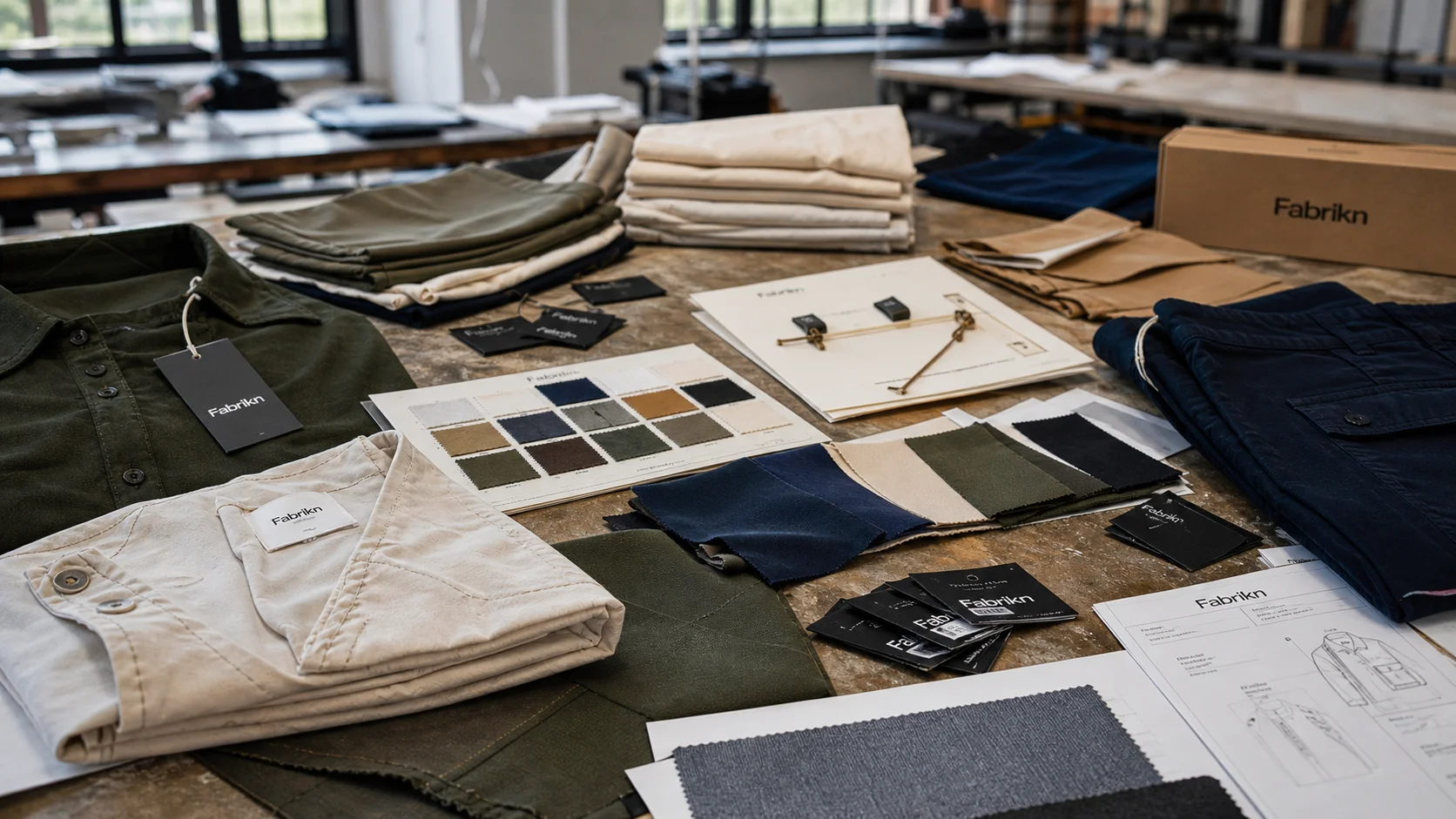
Logo Tissue Paper for Apparel with checks for samples, fit, MOQ, QC evidence, pricing terms, and delivery risk.
Fast answer: Logo Tissue Paper for Apparel: GSM, Ink, Fold Size, and MOQ should be judged by production evidence, not by a generic sourcing promise. The buyer needs sample proof, cost breakdowns, QC checkpoints, and delivery buffers in writing.
Ask for recent sample photos, measurement tolerances, fabric or print test assumptions, decoration test notes, packing examples, and a named inspection checkpoint. These details show whether the team can repeat an approved sample at bulk volume.
Separate garment cost, decoration, labels, packaging, sampling, testing, freight, and rush charges. When every cost line is visible, it becomes easier to reduce colorways, adjust size depth, or reserve more time for sampling.
The first thing a customer touches should not feel like an afterthought. I have watched shoppers lift a poly mailer, pause at plain folded knitwear, then move on with no ceremony at all. I have also seen the same tee wrapped in custom tissue paper with logo for apparel brands, folded around a sticker seal and a short note, turn a routine delivery into a small moment of theater.
That matters because the box is not what people feel first. It is the tissue. In factory visits, brands often spend $1.50 to $4.00 on rigid mailers or printed cartons and then squeeze the wrap that customers actually touch first. A branded tissue layer can cost cents per order, often around $0.03 to $0.12 depending on volume, sheet size, and print coverage, yet it shapes perceived value more than a heavier insert card or a thicker corrugate box.
Repeat purchase intent tends to rise when opening feels deliberate. Not because customers can calculate packaging economics. They cannot. They read cues. Clean folds suggest care. A logo repeat says the brand expects to be remembered. A stickered seam gives the moment structure, which is why tissue frequently outperforms pricier inserts in giftability and social sharing. The garment seems considered. The order feels less transactional.
Regional factory differences sharpen that point. In parts of Asia, I have visited converters producing lower-GSM tissue at scale, sometimes 17 to 20 GSM, with very efficient turnaround and narrow color menus. European mills, by contrast, often offer tighter color control, more consistent sheet cutting, and stronger FSC options, though the unit cost can run 15% to 35% higher once freight and duties are counted. According to Global Organic Textile Standard guidance and paper certification disclosures, buyers increasingly ask for traceable inputs even in packaging, not just in fabric.
Here’s what most people miss: brands often overspend on boxes and underinvest in tissue, even though custom tissue paper with logo for apparel brands is the first layer fingers touch. Last year I worked with a brand that shifted $1.20 from box upgrades into better tissue and a cleaner fold sequence. Carton spend fell. Customer photo rate rose. The math was unromantic, and the result was not.
Custom tissue starts as virgin fiber, recycled fiber, or a blend of both. The pulp is refined, formed into very thin sheets, pressed, calendered for a smoother surface finish, then wound into rolls before slitting and printing. That sequence sounds simple. It is not. Every step changes opacity, hand feel, and how the paper behaves on a packing table where 600 units might be folded in a single shift.
GSM is the number buyers ask about after price. A common apparel spec sits at 17 to 22 GSM. That range feels light, drapes well, and keeps cost down. Step up to 28 to 30 GSM and you get better tear resistance, less show-through, and a more substantial feel, though the paper may bulk up in cartons and add 8% to 18% to the unit cost. For a brand shipping French terry 320 GSM hoodies or structured denim, that heavier tissue can make sense. For silk blouses, the lighter sheet often looks more elegant.
Printing method matters just as much. Flexographic printing is the workhorse for high volumes, especially 10,000 sheets and up, because plates spread cost across scale. Offset gives sharper graphics and cleaner small type, which matters for monograms or fine linework. Digital printing suits short runs and sampling, especially when a brand wants 500 to 2,000 sheets in 3 to 7 days. According to ISO paper and print quality standards, consistency in registration and color tolerance is what separates acceptable packaging from wasteful scrap.
When I visited plants in Vietnam and Guangdong, I noticed the same pattern: faster lead times usually came with hard limits. Three colors instead of four. Two sheet sizes instead of five. 60% print coverage instead of full flood coverage. The trade-off is real. If you ask for everything, you get slower proofs and more rejects. If you constrain the spec, you often gain 5 to 10 days.
Sustainability choices are visible here too. FSC-certified paper, recycled content, and soy-based inks improve the profile. Metallic foils, laminations, and heavy coatings can undermine recyclability fast. I have seen brands add silver foil for a premium look and then struggle to explain why the packaging no longer fits the rest of their sustainability story. If the tissue is meant to be recycled, the finishing system should behave like it.
Specific machines make the difference. A Voith Tissue Master with Yankee dryer and a multi-nip calender gives a smoother hand. A Solno rewinder with vacuum-assisted tension control keeps sheet edges square before slit-tearing or stack packing. Flexo stations with Anilox rolls ensure consistent ink laydown—water-based, pigment-rich inks for high color strength, or ultra-low migratory ink when the tissue is near delicate garments. Coating units add light dispersion when you need matte finish or embossing rollers create subtle texture for a tactile premium.
The best tissue designs look calm. They do not shout from the fold. A logo placed at the corner of a 50 x 70 cm sheet can feel elegant on a blazer, while the same mark repeated too tightly across a 70 x 100 cm sheet can read busy and cheap. Fold style matters too. A neat half-fold around a shirt creates a stage. A crumpled fill inside a shoe box does not.
Color choices are not just aesthetic. Bright white tissue usually keeps print costs lower and makes color matching simpler, especially for brands with tight Pantone expectations. Darker bases can hide wrinkles and scuffs, which is useful in transit, but they often require more ink and tighter calibration. That can push waste up by 3% to 7% during setup. For premium accessories, I like clean white with a restrained print. For seasonal capsules, a tinted sheet can work if the warehouse packing line is consistent.
Finish changes behavior on the line. Matte feels soft and photographs well. Smooth tissue feeds faster through packing teams because it catches less on gloved hands. Embossed paper adds texture but may slow folding. Crinkle surfaces travel well through shipping because they disguise pressure marks, though they can look less formal. For DTC basics at a $20 to $60 price point, simplicity is usually strongest. Luxury outerwear at $300 and above can support a more tailored repeat, but even there, restraint wins more often than clutter.
The thing nobody tells you: a restrained logo repeat often looks more expensive than full-coverage branding, especially on thin 17 GSM tissue. One logo every 20 to 30 cm gives the eye room to breathe. It also reduces ink load and lowers the risk of muddy registration. I have seen boutique brands with a single-tone repeat outclass labels spending twice as much on all-over patterns.
For brands building packaging alongside private label clothing or pairing it with detailed product lines such as custom bra manufacturing, the packaging logic should match the collection. A capsule drop wants a cleaner sheet. A holiday set can tolerate a bolder repeat. A luxury silk scarf box needs sheet size, fold depth, and logo scale to work together, not compete.
Quotes for tissue are rarely about paper alone. The real drivers are paper weight, sheet dimensions, print colors, coverage, and order volume. On a 5,000-sheet run with two spot colors on 17 GSM paper, we saw a supplier in Guangzhou quote $0.045 per sheet, while a mill in Ho Chi Minh City quoted $0.058 once freight to Los Angeles was included. Add a third color, switch to 28 GSM, push the print coverage to 80%, and the same mills jump to $0.075 to $0.095 per sheet.
Ordering 500 units of packaging—folded sheets, sticker, and branded twill ribbon—from a Dhaka finishing house costs $2.50-4.00 per unit at 500 MOQ once you factor in poly bundles, custom sticker seals with UV varnish, and the lower labor rates on the folding line. At that low volume, digital printing with aqueous inks is the only practical route; prices fall off quickly after 1,500 units when flexo plates amortize.
On a larger 50,000-sheet run, converters expect 18-22 business days from approved artwork to container load if the paper is standard 100% recycled pulp and there is no special embossing. Expedited charges add 12% to 20% but reduce the timeline to around 12 business days. Packaging that pairs with seasonal apparel often needs that acceleration, so build the expedite budget into the capsule cost per garment.
Remember, shipping and quality inspections can add another $0.02 to $0.04 per sheet once duties, inland drayage, and inspection fees (third party QA at the port of Istanbul or Shenzhen) are factored in. The cheapest tissue is rarely the best value if you miss a recall or have to rework closures because ink bled or the tissue tore during forced folds.
Site visits tell you more than a glossy spec sheet. I recommend visiting at least one facility in Guangzhou or Ho Chi Minh City where the converters run a Voith or Metso tissue machine, and another in Dhaka for the finishing work, because the actual folding and wrapping often happens closer to the apparel assembly line. For European or Middle Eastern brands, a plant near Istanbul can provide shorter sea transit and more robust traceability.
Look for certifications for both paper and operations. GOTS and OEKO-TEX Standard 100 tell you that the inks and adhesives on the tissue meet textile-contact safety limits, while GRS (Global Recycled Standard) highlights the recycled input percentage. WRAP and BSCI audits are key when you want to ensure labor compliance; they show that the workforce handling your packaging meets internationally recognized social responsibility criteria.
Check the machines: confirm the mill has a Yankee dryer with vacuum roll cleaning, a multiple-nip calender for finish control, and a Solntt or Marquip rewinder for tight rolls. In finishing, verify that the stackers use servo-driven servo packers and that gluing stations use water-based adhesives approved for textiles, not solvent-based glues that could leave a scent on silk. Observe the folding line—manual folding stations with air knives create consistently sharp edges, while automated Mori Seiki heads reduce variability when volumes rise.
Ask for inspection reports: incoming paper roll moisture content (should be 6% to 8%), ink adhesion tests, and pull-tested stickers. Make sure every batch includes a certificate of compliance for food contact if the tissue might touch garments that later brush against skin, even if you are only wrapping over-sized firefighting gear or swimwear.
Ahead of every launch, map the packaging timeline backward from the delivery date. For international suppliers in Guangzhou or Ho Chi Minh City, allow 18-22 business days for production plus 7-10 days for ocean transit to the U.S., and another 3-5 days for customs clearance and inland trucking. That means you need paper in hand 6 to 7 weeks before the launch, longer if there are custom stickers or lamination pockets.
During peak season, maintain a 4-week reorder buffer. Instead of waiting until on-hand inventory hits zero, trigger production when you are at 60% of the minimum run rate. That usually keeps you ahead of factory capacity constraints—especially when converters in Istanbul or Dhaka are juggling apparel tissue for multiple European luxury houses and DTC startups.
Coordinate your art approvals with your manufacturing timeline. Have dielines verified by the same QC team that oversees the Converting stage. Review cardstock proofs and digital swatch cards (Pantone-coded) so you are not adjusting colors after the base paper arrives. Proof cycles typically take 3-5 business days plus 1-2 days for courier, so locking in art at least 30 days before the shipment is critical.
Factor in emergencies. Keep one extra pallet of 17 GSM white tissue with a neutral logo repeat and a roll of matching sticker film. That “emergency kit” buys you time if a main run hits a printing glitch, or if you pivot to a pop-up where you need fast packaging without fresh art approval.
First, quantify how many tissue sheets you really need per launch: multiply SKU units by the average number of folds, add 5% for overstock, and always plan for a small test run before the big drop. Second, verify the supplier’s certifications, especially GOTS, OEKO-TEX Standard 100, GRS, WRAP, and BSCI, so you can speak confidently about compliance in investor or retailer briefings.
Third, align your timeline with the converter’s production schedule. If they quote 18-22 business days, do not ask for same-week shipping unless you are ready to fund expedited air freight. Fourth, keep an open line with your converter in Guangzhou, Dhaka, Ho Chi Minh City, or Istanbul—weekly updates on diecut delivery, moisture content, and ink densities keep you ahead of problems.
Lastly, pilot a simple custom design before scaling. A two-color logo on a 50 x 70 cm sheet printed in a flexo press often delivers a better return than a rushed, full-coverage design that squeaks through QA only to tear or smear in transit.
Yes. Digital printing partners in Istanbul, Dhaka, and Guangzhou can handle 500-sheet runs, typically charging $2.50-4.00 per finished unit when you include stickers and custom folding. For smaller art tests, you can even go under 500 sheets, but expect higher per-unit pricing because the printer still needs to set up plates or print heads.
For converters running standard 17 GSM white tissue with a two-color flexo print, expect 18-22 business days from design approval to container loading, assuming the mill has capacity. Rush orders can come in as fast as 12 business days at a 12% to 20% premium. Always confirm the timeline before confirming your launch date.
Ask for documentation for GOTS and OEKO-TEX Standard 100 if the tissue touches skin-friendly garments, GRS if you want recycled content, and WRAP or BSCI for social compliance. Some mills also provide FSC Chain of Custody and ISO 9001 quality management certificates. These credentials ensure you can transparently talk about sustainability when presenting to retail partners.
Yes, but be cautious. Metallic foils or holographic laminates require extra finishing steps like cold foiling or UV coating, which add 12% to 25% to the unit cost and hurt recyclability. If you use foil, coordinate with a finishing warehouse that runs a cold foil unit near the folding line and stores foil rolls in humidity-controlled racks to prevent curl.
Work with a converter that uses calibrated spectrophotometers (X-Rite or Pantone spectro) and keep a log of the Pantone numbers plus ink density values (L*a*b) in each batch. A Pantone-matched swatch card is essential before full production. For critical colors, request an ink drawdown on the actual paper stock to see how the hue behaves at the expected GSM.