
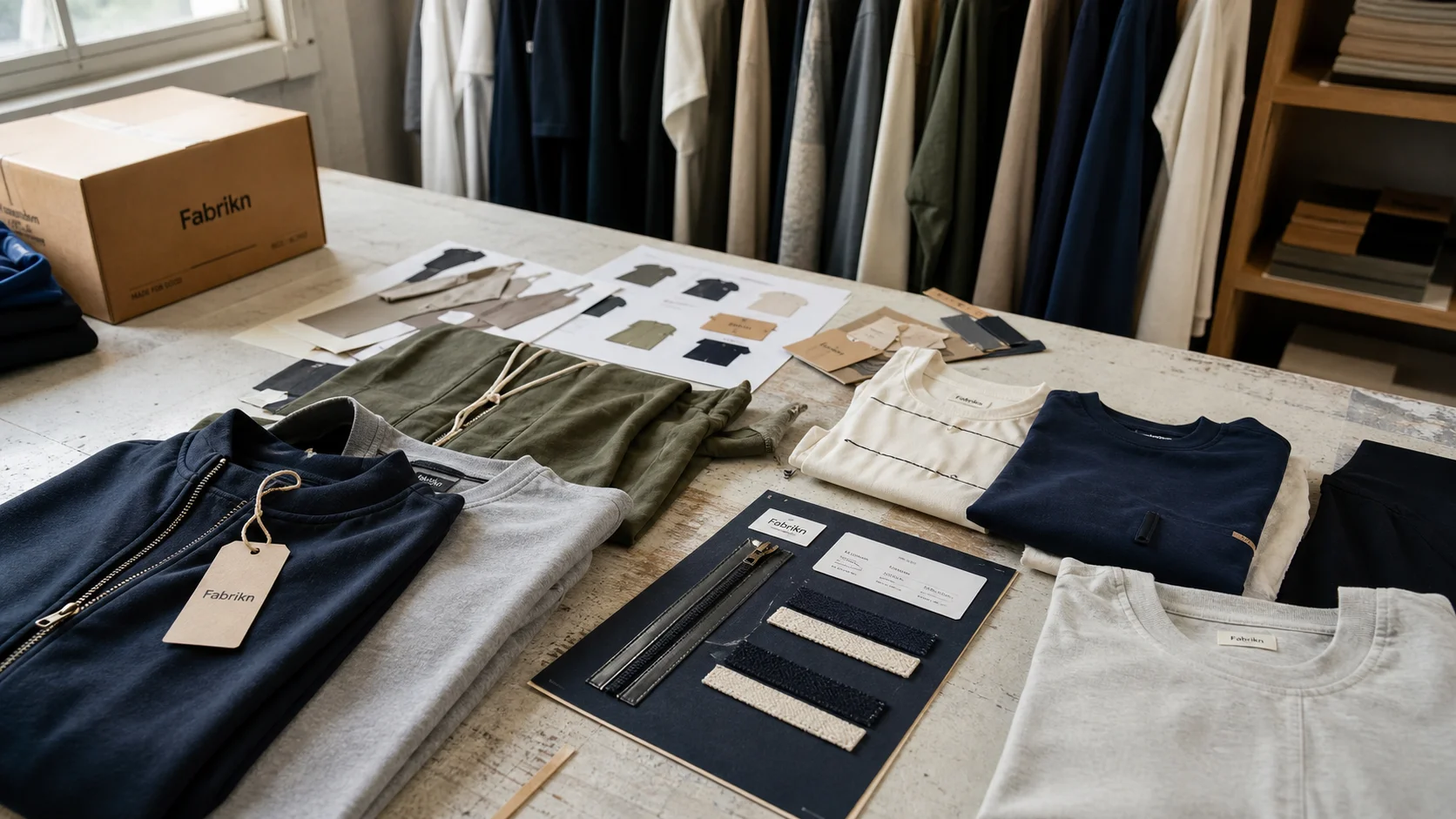
Custom Tissue Paper with Logo for Apparel with checks for samples, fit, MOQ, QC evidence, pricing terms, and delivery risk.
Fast answer: Custom Tissue Paper with Logo for Apparel: What Retailers Pay should be judged by production evidence, not by a generic sourcing promise. The buyer needs sample proof, cost breakdowns, QC checkpoints, and delivery buffers in writing.
Ask for recent sample photos, measurement tolerances, fabric or print test assumptions, decoration test notes, packing examples, and a named inspection checkpoint. These details show whether the team can repeat an approved sample at bulk volume.
Separate garment cost, decoration, labels, packaging, sampling, testing, freight, and rush charges. When every cost line is visible, it becomes easier to reduce colorways, adjust size depth, or reserve more time for sampling.
I once stood in a Vietnam packing line watching 3,000 folded shirts disappear into plain poly bags. The stitching was clean. The handfeel was strong. Still, the bundle looked cheaper than it was because the first thing anyone saw was plastic, not care. That is where custom tissue paper with logo for apparel starts doing real work: one more touchpoint, one more signal, one more reason to place the garment in a better price tier.
Price changes the whole read. A $28 tee can survive a simple fold, a barcode sticker, and a poly mailer. Put the same treatment on a $128 knit and it suddenly feels underbuilt. At $28, packaging has to say clean and organized. At $128, it has to say restraint, detail, and control down to the fold width. Same garment, different expectation. Retail buyers notice the box, the tissue, the crease. Then they notice the seam allowance.
Premium packaging matters more on lower-priced apparel than many founders expect. A small tissue spend can protect margin better than a blanket discount because it lifts perceived value without pushing freight much. A single 17-22 gsm sheet adds only a few grams, yet it changes what buyers see in the box or bag. I have stood in packing rooms where the tissue cost was under $0.06 per unit and the lift was far bigger than a $2 markdown.
There is a practical side too. Tissue hides transport wrinkles, reduces abrasion on brushed fleece, and keeps returns from looking like worn goods when a customer opens the package again. It also makes gifting easier and gives social sharing a little more reason to happen. People photograph presentation before they photograph composition.
According to trade.gov apparel trade guidance, apparel trade stays brutally price-sensitive across markets. That is exactly why visible brand cues matter. When the product looks similar, the package becomes part of the difference. I have worked with labels that chased weak sell-through with markdowns, only to find that a modest packaging investment delivered a cleaner route to perceived value. Packaging spend of cents, not dollars, can defend margin better than a deeper discount.
Paper grade is where many teams underbuy. Common weights are 17 gsm, 22 gsm, and 30 gsm. At 17 gsm, tissue feels light and economical, but it tears more easily during folding, especially on sharp corners or when operators move fast. At 22 gsm, opacity improves and rips show up less in shipment. At 30 gsm, the sheet feels more substantial and handles large prints without looking flimsy. For pressed shirts, soft tailoring, or denim accessories, that extra thickness matters more than most design teams think.
Print method changes both cost and detail. Flexographic printing fits high-volume repeat logos and 1-color patterns, especially once orders hit 5,000 sheets and beyond. Offset handles sharper lines, tighter registration, and multiple colors, though it tends to make more sense at mid-size runs. Digital printing works for low minimums, seasonal tests, and complex artwork with gradients, but the per-sheet cost climbs fast. I have seen brands burn cash by using digital for a simple 1-color mark that could have been flexo at 20% to 40% less per unit.
Single-color printing usually gives the best unit economics. A 1-color logo can cut cost by 20% to 40% versus full-coverage printing because it uses less ink, fewer plates, and less setup time. Full bleeds look dramatic, but they add ink coverage, drying time, and more spoilage during startup. Strong logos do not need to shout across every inch of the sheet. They need to repeat cleanly at 2-inch or 3-inch intervals and stay legible after folding.
Finish choices carry trade-offs. Matte tissue reads more premium to my eye because it looks softer on shelf and photographs well under store lighting. Coated or specialty finishes can add visual punch, but they may slow production, add 7-10 days of lead time, or reduce recyclability if the coating does not fit paper recovery. Recycled content and FSC certification matter because they back up the claim, not just the mood. Acid-free paper also helps protect pale garments from discoloration over time, which matters for white shirting, silk blends, and knitwear sitting in inventory for 3-6 months.
According to FSC, certified fiber is traced through documented supply chains, not guessed at. I ask for that paperwork because “eco” means very little without verification. If you are buying custom tissue paper with logo for apparel from a manufacturer, the best spec is usually the one that balances opacity, print clarity, quality, and packing speed rather than the one that looks most expensive on a sample table. The garment sits inside the paper. The paper should protect it, not compete with it.
Pricing moves sharply with quantity, and teams underestimate that constantly. For runs of 500 to 1,000 sheets, unit prices often land around $0.18-$0.35 per sheet depending on size, ink coverage, and paper weight. At 3,000 to 5,000 sheets, that can fall to $0.08-$0.16. At 10,000 to 25,000 sheets, bulk pricing may dip to $0.04-$0.09, especially for a simple 1-color repeat. I have had a factory quote $140 in setup plus $0.21 per sheet on a short run, then cut that to $0.07 when the order scaled.
Setup charges are fixed. Plate fees, die preparation, proofing, and machine calibration can add $75-$400 before the first usable sheet appears. On a 500-sheet order, a $250 setup fee adds $0.50 to every sheet. On a 10,000-sheet order, it adds only $0.025. Low quantities get expensive fast. The design looks cheap on a spreadsheet until the fixed costs are split across a tiny batch.
Domestic and overseas sourcing change the math in a less obvious way. A local supplier may quote $0.12 higher per sheet, but a domestic order can arrive in 5-7 days instead of 20-35 and dodge pallet freight, customs delay, and rework risk. Overseas pricing can look tempting, especially from China, where paper converting capacity is strong and plate costs can be lower. Freight on a short run can erase the savings. I have seen a $300 production advantage disappear into a $420 shipping bill on a 1,500-sheet order. Painful lesson. Usually learned after approval.
Hidden costs stack quickly. Color matching can add $40-$120 if Pantone development is needed. Sampling can cost $25-$80 before approval. Corrugated packing, carton labels, and warehouse receiving may add another $0.01-$0.03 per sheet. Need individual packs, shrink bundling, or moisture protection? Add more. A brand storing tissue for 6 months in a humid warehouse may also need better carton liners. None of that is glamorous. All of it protects quality.
The thing nobody tells you: the cheapest quote is often the most expensive once spoilage, reprints, and missed ship dates are counted. I have watched a “low cost” vendor lose 8% of a run to registration drift and paper jams, then charge for a second print. The true cost was 2.5x the first quote.
When I advise teams on cut and sew manufacturing, I point out that packaging should be costed like any other production input, not treated as a branding afterthought. If your tissue order supports 2,000 garments and prevents 1% damage or return confusion, it is already doing part of the margin work. For a fast response on pricing, you can request a custom tissue paper quote for apparel packaging and compare a small pilot with a larger seasonal buy before you commit to scale.
Luxury labels treat tissue as ritual. Usually 22-30 gsm, often printed in one soft color or a restrained repeat, folded around the garment with near-ceremonial precision. The point is not volume. It is tension and release. Open the box, then the tissue, then the garment, and each layer says the same thing: this was handled with intent. In that tier, I have seen packaging budgets reach $1.50-$4.00 per order without a second thought. The margin can take it.
Mid-market fashion uses tissue differently. The goal is to show care without letting packaging cost chew through margin on a $48 blouse or $79 trouser. A crisp 17-22 gsm sheet, a clean 1-color logo, and consistent folding can be enough. I have walked packing rooms in Portugal and Los Angeles where a simple tissue sheet stabilized brand presentation better than a pricier hangtag. Customers see the tissue before the hangtag, before the inner label, sometimes before the product. That sequence matters.
Fast-moving basics are the skeptical crowd, yet they often gain the most. A $5 tee and a $150 blazer do not need the same packaging density, but both need order. Basics brands use tissue to protect pressed garments, reduce abrasion, and keep high-volume packing lines consistent. In a line moving 1,200 units a day, a standard sheet size can shave seconds off every pack and reduce folding variation across operators. Small move. Big month-end difference.
Regional preference shows up in the samples I collect. European brands tend to like recycled texture, softer print contrast, and a slightly muted white that reads honest instead of glossy. Some US labels prefer sharper logo contrast and brighter stock because they want the mark to pop in e-commerce photography. Neither is universally right. Product category, retail environment, and how much of the package customers keep decide most of it.
When I visited a knitwear factory in Spain, the pack team showed me how tissue reduced abrasion on brushed merino and kept collars from deforming after 14 days in carton storage. That is packaging value a sticker cannot match. A sticker sits on top. Tissue supports the shape before the garment is removed. For brands building private label clothing services, that difference can separate a product that arrives merely intact from one that arrives looking considered.
Tissue is small by weight, but it is not invisible in impact. A standard apparel pack may use 2-6 sheets, and the difference between virgin and recycled fiber matters when you scale that across 50,000 units. Compared with plastic wraps and foam inserts, paper tissue is usually easier to recycle and more likely to be disposed of properly by consumers. Still, a green claim means nothing without documentation. I ask suppliers for recycled content statements, FSC paperwork, and a clear spec for gsm and fiber source.
Ink choice matters too. Soy-based and water-based inks are often favored because they can reduce volatile compounds and print cleanly on tissue, though the exact environmental profile depends on formulation and cleaning practices. Conventional inks may still be used for sharper contrast or speed, but buyers should ask whether the ink is compatible with paper recovery and whether it changes odor or rub-off on light-colored garments. If the print smears during folding, the sustainability story does not help the customer.
According to OEKO-TEX, material claims should be backed by testing and traceability, not marketing language. That standard works for tissue as much as fabric. If a vendor says “recycled,” I want the percentage. If they say “eco-friendly,” I want the paper spec and the certification. Vague language may sell a sample. It does not survive procurement.
Factory scrap is the silent problem. Offcuts, overprints, and startup waste can quietly add 3% to 8% extra material use if quality control is weak. I have watched a supplier discard entire print starts because the first 200 sheets were misregistered by a few millimeters. Better QC, tighter file prep, and proof approval reduce that waste sharply. If your supplier cannot explain how it handles spoilage, you are not buying sustainable packaging. You are buying a claim.
I stay cautious with green marketing because too many brands use it as decoration. Tissue with recycled content and verified certification is a solid choice, but only if the supplier can show paper mill paperwork, ink data, and production records. The same discipline applies when I review fabric mills for cut and sew manufacturing. If a factory cannot document its inputs, the claim should stay off the hangtag and off the website.
The first documents I request are simple: a spec sheet, a digital proof, any relevant certification, and a lead-time commitment in writing. If those four items are missing, I move carefully. A good spec sheet should show sheet size, gsm, print color count, finish, tolerance, and packing format. The proof should show repeat pattern scale and trim margins. The lead-time commitment should state sample timing and production timing separately. Suppliers that blur those steps often blur deadlines too.
Supplier type changes the buying experience. Domestic converters usually offer faster sampling, easier communication, and lower freight risk, with minimums that may start at 500 or 1,000 sheets. Overseas suppliers often bring lower unit cost and more printing capacity, but they may ask for 5,000 to 10,000 sheets and 20-35 days for production. If your season is tight, speed wins. If your volume is stable and your artwork is simple, overseas can make sense. I have seen both work well. I have also seen both fail for the same reason: poor file prep.
From samples, I judge color accuracy first. Does the logo hit the right Pantone, or drift warmer, cooler, or flatter than the brand guide? Then I check repeat registration across several sheets. A logo that shifts by 2-3 mm may be acceptable for a casual label, but it reads messy in a luxury box. Next comes folding performance. Does the tissue crack on creases? Does it tear when wrapped around a blazer shoulder? If yes, the paper grade is wrong or the print load is too heavy.
Turnaround promises deserve skepticism when files are not ready. A supplier may say 10 days, but if the artwork lacks bleed, repeat alignment, or print-safe vector files, the clock resets. I ask for PDF, AI, or EPS files, not screenshots. I also ask whether the factory can share production photos or video from a live run. That request tells you a lot. A supplier that welcomes visibility usually has tighter control over tolerance and packing. If you are comparing a manufacturer, factory, or supplier in China or elsewhere, ask for the same evidence each time.
For buyers building a wider apparel assortment, it helps to browse our product catalog of custom apparel packaging options alongside packaging specs, because tissue choices should fit the garment line, not sit apart from it. A crisp shirt program may need different pack behavior than a fleece capsule or a blazer range. That alignment saves time, and time is money when you are placing wholesale and bulk seasonal orders.
Start with a controlled pilot. I would rather see a brand test 1,000 to 2,000 sheets on one category than rush to 20,000 sheets and find the logo is too dark or the fold is awkward. Build a checklist before you order. Confirm sheet size, gsm, print count, Pantone target, proof timing, packing format, carton count, MOQ, and delivery window. If the tissue is part of a new launch, pair it with your garment calendar so sample approval does not collide with production packing.
Artwork prep deserves real discipline. Set files in vector format where possible, keep text outlined, and leave bleed around the repeat. If the print is one color, define the Pantone number early. If it is multiple colors, confirm how many plates or passes the supplier will need. I have seen brands save 7-10 days by sending print-ready files instead of a flat JPEG. That delay matters when the goods are already in transit and the warehouse is waiting on pack-out materials.
Timelines are usually more predictable than people think. Sampling can take 3-7 days domestically or 7-14 days overseas. Production may take 5-10 days for a short run or 15-25 days for a larger order. Transit adds another 2-5 days locally or 20-35 days internationally. Warehouse receiving and QA can take 1-3 days after arrival. Build that into the launch schedule, because tissue that arrives late is not a packaging solution. It is a bottleneck.
If you need supplier support early, private label clothing services can help align garment packaging with the rest of the line. That matters when brands are balancing retail, e-commerce, and wholesale deadlines at once. I have watched the best teams treat tissue as part of the pack architecture, not a last-minute add-on.
My blunt advice: treat packaging like part of the product, not a ribbon tied around it at the end. If custom tissue paper with logo for apparel supports margin, speeds packing, and makes the garment easier to remember, keep it. If it does none of those things, cut it back and spend the money where customers will actually feel it.
Small runs of 500 to 1,000 sheets often land around $0.18-$0.35 per sheet, while 10,000-plus sheets can drop to $0.04-$0.09 depending on paper weight, print colors, and packing format. Setup fees of $75-$400 can change the real unit cost a lot on low quantities.
Sampling usually takes 3-7 days domestically or 7-14 days overseas. Production often runs 5-10 days for short runs and 15-25 days for larger orders, with transit adding 2-5 days locally or 20-35 days internationally.
Most apparel buyers choose 17 gsm, 22 gsm, or 30 gsm. I usually recommend 22 gsm for a balance of opacity, tear resistance, and fold performance, while 30 gsm works better for heavier garments or premium presentation.
Yes, if the supplier can document recycled content, FSC certification, and ink type. Paper tissue is generally easier to recycle than plastic packaging, but vague “eco” claims are weak unless backed by paperwork and production records.
Ask for a spec sheet, proof, certification, lead-time commitment, and sample photos from production. You should also confirm sheet size, gsm, print method, Pantone targets, MOQ, and minimum order quantity before approving the first run.