
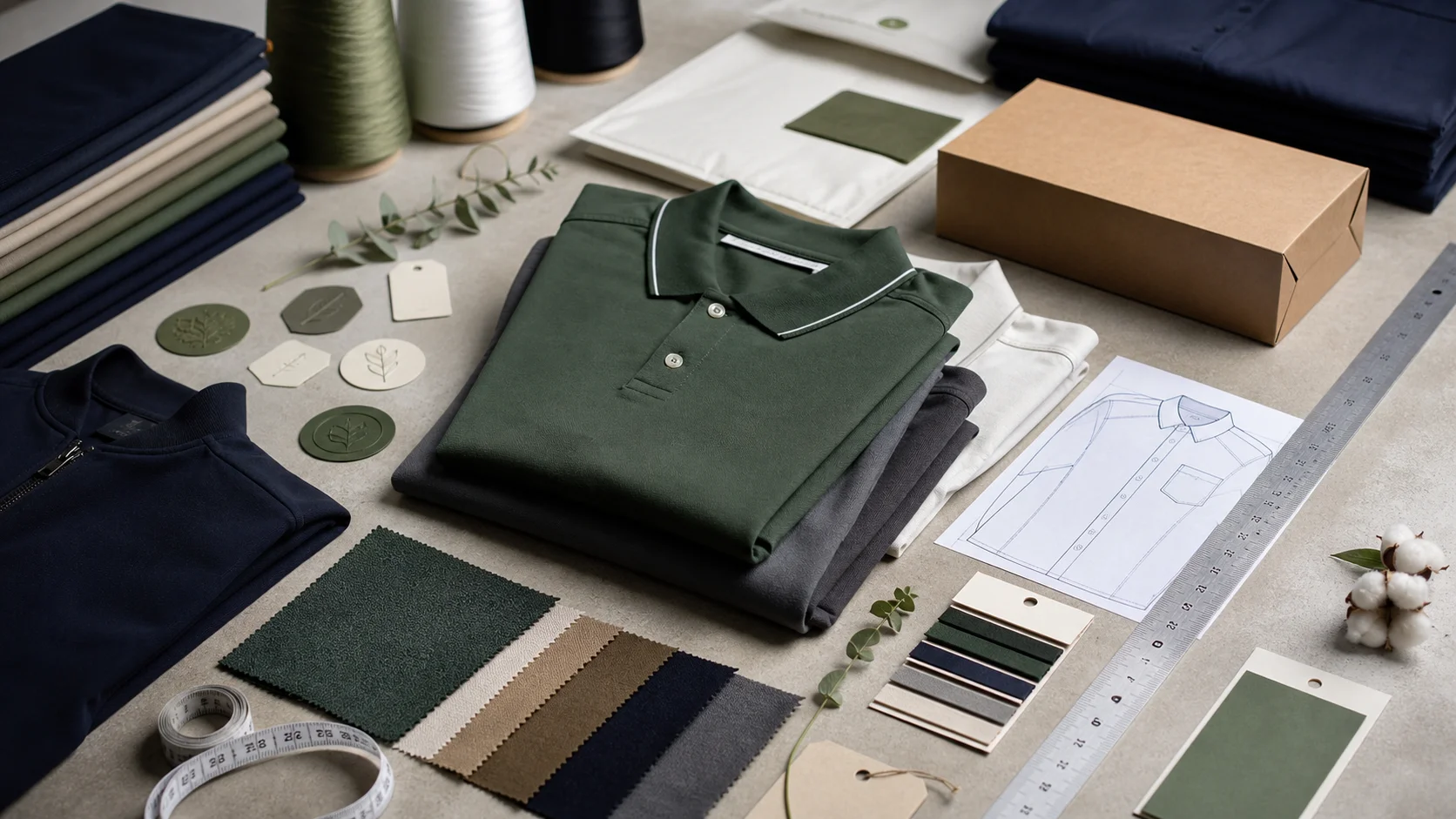
Logo Tissue Paper Buyer Checklist with checks for samples, fit, MOQ, QC evidence, pricing terms, and delivery risk.
Fast answer: Logo Tissue Paper Buyer Checklist: GSM, Ink, Fold Size, and MOQ should be judged by production evidence, not by a generic sourcing promise. The buyer needs sample proof, cost breakdowns, QC checkpoints, and delivery buffers in writing.
Ask for recent sample photos, measurement tolerances, fabric or print test assumptions, decoration test notes, packing examples, and a named inspection checkpoint. These details show whether the team can repeat an approved sample at bulk volume.
Separate garment cost, decoration, labels, packaging, sampling, testing, freight, and rush charges. When every cost line is visible, it becomes easier to reduce colorways, adjust size depth, or reserve more time for sampling.
The parcel starts talking before the garment does. Across packing tables in Los Angeles and Ho Chi Minh City, one pattern keeps repeating: presentation shapes perceived value more quickly than many brands like to admit. For apparel teams, printed tissue paper with logo for clothing orders is the easiest way to make an order feel considered the moment it is opened. A modest logo sheet can move a $35 tee into “giftable” territory. Plain tissue? It vanishes the second the item comes out.
Factory floors make the contrast obvious. I’ve stood in places turning out $80 knitwear and $12 basics, and the sharper parcel wasn’t always attached to the pricier item. Some brands pour money into French terry at 320 GSM, enzyme washes, and custom neck labels, then send the order out in a blank polybag with a crushed insert. That mismatch lands badly. The box is the first proof that the brand pays attention.
Package-design studies consistently show that presentation shifts perceived value and shareability. Apparel follows the same rule. Customers open the parcel before they inspect seam allowance or stitch density. Fold. Tissue. Print sharpness. Logo placement. Those are the details they register first. A clean branded wrap can buy 10 to 20 extra seconds of attention — an eternity in e-commerce.
Low cost, high visibility. That’s the appeal. Printed tissue paper with logo for clothing orders often lands below $0.08 to $0.25 per order, depending on sheet size, ink coverage, and whether the MOQ is 500 or 5,000. Plenty of brands spend on a premium carton and skip the one surface customers actually touch first. Backwards.
During export-factory visits in Vietnam and Portugal, I kept seeing the same thing: the strongest unboxing moments came from brands that controlled the sequence. Tissue. Sticker. Card. Fold. Deliberate, not loud. A plain $7 modal tank looked more considered when wrapped properly, while a $120 wool item could feel unfinished if the box opened to loose folds and empty space.
There’s a practical side too. Printed tissue paper with logo for clothing orders protects folded garments from abrasion, dust, and transfer marks during a 3-4 week transit window, and it helps reduce return complaints tied to creased presentation. The sheet is small. The effect isn’t. In a business where one repeat order can offset 20 to 30 weak impressions, that’s cheap insurance.
Printed tissue paper with logo for clothing orders is not one product. It’s a set of tradeoffs. Common weights: 17 gsm, 18 gsm, 22 gsm, 30 gsm. At 17 gsm, the paper feels light and elegant, but opacity is limited and fold strength is modest. 22 gsm gives better tear resistance and less show-through. 30 gsm feels more substantial, though a parcel can start looking bulky if the garment already carries weight.
Opacity matters more than most buyers expect. A pale blush logo on 17 gsm tissue can vanish once folded. Black or navy usually reads cleaner on thin stock because contrast does the work. Darker logos can look stronger on thinner tissue, while pale pastels need better opacity or a heavier sheet to avoid that washed-out look. I’ve seen brands approve a soft sage print on screen and then reject it on paper because the sheet drank too much light.
Ink choice changes everything. Water-based inks generally sit softer on the sheet, while soy-based systems can offer solid coverage with lower odor, though drying time has to be managed. Coated tissue gives sharper edges and a slightly glossier finish, but many brands prefer uncoated paper because it feels more natural and folds more predictably. Fine lines need discipline. A logo with hairline serifs or tiny taglines can lose detail if registration drifts even 1-2 mm.
According to AATCC, print and color evaluation in textiles depends heavily on controlled viewing and repeatability, which is exactly why tissue proofs should be checked under the same lighting every time. I ask for a daylight inspection, then a warm retail-light check, because tissue that looks crisp in the sample room can turn muddy in a boutique fitting room.
Acid-free paper is worth specifying for premium clothing orders, especially if garments may sit in storage for 60-90 days. Recyclable claims need care too. Paper may be recyclable, but heavy ink coverage, metallic foils, and adhesive residue can complicate the claim. Print registration often affects premium perception more than the logo itself. A logo sitting 3 mm off-center reads like a mistake, even when the stock is excellent.
For brands using sublimation printing services on garments, the lesson carries straight across: color consistency is a system, not a lucky break. Tissue, swing tags, and the garment print should share the same Pantone logic. If the shirt is dialed in and the tissue drifts, the package feels split-brained. Small details. Big verdict.
Pricing changes fast once you move from samples to production. At 500 pieces, I’ve seen brands pay nearly $0.42 per sheet. At 5,000, it often falls to $0.11-$0.18. At 10,000, $0.07-$0.12 isn’t unusual, depending on size, print color count, and finishing. The sharpest savings usually show up after the MOQ is crossed.
Here is the range I use in buyer negotiations:
Those are bands, not promises. Plate fees, screen charges, die setup, folding, and carton packing all move the number. A one-color logo on 50 x 70 cm paper is far cheaper than a full-bleed repeat on a custom size. Shipping can fool people too. A pallet of tissue is light, but not free, and air freight can wipe out a low unit price in a hurry.
Asia usually delivers the lowest unit costs. In factories I visited in China and India, labor was small and the print infrastructure was already in place, so the price often favored brands buying 5,000 sheets or more. Local production in Europe or North America can cost 20-45% more per sheet, but lead times may tighten to 7-14 days instead of 3-6 weeks, which helps when replenishment is urgent.
Trade data from trade.gov shows how freight volatility can distort landed cost, especially for low-density goods that are cheap to make and expensive to move relative to value. I’ve watched a $0.09 sheet become a $0.15 landed line item once express shipping, customs brokerage, and split cartons were added. That’s why small brands overpay most. They sit below the curve.
When a brand also runs private-label programs, the packaging math should sit beside garment sourcing. I often pair tissue negotiations with private label clothing services planning, because both depend on forecasted volume, not hope. If your line is 300 units per color and 4 colors deep, buying 1,000 sheets may make more sense than 5,000, even if the unit price is higher, because dead stock in packaging is still dead stock.
Regional quirks matter. Local printers may move faster, but they often charge higher setup fees for small runs. Asian suppliers can look cheaper on paper, then add export cartons, inner bundling, and port documentation. The real price is the delivered price, not the quote. I ask for it in writing every time.
Supplier vetting starts with samples, not promises. I ask for print samples on the exact paper weight, shade tolerance notes, curl behavior after folding, and consistency across at least 20 sheets. If the tissue waves at the edges or springs open after creasing, it will slow packing and annoy staff. Speed on the packing floor matters when teams are handling 200 to 800 units a day.
Ask for a pre-production proof, photos of live production, and references from at least 2 past clients. Stock images tell you nothing about registration accuracy or bundle packaging. I want to see the press running, the trimmed stacks, and the cartons sealed. Hidden plate changes are a red flag. So are vague answers about “same quality” when you ask whether the logo will be printed on the front, back, or both.
Smudging is the obvious failure. Uneven cuts are the quieter one. A sheet cut 2-3 mm off can wreck fold symmetry across a carton of 500 pieces. Weak packaging of the tissue bundles also causes trouble because the edges fray in transit, especially on humid routes. I’ve opened boxes in Manila and Marseille where the first 30 sheets were fine and the next 20 had corner dents from loose stacking.
The thing nobody tells you: if a supplier cannot show you a production photo with your exact paper spec, they are often quoting from memory, not from a machine schedule.
There are three supplier types. Printers usually give the best control over ink and registration. Packaging brokers can source faster but may add margin and lose visibility. Garment manufacturers who resell tissue can be convenient, especially if you are already using cut and sew manufacturing, but they are not always the best at print detail. The right choice depends on whether your priority is cost, speed, or visual precision. For a true custom program, ask whether the factory is a manufacturer, a trading company, or a hybrid supplier in China, and how production is handled from proof to carton.
Packaging layers do different jobs. Tissue creates the first visual field. Stickers seal. Ribbons signal gifting. Belly bands carry information. If you only choose one, tissue usually wins for folded apparel because it covers more surface area without shouting. A branded sheet can make a box feel curated in 2 seconds, while a sticker usually registers as functional first and decorative second.
My rough comparison, based on factory quotes and packing studies, looks like this:
For premium basics, I like tissue plus a small sticker. For DTC basics, tissue plus a clean insert card usually beats ribbon because ribbon adds labor without enough payoff. For gifting, tissue, ribbon, and a card can justify a higher box price, but only if the fold is precise. For wholesale cartons, a belly band can do the work of 3 loose elements while staying efficient. Many wholesale buyers also ask for bulk packing to reduce handling and protect quality during transit.
Here’s what most people miss: cheap-looking add-ons can weaken a premium brand more than no add-on at all. I’ve seen a $60 sweatshirt lose credibility because the ribbon looked like party supply stock. The brand would have been better off with only tissue and a sharp hangtag. In packaging, restraint often reads richer than excess.
This is where the garment category matters. Heavy fleece, tailored shirts, and structured outerwear usually tolerate more layers. Light jersey, babywear, and minimalist basics need calmer packaging. A brand working on custom baby clothing manufacturing may want softness, fewer adhesives, and no strong scent from inks or glues. The best add-on is the one that fits the product, not the one that looks busy on a mood board.
Eco claims should be verified, not borrowed. Ask for recycled content percentage, FSC certification, and confirmation that the inks are recyclable or at least non-toxic under the supplier’s stated system. The FSC standard matters because it ties paper sourcing to responsible forestry, not just marketing language. I also check whether the tissue is acid-free and whether the printer can document the mill, not only the broker.
Sustainability language behaves differently by price point. Luxury buyers often expect proof and will pay attention to certified paper, while budget shoppers care more about clean presentation and whether the tissue tears during packing. A $14 top wrapped in brittle “eco” tissue feels worse than a non-eco sheet that folds properly. Performance comes first. Messaging comes second.
Overclaiming compostability is a trap. Unless the whole supply chain supports it, that claim can backfire. In some regions, the tissue may be recyclable, but mixed inks, foil accents, and adhesive dots complicate disposal. I’ve also seen poorly made “eco” tissue create more waste through tears and re-packing, which cancels the headline claim. A sustainable material that fails 15% of the time is not sustainable in practice.
For brands comparing responsible sourcing programs, third-party standards can help frame the conversation. Textile Exchange offers useful context on preferred materials and fiber traceability at textileexchange.org, while OEKO-TEX explains chemical safety testing at oeko-tex.com. Those references do not replace supplier audits, but they do help buyers ask better questions.
My 7-day buyer plan is straightforward. Day 1, measure the folded garment and box depth. Day 2, choose sheet dimensions, usually 50 x 70 cm or 60 x 90 cm. Day 3, set one or two print colors and confirm Pantone references. Day 4, request quotes from 2-3 suppliers on the exact same spec. Day 5, approve a sample. Day 6, verify MOQ, lead time, and carton counts. Day 7, place the PO only if the proof matches the fold.
Before you buy, confirm the sheet count per order, the folding method, the paper weight, and whether a backup stock color exists if the press runs late. Ask for a written timeline: brief to proof in 2-4 days, production in 5-12 days, packing in 1-3 days, delivery by air or sea in 3-30 days depending on route. Fast claims without dates are not plans.
Compare 2-3 suppliers on the same spec. That is how hidden costs show up. One quote will include plates, another will split shipping, and a third will quietly downgrade paper weight. I have saved clients $180 to $900 per run by forcing identical comparisons. A sample run is cheap insurance. Order it before full carton volumes, because tissue that looks good online can behave very differently in hand.
In practice, the winning choice is the supplier who can repeat the same result 3 times, not the one with the slickest PDF. Consistency beats flair. Every time. For brands ordering from a factory or supplier in China, it is worth confirming how production QC, packing, and export cartons are handled before you release the deposit. Printed tissue paper with logo for clothing orders works best when the spec is tight and the follow-through is tighter.
Most buyers pay $0.07-$0.25 per sheet at scale, with small runs landing closer to $0.18-$0.42. At 500 sheets, setup charges and plate fees can add $35-$90 to the order. At 5,000 sheets, the unit cost usually drops sharply.
MOQ is often 500 to 1,000 sheets for simple one-color prints, though some suppliers ask for 2,000 or more if the artwork is complex. If you need custom size, foil, or multiple colors, expect the MOQ to rise. Always confirm whether the MOQ is per design or per sheet size.
Typical production time is 5-12 days after proof approval, then 3-30 days for delivery depending on shipping method and region. Local suppliers can move faster, sometimes in 7-14 days total. Overseas freight can add 1-4 weeks.
Usually yes, if the tissue is plain paper with recyclable inks and no heavy foil or adhesive contamination. Recycled content of 30%-100% is common, but you should ask for documentation. FSC certification helps verify the fiber source, not just the print claim.
Check paper weight, opacity, fold behavior, print registration, MOQ, and shipping terms. Ask for a pre-production sample and compare it under daylight and store lighting. If the edges curl or the logo drifts by more than 1-2 mm, revise the spec before placing the PO.